Learn how SAP SCM can improve supply chain performance, reduce operational inefficiencies, and strengthen resilience across global operations.
Imagine a manufacturer with sufficient inventory to fulfill customer orders that still struggles to deliver on time. The required components might be sitting at another facility, a supplier could be running behind schedule, or production capacity may have changed since the last planning cycle. Resolving these problems involves several departments, sometimes spread across different countries.
Global enterprises face additional complications. Regional ERP systems may use different product identifiers, warehouses may operate with separate applications, and suppliers do not always provide timely updates. Even when the information exists somewhere in the company, getting a reliable picture of the situation can take longer than the decision itself.
The short answer: SAP Supply Chain Management (SAP SCM) helps global enterprises improve supply chain visibility, coordinate demand and supply planning, optimize inventory, manage warehouse and transportation operations, strengthen supplier collaboration, and prepare for disruptions. The results depend on which SAP applications a company implements, how well they work with its existing systems, and which business processes the project addresses.
What Is SAP Supply Chain Management?
SAP Supply Chain Management covers a portfolio of applications for supply chain planning, manufacturing, logistics, and collaboration with external partners. If your organization has used SAP software for a while, you may also be familiar with the older SAP SCM suite, which included SAP Advanced Planning and Optimization (SAP APO). Today's SAP supply chain portfolio includes a broader range of solutions with different areas of responsibility, some of which can be used alongside existing ERP environments.
The following products are particularly relevant to the benefits covered in this article.
|
SAP solution |
Main capabilities |
Typical use cases |
|
Demand and supply planning, inventory optimization, S&OP, and scenario analysis |
Coordinating supply chain plans across products, facilities, and regions |
|
|
ERP processes for procurement, manufacturing, inventory management, sales, and finance |
Connecting supply chain transactions with core business operations |
|
|
Warehouse operations, inventory handling, picking, packing, and advanced warehouse execution |
Managing complex warehouse and distribution processes |
|
|
Freight planning, transportation execution, and transportation cost management |
Coordinating shipments, carriers, and freight expenses |
|
|
SAP Business Network for Supply Chain |
Collaboration on forecasts, supply commitments, inventory, and related partner processes |
Exchanging supply information with suppliers and manufacturing partners |
SAP S/4HANA often provides the ERP foundation for these processes. SAP IBP can support demand and supply planning, SAP S/4HANA can handle related business transactions, and SAP EWM and SAP TM can support warehouse and transportation execution. Companies can implement these solutions in different combinations, including alongside non-SAP systems, depending on their existing architecture, integration requirements, and business priorities.
Six Key Benefits of SAP SCM for Global Enterprises
1. Better supply chain visibility
A consolidated inventory report may suggest that enough stock is available to meet demand. However, some materials might be reserved for other orders, waiting for quality inspection, or missing recent warehouse transactions. If planners cannot distinguish available stock from inventory that cannot yet be used, they may confirm delivery dates that the company cannot meet.
Several SAP applications contribute to supply chain visibility. SAP S/4HANA provides transactional information about materials, orders, procurement, and production. SAP EWM supports warehouse-level inventory and execution processes, while SAP IBP uses relevant planning data to evaluate demand and supply conditions across the modeled network. SAP IBP also offers monitoring and alerting capabilities that help planners identify exceptions affecting their plans.
Consider a situation where an ERP system shows that sufficient inventory is available for an order, but warehouse records indicate that the required goods have not yet been picked. Before confirming the delivery date, the responsible team needs to check the remaining warehouse activities and determine when the order can realistically be dispatched. Access to consistent operational information can make this assessment faster, particularly when employees work across different systems or locations.
For a multinational business, the quality of this information matters as much as its availability. Different material identifiers, missing transactions, and delayed updates from external partners can undermine a consolidated view. Connecting applications will not resolve those issues unless the company also addresses the underlying data and process inconsistencies.
To assess whether visibility has improved, companies can measure inventory record accuracy, how long teams take to investigate exceptions, and the effort involved in reconciling operational reports. These measures help establish whether employees can obtain reliable information when they need to act.
2. More responsive demand and supply planning
A demand forecast may be reasonable when it is approved, but it becomes outdated a few weeks later. Customer orders change, suppliers revise their commitments, and production capacity becomes unavailable. Planning teams then have to understand how these developments affect purchasing, manufacturing, inventory, and delivery schedules.
SAP Integrated Business Planning for Supply Chain supports demand forecasting, inventory planning, sales and operations planning (S&OP), and response and supply planning. Its capabilities allow organizations to examine constraints, compare planning scenarios, and coordinate decisions across functions.
Let's take a consumer goods manufacturer that sees an unexpected increase in demand in one market. The company could transfer inventory from another region, raise production volumes, or change order priorities. Each option would affect more than the market experiencing higher demand: transferring inventory could create shortages elsewhere, additional production might require overtime or new material orders, and changing priorities could delay existing commitments.
Scenario analysis in SAP IBP can support this evaluation. Teams can model relevant changes and examine their potential consequences before updating their plans. The level of detail depends on the implemented capabilities, planning models, and available data, so the project scope needs to reflect the decisions the company wants to support.
SAP IBP supports statistical forecasting and machine learning for demand planning, including capabilities for detecting outliers and improving forecast accuracy. Demand sensing helps refine short-term forecasts using recent demand signals, while AI-assisted forecast results analysis can help planners interpret forecasting outcomes. The availability of these functions depends on the SAP IBP capabilities implemented.
According to Gartner research published in 2026, 83% of surveyed supply chain organizations were adopting AI incrementally, either through specific use cases or by gradually expanding its application. For companies considering AI capabilities in SAP IBP, this supports a practical approach: start with a defined planning problem, evaluate the results, and expand adoption where the business value is clear.
Connecting supply plans with manufacturing
Supply planning and detailed production scheduling operate at different levels. SAP IBP helps companies coordinate demand, inventory, and supply plans, while production scheduling must account for individual manufacturing resources, operation sequences, and other constraints.
SAP S/4HANA Manufacturing for Planning and Scheduling supports detailed planning and scheduling requirements. Shop-floor execution involves manufacturing execution processes and, where needed, dedicated manufacturing execution systems. The distinction becomes relevant when a company expects improvements in production performance as part of its supply chain transformation.
LeverX's work with Retal Group, an international PET packaging manufacturer, offers a practical example. The project included SAP S/4HANA Production Planning and Detailed Scheduling and integration with the company's existing warehouse management and manufacturing execution systems. LeverX subsequently helped stabilize the SAP S/4HANA Global Template and supported its rollout to additional regions.
A better demand forecast may have a limited influence on production performance if planners lack accurate information about machine availability or if the scheduling process cannot accommodate manufacturing constraints. For that reason, the business case should distinguish improvements in forecasting from changes in production scheduling and execution.
Useful KPIs include forecast error, planning cycle time, production schedule adherence, and avoidable material shortages. Their relative importance depends on whether the project focuses on forecasting, supply coordination, or production planning.
If you are evaluating planning software, our guide to SAP Integrated Business Planning provides a more detailed explanation of its capabilities and potential applications.
3. Better inventory control and working capital management
Companies need enough inventory to meet customer demand and keep production running. At the same time, excessive stock ties up working capital and can increase storage, handling, insurance, and obsolescence costs. Finding the right balance becomes more complicated when a business operates factories, central warehouses, and regional distribution centers in several countries.
Inventory targets that make sense for one facility may create unnecessary stock elsewhere. A regional warehouse might hold a large buffer because replenishment from a central location is unreliable, while another facility keeps additional inventory to compensate for uncertain demand. These decisions can accumulate across the network, increasing the company's overall inventory requirements.
SAP IBP includes inventory planning and optimization capabilities that help companies evaluate inventory requirements using demand variability, lead times, supply uncertainty, and service objectives. Multi-echelon inventory optimization is particularly relevant when stock is distributed across several levels of a supply network.
Rather than calculating safety stock independently for every warehouse, planners can consider inventory requirements across those levels. For a distributor maintaining large regional buffers, better information about replenishment lead times and demand variability may help determine whether some inventory can be reduced or held at a different location without compromising service.
What does inventory optimization mean financially?
Suppose a global distributor holds an average of $80 million in inventory. If a planning initiative reduces that figure by 5% while maintaining acceptable service levels, the average inventory value would fall by $4 million. Assuming other factors remain unchanged, the reduction could also decrease the amount of working capital tied up in inventory.
The $4 million should not be treated as recurring annual savings. Ongoing financial benefits may arise from lower storage expenses, fewer inventory write-offs, or reduced carrying costs, but those effects need to be calculated using the company's actual expenses.
There is also a service-level consideration. An enterprise might reduce inventory while experiencing more shortages or paying for urgent replenishment shipments. When evaluating the outcome, finance and supply chain teams should consider inventory value alongside stockouts, transportation expenses, and fulfillment performance.
4. More efficient warehouse and transportation operations
A company can develop a feasible supply plan and still miss its delivery commitments because of execution problems. Goods may be picked too late, loading operations may take longer than expected, or a shipment might not be ready when the carrier arrives.
For multinational enterprises, coordinating these activities can be difficult. Warehouses often differ in layout, equipment, staffing, and operating procedures, while transportation teams work with multiple carriers, freight arrangements, and regional systems. The resulting differences can complicate performance comparisons and make it harder to introduce improvements across locations.
Improving warehouse operations with SAP EWM
SAP Extended Warehouse Management supports receiving, putaway, replenishment, picking, packing, and outbound processing, along with more advanced warehouse operations.
Consider a distribution center that handles orders containing dozens of different products. Warehouse employees need to retrieve the right items, coordinate picking tasks, and prepare shipments according to the agreed delivery schedule. SAP EWM can help organize these activities using configured warehouse processes and task management rules.
Depending on the facility, better task allocation and picking strategies may reduce unnecessary travel, improve picking accuracy, or increase throughput. The results will still depend on the warehouse layout, equipment, order volumes, and staffing, which should be considered during process design.
Coordinating transportation with SAP TM
SAP Transportation Management supports freight planning, transportation execution, and transportation cost management. It can help enterprises coordinate shipments, carriers, schedules, and related expenses across their transportation networks.
For example, a distributor may be able to consolidate deliveries or improve vehicle utilization. Yet consolidation involves trade-offs: waiting to fill a vehicle can delay orders, while reducing the number of routes may leave the company more exposed when a transport connection becomes unavailable.
Transportation decisions should reflect delivery requirements as well as cost. Warehouse and transportation activities also need to be coordinated so that goods are ready for dispatch when planned transport resources become available. This coordination becomes particularly relevant when companies use separate warehouse and transportation applications.
Relevant measures include picking accuracy, warehouse productivity, cost per order, freight cost per shipment, on-time dispatch, and delivery performance. They can help identify where execution improvements are producing measurable operational or financial results.

5. Stronger supplier collaboration
A manufacturer can maintain an accurate production plan and still face delays because a supplier cannot deliver the required components. A purchase order may have been confirmed weeks earlier, but the supplier's capacity or material availability may have changed since then. When the problem becomes visible shortly before delivery, the buyer has less time to find an alternative. Companies working with external manufacturers and suppliers need reliable information about future commitments, along with procedures for responding when those commitments change.
SAP Business Network for Supply Chain supports collaboration between buying organizations and their trading partners on relevant planning, procurement, inventory, and supply processes. Depending on the capabilities implemented, companies can exchange forecasts, collect supplier commitments, and coordinate responses when supply conditions change.
An automotive manufacturer, for instance, can share component requirements with participating suppliers and compare confirmed quantities with its production needs. If a supplier reports a capacity shortage, the manufacturer can assess which orders may be affected and investigate possible alternatives.
The process requires supplier participation and agreed procedures. Trading partners need to provide timely information, while the buying company must establish how exceptions are reviewed, who contacts the supplier, and when commitments should be updated. Supplier onboarding and the quality of exchanged data can therefore affect how much value the company obtains from the solution.
Supplier on-time delivery, commitment accuracy, response time, and late-discovered shortages are useful measures of collaboration performance. They can show whether the company is identifying supply problems early enough to respond.
6. Greater resilience to supply chain disruptions
When a production facility becomes unavailable, the business needs to determine what can be moved elsewhere and what the change will cost. Alternative factories may have different equipment, suppliers may lack the necessary qualifications, and transportation routes can impose further constraints.
Imagine a manufacturer facing a temporary shutdown at one plant. Another facility may appear to have spare capacity, but transferring production could require additional materials, changes to scheduling, or new delivery arrangements. Management needs to understand these conditions before deciding whether the alternative is feasible and how it would affect customer commitments.
Resilience also depends on the preparations a company makes before an incident occurs. SAP IBP can help planners model alternative supply scenarios using the constraints represented in their planning environment, while SAP Business Network for Supply Chain can provide information about participating suppliers' commitments. These capabilities can support contingency planning, although companies still need to verify whether alternative suppliers, facilities, and transportation arrangements are operationally feasible.
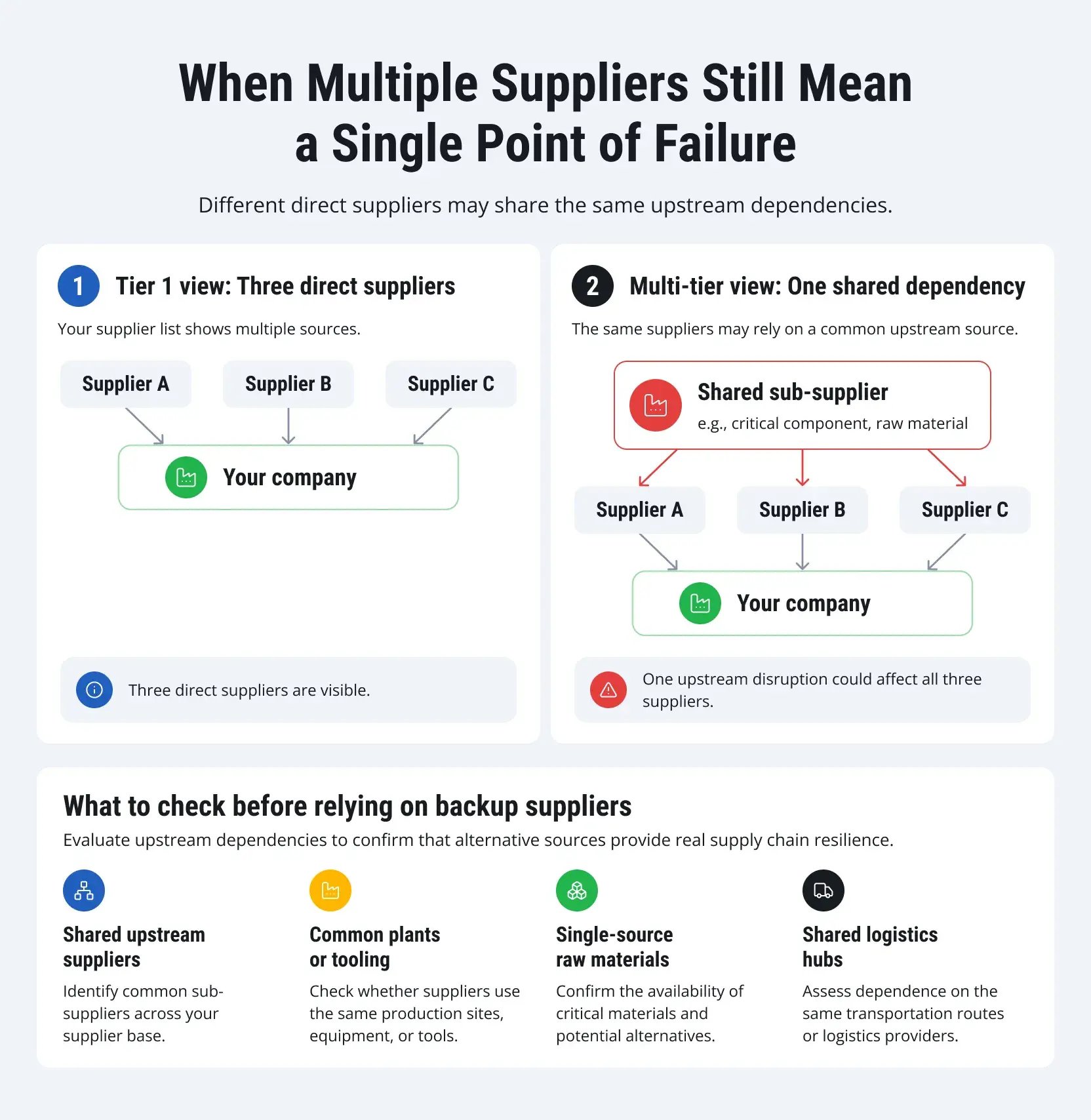
Companies should also examine multi-tier supply chains for shared upstream dependencies: two seemingly independent suppliers may rely on the same sub-supplier or production facility. Identifying these dependencies requires visibility beyond direct suppliers and may involve additional supplier mapping and data collection.
The visibility gap is considerable. According to McKinsey's 2025 supply chain risk survey, 95% of respondents reported visibility into risks involving their direct suppliers, but only 42% had visibility extending to tier-two suppliers or beyond. This helps explain why companies need to investigate shared upstream dependencies rather than assume that two direct suppliers represent independent sources of supply.
Some preparations involve ongoing costs. Maintaining a backup supplier or spare production capacity may reduce disruption exposure while increasing expenses during normal operations. Companies should compare those expenses with the potential financial and operational consequences of interruptions, taking into account how frequently disruptions might occur and how severely they could affect the business.
Useful measures include recovery time, supplier concentration, the number of critical single-source materials, and the cost of maintaining alternative arrangements. Together, they can help management assess whether investments in resilience are justified.
How Can Enterprises Measure the Business Value of SAP SCM?
SAP SCM improvements can affect financial performance in several ways. Some reduce operating expenses, others release working capital, and some allow a company to handle more work with its existing resources. These effects need to be assessed separately when preparing the business case, especially when several SAP applications and business processes are involved.
Establish a baseline and identify measurable improvements
Start with the operational metrics most closely related to the problems identified during the assessment. Document their current values over a representative period, accounting for seasonal fluctuations, changes in product mix, and unusual events that could distort the results.
The baseline should also reflect how each metric is calculated and which systems provide the underlying data. Otherwise, changes in reporting methods or data availability could be mistaken for actual performance improvements.
Once the baseline is established, define the expected improvement and explain which SAP capabilities and process changes are intended to produce it. The assumptions should be reviewed with the employees responsible for those operations, since they can identify constraints that may be missing from the initial estimate.
Translate operational changes into financial outcomes
Finance should then determine whether the projected improvements affect recurring costs, working capital, revenue, or available capacity. Suppose a warehouse can process more orders without adding employees. The immediate outcome may be additional capacity rather than reduced payroll. That capacity could become financially valuable if it supports more sales or postpones expansion, but it would be premature to count it as a direct reduction in labor expenditure.
A similar distinction applies to forecasting. Lower forecast error is useful when it contributes to better inventory decisions, less waste, or fewer shortages, and each resulting benefit needs its own calculation.
The business case should also include implementation expenses, software costs, integration work, support, and ongoing process management. After deployment, the company can compare actual performance with the baseline and investigate whether the observed improvements are attributable to the project. These findings provide a basis for evaluating the investment and deciding whether similar changes should be introduced elsewhere in the organization.
What Should Enterprises Consider Before Implementing SAP SCM?
Before selecting SAP applications, companies need to establish what is causing their current supply chain problems. Recurring delivery failures provide a good example: they may result from inaccurate forecasts, unreliable supplier commitments, warehouse bottlenecks, or transportation constraints. The business symptoms can look similar, while the required solutions differ considerably. An initial assessment should establish where the greatest operational and financial impact occurs and determine whether the existing SAP landscape already includes capabilities that could be used more effectively.
Data and integration readiness
Supply chain applications rely on information about materials, locations, inventory, orders, lead times, and available capacity. When an enterprise operates multiple regional systems, these datasets may use different definitions or contain inconsistent records.
The requirements vary by application. SAP IBP needs suitable planning data, while warehouse and transportation processes depend on accurate, timely transaction data. Supplier collaboration introduces additional dependencies on information received from external partners.
SAP Integration Suite can support integration scenarios involving SAP and non-SAP applications. However, interfaces still need to be designed, tested, and maintained, and the organization must determine who is responsible for data quality. Addressing these questions before implementation helps prevent problems that could otherwise affect planning or execution after go-live.
Global standards and local requirements
International companies need consistent definitions and processes that support global coordination. At the same time, regional operations may have legitimate differences in transportation arrangements, regulatory requirements, or distribution practices.
These differences should be considered when designing global process templates. The implementation team also needs to establish ownership of master data, planning priorities, and exception-handling procedures, particularly when decisions made in one region can affect operations elsewhere. Without these arrangements, regional teams may continue using conflicting information or making decisions that undermine the overall supply plan.
A common process template can also make regional rollouts and the onboarding of new plants or warehouses more manageable by reducing the amount of design work repeated at each location. When companies acquire new businesses, they can assess which existing processes can be adopted and which local requirements or system integrations call for adjustments. This approach helps maintain consistency as the supply chain network expands, although each rollout still requires its own data preparation, integration work, and testing.
Implementation scope, costs, and adoption
A phased rollout may help companies manage implementation risks, particularly when the organization operates several ERP systems or supply chain applications. The rollout sequence should follow actual dependencies: inventory optimization may require reliable demand and supply data, supplier collaboration may involve onboarding external partners, and changes to warehouse execution can affect transportation scheduling.
When preparing the budget, include software licensing or subscriptions, implementation, integration, data preparation, training, and ongoing support. Certain capabilities may require additional SAP products or entitlements, so these prerequisites should be confirmed before the project scope and costs are approved.
The company also needs to prepare people for the new processes. Advanced planning capabilities will have limited effect if employees continue making decisions in disconnected spreadsheets or fail to follow the agreed procedures. Clear ownership, training, and post-go-live support can help teams incorporate the new capabilities into their daily work.
How Can LeverX Support SAP Supply Chain Transformation?
LeverX helps enterprises assess their supply chain processes and SAP environments, evaluate available solutions, and plan implementation and integration work. Depending on the project requirements, our consultants can prepare a proposed solution architecture, identify integration needs, and develop a phased roadmap with implementation priorities and dependencies.
For companies using SAP S/4HANA, this work may include evaluating how supply chain planning, warehouse management, transportation, and supplier collaboration applications should interact with core ERP processes. The recommendations should reflect the current system landscape and the business results the company expects to achieve.
Conclusion
Supply chain priorities vary considerably between global enterprises. A manufacturer may need to improve supply planning and production coordination, while a distributor may be more concerned about inventory levels or delivery performance. Companies working with complex supplier networks face another set of challenges.
SAP provides applications for these areas, but the value of an implementation will depend on how well the selected capabilities address the company's operational requirements. Establishing measurable targets, checking the underlying assumptions, and monitoring results after implementation will help determine whether the investment improves costs, service, working capital, and resilience.