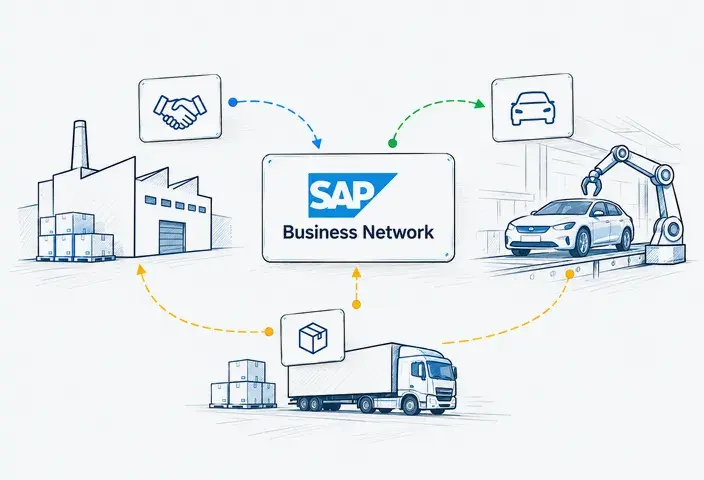
Learn how SAP Business Network connects trading partners, improves supply chain visibility, and enables faster collaboration across critical processes.
Few supply chain decisions involve just one company. What suppliers can deliver affects production, and what carriers can move affects when goods reach their destination, making collaboration with stakeholders essential. Keeping everyone aligned requires timely information, but that becomes difficult when partners rely on separate systems and manual exchanges, hindering collaboration with your trading partners. Emails get missed, spreadsheets become outdated, and important changes take longer to reach the teams responsible for responding.
With SAP Business Network, companies can interact with suppliers, carriers, and other trading partners and manage their interactions digitally. Below, we’ll see what this means for everyday supply chain processes, where other SAP solutions come into play, and what to consider when planning an implementation.
Why Supply Chain Collaboration Is More Important Than Ever
In such an interconnected supply chain, a single delivery delay can quickly lead to a chain reaction — among suppliers, manufacturers, logistics companies, customers, and everyone else. Manufacturers purchase products from multiple suppliers. Production can span multiple countries. Products may pass through a long chain of logistics partners before reaching the customer. And the more companies involved, the more difficult it is to ensure effective collaboration among all participants.
There's also less time to react. Demand fluctuates rapidly, materials become scarce, transportation capacity is redistributed, and customers expect reliable delivery no matter what. Learning about a supply constraint three weeks before production gives a manufacturer more options than discovering it when production is about to begin.
This has changed what supply chain collaboration needs to accomplish. Sending a forecast, purchase order, or shipment update from one system to another is useful, but the exchange itself does not solve anything unless it includes instant access to the status of materials needed. When plans change, partners need to understand the consequences and work out a response.
Visibility gives companies a clearer view of supply chain events. Collaboration allows partners to respond to those events together. This could mean changing an order quantity, moving inventory from another warehouse, revising a production schedule, or arranging a different delivery.
As supply chains become more interconnected, coordinating these decisions across company boundaries becomes increasingly important. Digital collaboration can help ensure that the information needed to make them reach the right partners is still available, while practical options are still available.

Where Supply Chain Collaboration Breaks Down
Most collaboration challenges aren't limited to a lack of information. The information typically exists somewhere — in another company's system, in a spreadsheet, or only reaches the right team after a decision has been made. As more suppliers and logistics partners join the network, bridging these gaps becomes more difficult, not easier.
Disconnected systems and data silos
The buyer may use SAP S/4HANA, the supplier a different ERP system, and the carrier its own transportation platform. Planning, purchasing, inventory, and logistics systems add additional data sources to this picture.
As a result, the same order or shipment can look different depending on who is viewing it. Quantities may not match, status updates may be missing, and one partner may be working with a newer forecast than another. Teams then spend time checking which information is current before they can act on it.
Manual document exchange
Purchase orders, confirmations, invoices, forecasts, and shipping documents still move through email and spreadsheets in many supply chains. Some partners use portals or EDI, while others rely on manual processes. A company can easily end up supporting several ways of exchanging the same type of document.
The cost goes beyond data entry. Someone has to check incoming documents, correct errors, follow up on missing information, and reconcile discrepancies between systems. The workload grows with transaction volume.
Limited visibility beyond the enterprise
An ERP system primarily provides visibility into internal processes. Cross-company visibility typically depends on data shared by and integrated with external partners.
Those external gaps matter because internal plans are often based on commitments from outside the business. If the underlying situation changes and that information does not make its way back quickly, purchasing and production teams may continue planning against assumptions that are no longer valid.
Slow exception management
The later a supply chain exception becomes visible, the fewer options teams may have to address it. Suppose a supplier confirms 10,000 units but later determines that only 7,000 will be available by the requested date, which can mitigate risks in supply chain planning. If that change is communicated too late, the buyer may have little time to adjust production, source the remaining quantity elsewhere, or revise the delivery schedule.
What starts as a supplier issue can then lead to a production delay, an inventory shortage, or a missed customer commitment, emphasizing the need for supply chain visibility.
Difficult supplier onboarding and collaboration at scale
Connecting a handful of strategic suppliers is one thing. Extending supplier collaboration to hundreds or thousands of partners is much harder.
Building a separate integration for every relationship creates ongoing work whenever systems, document formats, or business processes change. Smaller suppliers may also lack the technical resources required for complex integrations. As the network expands, companies need an approach that can support different partner capabilities without turning each new connection into its own IT project.
This is one reason businesses look beyond point-to-point integrations toward supply chain collaboration software and a shared supplier collaboration platform. The goal is to make partner connectivity repeatable enough to scale while keeping business data and processes aligned across the network.
What Is SAP Business Network?
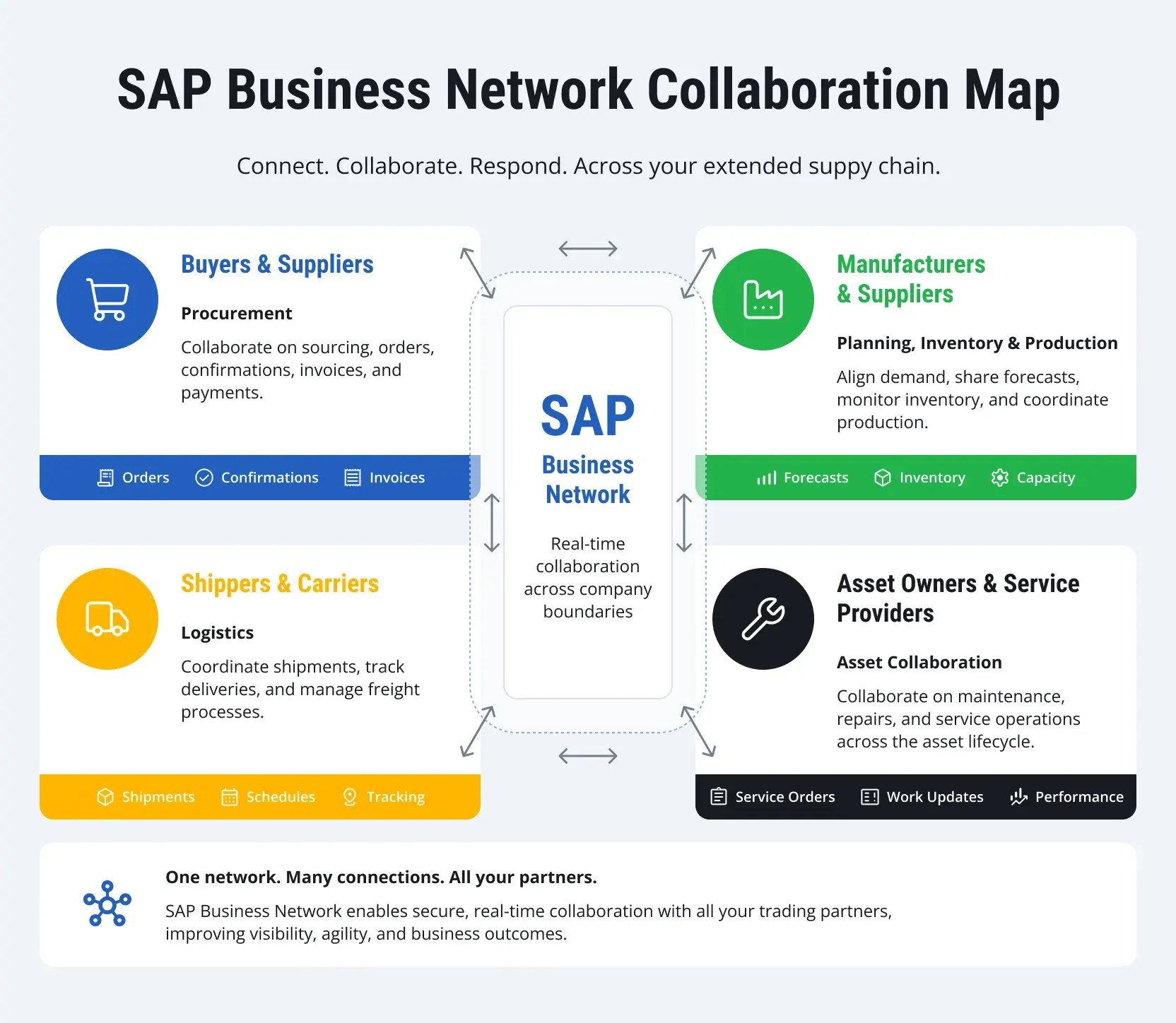
SAP Business Network is a cloud-based B2B network that enables companies to directly interact with suppliers, logistics companies, service providers, and other trading partners. It supports the exchange of business data and documents across procurement, supply chain, logistics, and asset management processes.
The network model is important here, as it supports resilient supply chain operations in a dynamic environment. A conventional enterprise application primarily manages processes within one organization. SAP Business Network extends those processes beyond company boundaries. A purchase order, for example, can become part of a shared process between buyer and supplier, with confirmations, changes, shipping information, and other updates exchanged as the transaction moves forward.
SAP Business Network covers several areas of cross-company collaboration:
|
Area |
What partners can collaborate on |
|
Procurement |
Purchase orders, order confirmations, invoices, and other procurement transactions |
|
Supply chain |
Forecasts, commitments, inventory, manufacturing, and quality processes |
|
Logistics |
Freight orders, shipment execution, tracking, and logistics documentation |
|
Asset collaboration |
Equipment data, asset information, and related processes |
For supply chain teams, the business value lies in extending internal processes to external partners and enabling shared, structured collaboration through a centralized platform for procurement transactions on a single interface. As part of the SAP Business Network platform, SAP Business Network Supply Chain Collaboration connects buyers and suppliers in a shared environment where they can exchange forecasts, orders, inventory, and production data.
Key Supply Chain Collaboration Capabilities of SAP Business Network
Orders change after they're placed. Suppliers revise delivery dates or confirm different quantities. Forecasts change, and deliveries don't always arrive as expected. All of this requires information sharing across companies, often across multiple companies. SAP Business Network provides customers, suppliers, and logistics partners with a common platform for managing these everyday interactions, from orders and forecasts to inventory, shipments, and exceptions.
Order collaboration
An order rarely stays untouched from creation to delivery. A supplier may confirm a different quantity, propose another delivery date, or need to respond to a change from the buyer.
SAP Business Network enables both parties to exchange purchase orders, confirmations, changes, and related documents within a connected process. Buyers have a clearer view of what the supplier has committed to deliver and can identify discrepancies between orders and confirmations as information is exchanged. This also reduces the need to compare documents and track changes through separate emails and spreadsheets.
Forecast and commitment collaboration
A forecast only helps production planning if suppliers can support it. Through SAP Business Network Supply Chain Collaboration, buyers can share forecast requirements with suppliers, while suppliers can respond with their commitments.
A forecast on its own only shows one side of the picture. Once planners can compare expected demand with what suppliers are able to deliver, potential shortages are easier to see. Buyers and suppliers can then use that information to review supply, inventory, and production plans.
Cross-company inventory visibility
Inventory decisions often depend on stock that sits outside the company's own facilities. Components may be held by a supplier, inventory may be managed under a consignment arrangement, or replenishment may depend on consumption data shared between partners.
Through SAP Business Network Supply Chain Collaboration, buyers and suppliers can share inventory information across company boundaries. This gives buyers greater visibility into inventory held by suppliers or managed through collaborative inventory processes, helping both sides coordinate replenishment based on more current information.
This extends inventory visibility beyond the company's own systems and gives teams a more complete view of stock across participating partners.
Structured supplier collaboration
Supplier collaboration involves far more than sending a purchase order and receiving an invoice. Throughout the relationship, companies may exchange:
- Purchase orders and order changes
- Order confirmations
- Forecasts and commitments
- Advanced shipping notices
- Invoices
- Inventory information
- Quality-related data
When each exchange follows a different route, keeping track of the latest information becomes difficult. SAP Business Network provides structured workflows for these interactions, giving buyers and suppliers a more consistent way to work together.
This becomes particularly important at scale. A supplier collaboration platform can reduce the need to manage every supplier interaction through a separate set of emails, files, portals, or point-to-point connections.
Logistics collaboration
Collaboration does not end when goods leave the supplier. Manufacturers also depend on carriers and logistics providers for information about what has shipped, where it is, and when it is expected to arrive.
SAP Business Network for Logistics extends this exchange into transportation processes. Companies and their logistics partners can work with shipment information, freight documents, status updates, estimated arrival times, and exceptions that occur during execution to streamline procurement transactions.
A delayed shipment, for example, becomes an operational signal that planning and fulfillment teams can use to understand where execution is deviating from the plan.
Exception management
Disruptions will still happen. What changes in a connected process is how information about those disruptions moves between the companies involved.
Consider a supplier that can no longer deliver the full quantity on the agreed date. In a fragmented process, the supplier may send an email or update a spreadsheet. Someone on the buyer's side has to see the change, check it against current requirements, and pass it to the planner. By then, the shortage may already be affecting the production schedule.
With a connected process, the supplier can update its commitment through the network, making the change available digitally to the buyer. This creates a more direct flow of exception information between the supplier and the teams responsible for assessing its impact.
SAP Business Network does not remove supply shortages, transportation delays, or sudden changes in demand. It provides a connected environment for sharing changes and exceptions across company boundaries so that the organizations involved can coordinate their response.
How SAP Business Network Fits Into the SAP Supply Chain Ecosystem
Core planning and execution remain anchored in the enterprise applications responsible for those processes, while SAP Business Network extends selected workflows to external trading partners. Solutions such as SAP S/4HANA, SAP Integrated Business Planning (SAP IBP), SAP Transportation Management (SAP TM), SAP Extended Warehouse Management (SAP EWM), and SAP Ariba continue to support planning, execution, and procurement within the enterprise. SAP Business Network extends relevant processes beyond company boundaries, allowing information from these systems to become part of the work a company does with suppliers, carriers, and other trading partners.
A purchase order, for example, may originate in SAP S/4HANA, but much of what happens next involves the supplier. Quantities need to be confirmed, delivery dates agreed on, and changes communicated as the transaction progresses. SAP Business Network connects the supplier to this process, while SAP S/4HANA continues to handle the transaction on the buyer's side.
The same principle applies across the supply chain: a networked platform facilitates better collaboration among all stakeholders.
|
SAP solution |
What it handles |
How SAP Business Network extends the process |
|
SAP S/4HANA |
Core transactions and business execution |
Connects procurement, order, inventory, and related processes with trading partners |
|
SAP IBP |
Demand, supply, and inventory planning |
Provides planning information that can support supplier collaboration through the integrated landscape |
|
SAP TM |
Transportation planning and execution |
Extends transportation processes to carriers and logistics providers |
|
SAP EWM |
Warehouse operations and execution |
Connects inbound and outbound fulfillment activities with external supply chain processes |
|
SAP Ariba |
Sourcing, contract management, upstream procurement, and supplier lifecycle management |
Connects upstream procurement decisions to downstream operational execution (POs, confirmations, e-invoicing) across trading partners |
Integration between SAP Business Network and enterprise applications can be supported by SAP Integration Suite and, depending on the scenario, SAP Integration Suite, managed gateway for spend management, and SAP Business Network. The exact integration approach depends on the applications, processes, and transactions involved.
How these solutions work together will look different from one company to another. A manufacturer focused on supplier planning may put SAP IBP and SAP Business Network Supply Chain Collaboration at the center of its architecture to enhance collaboration and streamline procurement transactions. A business looking for better coordination with carriers may have a stronger connection between SAP TM and SAP Business Network.
There is no single architecture suitable for all supply chains. The correct configuration depends on which processes must cross company boundaries, which SAP and non-SAP systems are already in use, how data is exchanged between them, and which partners are involved.
-min-2.jpg)
SAP Business Network vs. Traditional Supplier Portals and Point-to-Point Integration
Companies have been exchanging supply chain data electronically for decades. EDI, supplier portals, direct system integrations, email, and spreadsheets all have their place, and many companies use several of them at the same time to automate their workflows. The challenge usually appears as the partner network grows, making it essential to streamline communication and collaboration. In fragmented or point-to-point environments, growth in the partner network can increase the number of interfaces and communication channels that must be maintained.
SAP Business Network takes a different approach. Instead of relying on a separate point-to-point connection for every partner relationship, companies collaborate through a shared network to streamline procurement processes. This can reduce the need for bespoke integrations and make it easier to extend the same processes to a larger group of suppliers and logistics providers, fostering a more resilient supply chain.
|
Approach |
Where it can become a challenge |
Network-based approach |
|
Email and spreadsheets |
Updates are manual and can be difficult to track as transaction volumes grow |
Partners work through structured digital processes |
|
Individual supplier portals |
Suppliers working with many customers may have to use multiple portals and workflows |
Partners connect and interact through a shared network |
|
Point-to-point integrations |
Each new connection adds development and maintenance work |
A network model can reduce the need to build and maintain a separate bespoke connection for every partner. |
|
EDI |
Works well for standardized transactions, but may cover only part of the collaboration between partners |
The network can support transactions alongside broader supply chain collaboration and visibility |
This does not make existing integration methods obsolete; rather, they can be enhanced through quality collaboration techniques. EDI remains a practical choice for many high-volume, standardized transactions, and direct integrations can make sense when two companies have specific requirements. Supplier portals may also be sufficient for smaller or less complex partner networks.
The network model becomes particularly useful when collaboration needs to extend across many partners and processes. Rather than replacing every existing connection, SAP Business Network can reduce the number of disconnected ways companies work with suppliers and give them a more consistent foundation for digital supply chain collaboration.
Benefits and Measurable Business Outcomes of a Connected Supply Chain
Partner collaboration and process optimization are only important if they improve supply chain performance. With SAP Business Network, much of this value comes from faster access to external information, more consistent cross-company processes, and less manual work required to keep buyers, suppliers, and logistics partners aligned.
More time to respond to supply and delivery risks
A supplier may not be able to meet the confirmed quantity. A shipment may arrive later than expected. The earlier teams know about these changes, the more options they have.
Earlier visibility into supplier and logistics exceptions can give planning and procurement teams more time to adjust production, look for another source, use available inventory, or revise delivery plans. This can help limit the operational impact of shortages, delays, and changes in supplier commitments.
More reliable order fulfillment
Order fulfillment depends on several pieces falling into place and requires proactive coordination among stakeholders. Suppliers need to meet their commitments, inventory has to be available, and shipments need to arrive when expected.
With a current view of supplier commitments, inventory, and shipments, teams can better understand whether orders are progressing as planned. When conditions change, they can respond based on the latest information instead of working with outdated plans.
Less time spent on manual coordination
A surprising amount of supplier collaboration can still involve copying data between systems, checking spreadsheets, following up by email, and reconciling different versions of the same document.
Structured digital collaboration can reduce this administrative effort. Teams can spend less time tracking down confirmations, checking which version is current, and reconciling information across separate channels, leaving more time to focus on exceptions that require a business decision.
Better data for supplier performance management
Supplier performance is difficult to assess consistently when much of the interaction happens outside structured systems, leading to siloed information and potential quality issues and complaints. Structured digital processes can provide more consistent data on confirmations, changes, delivery events, and exception handling, supporting supplier performance analysis.
This gives procurement and supply chain teams a stronger basis for evaluating supplier performance over time. It can also make conversations about recurring delays or missed commitments more specific because both sides have a clearer record of what happened.
More informed inventory decisions
Companies often hold excess inventory because they are unsure about suppliers' availability or when replenishment will arrive. Better information doesn't eliminate this uncertainty completely, but it can reduce uncertainty when making inventory decisions.
Knowing what suppliers can deliver, what inventory is available, and what shipments are on the way helps teams decide when to replenish stock and how much safety stock they need. This can help avoid excess inventory while keeping products available.
What to Consider Before Implementing SAP Business Network
Connecting systems is only part of the SAP Business Network implementation. Even more complex work lies ahead: determining which processes should be included in the network, which partners to start with, and whether the data and workflows within this network can withstand large-scale interaction. These initial decisions are far more important than they seem at first glance. Making these decisions carefully can help accelerate time to value and reduce implementation complexity.
Start with the processes that need better collaboration
Trying to connect every process at once can make the project unnecessarily complex. A better starting point is to identify where collaboration currently creates the most friction.
For one company, that may be purchase orders and confirmations, which help streamline their procurement operations. Another may need better forecast collaboration with strategic suppliers or more timely shipment information from logistics providers to address quality issues and complaints effectively. These priorities help define the initial scope and provide a basis for expanding the network later.
Decide which suppliers to onboard first
Not all suppliers need to be connected at the same time. Companies can prioritize them based on transaction volume, spend, strategic importance, supply risks, and the need to automate processes for efficiency. For example, a supplier with a high order volume and frequent changes is likely a better candidate for the initial rollout than a supplier the company works with only a few times a year. Segmentation also allows companies to choose an onboarding approach that suits each group, rather than forcing everyone through the same process.
Map the existing SAP landscape
SAP Business Network needs to fit into the systems already running the business. That means understanding how SAP S/4HANA, SAP Ariba, SAP IBP, SAP TM, SAP EWM, and any non-SAP applications are used today.
The goal is to determine what data and transactions actually need to be transferred between internal systems and external partners, where integration is truly needed, and — just as importantly — which application serves as the system of record for each process or data object.
Clean up data and processes before scaling
Connecting partners will not fix inconsistent master data or unclear workflows. In fact, these issues tend to become more visible once information starts moving between companies.
Material and supplier records, document formats, units of measure, process rules, and other shared data need to be consistent enough for both sides to work with them. Addressing these issues before a large rollout can prevent avoidable errors and reduce the amount of manual correction later.
Make partner onboarding part of the project
Technical go-live is only one milestone. Suppliers and logistics providers still need to connect, understand the new process, and use it in their daily work.
Partner onboarding should therefore be planned alongside integration and configuration. Not every supplier needs the same connectivity approach. Suppliers with lower transaction volumes can participate through a free Standard account, using options such as interactive email and the SAP Business Network portal. Partners that require greater automation can use an Enterprise account with integration options such as EDI or APIs.
This flexibility can reduce onboarding barriers by giving different partner groups a way to participate that reflects their transaction volumes, technical capabilities, and automation requirements. Companies should still plan for transaction testing, user guidance, and adoption support. For large networks, the onboarding approach can have as much influence on the rollout as the technology itself.
These decisions are closely connected. Process scope affects integration, integration depends on the existing SAP landscape, and the value of the network ultimately depends on partner participation. This is where experience across both SAP technology and supply chain processes becomes particularly important.
.jpg)
How LeverX Supports SAP Business Network Initiatives
SAP Business Network projects touch several parts of the enterprise landscape at once. There are integration decisions to make, processes to align, data to prepare, and partners to onboard. LeverX works across these areas, from the initial assessment through implementation and ongoing support.
Business and collaboration process assessment
The work starts with understanding how collaboration happens today. We map supplier, procurement, planning, and logistics processes to find where information is delayed, handled manually, or difficult to share across company boundaries, enabling better collaboration with trading partners and logistics providers.
This assessment helps define which collaboration scenarios should be addressed first and what needs to change in the existing process before implementation begins.
SAP Business Network implementation
Once the scope is clear, our team configures SAP Business Network around the selected scenarios. These may include order and forecast collaboration, inventory processes, logistics interactions, or other workflows involving external partners.
The implementation is built around how the business actually works, including transaction flows, partner roles, data requirements, and exception handling.
SAP landscape integration
SAP Business Network needs to exchange data with the systems responsible for planning and execution. Our experts design and implement integrations across the SAP landscape. This includes defining which data moves between systems, when it needs to move, and which application remains the system of record for each process.
Partner onboarding and process adoption
A network delivers little value if partners are connected technically but continue working through old channels. We support the onboarding process for suppliers and other trading partners, including connectivity, transaction testing, process alignment, and rollout support.
The approach can also be adapted to different partner groups rather than expecting every supplier to have the same technical capabilities or transaction volumes.
Application management and continuous improvement
Requirements rarely stop changing after go-live. New suppliers may need to be connected, transaction volumes can grow, and companies may decide to extend collaboration into additional processes.
Through SAP Application Management Services (SAP AMS), our experts can support the environment after implementation, troubleshoot issues, monitor integrations, optimize existing processes, and help introduce new collaboration scenarios as business needs evolve.
If you are evaluating SAP Business Network, a useful starting point is your current SAP landscape and the points where collaboration with suppliers or logistics partners tends to break down. Talk to LeverX about your existing processes and integration landscape to identify where SAP Business Network can make those interactions easier to manage.
Conclusion
The true test of supply chain collaboration lies not in the plan itself, but in what happens when the plan changes. At that point, companies need sufficient information to understand what happened, who was affected, and what options remain. This requires closer coordination between the people and organizations responsible for different parts of the chain.
SAP Business Network provides the foundation for that coordination across company boundaries. But technology alone does not determine the outcome. The value depends on choosing the right processes to connect, integrating them properly with the existing landscape, and making sure trading partners actually become part of the new way of working.
For companies considering SAP Business Network, the first question is not technical, but practical: what's actually going wrong when working with external partners today? This is typically where the feasibility is assessed, and the scope of work is determined.