Explore common SAP equipment data problems, from missing technical attributes to outdated functional location assignments. Learn how to assess, cleanse, and govern asset data for better maintenance planning, reliability reporting, and AI readiness.
A maintenance planner is preparing a pump replacement, but the SAP record raises questions. The manufacturer's model number is missing, and the functional location still shows a pump removed during an earlier repair. Before ordering replacement parts, the planner has to confirm which pump is actually installed.
Incomplete equipment records can complicate maintenance planning, spare parts identification, and reliability reporting. In its 2026 Water Report, Black & Veatch surveyed more than 600 U.S. water-industry leaders and stakeholders. Among respondents assessing the quality of asset information in their enterprise asset management (EAM) or computerized maintenance management system (CMMS), only 7% rated it as very good. The survey illustrates asset information challenges in the U.S. water sector, although it does not measure SAP equipment master data specifically.
Similar discrepancies can affect organizations migrating equipment records to SAP S/4HANA or combining maintenance information with operational data for analytics and AI. Outdated equipment assignments and inconsistent identifiers can carry over into new systems unless teams identify and correct them during data preparation.
Short answer: SAP equipment master data identifies technical assets, describes their characteristics, and records relationships with functional locations and other equipment. Improving its quality involves verifying existing records, correcting discrepancies, standardizing technical information, and assigning responsibility for updates. Maintenance analytics and AI applications also require reliable maintenance history, operational measurements, and connections between data sources.
What Is Asset Master Data in SAP?
In SAP Enterprise Asset Management (SAP EAM), equipment and functional locations serve as the primary technical objects for identifying maintainable assets and organizing maintenance activities. Their master records contain technical characteristics, organizational assignments, and structural relationships.
Maintenance teams use these records to locate equipment, check specifications, and associate maintenance activities with the appropriate technical objects. Related maintenance master data includes maintenance plans, task lists, measuring points (including counters), and maintenance bills of material (BOMs). SAP technical object data also helps teams connect maintenance transactions to equipment or functional locations when reviewing maintenance history and costs.
SAP uses the term asset master data in financial processes as well. SAP Financial Accounting (FI) includes Asset Accounting (FI-AA), where asset master records contain information used for valuation, depreciation, and other accounting activities. Equipment master records support technical maintenance processes and can reference financial assets when integration is required. The SAP FI-AA guide explains this relationship.
Throughout this article, SAP asset master data refers to technical asset information used in SAP EAM.
What is the difference between equipment and functional locations in SAP?
SAP equipment records identify individual technical objects that require separate maintenance tracking. Pumps, motors, compressors, production machines, and vehicles can all have equipment records. Each receives a unique equipment number and may contain specifications, organizational assignments, classification data, and relationships with other objects.
Functional locations represent positions or functional units within an operational structure. They can describe physical areas, production systems, or operating positions and form hierarchies reflecting how a facility is organized.
Consider a cooling-water system with a pump installed at functional location CW-P101. The location identifies the operating position, while equipment record EQ-10025 identifies the pump itself. If the organization tracks the replacement as a separate piece of equipment, technicians can remove the existing assignment and install the replacement at the same functional location. SAP can retain the installation periods for both machines, provided the changes are recorded correctly.
Equipment can also be managed independently of functional locations. Depending on the configuration, a functional location may accommodate several pieces of equipment, and the organization determines which physical assets require individual equipment records.
The SAP equipment usage list allows maintenance teams to review installation periods. Technicians investigating recurring failures can use this information to examine whether one machine experienced problems at different positions or several machines had similar problems at the same location.
SAP functional location data supports reporting across operational structures. Equipment hierarchies describe relationships between machines and their components through superior and subordinate equipment assignments. These structures serve different maintenance and reporting needs and should follow the organization's agreed technical object design.
What information is stored in SAP equipment master data?
SAP equipment master records contain information used to identify and describe individual technical objects. Standard equipment master data can include equipment numbers, descriptions, manufacturer details, technical specifications, organizational assignments, and structural relationships. Organizations can maintain additional characteristics through SAP classification.
Maintenance plans, measuring points, notifications, and orders are maintained as separate SAP objects. They can reference equipment or functional locations, allowing maintenance teams to use related information without storing every maintenance record inside the equipment master.
The table distinguishes equipment master data from associated master records, equipment usage history, and maintenance transactions.
|
Data category |
Information and SAP record type |
Maintenance application |
|
Equipment master record |
Equipment number, description, manufacturer, model, manufacturer serial number |
Identifying equipment and checking technical specifications |
|
Equipment assignments and relationships |
Functional location assignment, superior equipment, maintenance plant, planner group |
Locating equipment and identifying maintenance responsibilities |
|
Equipment classification |
Classes and technical characteristics associated with the equipment record |
Comparing similar machines and identifying equipment with specified characteristics |
|
Functional location master data |
Separate technical object records describing operating positions and hierarchies |
Organizing maintenance activities by facility, system, or operating position |
|
Related maintenance master data |
Separate objects such as maintenance BOMs, task lists, maintenance plans, and measuring points |
Preparing maintenance work, schedules, and spare parts requirements |
|
Equipment usage history |
Recorded installation and removal periods |
Identifying where a tracked machine was installed during a particular period |
|
Maintenance transactions and measurement records |
Notifications, orders, confirmations, measurement documents |
Reviewing reported problems, work performed, and recorded measurements |
Maintenance notifications can document malfunctions, damage, causes, and activities. Maintenance orders support work planning and execution, while confirmations capture work performed, time spent, and technical findings. Measurement documents record readings associated with measuring points or counters.
These distinctions matter when assessing data quality. A motor may have complete manufacturer information and technical specifications while its failure history remains unreliable because technicians assigned notifications to the wrong machine or used inconsistent damage codes. An equipment master data assessment should distinguish problems in master records from discrepancies in related maintenance information. The findings can then be addressed through permitted corrections, additional validation, or documented reporting rules.
Common Asset Master Data Quality Problems
Equipment data discrepancies can develop during commissioning, acquisitions, migrations, and routine maintenance. Companies operating several plants may also encounter different local procedures for creating technical objects, maintaining classifications, and recording equipment changes.
Common problems include:
- Missing technical attributes. Manufacturer details, model numbers, serial numbers, or specifications may be absent from SAP. Maintenance planners may need engineering drawings, supplier documents, or local spreadsheets before selecting replacement parts.
- Duplicate equipment records. Manual record creation and system consolidation can leave multiple equipment numbers associated with the same physical asset. Historical maintenance transactions may then be distributed across those records.
- Inconsistent naming and classification. Plants may use different descriptions, characteristic values, equipment categories, or units of measure for similar machines. Cross-site searches and comparisons require additional verification.
- Incorrect functional location assignments. Equipment may remain assigned to an obsolete position after relocation or replacement, complicating the reconstruction of historical installations.
- Inconsistent technical object hierarchies. Missing superior equipment relationships and outdated functional location structures can affect reporting at component, machine, and system levels.
- Outdated equipment lifecycle information. Permanently retired equipment may still be included in reports of equipment currently in service when its status or reporting classification has not been updated. This can inflate equipment counts and affect maintenance KPIs.
- Unreliable maintenance history. Missing failure dates, inconsistent damage codes, incomplete confirmations, and maintenance orders left open after work has been completed can limit failure analysis. These issues concern transactional records and often become apparent during broader equipment data assessments.
Acquisitions and system consolidation can make discrepancies particularly difficult to resolve. An acquired manufacturing plant may identify its machines through a legacy CMMS, while the parent company uses SAP equipment numbers. Similar descriptions or model numbers offer insufficient evidence for determining whether two records refer to the same physical machine.
Before consolidating these records, teams need to compare available identifiers, manufacturer serial numbers, installation information, and historical maintenance references. Incorrectly merging separate machines can make their maintenance histories difficult to interpret.
Problems can also arise when departments follow different update procedures. Engineering may approve technical changes, maintenance teams may record completed work, and IT may perform authorized system updates. Without an agreed process for communicating changes, SAP records can remain outdated.
How Poor Asset Data Quality Affects Maintenance Decisions
Equipment data discrepancies affect maintenance activities in different ways. Missing specifications may require verification before work begins, while incorrect equipment references can compromise historical comparisons involving several machines or operating periods.
The consequences depend on the information involved, the maintenance task, and the alternative sources available to employees.
Maintenance planning and spare parts preparation
Maintenance planners use equipment specifications to estimate work requirements and select compatible components. If an equipment record contains an outdated motor model number, the planner may need to inspect the machine before ordering a replacement.
Maintenance BOMs associate spare parts with equipment or functional locations. The SAP BOM guide explains their role in maintenance planning and order preparation.
An equipment BOM may still list parts from an earlier machine configuration. The task list can have a similar problem, with instructions written for equipment that has since been modified or replaced. Before preparing the work order, the planner needs to compare these records with the installed equipment and approved technical documentation. Incorrect maintenance plant or work center assignments may also require additional coordination between the teams involved.
Counter readings need separate attention. Incorrect values can affect performance-based maintenance schedules, particularly when accumulated operating hours determine when work should be performed. SAP maintains counters as a special type of measuring point, with readings recorded through measurement documents. Its counter guide explains how these records contribute to maintenance planning.
Accurate equipment references can also help U.S. maintenance teams locate current machine-specific procedures, including those relevant to OSHA's lockout/tagout standard. The standard establishes requirements for controlling hazardous energy during covered servicing and maintenance activities. SAP can assist with document retrieval when the relevant procedures are linked to the equipment; employers retain responsibility for meeting applicable safety requirements.
Failure analysis and reliability reporting
When several motors of the same model operate on one production line, failure history can become difficult to interpret. Some notifications may reference individual equipment numbers, while older records identify only the functional location. To compare the motors' reliability, analysts need to establish which machine was installed when each failure occurred.
Failure classification introduces further complications. One plant may record bearing damage using a specific code, while another uses a general mechanical failure category. A report comparing those codes could misrepresent the distribution of failure types.
Metrics such as mean time between failures (MTBF) require consistent failure definitions and appropriate operating exposure. Maintenance order counts alone cannot establish failure frequency because orders may cover inspections, preventive tasks, corrective repairs, and other activities.
Before comparing equipment performance, analysts should verify installation periods, failure events, and operating information. Historical gaps and inconsistencies in event classification need to be documented because they can affect the resulting calculations.
Asset criticality and maintenance prioritization
Asset criticality assessments generally consider equipment function, failure consequences, production dependencies, safety risks, environmental exposure, and redundancy. Where an SAP ABC indicator is used to classify technical objects, its values and assignment rules should be checked against the organization's criteria for operational criticality.
SAP technical object hierarchies can provide information about how equipment is organized. However, a structural relationship does not necessarily describe every operational dependency relevant to a criticality assessment.
For example, a shared component may affect several production units even when the SAP equipment hierarchy places it under one machine. If the assessment relies exclusively on that hierarchy, the team may overlook dependencies documented in engineering drawings or operational risk assessments.
Maintenance cost reporting
Maintenance cost reports may group order costs by equipment, functional location, production line, or other organizational criteria. The results also depend on how costs are assigned to maintenance orders, whether accounting takes place at the order-header or operation level, and which settlement and reporting rules apply.
Before comparing maintenance costs across equipment or plants, analysts should verify the technical objects referenced in maintenance orders, the level at which costs are recorded, and the applicable settlement rules. SAP's order settlement documentation describes how maintenance order costs are assigned and settled.
How to Improve Asset Master Data Quality in SAP
Improving equipment records usually begins with identifying discrepancies that affect maintenance work. A company preparing for reliability analysis may focus on installation history and failure classification, while an SAP S/4HANA migration project may require equipment identifiers and hierarchy relationships to be reconciled before transferring records.
Once the affected data has been identified, maintenance, engineering, and SAP teams can agree on corrections, validation requirements, and responsibilities for future updates.
What does good asset data quality mean?
Equipment master data quality can be assessed using six dimensions: accuracy, completeness, consistency, timeliness, uniqueness, and traceability. Each examines a different type of data problem.
|
Dimension |
Meaning |
Example of a quality check |
|
Accuracy |
Information reflects verified equipment characteristics and assignments |
Compare SAP specifications with engineering documents or physical equipment |
|
Completeness |
Records contain the attributes required for their intended use |
Check required fields for each applicable equipment group |
|
Consistency |
Records follow agreed definitions, formats, and classification rules |
Compare characteristics, descriptions, and units across plants |
|
Timeliness |
Equipment changes appear in SAP within the agreed period |
Measure the delay between a physical change and the approved record update |
|
Uniqueness |
A tracked physical asset has no unintended duplicate equipment identities |
Investigate suspected duplicates using identifiers and source records |
|
Traceability |
Users can identify sources, approved changes, and historical relationships |
Review technical documents, change records, and equipment usage history |
A pump record may contain a manufacturer value and satisfy a basic field population check. If the value refers to equipment removed several years earlier, the record still has an accuracy problem.
The requirements also depend on how teams use the information. Preventive maintenance planning needs current specifications and task lists. Reliability analysis places additional demands on failure records and operating periods, particularly when equipment moves between locations.
How to assess SAP equipment master data quality
An assessment should begin with equipment that presents operational risks or has known data problems. The selected scope needs to reflect the decisions the organization intends to improve.
- Select the scope. Identify the plants, equipment groups, and maintenance processes under review. Determine where the relevant information resides, including SAP and connected systems.
- Define quality rules. Specify required attributes, permitted values, classification rules, hierarchy requirements, and acceptable update periods. Rules may differ between equipment groups.
- Profile and verify records. Detect missing fields, inconsistent characteristics, outdated assignments, and potential duplicates. Check selected findings against approved engineering documents, installation records, or physical equipment.
- Prioritize corrections. Evaluate the operational consequences of confirmed discrepancies. Assign each issue a responsible owner, correction procedure, and priority.
The assessment should produce a documented data quality baseline and a prioritized remediation backlog. Each finding should identify the affected records, violated rule, supporting evidence, business impact, and proposed correction.
Consider an assessment of critical pumps that identifies outdated functional location assignments and inconsistent manufacturer information. Maintenance personnel would need to confirm the installed machines, while engineering would verify the specifications. Authorized data owners would then review and approve the necessary changes.
How should data completeness be measured? Organizations can measure it at record and attribute levels, using rules appropriate to the equipment population.
- Record-level completeness: The percentage of applicable equipment records satisfying all required-field rules.
- Attribute-level completeness: The percentage of records with an acceptable value for a particular required attribute, calculated only for records to which that requirement applies.
A simple field population check can provide an initial measure, but organizations also need rules for placeholders and other unacceptable entries.
Suppose 100 pump records require a manufacturer value. If 95 contain a nonempty entry, the field population rate reaches 95%. However, five of those entries contain the placeholder Unknown. Under a rule that rejects placeholders, attribute-level completeness falls to 90%. The remaining manufacturer values still need separate accuracy checks against trusted sources.
Completeness and consistency checks can often cover the entire selected dataset. Verification of physical installations may require sampling and on-site inspections. Results from a risk-based sample should only be generalized to the full equipment register when the assessment method supports that conclusion.
Establish data ownership and governance
Asset data governance should establish responsibilities for creating, verifying, approving, updating, and retiring equipment records.
Maintenance and asset management teams usually define operational information requirements. Engineering verifies specifications and configuration changes, while reliability specialists establish the information needed for failure classification and analysis. Data stewards coordinate quality monitoring and the resolution of identified discrepancies. IT and SAP specialists configure authorizations, validation rules, workflows, and integrations.
"For organizations with multiple plants, I recommend assigning one accountable data owner per technical object type, supported by data stewards at each site. Maintenance and reliability engineering should define data standards, while IT manages the supporting tools, validation rules, and integrations."
Yauheni Sarachynski, SAP EAM & Service Transformation Expert at LeverX
Consider an engineering modification to a conveyor drive. Engineering approves the revised technical specification, maintenance records the completed modification, and the responsible data owner reviews the corresponding SAP changes. The work may require updated equipment characteristics, technical documents, and maintenance instructions.
The procedure should specify who reports the modification, who verifies the revised information, and who approves the SAP update. If several applications contain the affected technical attributes, the team also needs to determine which records require synchronization.
Different organizations may assign these tasks to different departments. Regardless of the arrangement, changes should follow documented approval procedures, and data owners need a way to resolve conflicting information.
Asset master data management also extends to the systems holding technical information. Engineering applications, local maintenance systems, and SAP may contain overlapping attributes. Data owners should determine which system governs each attribute and how approved changes reach the other applications.
When equipment is taken out of service, the responsible team should review its status and installation assignments, record any applicable changes, and determine which historical records must remain accessible. The procedure depends on the SAP configuration and the organization's equipment lifecycle and retention requirements. Equipment that may be repaired or installed elsewhere also needs to remain distinguishable from equipment permanently retired from service.
Standardize equipment data and classification
SAP equipment data management requires agreed naming conventions, equipment categories, technical characteristics, measurement units, and hierarchy rules. These standards should reflect how each equipment group is maintained and reported.
Centrifugal pumps may require information about flow rate, head, rotational speed, and rated motor power, depending on the maintenance and reporting requirements. Transformers and conveyors require different characteristics, and the level of detail may vary with equipment criticality.
Which SAP equipment fields should be required? SAP system requirements and configurable field-selection settings influence which master record fields must be entered. Organizations establish additional business requirements according to equipment categories, maintenance activities, and reporting needs.
For instance, manufacturer and model information may be needed for spare parts identification. Equipment identity and installation history carry particular importance when analyzing failures across machines and operating periods. Depending on the SAP environment, teams can enforce requirements through field controls, validation rules, approval procedures, and periodic quality checks.
Measurement units need attention when U.S. facilities exchange information with global systems. Pump flow may be recorded in U.S. gallons per minute (gpm), pressure in pounds per square inch (psi), and motor power in horsepower (hp). Other facilities may use cubic meters per hour (m³/h), bar, or kilowatts (kW).
Data standards should specify approved units, measurement bases, conversion rules, and verification requirements. These details help teams identify incompatible values before comparing records or migrating technical information.
SAP equipment classification supports structured technical characteristics beyond standard master record fields. The SAP classification guide explains how classes and characteristics can describe equipment and help users find technical objects with particular properties.
Functional location hierarchies require separate structural rules reflecting how facilities, systems, and operating positions are organized. Approved standards should also be incorporated into equipment onboarding, engineering handover, and maintenance data update procedures.
Cleanse, validate, and deduplicate existing records
Once discrepancies have been identified, teams can begin correcting records according to their operational priority. Missing specifications should be checked against manufacturer documentation, engineering records, or physical equipment. Inconsistent classification values may require mapping to approved classes and characteristics.
Duplicate identification needs particular care. Two machines may share a manufacturer and model, while a single physical asset may appear under different descriptions or equipment numbers. A review should examine equipment identifiers, manufacturer serial numbers, installation records, and historical maintenance references before deciding whether records describe the same machine.
"We prioritize equipment data cleansing based on asset criticality and operational impact. Equipment identities, hierarchies, and potential duplicates should be verified before detailed attributes are standardized. Otherwise, teams risk repeating corrections when those underlying relationships change."
Yauheni Sarachynski, SAP EAM & Service Transformation Expert at LeverX
Changing or retiring an equipment record can affect its relationships with notifications, orders, measuring points, and other objects. Teams need to understand these dependencies before making corrections so that historical maintenance activity remains interpretable.
For SAP data migration projects, approved mapping and transformation rules should be tested before transferring production data. Reconciliation should confirm that the target system contains the expected records, identifiers, and technical object relationships.
Automated tools can identify discrepancies and apply approved validation rules. Technical conflicts involving physical equipment identity or specifications require verification by the responsible business teams. Once corrections have been applied, teams should confirm that the updated records satisfy the agreed requirements and that maintenance processes still reference the intended technical objects.

Maintain data quality over time
Depending on the SAP environment, organizations can implement field checks, configurable validation rules, approval workflows, and additional data quality controls. Scheduled reviews or data quality reports can help identify suspected duplicate records, overdue updates, and unresolved discrepancies. Data owners should review these findings and coordinate the necessary corrections.
How often should SAP equipment master data be reviewed? Equipment records should be updated following relevant events such as commissioning, relocation, modification, replacement, and retirement. Scheduled verification can then focus on equipment groups where outdated information would have greater operational consequences.
Review intervals should reflect asset criticality, previous data quality findings, and the frequency of equipment changes. Physical installation assignments and engineering specifications may require verification against documents or on-site observations.
Data owners should monitor record-level and attribute-level completeness, classification compliance, confirmed duplicates, installation accuracy, and update timeliness. Significant discrepancies need an assigned owner, a target resolution date, and an agreed escalation procedure.
Preparing Asset Master Data for Analytics and AI
Accurate SAP equipment master data gives analytics and AI applications the equipment identifiers, technical characteristics, and installation history needed to interpret maintenance events and operational measurements. When these references contain errors, analysts may struggle to connect sensor readings, failures, and maintenance activities to the machines involved.
Depending on the application, additional information may come from maintenance orders, notifications, measurement documents, industrial historians, manufacturing execution systems (MES), supervisory control and data acquisition (SCADA) systems, and Internet of Things (IoT) platforms.
Recent manufacturing research illustrates the problems companies encounter when combining operational data. In the Manufacturing Leadership Council's 2026 survey, 49% of respondents rated their operational data's AI readiness as low. Respondents also identified extracting data from legacy systems (43%) and integrating different sources (37%) among the obstacles to data-driven decisions. The survey covered manufacturing operational data broadly, including information beyond SAP equipment records.
Consider a pump monitored through an industrial historian. When the pump is replaced, its SAP equipment number changes, but the functional location and historian tag may remain the same. Historical sensor readings must therefore be matched to the equipment installed during each measurement period.
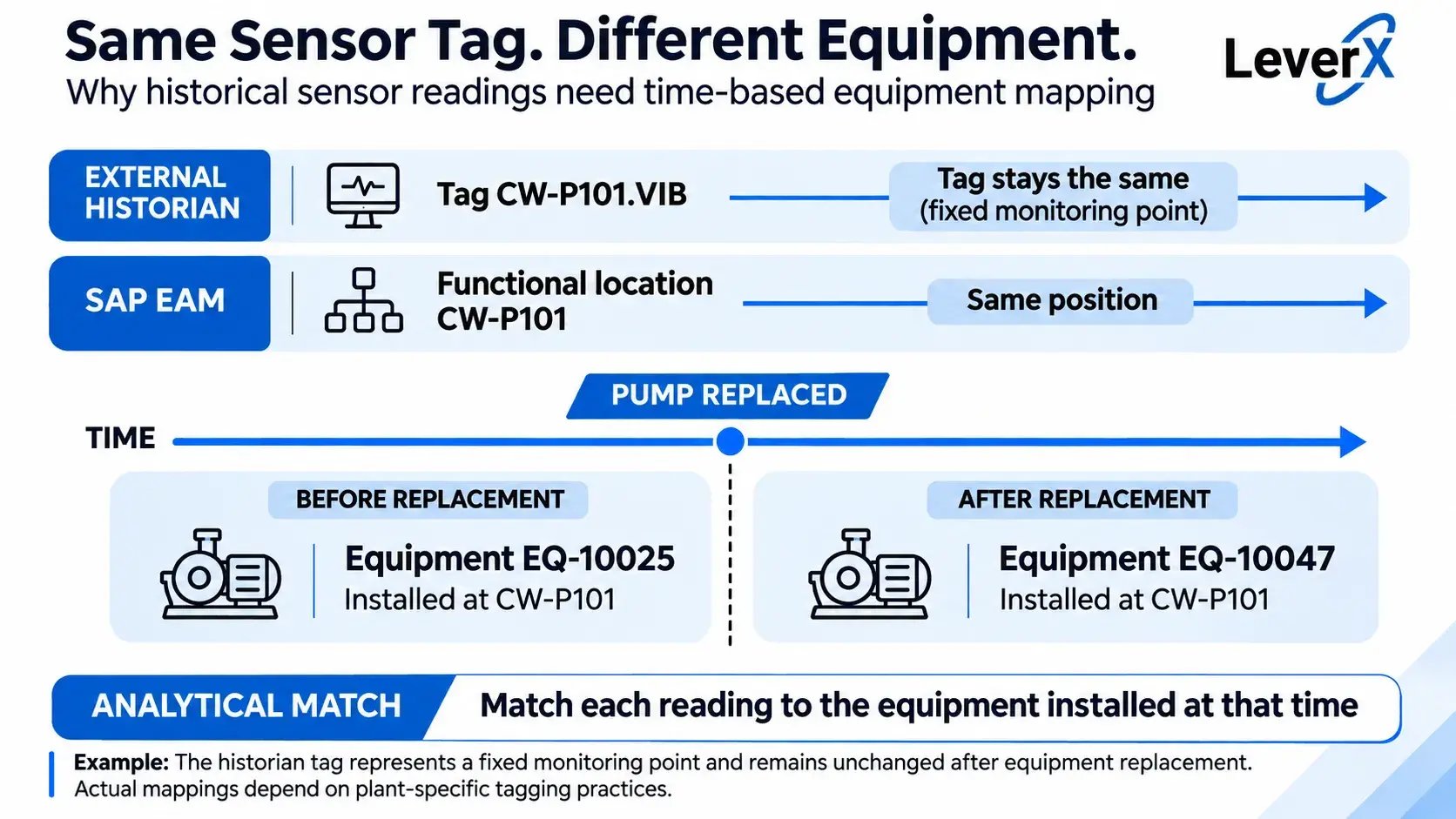
Without time-based mapping, analytics and AI models may attribute historical sensor readings from a replaced pump to its successor, distorting equipment condition trends and failure analysis.
Is your SAP asset data ready for analytics and AI?
Data requirements vary according to the intended use case. Maintenance cost reporting, reliability analysis, predictive maintenance, and AI-assisted knowledge retrieval require different combinations of technical records, maintenance history, and operational information.
|
Use case |
Key data requirements |
Critical readiness issue |
|
Maintenance cost reporting |
Technical object references, maintenance order costs, reporting periods |
Costs may be attributed inconsistently when object references or reporting rules differ |
|
Reliability analysis |
Failure definitions, event dates, equipment identities, operating exposure |
Failure events cannot be associated reliably with the correct equipment or operating periods |
|
Predictive maintenance |
Time-stamped operational measurements, equipment identities, operating context, historical observations |
Measurements cannot be consistently related to equipment condition and maintenance outcomes |
|
AI-assisted maintenance knowledge retrieval |
Current technical documents, equipment references, document versions, access permissions |
The application may retrieve obsolete or irrelevant instructions |
Accurate equipment records provide technical context for AI applications. Model reliability also depends on representative operational data, sufficient historical coverage, and appropriate validation. Whether the application improves maintenance decisions depends on integration with existing systems and procedures for reviewing and acting on its results.
Predictive maintenance applications, including relevant capabilities of SAP Asset Performance Management (SAP APM), require attention to historical coverage and measurement quality. Equipment failures may occur infrequently, while changes in operating conditions and maintenance interventions can affect sensor readings.
Supervised models may need representative observations and reliable failure labels. Anomaly detection methods have different requirements, although they still need information about operating conditions. AI-assisted maintenance knowledge retrieval involves additional document management requirements. Applications that locate technical instructions or previous maintenance records need correct equipment references, current documents, and version control.
An obsolete procedure associated with installed equipment could lead the application to retrieve instructions for an earlier configuration. Implementations should account for access permissions, document sources, and human review of recommendations.
How to prepare asset data for AI use cases
Preparing asset data for AI begins with a defined maintenance problem and an evaluation method that reflects the decisions the application should support.
A manufacturer planning to detect abnormal operating conditions in critical pumps could start with a small group of machines. The project team would first examine historical sensor coverage, equipment operating conditions, recorded failures, and maintenance interventions to determine whether the available information supports the intended analysis.
The team should document the proportion of sensor tags successfully matched to equipment records and check whether those mappings remain valid across the selected historical period. It should also document data lineage, including source systems, relevant transformations, and refresh frequencies for maintenance and sensor data. Missing observations, inconsistent timestamps, and equipment configuration changes may limit the data available for analysis.
The historical data must also support the intended analytical method. Failure events may be too infrequent for some supervised approaches, or maintenance records may lack the detail needed to identify what happened before a breakdown. Anomaly detection could offer another approach, depending on the measurements and operating context.
Model evaluation should reflect the maintenance process. If the application flags abnormal readings, employees need to determine which signals warrant investigation and record whether inspections confirm a problem. False alerts, missed events, and the time required to review results can all affect the usefulness of the application.
A pilot should establish whether the analysis improves maintenance decisions compared with existing methods and whether employees can use its results within established maintenance procedures.
How LeverX Can Help Improve SAP Asset Data Quality
LeverX addresses equipment data quality within the broader context of SAP Asset Management. Our SAP Asset Lifecycle Management services cover equipment records, functional location structures, technical object relationships, and the maintenance processes that depend on this information. This allows data quality issues to be assessed in terms of their impact on work preparation, equipment history, and reporting.
For organizations operating multiple plants or consolidating systems, LeverX can also help reconcile equipment information across SAP, legacy CMMS, and engineering applications. This work may involve identifying conflicting equipment numbers, comparing technical specifications, and defining source-to-target mappings before migration.
Depending on the project scope, LeverX can assist with:
- Asset data quality assessment: Reviewing equipment records, functional locations, classifications, hierarchies, and maintenance references to identify discrepancies affecting maintenance processes and reporting.
- Data standardization and cleansing: Defining technical attribute requirements, harmonizing classification and naming conventions, and preparing corrections based on verified source information.
- SAP migration and integration: Mapping equipment identifiers and technical object relationships across systems, preparing transformation rules, and validating migrated records. LeverX's SAP integration services also support connectivity between SAP and non-SAP applications.
- Data governance: Establishing ownership of technical attributes, approval procedures for equipment changes, and responsibilities for resolving data quality issues throughout the equipment lifecycle.
- Analytics readiness: Assessing whether equipment identifiers, installation history, maintenance events, and operational measurements can support the intended reporting, reliability analysis, or AI use cases.
- Data management: LeverX's Data Management Platform supports data extraction, transformation, cleansing, validation, and transfer across SAP and non-SAP systems. Its configurable workflows, templates, and connectors can help teams prepare and check data during migration and consolidation projects. Combined with SAP Asset Lifecycle Management expertise, these capabilities support data preparation that accounts for maintenance requirements and technical object relationships.
Some discrepancies still require business verification. For example, determining whether two equipment records describe the same physical machine or whether a functional location assignment reflects the actual installation may require input from maintenance and engineering teams.
Depending on the agreed scope, project deliverables may include a documented data quality baseline, a prioritized remediation backlog, approved attribute and classification rules, source-to-target mappings, validation and reconciliation results, and recommendations for ongoing data governance.
Conclusion
Organizations can begin by reviewing equipment whose incorrect specifications, installation history, or maintenance records could affect work preparation and reporting. The assessment should verify those records against approved technical information, document discrepancies, and assign corrections to the responsible teams.
The findings can help maintenance planners identify which equipment information needs attention, give reliability teams a clearer understanding of historical data limitations, and establish requirements for future SAP migrations and analytics initiatives.