Before launching an MES pilot, learn which readiness gaps matter most, how to make a go/no-go decision, and what it takes to scale beyond one production line.
Implementing a manufacturing execution system (MES), such as SAP Digital Manufacturing (SAP DM), involves more than selecting software. Manufacturers also need to ensure that production data, equipment, ERP systems, and shop-floor workflows can work together.
According to Rockwell Automation's July 2026 report, 93% of surveyed manufacturers had MES deployed in at least one facility, but only 23% reported full integration across ERP, product lifecycle management (PLM), quality, and operational technology (OT) systems. The study covered 1,560 manufacturing decision-makers across 17 countries.
This checklist explains what to assess before an MES pilot, how to identify critical readiness gaps, and how to determine whether a plant is ready to proceed.
SAP Digital Manufacturing & MES Readiness: A Shop-Floor Digitalization Checklist
Implementing a manufacturing execution system (MES), such as SAP Digital Manufacturing (SAP DM), involves more than selecting software. Manufacturers also need to ensure that production data, equipment, ERP systems, and shop-floor workflows can work together.
According to Rockwell Automation's July 2026 report, 93% of surveyed manufacturers had MES deployed in at least one facility, but only 23% reported full integration across ERP, product lifecycle management (PLM), quality, and operational technology (OT) systems. The study covered 1,560 manufacturing decision-makers across 17 countries.
This checklist explains what to assess before an MES pilot, how to identify critical readiness gaps, and how to determine whether a plant is ready to proceed.
What Does MES Readiness Mean Before Implementing SAP Digital Manufacturing?
MES readiness describes how prepared a manufacturing environment is to support a defined production execution scenario, including the required data, system integrations, equipment connectivity, and operational processes.
The assessment focuses on a specific project scope, such as introducing digital production confirmations on one assembly line. It does not require every machine to be connected or all manual processes to be eliminated before implementation. Instead, it helps identify critical dependencies and distinguish issues that could prevent a pilot from proceeding from improvements that can be addressed later.
MES readiness covers five interconnected areas: machine connectivity, master data, ERP integration, operational preparedness, and implementation ownership. Each should be evaluated against the selected pilot scope rather than the requirements of a complete manufacturing transformation. When SAP Digital Manufacturing is the selected platform, the assessment should also cover platform-specific prerequisites, including SAP DM environments, user access, and integration components.
Where does SAP Digital Manufacturing fit?
A manufacturing execution system (MES) manages production activities between enterprise resource planning (ERP) and the shop floor. While ERP handles production planning, materials, and inventory management, MES coordinates execution, records production results, and supports quality control and traceability. It does not replace ERP or industrial control systems such as programmable logic controllers (PLCs) and supervisory control and data acquisition (SCADA) systems.
SAP DM, formerly marketed as SAP Digital Manufacturing Cloud (DMC), is SAP's cloud-based manufacturing operations management platform. It combines manufacturing execution with resource orchestration for scheduling and dispatching shop-floor operations, and manufacturing insights for monitoring production performance. These capabilities help manufacturers coordinate planned activities with actual production conditions.
SAP Digital Manufacturing should not be confused with SAP Manufacturing Execution (SAP ME), a separate SAP MES product.
SAP DM vs. Third-Party MES: Which Is Right for Your Plant?
SAP DM is worth considering when a company uses SAP ERP or SAP S/4HANA and wants to standardize manufacturing execution across multiple facilities. SAP provides supported integration scenarios for exchanging production orders, master data, confirmations, and other manufacturing information. Integration requirements vary by SAP backend and scenario. On-premises SAP ERP and SAP S/4HANA integrations typically use SAP Cloud Integration and SAP Cloud Connector, while SAP S/4HANA Cloud Public Edition supports direct cloud-to-cloud integration without these components. Configuration and testing are still required.
A third-party MES may be a better fit when a plant depends on specialized production workflows that would require significant customization in SAP DM. The same applies to manufacturers with an established MES that already meets operational requirements. In such cases, integrating the existing platform with SAP S/4HANA may be more practical than replacing it.
The decision should account for three factors:
- Functional fit: Can the system support the required production workflows, traceability, quality controls, and industry-specific processes without excessive customization?
- Integration effort: What interfaces, middleware, and maintenance will be required to connect the MES with ERP, equipment, and other manufacturing applications?
- Operational continuity: Can the proposed architecture meet the plant's availability, network connectivity, and recovery requirements?
Cloud connectivity is an important consideration when choosing an MES architecture. SAP DM for edge computing can support selected production operations during temporary cloud outages and synchronize supported transactions once connectivity is restored. Offline capabilities depend on supported scenarios, locally available data, and integration dependencies; some transactions or custom extensions may not be available. Therefore, SAP DM Edge should not be treated as a fully autonomous MES for permanently isolated networks. Manufacturers with strict offline requirements should validate these limitations before selecting their architecture.
Neither approach is universally preferable. The choice depends on functional requirements, the existing technology landscape, and the total cost of implementing and maintaining the solution.
The MES Readiness Checklist
Before scoring readiness, define the pilot's production scope, business objective, measurable acceptance criteria, and baseline performance indicators.
Use this checklist to assess the requirements for a defined MES pilot, not to confirm that implementation is already complete. For each item, record its status (Ready, In progress, Missing, or Not applicable), supporting evidence, responsible owner, and next action. Classify unresolved gaps according to whether they could prevent the pilot from starting or can be addressed during implementation.
1. Machine connectivity inventory
Complete the following machine-connectivity checks where automated equipment data collection is part of the pilot scope. Otherwise, mark non-applicable items accordingly.
- Equipment in the pilot scope is identified, including controllers, industrial systems, and supported communication protocols.
- Machines requiring gateways, adapters, or additional connectivity components are documented.
- OT network restrictions, access permissions, IT/OT security responsibilities, firewall changes, and approved change windows are documented.
- Where automated machine data collection is in scope, required signals, such as machine status, cycle counts, and alarms, are identified and their availability verified.
Focus on the data needed for the selected production scenario rather than collecting every signal available from the equipment.
2. Master data alignment
- Materials have valid identifiers, units of measure, and production-relevant attributes.
- ERP work centers are correctly mapped to the corresponding work centers or resources in the execution environment.
- BOMs, routings, or recipes reflect the production processes included in the pilot.
- Serial-number or batch-tracking requirements are defined where applicable.
- Data owners and procedures for correcting inaccurate or missing records are assigned.
According to SAP Learning, materials and work centers or resources are required for the described SAP S/4HANA integration scenarios. BOMs, routings, and recipes can also be transferred with production orders, depending on the scenario.
As evidence of readiness, teams can validate a sample production order against the required material, BOM, routing, and work center data, recording any mapping or data-quality issues before configuration begins.

3. ERP integration points
- Production and process order types, where applicable, and required data exchanges are defined.
- Data ownership and integration direction are agreed upon for each interface.
- Production confirmation requirements, including yield, scrap, and time reporting, are documented.
- Component consumption, inventory movements, and goods receipt posting rules are established.
- Quality results and batch-related data exchanges are mapped where applicable.
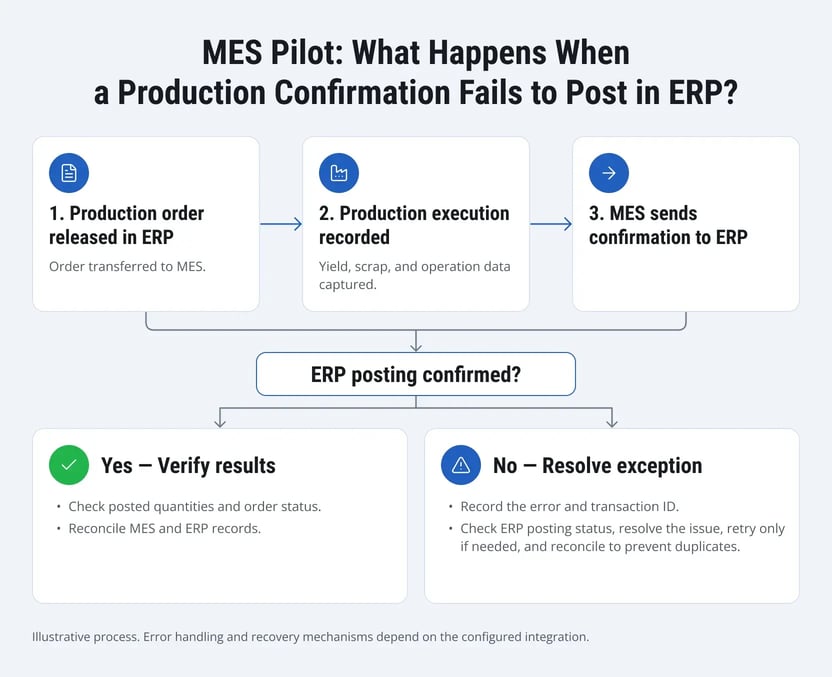
- Error handling, duplicate prevention, and transaction reconciliation procedures are defined.
- Asynchronous processing requirements are documented where applicable, including message sequencing and the handling of delayed or out-of-order updates.
Integration testing should verify that transactions are processed correctly, not simply that messages reach their destination. For example, a production confirmation must update the intended ERP order without creating duplicate postings.
For manufacturers using SAP S/4HANA, integration architecture should also account for the surrounding manufacturing applications and interfaces.
If an SAP S/4HANA migration is planned, MES integration requirements should be coordinated with the ERP roadmap to minimize temporary interfaces and avoidable rework.
4. Operational readiness and change management
- Pilot operators and shift supervisors are identified and available for training and testing.
- Existing manual activities and documents affected by MES are recorded.
- Responsibilities for production exceptions and incorrect data are assigned.
- Validation of exception scenarios such as rework, scrap, partial confirmations, and production order changes is planned for the pilot.
- Procedures for continuing or recovering production during system interruptions are defined.
- Operational acceptance criteria are agreed upon with production stakeholders.
Consider a plant replacing paper-based defect reporting with digital quality records. Operators must understand when to record defects, supervisors must know how to review them, and quality teams must have a process for handling affected products. These responsibilities need to be established before the new workflow becomes operational.
5. Implementation ownership and partner capabilities
- Responsibilities for MES configuration, ERP integration, machine connectivity, and testing are assigned.
- Required technical and manufacturing expertise is identified.
- If an external implementation partner is required, its relevant MES or SAP DM project experience has been verified.
- Consultants' responsibilities and post-go-live support arrangements are defined.
- Partner competencies and SAP partnership status are verified where relevant.
A partner's SAP status alone does not demonstrate expertise in a particular manufacturing environment. When evaluating providers, prioritize comparable project references, the integration scenarios delivered, and the experience of the proposed implementation team.
6. SAP DM platform readiness
- SAP DM subscription requirements, target environments, and the provisioning approach are defined.
- Required user roles, authorizations, and access arrangements are identified.
- Production Operator Dashboard (POD) requirements and operator device needs are agreed upon.
- SAP DM integration components and their setup responsibilities are identified based on the target architecture.
At this stage, the goal is to confirm that platform prerequisites are understood and their preparation is planned. The SAP DM environment, user access, and PODs do not need to be fully configured before pilot implementation begins. However, all components required for the selected production scenario must be configured, tested, and validated before production go-live.
How Does Machine Connectivity Work With SAP DM?
For supported machine-integration scenarios, SAP DM uses an on-premises Production Connector to communicate with shop-floor equipment and industrial systems. Typically installed within the plant network, the connector accesses data sources such as OPC Unified Architecture (OPC UA) servers. Machine data tags are mapped to manufacturing assets in SAP DM, allowing production applications to use equipment information.
SAP Cloud Connector provides secure access from SAP DM to the on-premises Production Connector, while communication from the Production Connector to the cloud uses a direct connection. This architecture is separate from ERP-to-MES integration, which handles production orders, confirmations, and other business transactions. SAP describes the components in its Production Connector documentation.
Machine connectivity also requires interpreting production signals correctly. For example, a machine may report a completed cycle, but that does not necessarily mean the finished unit has passed inspection. The integration must define which signals trigger manufacturing transactions and which require additional validation.
Not every MES pilot needs automated machine data collection. Operators can record production activities manually when the selected scenario allows it. However, projects involving automated data capture should validate signal accuracy, connection stability, and recovery procedures. Teams must establish how missing or duplicate events are handled and whether production can continue during network interruptions. Where edge computing is included in the architecture, teams should verify which transactions can continue locally, whether the required data is available during an outage, and how pending transactions are synchronized after connectivity returns.
How Do You Know When a Plant Is Ready for an MES Pilot?
A plant is ready to start an MES pilot when the selected production scenario is clearly defined, critical technical dependencies are understood, and the team has the resources and responsibilities needed to begin implementation.
A plant is ready to start an MES pilot when the selected production scenario is clearly defined, critical technical dependencies are understood, and the team has the resources and responsibilities needed to begin implementation.
For example, a pilot covering one assembly line should have identified data sources, a feasible ERP integration approach, approved access to required systems, and agreed acceptance criteria. The interfaces do not need to be fully operational yet, but unresolved dependencies must not prevent the pilot from meeting its objectives.
Based on the assessment, manufacturers can make one of three decisions:
Ready to proceed: Critical prerequisites are in place, implementation responsibilities are assigned, and no known issue prevents the pilot from starting.
Ready with conditions: Noncritical gaps remain, but each has an owner, a resolution plan, and a deadline aligned with the pilot schedule.
Not ready: Critical dependencies — such as the absence of necessary production data for a chosen pilot scenario, unresolved issues regarding access restrictions to operational technology (OT), or a lack of personnel responsible for implementation — must be addressed before work begins.
Pilot acceptance criteria should be defined before implementation and validated during testing. For a production confirmation scenario, these may include successful order synchronization, accurate yield and scrap postings, prevention of duplicate confirmations, and verified recovery procedures after connection failures. Relevant quantitative thresholds should be agreed upon in advance.
These are practical decision categories, not formal SAP readiness statuses. Document the go/no-go decision and any conditions that must be met before proceeding.
What Should a Phased MES Rollout Look Like?
A phased MES rollout begins with a limited production scenario and expands once its technical and operational requirements have been validated. Each phase should have measurable outcomes and clear criteria for moving forward.
“The easiest production line isn't always the best choice for an MES pilot. You need a scenario that's manageable but still exposes the integration challenges, operational exceptions, and process variations you'll encounter during a larger rollout. Otherwise, a successful pilot may tell you very little about your readiness to scale.”
Ruslan Aliev, SAP Manufacturing Solution Architect, LeverX
The selected pilot scenario should therefore shape the rollout plan, including what needs to be validated before extending MES to additional lines or facilities.
|
Phase |
Key activities |
Criteria for moving forward |
|
1. Pilot implementation |
Configure MES workflows, connect the required systems, and prepare operators for a selected production scenario. |
Required interfaces and workflows are available for end-to-end testing. |
|
2. Pilot validation |
Test production transactions, exception handling, and operator usability under realistic conditions. Validate performance using representative production volumes, including POD response times, API performance, concurrent transactions, and integration throughput. |
Agreed acceptance criteria are met, and critical defects are resolved. |
|
3. Rollout standardization |
Document reusable configurations, integration patterns, testing procedures, and support responsibilities. |
A repeatable deployment approach is approved, with plant-specific variations identified. |
|
4. Expansion across operations |
Extend MES to additional lines, product groups, or facilities, adapting the template where necessary. |
Each deployment meets its local operational and technical acceptance criteria. |
Pilot results should also be compared with pre-implementation baselines to determine whether the new processes deliver measurable improvements. Depending on the scenario, relevant indicators may include production reporting delays, manual data corrections, transaction error rates, or traceability record completeness. The measurement method and evaluation period should be agreed upon before testing.
Scaling MES involves more than repeating the initial configuration. Plants may differ in equipment, production processes, network restrictions, and compliance requirements. A reusable rollout template helps maintain consistency, but each deployment still requires local validation.
How LeverX can help assess MES readiness
LeverX helps manufacturers evaluate their ERP and shop-floor environments, identify integration dependencies, and define a realistic MES pilot scope. Depending on the assessment scope, the deliverables may include a prioritized readiness gap list, an ERP and shop-floor integration map, assigned responsibilities, and measurable pilot acceptance criteria.
MES–ERP integration in practice: an automotive manufacturing project
In a project for a large automotive manufacturer, LeverX conducted a 15-day on-site assessment across multiple assembly locations, followed by six weeks of As-Is process documentation. As part of the broader SAP S/4HANA transformation, the team integrated the company's existing GM GEPICS MES with SAP S/4HANA, enabling real-time data exchange between production execution and enterprise planning.
The project demonstrates how understanding existing manufacturing processes and integration requirements can help companies modernize their SAP environments without necessarily replacing their MES.
Conclusion
Start with a defined production scenario, identify critical data and integration gaps, and agree on measurable pilot acceptance criteria before implementation begins. Expand only after the pilot demonstrates reliable execution and measurable operational value.