Discover how SAP combines logistics execution, carbon tracking, and ESG reporting to build more sustainable and efficient supply chains.
Freight networks and warehousing operations now lie directly at the core of enterprise ESG agendas. Everyday logistics activities — ranging from facility storage and stock transfers to supplier shipping — can represent a material source of Scope 3 value-chain emissions. Emerging regulatory disclosure mandates, combined with pressure from institutional investors, leave little room for broad climate pledges. What boardrooms need today is granular operational data capable of supporting verifiable decarbonization efforts.
Achieving green supply chain target metrics depends on aligning physical transport workflows with continuous emissions auditing. Regulatory frameworks increasingly require organizations to disclose emissions and substantiate climate-related performance. Handling these complex operations reliably requires enterprise software systems that bind daily shipping execution directly to carbon accounting frameworks.
SAP builds carbon evaluation capabilities into standard supply chain workflows. SAP solutions can connect operational activity data, footprint calculations, and carbon accounting with financial dimensions. Combining operational records with governed emission factors and calculation methods allows companies to improve carbon-data granularity while maintaining clear data trails for external audit validation.
This article reviews the financial and regulatory rules shaping supply chain sustainability, the practical obstacles teams face when calculating transport emissions, and the specific SAP tools that support automated carbon transparency across global logistics operations.
Why Sustainable Logistics Has Become a Strategic Business Priority
For decades, logistics performance came down to four core operational targets: shipping speed, freight expenses, stock turnover, and order accuracy. While these legacy baselines still matter, assessing end-to-end supply chain health now demands an expanded framework.
A combination of market and regulatory forces drives this transition. Regulatory agencies have steadily moved from voluntary climate guidelines to strict disclosure laws and enforceable carbon caps. At the same time, institutional funds check ESG performance metrics right alongside quarterly income statements before committing investment capital. On the commercial side, enterprise procurement teams now routinely mandate that vendors and transport partners submit verified emissions data during contract bidding rounds.
According to data from the International Energy Agency (IEA), transport accounts for approximately 20% to 24% of global carbon dioxide emissions. This footprint makes fleet management and distribution networks primary targets for decarbonization. Tracking these emissions remains difficult because logistics relies on complex webs of third-party carriers, regional distribution centers, component suppliers, and ocean freight lines — making emissions auditing far more complex than reading a single facility utility bill.
Emissions reduction targets often align directly with standard cost control. Shortening transport routes lowers total diesel consumption. Improving truckload capacity reduces empty miles. Modernizing warehouse facilities trims power consumption and packaging waste. These changes lower day-to-day operating expenses while reducing carbon output, allowing businesses to execute environmental programs as efficiency projects rather than standalone expenses.
Environmental management functions as an everyday operational task. Executive teams need clear, transaction-level visibility into supply chain emissions built on actual operational data, replacing annual estimates and manual spreadsheet calculations. Modern enterprise systems sit at the center of SAP sustainability programs, connecting daily shipping decisions directly to verifiable environmental results.
The Primary Obstacles to Supply Chain Decarbonization
Reducing logistics emissions becomes more difficult once companies move from corporate targets to day-to-day execution. Reliable carbon data, consistent calculation methods, partner visibility, and the need to balance emissions against cost and service levels all create practical challenges.
Fragmented logistics and sustainability data
Daily shipping choices rely on continuous data from transportation platforms, warehouse software, enterprise resource planning databases, procurement records, and carrier feeds. Sustainability analysts, meanwhile, typically calculate environmental metrics inside separate compliance software or standalone spreadsheets. This structural split disconnects routing choices from carbon accounting, making it exceptionally hard to trace greenhouse gas emissions down to specific SKUs, customer orders, or transit corridors.
Gaps in primary operational data frequently force companies to fall back on industry averages, modeled activity figures, or secondary lookup tables. While top-down estimates satisfy basic annual regulatory disclosures, they offer no actionable insights to fleet managers attempting to optimize real-time carrier assignments or daily routing schedules.
Measuring transportation emissions accurately
Determining actual freight emissions involves significantly more variables than logging basic fuel receipts. Precise carbon accounting requires tracking several interconnected operational details:
- Transport mode selection and exact route mileage
- Vehicle class specifications and gross weight limits
- Freight tonnage, physical cargo dimensions, and container fill ratios
- Fleet capacity utilization and empty return trips
- Specific energy sources, including regional bio-diesel blends or local power grid mixes
- Carrier-specific operating efficiency records
As supply networks expand, companies must also separate direct emissions produced by company-owned fleets from indirect emissions generated by third-party logistics vendors. Collecting this granular information demands continuous, transaction-level data collection across every step of the transit route.
Managing Scope 3 emissions across logistics partners
Relevant upstream and downstream transportation and distribution activities can fall within Scope 3 Categories 4 and 9. Gathering detailed activity logs from external freight carriers and logistics vendors remains a major challenge in corporate environmental reporting.
Partner companies often calculate carbon footprints using conflicting formulas, reporting schedules, or emission factors. Certain global logistics providers issue itemized, shipment-level activity reports, whereas regional transport firms usually provide broad annual averages. Adopting uniform data collection standards aligned with the Greenhouse Gas Protocol helps organizations build reliable, audit-ready Scope 3 inventories across their supplier bases.
Balancing sustainability with operational performance
Carbon reduction goals must function alongside strict delivery timelines and tight budget limits. Transport managers regularly weigh environmental objectives against freight costs, transit deadlines, stock availability, and strict customer delivery windows.
Selecting ocean or rail freight slashes carbon output relative to air transport, even if shipments take days or weeks longer to arrive. Air cargo protects tight delivery deadlines, but it multiplies greenhouse gas emissions per ton-mile. Balancing these conflicting priorities depends on enterprise systems capable of scoring freight rates, transit times, and carbon figures together at the moment of route selection.
These practical constraints explain why building sustainable supply chain operations requires capabilities beyond periodic corporate ESG disclosures. Enterprise software must connect physical freight dispatch directly to carbon accounting ledgers, ensuring logistics planners and sustainability analysts operate from identical transaction data.
Why High-Quality Operational Data Is the Foundation of Carbon Tracking
Accurate carbon accounting begins long before an emissions report takes shape. The fidelity of greenhouse gas tracking relies directly on raw operational metrics gathered across the supply chain. Advanced calculation models yield unreliable output whenever shipment logs, transit milestones, vendor profiles, or product master files contain gaps or conflicting entries.
Every shipping action generates operational records that directly affect carbon calculations. Transportation orders log route mileage and freight modes. Distribution centers document stock transfers and material handling. Purchasing routines pinpoint vendor locations. Manufacturing platforms track bill-of-materials structures and production volumes. Combined, these transaction logs form the baseline for calculating emissions across a logistics network.
Companies relying on manual spreadsheets or periodically aggregated sustainability decks encounter conflicting baseline assumptions and broken audit trails. Separate divisions often pull from isolated databases, apply mismatched conversion factors, or adopt incompatible calculation formulas. Consequently, executive teams find these figures hard to verify, compare across fiscal quarters, or defend during third-party compliance audits.
Modern SAP sustainability solutions resolve this friction by embedding emissions calculations straight into core operational workflows. Organizations calculate footprints using the transaction data generated during purchasing, shipping, assembly, warehousing, and fulfillment tasks. Built on governed master files and clean transaction logs, enterprise-wide calculations improve data resolution, maintain consistency, and simplify reporting verification.
Reliable operational data enables continuous execution changes rather than annual reporting exercises. Linking emissions to specific shipments, transport corridors, parts, or carriers highlights the operational choices that drive the largest carbon outputs. Logistics coordinators can evaluate alternative routing scenarios, assess carrier efficiency, raise vehicle fill rates, and eliminate unnecessary freight movements using concrete operational metrics.
Establishing verified operational records as the foundation for carbon tracking creates the necessary conditions for measurable emissions cuts, rigorous ESG compliance, and informed supply chain decisions.
How SAP Enables Sustainable Logistics
Managing sustainable logistics requires more than calculating emissions after products have been delivered. Organizations need sustainability data to become part of everyday supply chain operations, allowing logistics planners, procurement teams, warehouse managers, and finance specialists to make decisions using the same trusted business information.
SAP addresses this challenge by connecting operational processes with sustainability management across the enterprise. Rather than introducing a standalone environmental reporting platform, SAP integrates carbon tracking into core business processes, enabling organizations to measure emissions alongside traditional operational and financial metrics. Carbon calculations are performed by sustainability applications using operational business data and configured calculation methodologies.
In SAP-centric landscapes, ERP transactional and master data can provide the operational foundation for footprint calculations across procurement, production, logistics, and related processes. Business transactions generated throughout the supply chain provide the activity data needed to calculate emissions at multiple levels, from individual shipments to products, business units, and legal entities.
SAP Transportation Management can calculate emissions for supported road-freight scenarios using parameters aligned with the GLEC methodology. The picture becomes more complicated once ocean, air, and rail movements enter the network. Multimodal Scope 3 accounting may require transportation data from SAP TM to be combined with SAP Sustainability Footprint Management or a specialized calculation engine such as EcoTransIT. Depending on the reporting setup, these tools can apply mode-specific GLEC methodology and relevant EPA SmartWay data, giving sustainability teams a more complete emissions record across the transportation network.
As logistics activities are executed, operational information can be combined with emission factors and sustainability models to calculate carbon footprints based on transactional activity data, configured emission factors, and calculation methodologies. These calculations become increasingly valuable when integrated with transportation planning, supplier collaboration, warehouse operations, and financial reporting, creating a more integrated flow of sustainability data instead of isolated reporting exercises.
This integrated approach allows organizations to:
- Use operational business data to increase the granularity and automation of footprint calculations
- Improve visibility across suppliers and logistics partners
- Support more traceable carbon reporting and assurance processes
- Identify emissions-reduction opportunities while evaluating cost, capacity, lead-time, and service-level trade-offs
Embedding environmental metrics straight into daily operational software allows enterprise planners to assess carbon impact right alongside cost and transit times. Route planning, vendor selection, freight consolidation, and facility management all benefit from more timely emissions information. This setup converts carbon output into a core operational metric that shapes routine logistics decisions, moving past the habit of treating sustainability as an isolated audit conducted after a quarter ends.
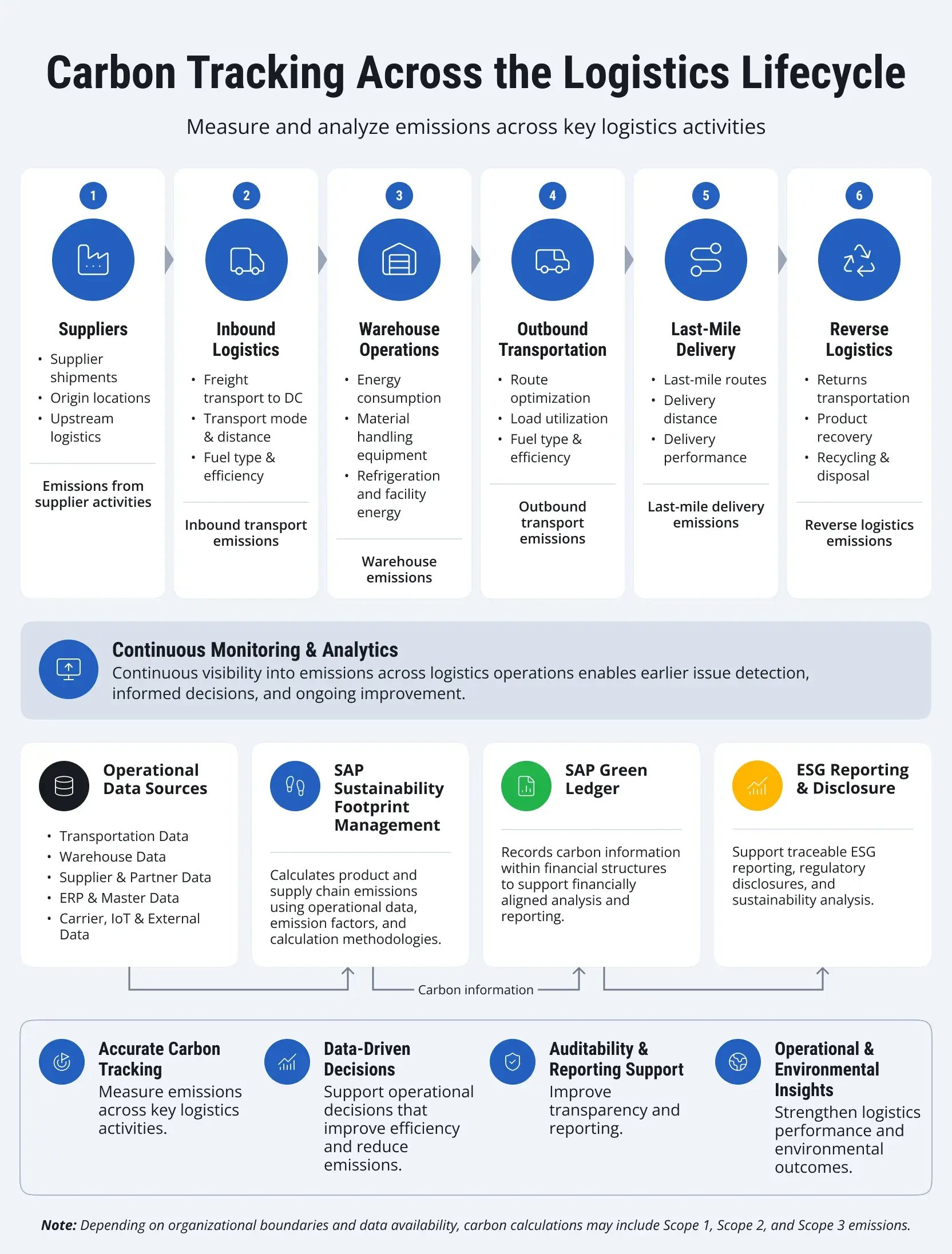
Carbon Tracking Across the Supply Chain
Targeted emissions reduction depends on pinpointing exact carbon output locations throughout a logistics network. For most organizations, freight transport makes up only one segment of a much larger footprint that encompasses warehousing, material handling, vendor operations, inventory transfers, and customer distribution.
Evaluating total environmental impact requires continuous tracking across every supply chain link rather than analyzing isolated shipping events.
Inbound logistics
Carbon accounting starts long before raw materials or finished goods land at distribution hubs. Enterprise teams actively monitor emissions from vendor shipments, international sea freight, port drayage, and inland transport.
Capturing inbound data allows procurement managers to benchmark alternative sourcing locations, assess transport modes, and measure how vendor selection affects overall carbon accounting.
Warehouse and distribution operations
Distribution facilities generate measurable emissions through power consumption, heavy equipment usage, climate control systems, internal material movement, and packaging lines.
Analyzing facility-level operations surfaces efficiency gains that trim utility expenses while cutting carbon emissions. Key focus areas include:
- Storage rack layout optimization to reduce forklift drive times
- High-density pallet storage systems that minimize total square footage
- Automated material handling equipment with variable-speed drives
- On-site energy management systems tied to peak-load hours
Outbound transportation and delivery
Outbound distribution represents a primary driver of transport emissions, varying based on network footprint, carrier mix, and order fulfillment models.
Calculating precise outbound footprints depends on several operational variables:
- Transport mode breakdown across air, rail, ocean, and over-the-road trucking
- Order consolidation rates and pallet load factors
- Fleet route efficiency and total haul mileage
- Fuel source composition, including biodiesel blends and electric vehicle fleets
- Carrier-specific fuel efficiency performance logs
Reverse logistics
Supply chain emissions continue well past final delivery. Return merchandise processing, asset recovery, packaging recycling, and closed-loop material flows require dedicated transport and warehousing steps that add to total carbon figures.
Integrating reverse logistics into overall carbon metrics provides complete audit visibility while advancing corporate circular economy goals.
Continuous monitoring over periodic reporting
Quarterly or annual reporting cycles prevent supply chain teams from identifying operational inefficiencies as they happen. In contrast, calculating carbon metrics alongside daily shipping transactions gives management more timely operational visibility into emerging emission spikes.
Shifting from annual post-mortem reporting to real-time operational visibility embeds environmental management directly into standard supply chain governance.
How SAP Solutions Work Together for Sustainable Supply Chains
Sustainable logistics depends on multiple business capabilities working together rather than a single application. SAP's sustainability portfolio connects operational systems, emissions calculations, financial reporting, and partner collaboration to create a consistent view of environmental performance across the supply chain.
Each solution contributes a specific capability while sharing business data across the broader SAP ecosystem.
|
SAP solution |
Primary role in sustainable logistics |
Business outcome |
|
Provides operational business data from procurement, logistics, manufacturing, and finance |
Reliable foundation for sustainability calculations |
|
|
Supports transport planning, carrier selection, and execution; calculates CO2e for applicable road-freight scenarios |
Supports cost, utilization, routing, and emissions-informed transportation decisions |
|
|
Calculates product and corporate carbon footprints, including supported transport-footprint scenarios |
More granular and traceable carbon footprint calculations |
|
|
Records carbon information within financial structures for reporting and analysis |
Financially aligned carbon accounting based on calculated emissions |
|
|
Improves collaboration with suppliers and logistics partners |
Support of supplier and logistics-partner collaboration relevant to Scope 3 data collection |
|
|
Supports predictive analytics, recommendations, and process optimization |
AI-assisted analysis and recommendations for logistics planning and optimization |
Rather than functioning independently, these solutions exchange information throughout the supply chain. ERP data provides the starting point, bringing together the master and transactional records generated across core business processes. SAP Transportation Management adds freight planning, execution, and transportation activity data. Depending on the system landscape and integration architecture, these inputs can be used for footprint calculations in SAP Sustainability Footprint Management. Eligible corporate footprint data can then flow into SAP Green Ledger, where carbon information is connected with relevant financial dimensions.
The result is a clearer link between what happens across logistics operations, the emissions associated with those activities, and the financial context in which the business evaluates them.
Business Benefits of Sustainable Logistics
Corporate sustainability initiatives often originate from regulatory mandates or investor ESG pressure. Once an enterprise captures granular emissions metrics across its freight network, however, environmental tracking shifts into a practical operational tool. The exact datasets gathered for compliance disclosures can simultaneously refine route planning, vendor management, freight expenditure, and network strategy.
Linking carbon monitoring directly to daily logistics execution strengthens both environmental metrics and operational margins.
Clearer visibility into transportation emissions
Lacking detailed operational records, pinpointing which logistics activities drive the heaviest carbon volume remains difficult. Embedding emission formulas directly into transport and distribution software clarifies where carbon output accumulates and how it fluctuates over time.
This level of operational transparency allows fleet managers to benchmark transit modes, evaluate vendor performance, identify wasteful transit corridors, and fund decarbonization projects that offer high returns.
More efficient logistics operations
Measures that curb greenhouse gases frequently trim day-to-day operating costs. Recalibrating delivery routes, building full truckloads, raising payload factors, and cutting redundant forklift movements lower fuel burn while reducing freight spend and wear on equipment.
Instead of running green initiatives as separate corporate programs, enterprise teams integrate carbon parameters directly into ongoing efficiency workflows.
Stronger ESG reporting and carbon accounting
Capital markets, regulatory agencies, commercial clients, and enterprise partners expect verifiable environmental disclosures backed by clear data lineage and repeatable calculation methods.
Leveraging integrated SAP platforms anchors environmental reporting to transactional operational data. This structural connection maintains reporting consistency across fiscal periods, streamlines third-party audit reviews, and reinforces stakeholder trust in published disclosures.
Improved supplier collaboration
Scope 3 Category 4 (Upstream Transportation and Distribution ) and Category 9 (Downstream Transportation and Distribution) can represent material components of a company’s logistics emissions, making vendor alignment necessary for genuine carbon reduction. Exchanging standardized operational metrics with contracted carriers and third-party logistics firms clarifies network-wide emissions, establishes uniform reporting baselines, and uncovers joint reduction opportunities across extended partner networks.
Better support for strategic decision-making
Verifiable environmental data allows supply chain strategists to evaluate operational trade-offs through a multi-variable framework. Rather than solving strictly for landed cost or transit speed, logistics planners weigh carbon impact alongside freight spend and service level agreements during network design, carrier selection, and procurement sourcing.
This integrated approach yields decisions that protect daily delivery performance while moving corporate sustainability goals forward.

Best Practices for Building Sustainable Logistics With SAP
Companies reach optimal environmental results when carbon accounting integrates directly into daily shipping tasks instead of running as an isolated compliance task. Inserting emissions metrics into route scheduling, warehouse operations, purchasing workflows, and accounting registers allows management to evaluate routine choices through both margin and environmental parameters.
Five execution steps reliably drive long-term operational performance.
Base carbon tracking on verified operational logs
Accurate emissions reporting rests on the precision of daily transaction records. Enterprise teams must audit master datasets, standardize freight workflows, and enforce strict data ownership protocols before scaling carbon accounting projects. Validated shipment files, vendor profiles, transit distances, and facility logs provide the necessary baseline for reliable carbon accounting.
Apply uniform calculation formulas
Calculations demand standardized formulas across regional divisions and external freight vendors. Using uniform conversion factors, calculation logic, and reporting schedules improves cross-department comparisons, simplifies external compliance audits, and reduces manual reconciliation work during quarterly disclosures.
Insert carbon factors into route orchestration
Emissions parameters belong alongside freight spend, delivery windows, and stock levels as core planning inputs. Scoring freight scenarios across expense and environmental indicators helps logistics teams isolate routing changes that cut total diesel consumption while trimming transit costs.
Increase carbon review cycles
Annual environmental disclosures offer backward-facing metrics, whereas weekly operational tracking allows teams to address routing problems more promptly. Evaluating emissions metrics alongside dispatch logs helps coordinators spot inefficient transit lanes, underfilled trailers, or lagging carriers before small errors accumulate into major carbon spikes.
Unify accounting, dispatch, and ESG units
Running a sustainable logistics network demands cross-departmental coordination. Shared operational oversight, identical reporting criteria, and connected enterprise systems can help align dispatch, carbon accounting, and reporting data through governed integrations.
Our Expertise in Sustainable Supply Chain Transformation
Deploying isolated SAP applications rarely resolves enterprise carbon tracking. Gaining real operational control requires verified master records, emissions calculations integrated into daily dispatch workflows, and carbon targets tied directly to balance sheets. Reaching this operational state means synchronizing distinct SAP environments, internal operating divisions, and external freight networks simultaneously.
LeverX partners with enterprises to build connected SAP sustainability landscapes that tie actual freight movement to verified carbon accounts. Our consultants combine hands-on supply chain engineering with expertise in SAP sustainability software and system integration, helping companies increase daily operational throughput while meeting strict corporate ESG mandates.
Core technical capabilities
- SAP Sustainability strategy and architecture: End-to-end blueprinting for multi-region enterprise decarbonization initiatives.
- Automated footprint management: Configuring calculation engines inside SAP Sustainability Footprint Management using supported SAP S/4HANA master and transactional data.
- SAP Green Ledger financial posting: Integrating SAP Green Ledger with SAP S/4HANA Finance to align GHG quantities with relevant financial dimensions.
- SAP Transportation Management execution: Supporting transportation planning and execution while incorporating applicable cost, capacity, and emissions information into logistics decisions.
- SAP Cloud ERP migration: Modernizing ERP can provide a more standardized transactional foundation for integrated logistics and sustainability processes.
- ESG data governance and lineage: Traceable data frameworks simplify external compliance reviews by maintaining a documented data lineage from source transactions through calculation and reporting.
- Supply chain workflow re-engineering: Re-architecting warehouse physical layouts, stock allocation strategy, and fulfillment tasks strips out redundant material handling and physical waste.
- Cross-functional data integration: Single-pipe environmental data feeds connect purchasing, plant floor manufacturing, freight dispatch, and corporate accounting ledgers.
Setting up a baseline carbon accounting model or scaling a multi-region ESG program involves similar technical hurdles. LeverX constructs adaptable SAP enterprise landscapes that give organizations deep emissions data resolution, end-to-end transactional traceability, and sustainable operational performance gains.
Conclusion
Treating logistics decarbonization as a side project separate from core transport operations is no longer viable. Complex shipping routes and shifting regulatory standards demand that companies track carbon metrics with greater consistency and traceability alongside traditional logistics KPIs.
Building an effective environmental strategy relies on governed transactional data, standardized calculation logic, and enterprise platforms that connect logistics activity data with footprint calculation and carbon accounting processes. When carbon parameters sit inside standard dispatch workflows, transport managers can spot route redundancies, negotiate better carrier terms, reduce fuel spend, and reinforce overall network resilience.
SAP software delivers a connected architecture for this operational shift by linking transportation modules, calculation engines, financial accounting entries, and ESG disclosure tools across an integrated SAP solution landscape. Instead of running environmental tracking as a periodic reporting exercise, enterprise teams insert operational intelligence straight into logistics execution — creating lasting value for both commercial operations and external stakeholders.