A practical guide to SAP S/4HANA asset accounting migration, covering reconciliation risks, validation approach, and real project insights.
Asset accounting tends to look stable on the surface in legacy SAP ECC systems. Reports balance, depreciation runs complete, and month-end closes without major incidents. But that stability is often misleading.
Underneath, many systems carry small inconsistencies — differences between Financial Accounting (FI) and Asset Accounting (AA), postings made directly to reconciliation accounts that bypass asset accounting, or legacy corrections that were never fully aligned across modules. These issues don’t always cause immediate problems because SAP ECC allows a certain level of separation between subledger and general ledger data.
SAP S/4HANA significantly reduces that separation. With the introduction of the Universal Journal, financial and asset accounting operate on the same line-item structure. There is no traditional reconciliation layer, no technical workaround, and no delay between posting and reporting. What used to be a periodic control becomes a real-time requirement.
That shift changes the nature of risk. Instead of discovering inconsistencies during reconciliation cycles, companies encounter them during migration testing, or worse, at go-live validation. Typical blockers include mismatches between general ledger and asset balances, inconsistent depreciation values across ledgers, and historical errors that suddenly become visible when SAP S/4HANA migration finance data is unified.
The practical implication is straightforward: fixed asset migration is a financial accuracy checkpoint that the system enforces without exception.
What Changes in Asset Accounting in SAP S/4HANA
The transition to SAP S/4HANA is a redesign of how financial data is structured and validated. At the center of this change is the Universal Journal (ACDOCA), which consolidates financial and controlling data into a single table. Asset accounting is no longer a technically separate subledger for posting purposes with its own reconciliation logic. Instead, asset transactions are recorded directly in the same structure as general ledger postings. Here is how the shift plays out.
|
Aspect |
SAP ECC approach |
SAP S/4HANA approach |
|
Data storage |
Separate tables for FI and AA |
Unified in ACDOCA |
|
Reconciliation |
Periodic and external |
Embedded and real-time |
|
Reconciliation accounts |
Required |
Integrated with automated posting logic (incl. technical clearing account) |
|
Parallel valuation |
Depreciation areas logic |
Ledger-based/account-based approach integration |
|
Transparency |
Aggregated views |
Full line-item visibility |
In practical terms, this means every asset posting immediately affects the general ledger. There is no delay, no batch correction, and no opportunity to reconcile differences after the fact.
This also affects how parallel accounting is handled. Depreciation areas must be aligned with ledgers before migration, because inconsistencies between accounting principles will no longer be masked by separate structures. The system becomes simpler, but also stricter. It expects financial consistency at the moment of posting, not after reconciliation.
Pre-Migration Readiness: Cleaning Asset Data Before Conversion
Most teams underestimate this phase because it is often described as data cleanup, which is misleading. What actually needs to happen is a full validation of financial consistency across asset data.
It’s recommended to start with the asset master data. Missing capitalization dates, incomplete depreciation areas, or incorrect asset classes may seem like minor data issues, but they directly affect how values are calculated and transferred into SAP S/4HANA. Once migrated, these inconsistencies are much harder to correct.
Depreciation logic is another critical area. In many systems, similar assets behave differently due to configuration drift—different useful lives, incorrect depreciation keys, or inconsistent settings across company codes. These differences become visible during migration simulations and often lead to unexpected variances.
Historical data also needs close attention. It is common to find assets with negative net book values, fully depreciated assets that are still posting, or manual adjustments that exist only in FI or AA. These cases are typical in long-running systems.
On top of that, the system state must be clean:
- All prior fiscal years closed
- No pending depreciation runs
- No incomplete asset transactions
- Properly settled assets under construction
A useful way to frame this phase is through a simple rule: if the asset history sheet, depreciation totals, and general ledger balances do not align perfectly before migration, they will not align afterward, either.
Common Reconciliation Pitfalls During Migration
When migration testing begins, asset accounting is usually where inconsistencies surface first. These are rarely new issues. They are existing gaps that become visible once SAP S/4HANA enforces real-time consistency between SAP FI and SAP AA.
The general ledger and asset subledger do not align
The most common issue is a mismatch between the general ledger and asset balances. This typically comes from manual FI postings or historical adjustments that were never fully reconciled with Asset Accounting. In SAP S/4HANA, there is no buffer layer, so even small differences block validation.
Depreciation results do not match
Depreciation values in SAP S/4HANA differ from legacy results. In most cases, this is caused by inconsistent depreciation keys or useful lives across assets. These differences accumulate over time and become visible when calculations are standardized during migration.
Historical adjustments are one-sided
Old corrections exist only in FI or only in AA. These adjustments may have been acceptable in SAP ECC, but once data is unified, they appear as unexplained differences in asset reports and must be resolved.
Currency values are inconsistent
Asset values do not align across currencies. This usually reflects inconsistent exchange rate handling or incomplete parallel currency setup in the legacy system. The issue becomes visible in multi-ledger environments.
Parallel accounting is misaligned
Different accounting standards produce inconsistent results. This happens when depreciation areas are not properly aligned with ledgers. In SAP S/4HANA, this directly affects reporting consistency across IFRS and local GAAP.
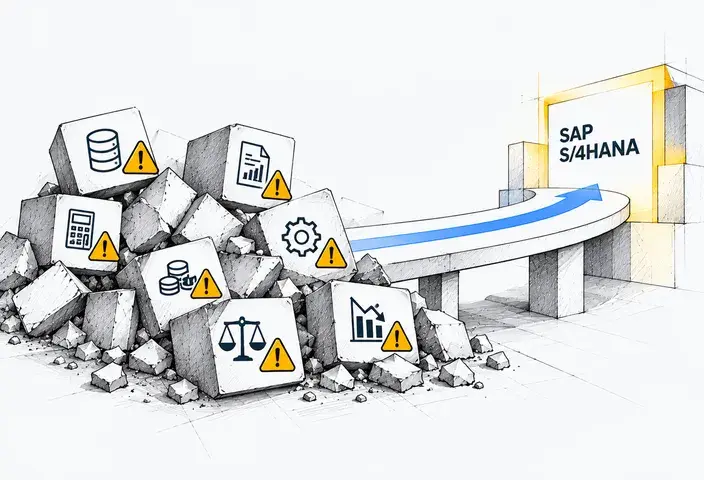
In practice, it means that these issues are pre-existing inconsistencies that SAP S/4HANA forces into the open. The later they are discovered, the harder they are to resolve.
Technical Migration Approaches: Brownfield vs. Selective Data Transition
For asset-heavy systems, the discussion typically focuses on two migration approaches. In a Brownfield conversion, the entire system is converted into SAP S/4HANA. Historical asset data is preserved, but line-item detail is restructured into the Universal Journal. This approach maintains continuity but requires near-perfect reconciliation before conversion. Any inconsistency becomes part of the new system.
Selective data transition offers more flexibility. Instead of migrating everything, companies can define which data to transfer and which to reset. This approach is often used when legacy data quality is too poor to correct efficiently. It allows organizations to rebuild asset values while maintaining essential balances.
The difference becomes clearer in practice.
|
Criteria |
Brownfield migration |
Selective transition |
|
Historical data |
Fully retained |
Partially migrated |
|
Data cleanup flexibility |
Limited |
High |
|
Reconciliation requirement |
Very strict |
Still required, but scoped |
|
Risk profile |
High if data is inconsistent |
Controlled if designed properly |
Regardless of the approach, asset balances must align with the general ledger at the point of migration. Balance carryforward is where this alignment is tested. Acquisition values, accumulated depreciation, and net book values must match across all reports and ledgers. If they don’t, the issue is financial.
-min-1.jpg)
Reconciliation Validation Strategy Before Go-Live
By this stage, responsibility should shift clearly toward finance; a structured validation approach helps avoid last-minute surprises.
It’s recommended to start with the trial balance. The totals in financial and asset accounting must match exactly. Even small differences indicate underlying issues that need to be resolved before proceeding.
Next, it’s necessary to validate the asset history sheet. Focus on three core figures:
- Acquisition value
- Accumulated depreciation
- Net book value
These values must remain consistent across reporting layers.
Depreciation simulation is equally important. Running test depreciation cycles in SAP S/4HANA and comparing them with legacy system results helps identify configuration or data inconsistencies early.
Parallel accounting requires separate validation. Each ledger must produce consistent and explainable results, especially when multiple accounting standards are involved.
Finally, cross-company consistency should not be overlooked. Intercompany asset transfers and shared asset structures must align across entities. A single successful test run proves very little. Consistency across multiple cycles is what indicates readiness.
Our Experience in SAP S/4HANA Asset Accounting Migrations
In SAP S/4HANA projects, asset accounting rarely becomes a problem because of the migration tools. It becomes a problem when financial data is assumed to be consistent without being properly validated.
In LeverX projects, we address this early. The work usually starts with a detailed financial data assessment, where FI and asset balances are reconciled at a granular level, and inconsistencies are identified before they can affect migration. From there, the focus shifts to understanding the root causes behind those differences rather than just correcting totals.
In practice, this means working through several areas that tend to carry the highest risk:
- Pre-migration financial data assessment to verify FI–AA alignment
- Asset reconciliation analysis to identify and explain discrepancies
- Brownfield conversion support, where historical inconsistencies must be resolved rather than carried forward
- Parallel valuation configuration to ensure consistency across ledgers
- Post-go-live stabilization, focused on validating balances and monitoring asset postings
- Audit support, where traceability between asset data and financial statements becomes critical
Across projects, the pattern is consistent. When these steps are treated as part of the core migration scope, asset accounting behaves predictably. When they are treated as secondary tasks, the same issues resurface later as SAP asset reconciliation issues, which are harder to explain and fix under time pressure.
Practical Lessons From SAP S/4HANA Asset Conversions
Migrations to SAP S/4HANA usually follow a predictable pattern. When you meet certain conditions, asset accounting stays under control. When those steps are ignored, the same issues tend to surface regardless of the industry or the size of the system.
Involving finance early
Bringing the finance team in from the first day is the most important factor for a smooth transition. Having these experts involved during the preparation phase lets reconciliation issues surface while there is still a window to fix them. When finance joins the effort later, those same problems typically show up during testing or cutover. At that point, the pressure is higher, and resolving errors becomes much more difficult for the whole team.
Multiple migration cycles
Running a single migration cycle is rarely enough to catch every inconsistency. In practice, it takes several iterations to stabilize asset balances and validate how depreciation behaves. Projects that skip these extra cycles often rely on assumptions that fail under real conditions. You need multiple runs to confirm that results remain consistent and reliable for the long term.
Reconciliation at scale
A single migration cycle is almost never enough to catch every data inconsistency. It usually takes several attempts to stabilize asset balances and verify that depreciation is behaving correctly. Using an automated and structured approach allows you to identify discrepancies faster and trace them more accurately. Without this structure, you tend to spend your time chasing differences instead of actually resolving the underlying problems.
The importance of clear documentation
Keeping clear records of asset-related adjustments and configuration decisions is vital. Without a trail of what was done and why, even resolved issues can resurface later in the project. Good documentation ensures that the logic behind the migration remains clear long after the initial conversion is finished.
Prioritizing financial consistency
When a project is managed well, asset migration feels like a controlled financial process. Without that, projects often fall back on technical workarounds to fix what are essentially financial errors. This rarely works in SAP S/4HANA because the system is built to enforce data consistency rather than ignore it. It’s highly recommended to address the underlying financial data rather than just move files from one place to another.
FAQ
Conclusion
Fixed asset migration is one of the few moments in an SAP S/4HANA program where assumptions about financial data are tested under real conditions.
What often changes is not the system, but the visibility. Data that appeared stable in legacy environments is now exposed at the line-item level, across ledgers and valuation views. That shift forces organizations to move from periodic control to continuous financial consistency.
From a project standpoint, this creates a clear dividing line. When asset accounting is treated as a finance-driven workstream, with defined validation steps and ownership, migration tends to follow a predictable path.
In practical terms, the value of this phase goes beyond migration itself. It establishes a level of transparency and control that carries forward into daily operations, reporting, and audit readiness.
That is why fixed asset migration is not just about getting to SAP S/4HANA. It is where the reliability of financial data is either confirmed or challenged.


-min-Jul-12-2022-09-46-40-14-AM.jpg)