Compare SAP Gold and Platinum partners, understand what partner levels really mean, and learn the key criteria for selecting the right SAP consulting partner.
When companies start comparing SAP consulting partners, partner status is usually one of the first things they look at. Labels such as SAP Gold Partner and SAP Platinum Partner naturally attract attention, but they don't tell you how a project will be delivered or what it's like to work with that partner.
A partner's status indicates its relationship with SAP. It says much less about the team that will design your future ERP landscape, run your workshops, manage cutover weekend, or help your business recover when something doesn't go according to plan.
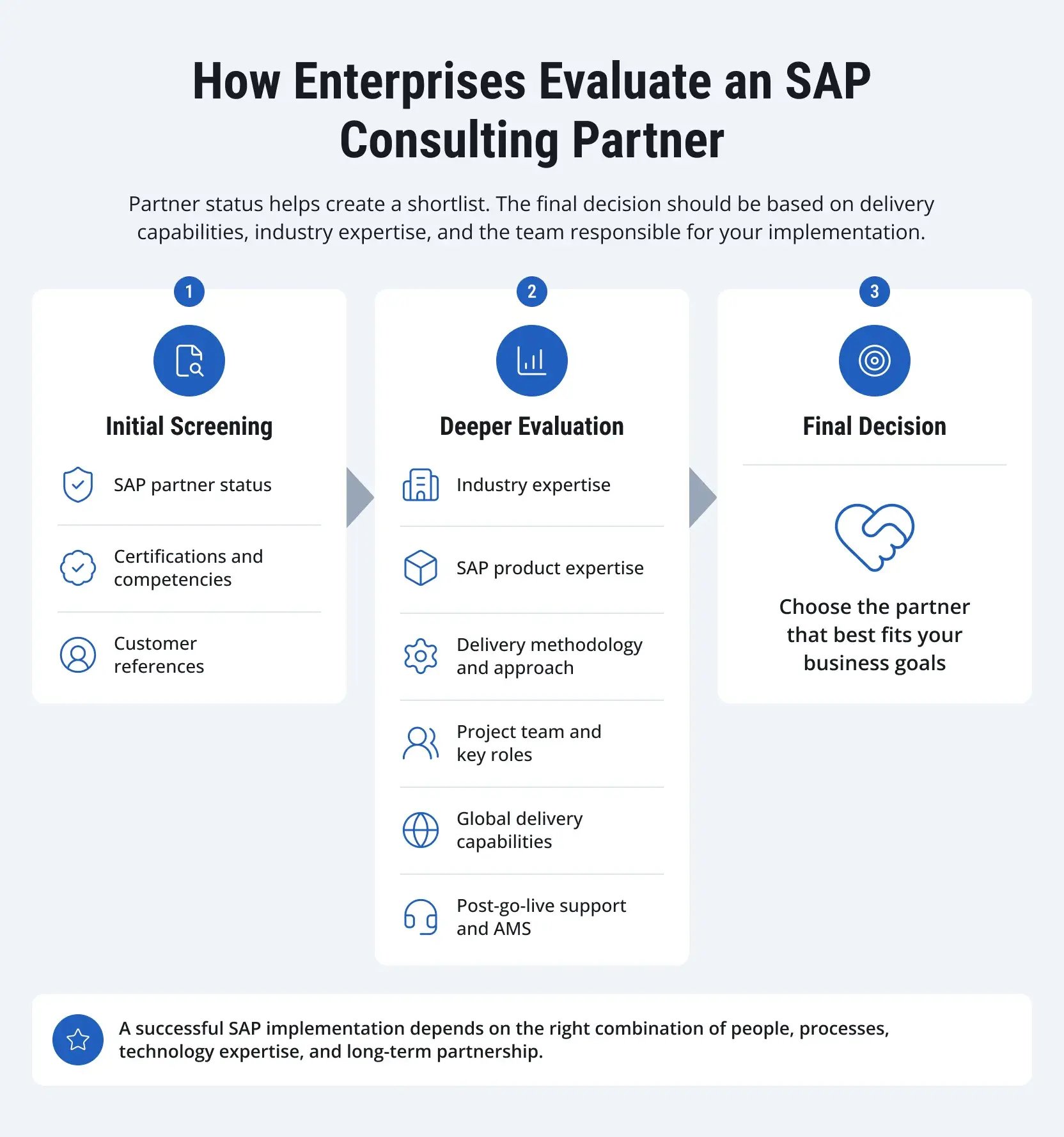
That's why experienced buyers rarely stop at a logo. They look at who has already implemented similar projects, whether the partner understands their industry, how implementation risks are managed, and what happens after launch. These factors have a far greater impact on the success of an SAP program than the partnership level stated in the website's footer.
In this article, we'll look at what SAP partner levels actually represent, where they provide useful insight, and where they shouldn't influence your decision.
Quick Answer
A partner badge can tell a lot about a company's relationship with SAP, but it doesn't reveal what it's like to work with them. Therefore, it's worth looking beyond certifications and inquiring about project experience, implementation approach, and who will be directly responsible for the implementation.
What Is an SAP Partner?
SAP doesn't implement most customer projects itself. That work is carried out by thousands of partner companies around the world, from boutique consulting firms to global system integrators.
Companies join the SAP PartnerEdge program to strengthen their expertise in SAP technologies and work more closely with SAP. The program requires partners to invest in consultant certifications, develop validated competencies across SAP solutions, and meet SAP's partner program requirements.
For customers, PartnerEdge provides a consistent way to identify consulting companies that have demonstrated SAP expertise through certifications and validated competencies. While participation in the program is a positive indicator, it should be considered alongside a partner's implementation experience, industry expertise, and delivery capabilities.
What often gets overlooked is that an SAP partner is a broad label. It describes a company's relationship with SAP, not necessarily the services it provides.
Different types of SAP partners
SAP partners serve distinct roles: some focus on implementing and optimizing core solutions, while others handle license sales or develop specialized software products that extend the capabilities of the wider SAP ecosystem.
The main categories include:
- Consulting partners: focused on advisory services, implementation, migration, and optimization
- Service partners: delivering integration, support, application management, and technical services
- Build partnerships: creating applications and extensions on SAP technologies
- Sell or resell partners: authorized to market and sell SAP software
Many companies combine several of these roles. Others specialize in just one.
That's an important distinction when evaluating vendors. A company can be an SAP partner without running SAP implementation projects or providing long-term managed services, so partner status should always be considered alongside the actual services and experience the company brings to the table.
What Do SAP Partner Levels Actually Mean?
The confusion surrounding SAP's partner program levels is a direct result of changing terminology. Over the years, SAP has repeatedly restructured its partner system, moving from legacy service levels to the PartnerEdge model, and now to a complex matrix of cloud tasks and competency points. This constant rebranding makes it incredibly difficult for buyers to match a partner's badge with their actual technical capabilities.
Regardless of the terminology, the purpose of partner levels has remained largely the same. It reflects how closely a company works with SAP and its ongoing investment in certifications, validated competencies, and customer success. While many buyers still search for terms such as SAP Gold Partner and SAP Platinum Partner, SAP has evolved its partner program toward a competency-based framework that recognizes expertise across specific SAP solutions and technologies.
While buyers still commonly search for terms such as “SAP Gold Partner” and “SAP Platinum Partner,” SAP now recognizes partner expertise through a competency-based framework. Partners earn Essential, Advanced, or Expert competency designations for specific SAP solution areas based on delivery experience, certifications, customer success, and proficiency.
Historically, Platinum status represented SAP's highest level of strategic partnership, reserved for a small group of partners with a broad global presence and close collaboration with SAP. Today, buyers more often encounter competency-based designations besides the legacy Gold and Platinum designations, although these terms remain widely used in the marketplace.
However, the principle remains the same. Partners with a broad range of competencies and active engagement with SAP typically have significant resources to invest in ongoing consultant certification, expertise across various solutions, and early access programs. For organizations implementing complex multi-product environments, a partner with this level of system investment can offer invaluable technical support and direct access to SAP to resolve critical issues.
That doesn't mean every engagement follows the same pattern. A partner may have thousands of consultants worldwide, dozens of SAP competencies, and years of collaboration with SAP. None of that tells you who will actually be assigned to your project. The architects, consultants, project managers, and developers responsible for your implementation will have a much greater impact on the outcome than the partner badge itself.
The comparison below reflects how Gold and Platinum partner levels are generally understood across the SAP market. Because SAP's partner program has changed over time, the table should be used as a practical guide, not as a definitive ranking.
|
Criteria |
What it reflects |
SAP Gold Partner |
Platinum Partner / Highest Strategic Tier* |
|
Investment in the SAP ecosystem |
Commitment to SAP certifications, competencies, and partner programs |
Strong investment in SAP certifications, competencies, and customer success |
Broader investment across the SAP ecosystem, with deeper strategic engagement |
|
SAP-certified consultants |
Size of the certified consultant pool |
Large pool of certified consultants |
Larger global pool of certified consultants |
|
Validated SAP competencies |
Breadth of recognized expertise across SAP solutions |
Multiple validated competencies across SAP solutions |
Broader portfolio of validated competencies across SAP solutions |
|
Relationship with SAP |
Level of collaboration and participation in SAP initiatives |
Established collaboration with SAP |
Strategic collaboration and participation in SAP initiatives |
|
Typical delivery footprint |
Project scale and geographic reach |
Regional and enterprise projects |
Large enterprise and global transformation programs |
*SAP has updated its partner program over time, and the names of partner levels have changed. Gold and Platinum remain widely recognized terms, so they are used here to illustrate the general differences buyers are most likely to encounter.
What Partner Status Doesn't Tell You
Partner status is a useful starting point when evaluating SAP consulting companies, but it shouldn't be the deciding factor. It tells you something about a company's standing within the SAP ecosystem, yet it leaves many of the questions that determine project success unanswered.
The comparison below shows the difference.
|
Partner status can tell you... |
Partner status can't tell you... |
|
Whether the company meets SAP's partner program requirements. |
Who will actually work on your project. |
|
It invests in SAP certifications and solution competencies. |
How experienced those consultants are with projects like yours. |
|
It has recognized expertise across SAP technologies. |
Whether the proposed architecture is the right fit for your business. |
|
It maintains an established relationship with SAP. |
How the project will be governed, tested, and delivered. |
|
It has demonstrated capabilities recognized by SAP. |
Whether the team understands your industry, business processes, and change management challenges. |
Partner status reflects the consulting company as an organization. A successful SAP implementation depends on something much more specific: the experience of the project team, the implementation methodology, and the ability to deliver the right solution for your business, from the first workshop to post-go-live support. The badge may open the conversation. The project team determines the outcome.
What To Look for Beyond Partner Status
A partner's SAP status is only one piece of the picture. Once you've confirmed that a company has the necessary SAP credentials, it's time to look at what will actually influence the outcome of your project. If you're planning a move to SAP Cloud ERP through programs such as RISE with SAP or GROW with SAP, it's also worth researching whether the partner has experience with those transformation approaches and the technologies that support them, including SAP Business Technology Platform (SAP BTP).
Industry experience
SAP experience is important, but industry experience matters too. A manufacturing company doesn't face the same challenges as a healthcare provider, retailer, utility, or financial institution. Partners who already understand your industry can get up to speed faster, anticipate common issues, and build on what they've learned from similar projects.
Customer references
Not all customer references carry the same weight. A project that's similar to yours will be much more useful than a list of well-known brands. If possible, ask to speak with a customer about their experience, from implementation through day-to-day support after go-live.
SAP product expertise
Modern SAP landscapes are often built around multiple SAP solutions, including SAP S/4HANA, SAP BTP, SAP SuccessFactors, SAP Ariba, and specialized supply chain applications. For many enterprise transformation programs, it's important to work with a partner that understands how these solutions fit together, rather than focusing on a single product alone.
Evaluating an SAP partner now requires assessing their ability to execute on SAP Business AI. Organizations must look beyond standard configurations to ensure a partner has the specialized SAP BTP expertise required to build custom AI extensions, deploy intelligent automations, and create interconnected, smart business workflows.
Delivery approach
Any project implementation follows a specific methodology on paper. What matters is how this methodology is applied in practice. Project management, PMO, risk management, testing, and transition planning all play a vital role in ensuring the successful completion of the project and minimizing disruptions during launch. Change management is equally important. Preparing business users for new processes and ensuring their adoption throughout the organization can have a significant impact on the long-term success of the project.
Global delivery capabilities
Global implementations extend far beyond software configuration. Success depends on managing local regulatory requirements, language differences, and teams working across time zones. For many organizations, access to global teams also facilitates 24/7 support during critical project stages and after go-live.
Long-term support
An SAP implementation is never truly finished. Because systems evolve and business priorities shift, organizations frequently retain their deployment partner post-launch for ongoing application management, system optimization, software updates, and daily support.
Questions To Ask Before Choosing an SAP Consulting Partner
Many implementation issues can be avoided by asking the right questions before the project begins. Asking the right probing questions early on is the most reliable way to evaluate a partner’s true operational methodology and confirm whether they are the right fit for your business.
Questions every SAP partner should be able to answer
Before choosing an implementation partner, make sure you get clear answers to the following questions.
|
Topic |
Questions to ask |
|
Experience |
How many SAP S/4HANA implementations have you completed? Can you share customer references? Can I speak with customers? |
|
Project team |
Who will actually deliver the implementation? How many senior consultants will be assigned? |
|
Delivery |
How do you manage project risks? What is your approach to testing and cutover? How do you manage project scope and change requests? |
|
Architecture |
Who owns the solution architecture? How do you keep the implementation aligned with Clean Core principles? |
|
Support |
What happens after go-live? Do you provide AMS and ongoing optimization? |
The answers to these questions will tell you much more than any partner badge. They will reveal how the consulting company approaches project implementation, who will be responsible for your project, and whether they have the experience and capabilities to support your business after launch.
Common Mistakes Companies Make When Selecting an SAP Partner
Many organizations choose SAP partners based on seemingly reasonable, but deeply flawed, assumptions. The belief that official certifications guarantee project success, or that a partner's willingness to adapt every workflow is an advantage, often leads to critical project delays, resource mismatches, and significant budget overruns.
Choosing the cheapest proposal
Price is always part of the decision, but two proposals with a similar cost can include very different levels of service. One may include senior consultants, structured testing, and post-go-live support. The other may treat those as optional extras. A lower upfront price can quickly disappear once additional work starts.
Assuming bigger automatically means better
Large consulting firms have impressive portfolios, but your project won't be delivered by the entire company. Every SAP project is delivered by a team of people. Their experience, the way they work together, and their understanding of your business will have a much greater impact on the project than the size of their company.
Letting partner status make the decision
An SAP partner tier is a commercial credential, not an engineering validation. It does not define the partner's solution architecture methodology, their project governance frameworks, or the technical competency of the specific resources assigned to your delivery team. These execution-level factors, together with a well-defined delivery methodology, usually have a much greater impact on project outcomes than partner status alone.
Focusing only on local presence
Having consultants nearby can be convenient, but proximity isn't always the primary advantage. Many SAP enterprise programs rely on global development teams, bringing together specialists from different countries. Access to the necessary expertise is often more valuable than having all the specialists in a single office.
Thinking the project ends at go-live
Launching a system doesn't mean the work is finished. This is the moment when employees begin using the system in their daily work, and this is often when new requests, process improvements, and additional development needs arise.
Planning the next stage in advance can save time later. Before finalizing the implementation, it's worth deciding who will maintain the system, handle future changes, and help it keep pace with business growth.
Why Enterprises Choose LeverX
The key message of this guide is clear: partner status is a commercial metric, not a project success indicator. In today's SAP environment, risk mitigation requires a multidimensional assessment. Priority should be given to deep industry knowledge, disciplined project management, and broad integration capabilities across product portfolios, rather than marketing advantages. Ultimately, your choice should favor a partner structurally prepared to support your architecture over the long term through application management and continuous optimization after launch.
That's the role LeverX has played for organizations worldwide for more than 20 years.
Support across the entire SAP journey
Some organizations engage LeverX to plan an SAP S/4HANA transformation. Other clients partner with us to extend SAP functionality with SAP BTP, modernize HR systems with SAP SuccessFactors, improve supply chain planning with SAP Integrated Business Planning (SAP IBP), and much more. In many cases, the collaboration continues beyond the initial project. What begins as a one-off project often evolves into a larger collaboration. Rather than bringing on a new vendor, many clients continue to work with the same team because they already understand their SAP environment and the solutions they use within it.
Expertise that goes beyond a single SAP product
Organizations rarely rely on just one SAP solution, especially as their business grows. As a result, many of our projects span multiple SAP products and technologies. LeverX works with the entire SAP portfolio, including SAP S/4HANA, SAP BTP, SAP SuccessFactors, SAP Ariba, SAP Extended Warehouse Management (SAP EWM), SAP Customer Experience (SAP CX), SAP Business Data Cloud, SAP Datasphere, SAP Analytics Cloud (SAC), and other SAP technologies. This extensive experience helps clients build interconnected SAP systems where data and business processes interact across the enterprise, rather than as a collection of disparate systems.
Built for complex delivery
Not all SAP projects are created equal. Some span a single business unit, while others touch multiple countries, languages, and regulatory environments. LeverX supports both scenarios. Our global teams combine local expertise with specialists in various SAP technologies, making it easier to scale projects while maintaining consistent delivery.
A focus on long-term value
Implementation decisions don't end with go-live. They influence future upgrades, integrations, and the overall maintainability of the SAP landscape. That's why our teams follow Clean Core principles where they make business sense, helping customers reduce unnecessary complexity while preserving flexibility for future changes.
Many organizations continue working with LeverX after implementation for application management, system enhancements, upgrades, and ongoing optimization. Because the same team already understands the SAP landscape and the decisions made during implementation, customers can continue evolving their systems without starting every new initiative from scratch.
Successful SAP programs aren't defined by a partner badge. They depend on experienced teams, practical delivery expertise, and a partner that continues to create value long after the initial implementation.
Conclusion
Choosing an SAP consulting partner is a decision that will influence your ERP program long after implementation begins. The right partner helps shape the solution, manage complexity, and support your business as new requirements emerge over time.
A thorough evaluation goes beyond certifications and partnership levels. Looking at project experience, the people assigned to your implementation, delivery practices, and long-term support give you a much clearer picture of what it's like to work with a consulting partner in practice.
Taking the time to evaluate these factors before signing a contract can help reduce project risk and build a stronger foundation for a successful SAP transformation.