Discover when SAP selective conversion is the right choice for S/4HANA migration, system consolidation, and business transformation initiatives.
At first glance, choosing an SAP S/4HANA migration strategy seems straightforward. Most organizations begin by comparing two established paths: Greenfield and Brownfield.
For large enterprises operating multiple SAP ERP Central Component (SAP ECC) systems, dealing with acquisitions, divestitures, regional templates, and years of accumulated transactional data, neither option may fully address the business requirements. A full system conversion can preserve data and processes that no longer support the future operating model. A complete reimplementation can introduce unnecessary cost, complexity, and disruption.
This is why many organizations adopt a selective conversion strategy, also known as a Bluefield approach or SAP selective data transition services.
Selective conversion provides an alternative to the traditional Greenfield and Brownfield approaches. You can overhaul outdated parts of your SAP landscape while preserving the historical records and workflows that still add value. You define your target setup and migrate only the master data, organizational structures, and transaction history required to support it.
The approach is commonly used in landscape consolidation initiatives, post-merger integration programs, shared-services transformations, and other projects where business change is just as important as the move to SAP S/4HANA itself.
In this article, we'll take a detailed look at how selective SAP conversion works, where it makes the most sense, and why so many companies are considering it as a practical alternative to a complete clean slate and migrating an entire complex legacy system.
Why Traditional S/4HANA Migration Approaches Don't Fit Every Organization
For many years, SAP S/4HANA projects were typically viewed as a choice between two approaches. The logic was simple: if the existing SAP environment was slowing down the system's development, they started from scratch. If the system still performed well enough, they migrated it to the new system. Now, however, this decision has become more difficult.
Modern SAP systems often include multiple ERP systems, years of proprietary development, regional process differences, acquired companies, and large volumes of historical data. At the same time, the transition to SAP S/4HANA is often linked to broader business initiatives:
- Mergers and acquisitions
- Divestitures and carve-outs
- Shared-services transformations
- Global template rollouts
- ERP consolidation programs
- Process standardization initiatives
As a result, many organizations are no longer looking for a simple technical migration. They're trying to solve business problems while moving to a new platform.
A Greenfield implementation may require rebuilding more than necessary. A Brownfield conversion may preserve more than necessary.
What Is Selective Conversion?
Unlike a traditional system conversion, selective conversion allows organizations to decide which data, structures, and processes should be carried forward into SAP S/4HANA. Selective system conversion, SAP selective data transition, and Bluefield are terms often used to describe variations of this methodology.
Bluefield makes those decisions possible. Instead of treating migration as an all-or-nothing exercise, organizations define what the future landscape should look like and then move only the data, structures, and processes needed to support it.
Greenfield vs. Brownfield vs. Bluefield
|
Approach |
What it means |
|
Greenfield |
Start over with a new SAP S/4HANA implementation |
|
Brownfield |
Convert the existing system and keep most configurations, processes, and data |
|
Bluefield (selective conversion) |
Selectively migrate and transform only the parts of the landscape that support future business requirements |
Selective conversion gives organizations greater control over the outcome, but it requires additional planning. Decisions regarding data, business processes, and organizational structures must be made early on, as they shape all subsequent actions.
Bluefield gives organizations greater control over the scope of migration, but this control comes with responsibility. Every decision regarding data, processes, and system structures must be carefully considered. Otherwise, the project could become increasingly complex.
For organizations dealing with complex SAP environments, that extra effort is often worth it. The flexibility gained through selective conversion is difficult to achieve with traditional migration approaches.

When Does Selective Conversion Make Sense?
Not every SAP S/4HANA project needs a Bluefield approach. If you're running a relatively clean SAP environment and your business structure hasn't changed much over the years, Greenfield or Brownfield may be enough.
Selective conversion usually enters the conversation when the migration becomes tied to a larger business problem.
|
Situation |
Why companies consider selective conversion |
|
Multiple ECC systems |
Consolidate landscapes without losing important history |
|
Mergers and acquisitions |
Integrate businesses without inheriting every legacy process |
|
Carve-outs and divestitures |
Separate data and organizational structures selectively |
|
Shared services programs |
Standardize processes across business units |
|
Global template initiatives |
Move to a common operating model while preserving historical records |
Multi-system ECC consolidation
Years of acquisitions, regional deployments, and local business requirements can leave organizations running multiple ECC environments that perform similar functions but operate differently.
When those systems move to SAP S/4HANA, many companies see an opportunity to simplify the landscape. The challenge is that not everything should be merged, and not everything should be discarded. Some historical data still matters. Some local processes still serve a purpose.
Selective conversion gives organizations the ability to make those distinctions instead of treating every system the same way.
Mergers and acquisitions
Few things create SAP complexity faster than an acquisition. One company suddenly becomes two ERP environments, two reporting structures, two sets of master data, and often two very different ways of doing business.
The goal is rarely to copy one system into another. Most organizations want to bring together the information and processes they need while leaving unnecessary complexity behind.
This is one of the reasons selective conversion is frequently used in post-merger integration programs.
Legal entity carve-outs and carve-ins
Carve-out projects create the opposite problem. Instead of combining systems, organizations need to separate them.
A business unit may be sold, spun off into a separate company, or reorganized under a new legal structure. The difficult part is separating the right data, users, transactions, and business records without disrupting day-to-day operations.
Selective conversion provides a practical way to define those boundaries and migrate only the relevant information.
Shared services centralization
Many financial system transformation programs begin with a simple goal: to stop performing the same work in different locations. As organizations transition to shared services models, they often need to standardize processes across regions and business units that have operated independently for years.
That kind of change rarely requires a complete restart, but it usually requires more than a straight system conversion. Selective conversion creates room for process redesign without forcing the organization to abandon valuable business data.
Global template standardization
Global SAP landscapes tend to accumulate local variations over time. One region adds a customization. Another introduces a different approval process. A third develops its own reporting structure. Eventually, maintaining those differences becomes expensive and difficult to govern.
Many companies use SAP S/4HANA migration services to create a unified global template. Selective conversion helps them achieve this goal without forcing each region to rebuild the system from scratch.
Our SAP Selective Conversion Approach
Selective conversion projects are rarely straightforward. Before a single row of data is moved, organizations have to answer some incredibly difficult questions.
Before defining the migration scope, organizations need a clear understanding of what's actually being used. Some processes remain essential to daily operations. Others exist only because they've been carried forward through years of upgrades, acquisitions, and local system changes. The answers shape every stage of the project.
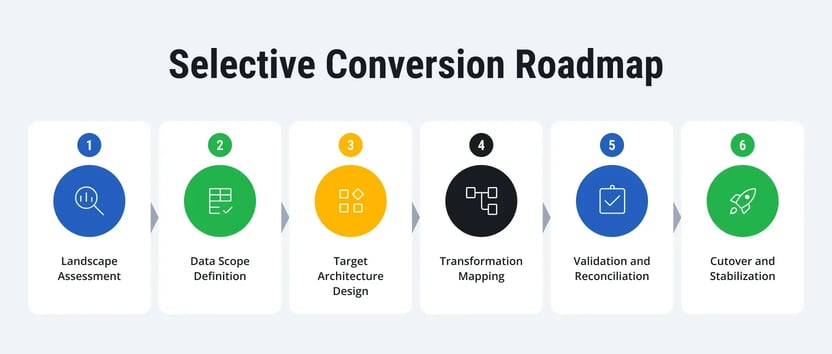
No two selective conversion projects are exactly alike. Still, the most successful initiatives tend to follow a structured process, with planning, validation, and business alignment receiving as much attention as the migration itself. When business processes, data, and organizational structures are all changing simultaneously, planning and validation are just as critical as the technical migration.
Landscape assessment
The first step is understanding what you're working with. For some organizations, that's a single SAP ECC environment. For others, it can be several systems spread across regions, business units, or acquired companies. Over time, those landscapes tend to accumulate duplicate processes, overlapping functionality, custom developments, and integrations that have remained in place for years without reevaluation.
Many organizations are surprised by how much of their SAP landscape exists simply because it has always been there. That's why the assessment phase starts with understanding what the business actually relies on today.
Data scope definition
One of the biggest advantages of selective conversion is that not everything has to move to SAP S/4HANA.
The challenge is deciding what should. Some organizations need access to decades of historical transactions. Others only need selected records for compliance, reporting, or operational purposes. Beyond transaction data, teams also need to decide which master data, organizational structures, configuration settings, custom developments, and archived records should be carried forward into SAP S/4HANA.
These decisions have a direct impact on project scope, timelines, system complexity, and long-term maintenance costs.
Target architecture design
Once the migration scope is clear, attention shifts to the future environment. This is the stage where organizations define how they want SAP S/4HANA to look after the transformation. In some cases, the goal is system consolidation. In others, it's process standardization, shared services, or a global operating model. The objective isn't to recreate the current landscape. It's to build one that better supports the business going forward.
Transformation mapping
Once the future landscape has been defined, project teams can begin mapping the existing environment to the target structure.
At this stage, project teams determine how structures from the source systems will fit into the future SAP S/4HANA landscape. A company code used in one system may need to be merged with another. Cost centers and profit centers may need to be aligned. In some cases, entirely new structures are introduced to support the future operating model.
The quality of this mapping often determines how smoothly data can be consolidated, reported on, and managed after go-live.
Business validation and readiness
Before go-live, business users validate migrated data, reports, and critical processes to confirm the new environment supports day-to-day operations. The goal is to ensure that teams can work confidently in SAP S/4HANA from day one.
Cutover and stabilization
A carefully coordinated transition plan is the only thing that separates a smooth launch from complete operational chaos. IT, finance, and supply chain management departments must be perfectly aligned to minimize business disruptions and ensure the migration moves forward effectively.
And the work doesn't stop at the transition stage. Once the system is live, the focus shifts to hypercare, where project teams monitor system performance, resolve issues, and support users as they adapt to the new SAP S/4HANA environment.
Ultimately, a successful selective conversion isn't measured by how many terabytes of data you moved or how many legacy servers you turned off. It’s defined by whether your new SAP landscape is actually easier to manage, better aligned with daily operations, and ready to scale without dragging years of unnecessary complexity along for the ride.
Technical Framework for SAP Selective Conversion
On paper, selective conversion sounds simple: move what you need, leave the rest behind. In practice, that's where the hard work begins.
A traditional system conversion is largely focused on moving an existing SAP environment to SAP S/4HANA. Selective conversion introduces a different challenge. Data may need to be consolidated from multiple systems, and organizational structures may need to change.
The technical challenge is not moving data. It's moving the right data while keeping everything connected and operational.
Common selective conversion objectives and challenges
|
Business objective |
What makes it difficult |
|
Consolidate multiple ECC systems |
Similar data is often structured differently across systems. |
|
Standardize business processes |
Existing organizational models rarely match the future design. |
|
Retain historical records |
Deciding which data should be migrated and which can remain archived. |
|
Reduce system complexity |
Years of customizations and local variations need to be evaluated. |
|
Maintain business continuity |
Critical operations cannot stop during migration. |
SAP Landscape Transformation
By the time many organizations begin their journey with SAP S/4HANA, the landscape has already changed significantly as a result of acquisitions, reorganizations, and years of changes to on-premises systems. SAP Landscape Transformation (SAP LT) is typically used to unify these environments and prepare data for the future landscape.
Data mapping and harmonization
Anyone who has worked with multiple SAP systems knows that the same business object can be represented in different ways.
A cost center in one system may follow a completely different structure than a cost center in another. Business partner records may be duplicated. Reporting hierarchies may vary by region or business unit.
These differences need to be resolved before the migration begins. If they aren't, the same issues can resurface in SAP S/4HANA, making reporting and day-to-day operations more difficult than they need to be.
Customer and vendor records that exist separately in SAP ECC cannot simply be moved into SAP S/4HANA as they are. They first need to be converted into the Business Partner model through Customer Vendor Integration (CVI). For many organizations, particularly those working with multiple systems, this becomes a significant part of the overall data transformation effort.
For organizations consolidating multiple ECC systems, this can add another layer of complexity. Duplicate customer and vendor records may need to be identified, master data structures aligned, and common governance rules established before the conversion can move forward.
Addressing these issues early helps reduce migration risks and create a stronger foundation for reporting, integration, and business processes in the future SAP S/4HANA environment.
Downtime and integration management
Data migration is only part of the job. Most SAP systems are connected to other business applications, from procurement and warehouse management platforms to manufacturing, reporting, and third-party solutions. These integrations must continue to function after the transition to SAP S/4HANA.
A successful selective conversion requires more than accurate data migration. The surrounding ecosystem has to continue working as expected when the new environment goes live.
At the same time, organizations need to minimize disruptions. Business process users still need to process orders, close financial periods, manage inventory, and provide customer service during the migration.
That's why downtime planning, integration testing, and cutover preparation are often just as important as the migration itself.

Governance and Risk Mitigation in Selective Conversion Projects
Selective conversion gives organizations more control over what moves to SAP S/4HANA. The tradeoff is that every decision carries consequences.
Migration decisions don't eliminate business responsibilities. Reports still need to be accurate, financial figures still need to be reconciled, and any changes made to the data must be documented and traceable.
That's why governance is not a separate workstream in a selective conversion project. It's part of every major decision made throughout the migration.
Common risks and mitigation strategies
|
Risk |
Potential impact |
Mitigation |
|
Financial data discrepancies |
Inaccurate reporting and reconciliation issues |
Ongoing validation and financial reconciliation controls |
|
Inconsistent master data |
Duplicate records, reporting errors, and process inefficiencies |
Master data governance and data quality reviews |
|
Compliance gaps |
Regulatory and legal risks |
Data retention policies and compliance reviews |
|
Missing audit trails |
Difficulties during audits and investigations |
Transformation documentation and traceability controls |
|
Poor data quality |
Reduced trust in the new SAP environment |
Data cleansing and validation throughout the project |
Master data governance and data quality
When consolidating data from multiple systems, duplicate records, conflicting master data, and inconsistent naming conventions are often discovered. Issues that had little impact on individual systems can create difficulties during consolidation and reporting.
Consolidating multiple systems typically reveals data issues that were previously easily overlooked. Many organizations use this phase of the project to clean up records and implement more consistent data management practices.
Compliance and audit readiness
Decisions about historical data are rarely based on storage capacity alone. Reporting obligations, audits, and regulatory requirements often determine what information must remain accessible after the migration.
The same applies to auditability. When data is transformed, consolidated, or moved between systems, there should be a clear record of what changed and how those changes were made.
Leaving these questions until after go-live can create unnecessary work and risk.
How Selective Conversion Reduces Risk Compared To Traditional Approaches
Greenfield and Brownfield migrations remain valid options for many SAP S/4HANA projects. The challenge is that large organizations often need something in between.
They may want to simplify their SAP landscape without losing years of business history. They may need to consolidate systems after an acquisition while preserving critical financial records. Or they may want to standardize processes without rebuilding everything from scratch.
This is where selective conversion offers a different path.
Greenfield vs. Brownfield vs. selective conversion
|
Area |
Greenfield |
Brownfield |
Selective conversion |
|
Business disruption |
High |
Low |
Controlled and scope-dependent |
|
Process redesign |
Extensive |
Limited |
Targeted |
|
Historical data migration |
Selective |
Typically all data |
Business-driven selection |
|
System consolidation |
Complex |
Limited |
Well suited |
|
Organizational restructuring |
High flexibility |
Limited flexibility |
High flexibility |
|
Governance and data quality improvements |
High |
Limited |
High |
|
Legacy complexity carried forward |
Low |
High |
Reduced |
Reduced business disruption
Greenfield projects often require organizations to redesign processes, rebuild integrations, retrain users, and migrate data into an entirely new environment. Brownfield conversions reduce that disruption but can preserve system complexity that the business no longer wants.
Selective conversion sits between these two approaches. It allows organizations to introduce change where it delivers business value while preserving processes, structures, and data that continue to serve a purpose.
Greater flexibility during transformation
Many SAP S/4HANA projects involve more than a technology upgrade. Organizations may be consolidating systems, standardizing processes across regions, centralizing shared services, or integrating acquired businesses.
These changes are difficult to achieve through a traditional system conversion, where the goal is largely to preserve the existing environment. Selective conversion provides more flexibility to reshape organizational structures, align business processes, and support broader transformation objectives during the migration itself.
Lower long-term complexity
Every SAP system carries a history. Some of that history is valuable. Some of it is the result of years of custom developments, local variations, temporary fixes, and business requirements that no longer exist.
As a result, organizations often operate with fewer systems, more consistent reporting structures, and lower maintenance overhead. Over time, that often leads to a cleaner system landscape that is easier to maintain, govern, and extend.
The goal is not simply to reduce migration risk. It's to arrive in SAP S/4HANA with a system landscape that better reflects how the business operates today rather than how it operated ten years ago.
Our Experience in Enterprise Selective Conversion Programs
Selective conversion projects often involve competing priorities. Business teams want to preserve reporting continuity, finance teams need accurate historical data, and IT teams are looking to simplify the landscape without disrupting operations.
LeverX supports organizations throughout the entire process, from landscape assessment and migration planning to validation, transition, and post-launch support.
Our experience includes:
- Enterprise SAP landscape transformation services and large-scale consolidation initiatives
- Mergers, acquisitions, and business integrations
- Legal entity carve-outs and divestitures
- Finance transformation and reporting harmonization initiatives
- Global SAP S/4HANA rollouts
- Post-go-live support and stabilization
Business Outcomes of SAP Selective Conversion
The biggest changes often become visible after the migration is complete. While outcomes vary from project to project, organizations frequently see improvements in reporting, system complexity, and ongoing maintenance efforts.
Reporting stops being a consolidation exercise
In organizations running multiple ERP systems, reporting often involves assembling information from several sources and then reconciling the differences.
While some complexity is inevitable, consolidation projects often help organizations standardize reporting and gain a more unified view of business performance.
For finance teams, that can mean spending less time explaining discrepancies and more time analyzing results.
Legacy complexity doesn't have to move forward
Many SAP landscapes include custom developments, interfaces, and workarounds that were introduced to meet past business requirements. Some remain valuable, while others continue to exist simply because removing them was never a priority.
A selective conversion provides an opportunity to reassess those dependencies and determine which components still support the business. As a result, organizations can reduce unnecessary complexity before moving to SAP S/4HANA.
A simpler landscape that's easier to maintain
Many organizations start with a landscape that has grown over years of acquisitions, expansions, and local business requirements. Multiple ERP systems, custom developments, and regional variations often lead to duplicate processes, complex integrations, and higher maintenance efforts. in-house developments, and regional variations resulting from acquisitions and years of business growth. This often results in duplicated processes, complex integrations, and a system that requires significant maintenance.
Consolidation helps reduce that complexity. With fewer systems to manage, organizations often benefit from more consistent reporting, fewer interfaces, and lower maintenance efforts.
The benefits also extend to future initiatives. A cleaner SAP landscape is easier to maintain, upgrade, and extend, which can simplify SAP Clean Core programs, cloud transformation projects, and future modernization efforts.
Conclusion
Few organizations start a selective conversion project because they're interested in migration methodology.
More often, they're trying to solve a problem. Their SAP landscape has become difficult to manage. Reporting takes too much effort. Multiple systems need to be brought together. Business structures have changed, but the technology landscape hasn't kept pace.
In situations like these, migrating to SAP S/4HANA is an opportunity not only to upgrade the platform but also to simplify their infrastructure, address long-standing challenges, and make decisions about the future of their SAP environment based on business priorities rather than the limitations of legacy systems.