A practical breakdown of how SAP Data Warehouse Cloud evolved into SAP Datasphere, what's new, what carried over, and how to decide your next move.
SAP renamed Data Warehouse Cloud to SAP Datasphere in March 2023. The rename came with real additions, not just a new logo. SAP introduced richer cataloging capabilities, expanded the semantic layer, and added new capabilities for working with business context. None of that required existing customers to rebuild anything, but it also wasn't communicated in a way that made the distinction obvious. So people still search for SAP Data Warehouse Cloud, still ask whether it's been discontinued, and still aren't sure if migrating to Datasphere means starting over.
In this article, we'll go through what actually changed, what didn't, and where SAP Analytics Cloud and SAP Business Data Cloud fit into the current picture. If you're running SAP Data Warehouse Cloud today, none of this requires an immediate decision, but it's worth understanding before you plan your next step.
Why SAP Data Warehouse Cloud and SAP Datasphere are Often Confused
When searching for SAP's data platform, you'll encounter two names used almost interchangeably: SAP Data Warehouse Cloud and SAP Datasphere. It's logical to assume that these are two different products or that one has completely replaced the other. Neither assumption is correct.
SAP Data Warehouse Cloud has become SAP Datasphere
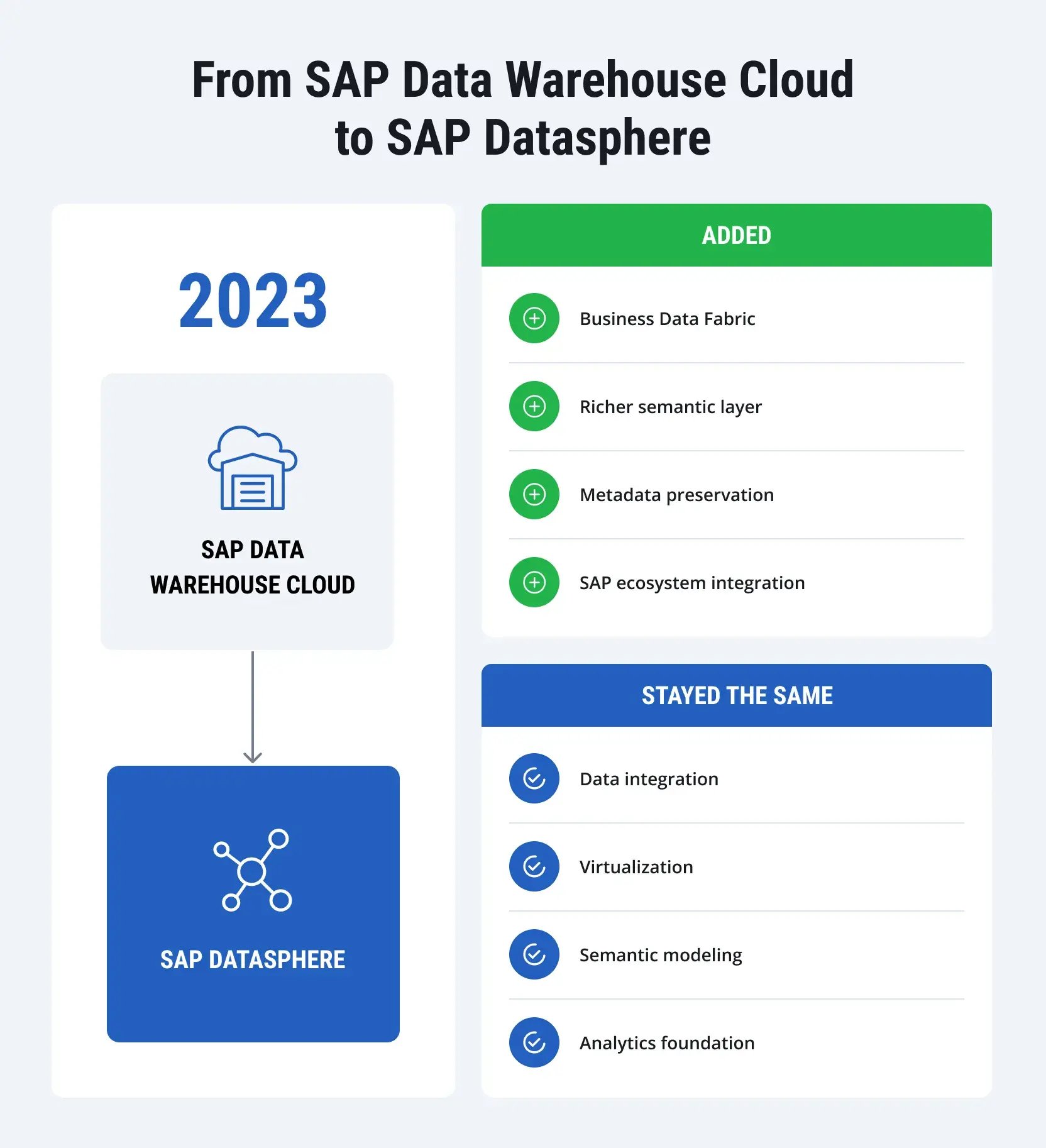
Datasphere isn't a new platform built from scratch. SAP took the existing Data Warehouse Cloud platform and expanded its capabilities to support a broader corporate data strategy, not replace the core product. Data integration, virtualization, semantic modeling, and analytics support remain present and operate largely as before. SAP has added stronger business semantics, deeper metadata storage, and tighter integration with the rest of the SAP ecosystem.
Why existing customers are hesitant
The name change left many practical questions unanswered for those actually using the platform. Is the old name supported anywhere? Do existing implementations need to be migrated? Will models and integrations created years ago still work under the new name?
For most organizations, the answer is: there's no pressure. Existing environments continue to function, and modernization can happen at any time that suits the business, not SAP's marketing calendar. Implementing Datasphere doesn't mean tearing down the existing data infrastructure and starting from scratch.
Why this matters
Resolving these interdependencies changes the teams' approach to planning. Once this question is resolved, a more useful discussion can begin: which new capabilities are truly worth implementing, what will be required to implement them, and whether upgrading now will bring real benefits or simply add work without any obvious return.
The Evolution From SAP Data Warehouse Cloud to SAP Datasphere
The move from SAP Data Warehouse Cloud to SAP Datasphere says more about how enterprise data management has changed than about SAP's product naming conventions. Most organizations today aren't running a single, tidy system. They're managing a mix of cloud applications, on-premises systems they haven't retired, and data scattered across platforms that were never designed to talk to each other. A cloud data warehouse on its own doesn't solve that. What's needed is a way to connect data across all of it without losing the business meaning that made the data useful in the first place.
That's the problem SAP built Datasphere to address. The core platform didn't go away. SAP expanded it to support a data management approach centered on business context rather than raw storage and movement.
Why SAP introduced Datasphere
Today, few enterprises run on a single system. Business data sits in SAP applications, third-party tools, cloud services, and legacy environments. Traditional cloud data warehouses handle storage and integration reasonably well, but a lot of organizations still can't get a consistent, trustworthy view of their data once it's scattered across all of that. SAP built Datasphere to close that gap.
Datasphere was built to close that gap. In practice, it:
- Connects SAP and non-SAP data sources without forcing everything into one physical location
- Expands metadata and semantic capabilities across enterprise data
- Strengthens data governance across connected systems
- Builds a foundation for enterprise-wide AI initiatives
This open ecosystem is really the biggest thing separating Datasphere from the old Data Warehouse Cloud. SAP built direct partnerships around it rather than leaving non-SAP integration to third parties: Databricks for lakehouse analytics and data science use cases, Confluent for real-time data streaming, and Google Cloud for BigQuery, where federated queries can pull data from both platforms without duplicating it. Snowflake connects too, through SAP's Open Connectors hub of pre-built API integrations. Put together, that's meant to function as a genuine multi-cloud data fabric, not a platform that happens to tolerate non-SAP sources on the side.
The rebrand was the first thing people noticed, but it only partly captures what changed. SAP moved the platform's positioning from "cloud data warehouse" toward something closer to an enterprise-wide data management foundation, and backed that shift with stronger metadata, governance, and integration capabilities.
None of this changes what the platform fundamentally does. It changes how much manual rework organizations have to do to keep their data trustworthy as it spreads across more systems.
Core Capabilities That Continue in SAP Datasphere
The name change didn't eliminate any of the functionality that made Data Warehouse Cloud useful. If you've worked with this platform before, much of what Datasphere manages will seem familiar.
|
Capability |
What continues in SAP Datasphere |
|
Data integration |
SAP and third-party data sources are connected via replication, federation, or virtualization. Teams continue to choose the method that best suits their needs, rather than being locked into a single option. |
|
Semantic modeling |
Business models and reusable semantic views still govern how data gets accessed. Reports and analytical models pull from the same business definitions they always did. |
|
Analytics enablement |
SAP Analytics Cloud, SQL-based tools, and self-service reporting all still run on top of it. That part of the stack hasn't moved. |
What SAP Added With Datasphere
Retaining the old capabilities was only half the story. SAP also built new functionality into Datasphere that reflects where the company wants enterprise data management to go, and most of it centers on keeping business context intact rather than just moving data faster.
Business Data Fabric foundations
The biggest addition is support for what SAP calls its Business Data Fabric approach. The distinction from ordinary data consolidation matters here: instead of just pulling data from different systems into one place, Datasphere tries to hold onto the relationships, definitions, and semantics that gave that data meaning in the source system.
In practice, this means:
- Business meaning survives the move between systems instead of getting stripped out along the way.
- Shared semantic definitions cut down on the duplication that happens when every team builds its own version of the same metric.
- Analysts work from data that's already business-ready, rather than rebuilding the same logic project after project.
The benefits aren't so much in new features as in time savings. Teams often spend less time on reporting and more time working with the data.
More reliable storage of metadata
Metadata handling also got a real upgrade. In the old model, replicating or transforming data usually meant losing the business definitions attached to it, which someone then had to recreate by hand. Datasphere lets organizations preserve and reuse metadata from connected SAP applications where applicable, instead of recreating business definitions from scratch each time.
That shows up as inherited business definitions that don't need to be rebuilt, semantic layers that get reused across models rather than duplicated, and fewer transformation steps standing between raw data and a usable report.
The net effect isn't a dramatic new capability so much as less friction. Systems and requirements keep changing, but the data foundation underneath doesn't have to be rebuilt every time they do.
Deeper integration across SAP applications
The third piece is closer integration with SAP's own applications. Datasphere doesn't treat SAP S/4HANA, SAP SuccessFactors, and SAP Ariba as separate data sources to be tapped and flattened into raw tables. It keeps the business meaning attached as information moves across that landscape, so a field from S/4HANA still means what it meant in S/4HANA once it shows up in a Datasphere model.
For analytics teams, this can mean working with recognizable business entities rather than piecing together disparate tables, reducing data preparation effort, and improving confidence in reporting when semantic models and governance are implemented effectively.
How SAP Data Warehouse Cloud Evolved Into SAP Datasphere
By this point, it's clear that SAP Data Warehouse Cloud and SAP Datasphere aren't separate products competing with each other. SAP Datasphere is the next evolution of the same platform. The comparison below isn't intended to help you choose between two alternatives. Instead, it highlights what stayed the same and what SAP expanded when it introduced Datasphere.
|
Category |
SAP Data Warehouse Cloud (before March 2023) |
SAP Datasphere (current platform) |
|
Product status |
Original cloud data warehouse platform |
Current version of the same platform |
|
Core platform |
Cloud-native warehousing, integration, and modeling |
Same platform with expanded data management capabilities |
|
Business semantics |
Semantic modeling for analytics |
Preserves business context across systems |
|
Metadata |
Standard metadata management |
Enhanced metadata reuse |
|
Integration |
Replication, federation, virtualization |
Same integration methods with deeper SAP integration |
|
SAP positioning |
Cloud data warehouse for enterprise analytics |
Foundation for SAP's Business Data Fabric strategy |
|
Best fit |
Organizations starting their cloud data journey |
Organizations building a connected enterprise data landscape |

How SAP Datasphere Fits Into SAP's Modern Data Architecture
Datasphere doesn't sit on its own. It's one piece of SAP's data and analytics stack, and it was built to work alongside other SAP products rather than take their place. Knowing where the boundaries fall between Datasphere and the tools around it matters for anyone actually planning an architecture, not just naming the pieces.
SAP Datasphere and SAP Analytics Cloud
The split here is fairly clean. Datasphere prepares and manages enterprise data, while SAP Analytics Cloud uses that data for dashboards, planning, forecasting, and ad hoc analytics. Together, they cover the full path from data preparation to business insights.
SAC pulls from Datasphere for interactive dashboards and reporting, enterprise planning and forecasting work, and self-service visualization for business users who don't want to wait on IT for every new view. Put together, the two cover the full path from raw, scattered data to a decision someone's actually making on a screen.
SAP Datasphere and SAP Business Data Cloud
SAP Business Data Cloud is SAP's broader platform for managing and sharing enterprise data across analytics, AI, and business applications. SAP Datasphere serves as one of its core data management components, providing the integration and data management capabilities that support the broader platform.
In practice, most organizations run into Datasphere first, usually while modernizing their data or analytics setup. Business Data Cloud tends to enter the conversation later, once a company is thinking past reporting and into SAP's broader push around AI and cross-application data products.
What Existing SAP Data Warehouse Cloud Customers Need to Know
For anyone already running SAP Data Warehouse Cloud, the practical details matter more than the naming history. Here's what actually changes, and what doesn't.
Migration isn't mandatory
SAP hasn't put a deadline on existing SAP Data Warehouse Cloud environments or forced anyone onto Datasphere on a set timeline. Current environments keep running as they are.
Organizations can take their time deciding whether to implement additional Datasphere capabilities, and for most, this decision ultimately becomes part of a broader analytics or data strategy rather than being considered a standalone project. The actual timeline is typically driven by something entirely different: an ongoing SAP S/4HANA transformation, new business analytics requirements, an AI initiative requiring stronger data management and governance capabilities, or a long-term architectural plan already in development before Datasphere arrived.
Existing models mostly carry over
Existing models, data connections, and semantic artifacts don't need a redesign just because the platform's name changed underneath them. That's a direct result of Datasphere sitting on the same platform foundation rather than replacing it.
In practice, organizations can usually reuse the data models and business views they already built, keep integration scenarios running without touching them, add new capabilities on top as they become relevant, and modernize a piece at a time instead of rebuilding the environment from the ground up.
However, every SAP environment is unique. Organizations should analyze custom development, integration, and architecture requirements before planning a major modernization initiative, just as they would with any significant platform upgrade.
Licensing and commercial considerations
Licensing is where things stop being straightforward, since it depends on the specific agreement an organization already has with SAP. Available options can differ based on when the environment was originally deployed and which licensing model it was set up under.
The more useful approach is not to treat the move to Datasphere as a fresh implementation with its own separate licensing conversation. It fits better as part of whatever modernization work is already on the table, whether that's an analytics transformation, a move toward SAP Business Data Cloud, or an S/4HANA program. Organizations should review their existing SAP agreements and consult SAP or an experienced SAP partner to understand the licensing options available and align them with their broader modernization strategy.
Common Misconceptions About SAP Datasphere
Because Datasphere maintains the core architecture of the Data Warehouse Cloud while expanding the capabilities of the SAP Business Data Fabric, organizations often wonder where legacy capabilities end and the new architecture begins. The following questions represent the most important decision points that arise during architecture analysis and modernization planning.
|
Common assumption |
What it actually means |
|
Datasphere replaces my data warehouse. |
The data warehouse capabilities are still there. Datasphere builds on them with stronger semantic modeling, better metadata handling, and broader enterprise data management capabilities. |
|
I have to migrate immediately. |
Existing SAP Data Warehouse Cloud environments continue to run. Moving to Datasphere is typically part of a broader modernization roadmap, not a project that has to happen overnight. |
|
Datasphere only makes sense for SAP systems. |
Although it's tightly integrated with SAP applications, Datasphere also works with non-SAP data sources through replication, federation, and virtualization. Hybrid landscapes are a common deployment scenario. |
|
Everything we've built will have to be replaced. |
Existing data models, integrations, and semantic objects can usually be reused. Most organizations extend what they already have instead of rebuilding their landscape. |
|
Datasphere makes SAP Analytics Cloud unnecessary. |
The two products solve different problems. Datasphere manages and prepares trusted business data, while SAP Analytics Cloud uses that data for reporting, planning, dashboards, and analytics. |
The true challenge lies in determining whether the advanced data fabric, cataloging, and virtualization capabilities introduced in SAP Datasphere align with your immediate data architecture roadmap. Rather than forcing a high-risk system replacement, organizations must evaluate when and where integrating Datasphere’s extended feature set delivers tangible operational value over their existing setup.
How to Choose the Right Data Strategy Going Forward
For most enterprise leaders, evaluating SAP Datasphere isn't a simple side-by-side platform comparison. It's an evaluation of their organization's data architecture and modernization priorities.
When legacy systems meet current operational reporting needs, rushing into an infrastructure overhaul yields minimal immediate return. However, as business strategies increasingly focus on enterprise AI, cross-platform integration, and multi-cloud environments, traditional architectures are reaching their limits. Reaching that inflection point shifts core capabilities — like centralized semantic layers, enterprise-wide cataloging, and automated governance — from forward-looking enhancements to operational necessities.
When your current environment may be enough
Many organizations can continue relying on their existing SAP Data Warehouse Cloud implementation if it already supports day-to-day operations and planned business initiatives.
This is often the case when:
- Reporting requirements are stable and well established.
- Analytics initiatives are limited in scope.
- Existing integrations continue to meet business needs.
- The organization wants to maximize the value of its current SAP Data Warehouse Cloud investment before expanding the platform.
In these situations, maintaining the current environment while monitoring future requirements is often the most practical approach.
When modernization makes sense
As data landscapes become more complex, the requirements placed on a data platform tend to change as well. Modernization becomes easier to justify when the organization is trying to solve problems that go beyond traditional reporting.
Common drivers include:
- Integrating data across SAP and non-SAP systems
- Scaling analytics across multiple business units
- Preparing trusted data for AI and machine learning initiatives
- Establishing consistent business definitions across reports and applications
- Strengthening enterprise-wide data governance and metadata management
In practice, data platform modernization rarely occurs in isolation. It typically goes hand in hand with larger transformation initiatives, such as migration to SAP S/4HANA, cloud adoption, or analytics modernization. This allows for the optimization of new capabilities where they will have the greatest impact, avoiding changes that add complexity without significant benefits.
How LeverX Helps Organizations Modernize Their SAP Data Landscape
No two SAP landscapes look the same. One company might be extending an SAP Data Warehouse Cloud environment that's been running for years. Another is trying to retire an aging SAP BW system, or getting ready for SAP Business Data Cloud, before they've even finished their Datasphere rollout. What makes sense for each of them depends on where their data actually lives today, how the business uses it day to day, and what the architecture needs to support two or three years out.
That's the part LeverX gets involved in. Our consultants start by looking at what's already there, rather than offering a standard migration path. From that assessment, we figure out which modernization steps are actually worth doing and implement SAP data solutions in a way that doesn't interrupt whatever's currently running in production.
Depending on where an organization is starting from, that work can include:
- Implementing and configuring SAP Datasphere
- Assessing the current data architecture and building a modernization roadmap around it
- Modernizing SAP BW landscapes and planning a realistic path to cloud-based platforms
- Connecting SAP Analytics Cloud to governed, trustworthy business data
- Preparing a landscape for SAP Business Data Cloud and SAP's Business Data Fabric direction
- Designing semantic models that keep business definitions consistent across reports and applications
- Setting up governance practices that cut down on duplicate modeling and improve data quality
- Planning migrations that protect what's already been built instead of starting from zero
- Adjusting the data platform as business requirements shift over time
Whether the next step is a full transformation project or just figuring out what SAP Datasphere would actually mean for your environment, LeverX can help build a roadmap that's driven by the business's needs first, with the technology decisions following from that, not the other way around.
Conclusion
Since the 2023 launch, the confusion around SAP Data Warehouse Cloud and Datasphere has as much to do with how SAP kept repositioning the product as with how poorly the changes were explained along the way. The platform itself stuck around. SAP built out its metadata management and semantic capabilities, then put a new name on the result. None of those changes required existing customers to rebuild their environments, but the distinction between the renamed platform and its expanded capabilities was not always communicated clearly.
If you're running SAP Data Warehouse Cloud right now, migration isn't really the question worth asking. What matters is whether SAP Datasphere's expanded capabilities actually address something your organization is dealing with. Some teams will find the answer obvious. Others will decide it makes more sense to fold Datasphere into a bigger project already on the roadmap, an S/4HANA transformation or an analytics overhaul, rather than treat it as its own initiative. Either way, base the call on your business priorities and your architecture, not on lingering confusion over a name SAP changed back in 2023.