Learn how AI, SAP Joule, and the Talent Intelligence Hub transform SAP SuccessFactors into a proactive recruiting platform.
Hiring has changed. It’s no longer just about filtering through piles of resumes or hoping a search brings up the right person. Companies are shifting. They want a skills-first approach where the system actually gets what a candidate is capable of doing. This is the reason SAP SuccessFactors is moving away from being a basic tracking tool and becoming a smart talent hub.
When you add AI into the mix, the system stops being just a database for applications. It starts to recognize potential. It looks at skills rather than just someone’s last job title. This changes the entire workflow. You move away from a slow, manual back-and-forth and into a process that helps you find the right person for the right seat. No more guesswork.
This makes the platform proactive. It doesn't just store resumes; it actively finds matches. Using SAP Joule simplifies complex tasks like drafting job posts or summarizing candidate screenings. Your team spends less time digging through profiles and more time talking to people. It cuts the busywork, lowers your costs, and gets the hiring done faster.

The Core Pillars of AI in SAP SuccessFactors Recruiting
SAP SuccessFactors has moved toward a design built around skills, mostly because of the new Talent Intelligence Hub. This built-in AI significantly enhances workflows and decision support. It moves the focus away from job titles and toward what a person can actually contribute.
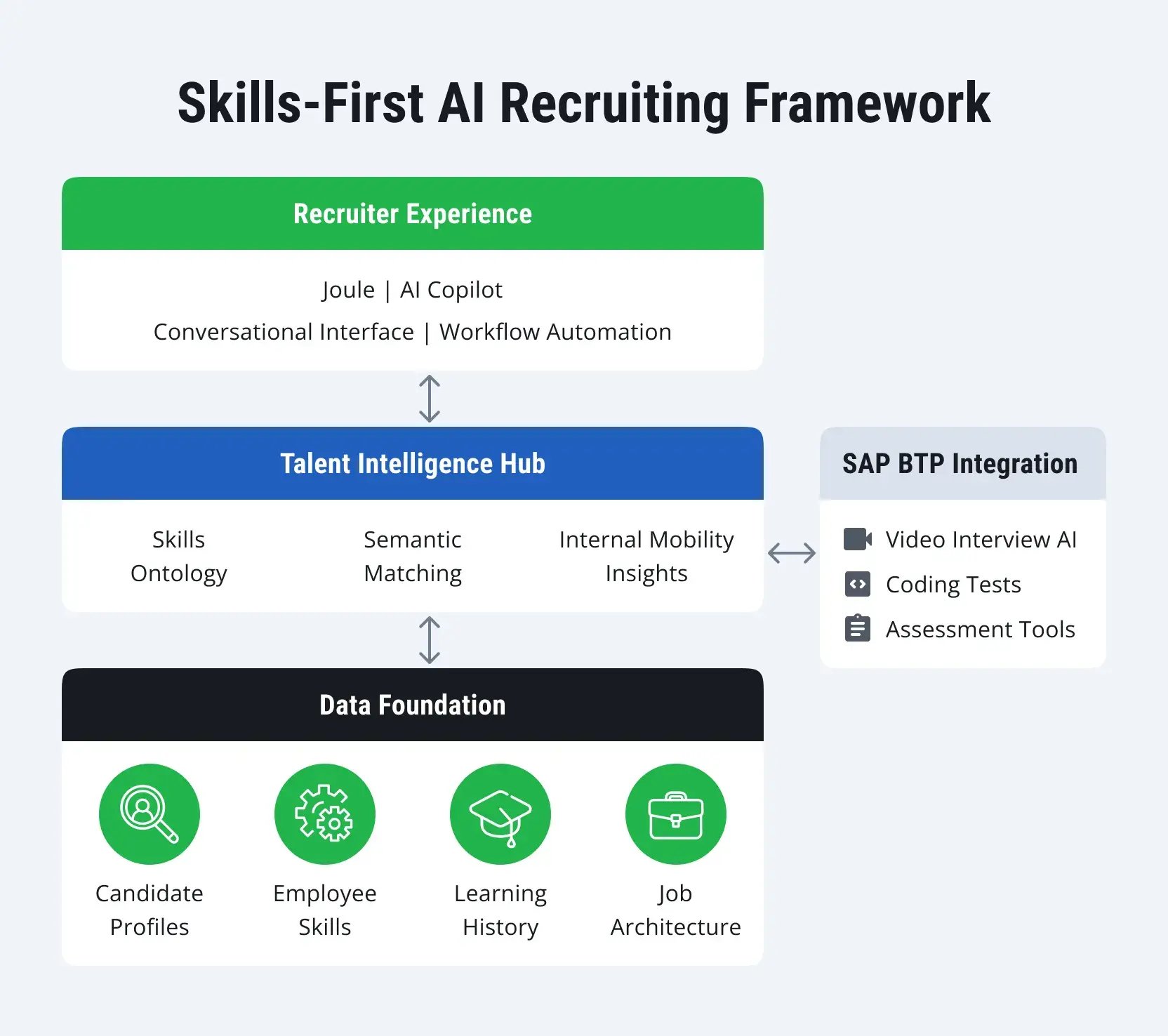
How the framework actually works
Instead of just matching keywords like a basic search engine, the system leverages the SAP Knowledge Graph. This sophisticated neural layer aligns skills, global labor market trends, and internal career paths, which provides a foundation for intent-based matching.
Letting SAP Joule take over the processes
Joule operates as a strategic AI agent for your recruiters. With its deep research capabilities, SAP Joule goes beyond simple tasks like drafting job descriptions or summarizing candidate screenings; it executes more complex workflows, such as cross-referencing external talent pools with internal portfolio databases. Since it lives right inside SAP SuccessFactors, you don’t have to keep jumping between different apps to get the info you need.
Finding the hidden matches
The matching tools look for gaps between what a candidate knows and what a job actually needs. This surfaces people who might be a perfect fit, but didn't use the exact right keywords. It’s also a great way to look back through your old pipelines to find high-potential candidates you might have overlooked the first time.
Cleaning up the administrative mess
The real goal is to fix the manual bottlenecks that usually slow down the hiring process. The system can now handle the logistics — things like scheduling interviews, sending reminders, and keeping everyone in the loop. This turns the recruiting module into a system that actually thinks ahead, so you aren't stuck waiting for a human to manually move the needle.
How AI Actually Helps in SAP SuccessFactors Recruiting
AI in SAP SuccessFactors isn't some magic fix that works overnight. The real impact is actually in the routine, daily stuff that usually drains a recruiter's energy. We are talking about drafting job posts, digging through piles of resumes, and the constant back-and-forth of setting up interviews.
Writing job postings consistently
Building a job description is rarely as simple as making a list of duties. You have to sync with hiring managers, find the right skills, and make sure the language is inclusive. Usually, this takes hours of back-and-forth.
By using Joule inside SAP SuccessFactors, recruiters can get a solid draft ready in just a few minutes. The system looks at your internal skills data and old hiring records to suggest the right competencies. This does more than just save time. It keeps your branding consistent and ensures the requirements actually match what your team needs. It lets recruiters get back to talking to people rather than fighting with a document.
Finding people through skills, not just keywords
Traditional screening relies too much on exact keyword matches. If a candidate uses slightly different wording than the job post, they might never even show up in the results. AI handles this differently. It looks at the link between skills and experience rather than just matching words.
This helps spot people with transferable skills who might have otherwise been missed. It’s also a great way to find those silver medalists from previous rounds — people who were great but didn't get the job at the time. Re-engaging them is a much faster way to fill a role than starting a search from scratch. It turns the Recruiting module into a system that actually understands your talent pool.
Fixing the scheduling mess
Setting up interviews is easily one of the most annoying parts of the job. Getting a busy manager and a candidate on the same page usually involves a dozen emails and a lot of waiting around.
AI-driven workflows take over the logistics by checking availability and proposing time slots automatically. It sends out the invites and even handles rescheduling on the fly. Recruiters still see what’s happening, but they don't have to manage every single calendar invite manually. This makes the whole experience smoother for the candidate and keeps the process moving before a good prospect loses interest.
Traditional vs. AI-enabled recruitment (2026)
|
Feature |
Traditional SAP SuccessFactors |
AI-optimized SAP SuccessFactors |
|
Sourcing |
Manual database search / LinkedIn |
Proactive matching via Talent Intelligence Hub |
|
Screening |
Resume keyword filtering (Boolean) |
Semantic skill analysis and intent mapping |
|
Candidate experience |
Static application forms |
Joule-guided conversational applications |
|
Diversity control |
Manual bias checks |
Automated bias detection in job language |
|
Scheduling |
Back-and-forth emails |
Agentic AI autonomous coordination |
The shift to agentic AI means that virtual agents can manage the entire logistics cycle without recruiter intervention, navigating complex scheduling and multiple time zones — something that is impossible with basic automation.
FAQ
Connecting Outside AI Tools Using SAP BTP
SAP already has a lot of AI built into it, but sometimes you just need something specific — like video interview software, coding tests, or personality assessments. Instead of letting these tools sit off in their own corner, you can use Joule Studio (built on SAP BTP) to orchestrate these tools, ensuring that external data from video interviews or assessments is natively accessible within the Joule conversational interface.
The goal here is to keep your recruiters from having to hop between different tabs and logins all day. When you use SAP BTP, you're basically keeping all that candidate data in one spot. It makes life easier for the hiring team and keeps your security and compliance rules consistent across every tool you’ve got plugged in. It’s a much better way to work than having a fragmented mess of tech that doesn't talk to each other.