

Explore how to prepare your organization for SAP S/4HANA go-live with effective change management, role-based training, user adoption planning, and readiness assessments.
An SAP S/4HANA implementation changes more than the technology employees use. It can affect how purchase orders are approved, financial transactions are posted, inventory is managed, and information moves across departments. Even when the system is technically ready, employees may struggle with unfamiliar workflows, revised responsibilities, or processes that differ from those in the previous ERP environment.
These challenges need attention long before go-live. Organizational change management (OCM) helps companies identify who will be affected, prepare employees for new ways of working, and support business continuity throughout the transition.
Quick answer: Before an SAP S/4HANA go-live, organizations should complete a role-level change impact assessment, establish executive sponsorship and business ownership, develop a stakeholder communication plan, deliver role-based training, prepare a user support network, and define measurable readiness and adoption criteria. These activities should align with the implementation schedule, with clear responsibilities assigned to internal teams and the SAP implementation partner.
What Is Change Management in an SAP S/4HANA Program?
SAP S/4HANA change management is the structured process of preparing employees, managers, and business functions to adopt the processes, responsibilities, and working practices introduced by a new ERP environment.
It addresses the organizational impact of the implementation, from changes in approval authority to the adoption of SAP Fiori applications and redesigned business workflows.
Organizational change management is different from technical change control. Technical change control governs modifications to system configurations, custom developments, and other technical components. OCM focuses on how people understand, prepare for, and adopt the resulting changes.
It is also broader than end-user training. Employees may know how to complete a transaction in SAP S/4HANA without understanding why the process has changed, who now owns an approval, or how exceptions should be handled.
In an SAP S/4HANA program, change management typically covers four connected areas:
- Change strategy and stakeholder engagement: Identify affected groups, secure leadership involvement, and address concerns about the transition.
- Change communication: Explain upcoming process changes, their business rationale, and what different employee groups need to know.
- User enablement: Prepare employees through role-based training, practice, documentation, and local support.
- Change effectiveness: Assess organizational readiness and measure how employees use the new processes after go-live.
SAP Activate includes organizational change management activities within its Solution Adoption workstream. The specific activities and deliverables vary by implementation scenario, but the objective is consistent: prepare business teams to work effectively in the new environment.
Why Does Change Management Matter During an SAP S/4HANA Implementation?
A technically successful implementation does not automatically produce the operational
A technically successful implementation does not automatically deliver the operational improvements outlined in the business case. Those improvements depend, in part, on employees being able to perform their work effectively in the new environment.
Consider a manufacturing company migrating from SAP ECC to SAP S/4HANA. Its procurement team may encounter revised approval workflows, new application interfaces, and different exception-handling procedures. If employees continue relying on outdated instructions or informal workarounds, the company may experience delayed approvals, additional support requests, and inconsistent process execution.
Similar challenges can affect financial close, order fulfillment, warehouse operations, and production planning.
The risks can be especially significant when a transformation introduces process standardization across multiple plants, business units, or countries. Teams accustomed to local procedures may resist standardized workflows. Some concerns may reflect a preference for familiar practices; others may reveal legitimate regulatory, operational, or integration requirements that the target design needs to address.
Change management helps organizations distinguish between these situations before they disrupt operations.
Research also suggests a relationship between effective change management and project outcomes. Prosci's benchmarking research has reported that respondents who rated their change management as excellent were more likely to report meeting or exceeding project objectives than respondents who rated it as poor. These findings span different types of organizational change and should not be interpreted as an SAP-specific success rate or proof of causation.
For SAP S/4HANA programs, the practical takeaway is clear: user readiness deserves the same planning discipline as system testing, data migration, and cutover preparation.
What Should an SAP S/4HANA Change Impact Assessment Cover?
A change impact assessment identifies how the future SAP S/4HANA environment will affect specific business roles, processes, responsibilities, and working practices.
The assessment should begin while target processes are being designed. Waiting until training development starts can leave too little time to address significant organizational changes.
Identify Changes at the Role and Process Level
An assessment organized only by SAP module may overlook changes that affect employees across multiple processes and applications. A single business role may interact with several modules, while two employees using the same module may experience very different changes.
For example, an accounts payable specialist may need to learn a revised invoice-processing workflow, while a finance manager may face new approval responsibilities and reporting procedures. Both work in finance, but they need different communications, training, and readiness checks.
For each affected role, document:
- Current and future workflows.
- Changes in responsibilities and decision-making authority.
- Required skills and application knowledge.
- Dependencies on other teams and business processes.
- Changes to authorizations and segregation of duties, where relevant.
- The level of business risk if the change is not adopted successfully.
This information provides the foundation for estimating the effort needed to prepare each user group.
Classify Impacts by Type and Business Criticality
Change impacts generally fall into four categories.
Process impacts involve how tasks are performed, including new steps, removed activities, revised approval sequences, and updated exception procedures.
Role and responsibility impacts involve who performs, reviews, or approves work. These changes may require updated job descriptions, operating procedures, or authorization assignments.
Technology and interface impacts involve how employees interact with SAP S/4HANA, SAP Fiori, and connected applications.
Organizational impacts involve broader changes, such as centralized services, shared process ownership, or the replacement of local workflows with global standards.
Assess each impact according to its business criticality and the number of affected users. A minor interface adjustment affecting hundreds of employees may require a different preparation approach from a major process change affecting a small team responsible for critical financial controls.
The result should be an actionable impact register linked to the communication, training, testing, and deployment plans.
How Should Organizations Manage Executive Sponsorship and Employee Resistance?
Executive sponsorship gives organizational change management the authority and visibility needed to address decisions that individual project teams cannot make alone.
An effective executive sponsor explains the business rationale for the transformation, supports process owners when established practices are challenged, and helps remove organizational barriers to adoption.
However, one executive cannot manage readiness across an entire enterprise. Business process owners and line managers also need defined responsibilities for communicating changes, allocating time for training, and confirming that employees can perform critical activities.
The implementation partner can facilitate these activities, but accountability for business adoption remains with the organization.
Build Communication Around Specific Changes
Employees need different information at different stages of an SAP S/4HANA implementation.
Early communication should explain why the organization is changing its ERP environment, what business objectives the program supports, and which functions may be affected.
As process designs become clearer, communication should become more specific. A warehouse employee needs to know whether receiving procedures, scanning activities, or inventory adjustments will change. A finance manager needs to understand modifications to controls, approvals, and reporting responsibilities.
Near go-live, communication should prioritize confirmed deployment dates, access requirements, support arrangements, temporary operating procedures, and escalation paths.
Messages should come from credible business leaders as well as the project team. Employees are more likely to understand the practical implications of a change when their own managers can explain what it means for daily operations.
Treat Resistance as Information
Employee resistance can reveal problems that are difficult to identify during system design.
For example, a plant manager may object to replacing a local inventory procedure because it supports a time-sensitive production requirement. The concern may indicate an overlooked business dependency rather than an unwillingness to adopt a standard process.
Change teams should document these concerns, evaluate them with the relevant process owners, and communicate the decisions made. Some issues may justify a design change. Others may be addressed through clearer instructions, additional practice, or an explanation of why the standardized process is necessary.
This approach helps organizations address legitimate operational concerns while maintaining the agreed target processes.
How Do You Build a User Adoption Plan Before Go-Live?
A user adoption plan connects identified changes with the activities employees need to complete before they begin using SAP S/4HANA in production.
The plan should follow the deployment strategy rather than treating the entire workforce as one training population.
For each affected user group, define:
- The processes and responsibilities that will change.
- The knowledge and skills employees need.
- Required communication, training, and practice activities.
- Activity owners and completion deadlines.
- Readiness criteria and remediation steps.
- Post-go-live support arrangements and adoption measures.
This gives each change management activity a clear owner, deadline, and expected outcome.
Align Adoption Activities With Rollout Waves
Organizations deploying SAP S/4HANA across multiple locations may introduce the system in phases. Each rollout wave can involve different processes, languages, regulations, working practices, and employee groups.
Review the change impact assessment for each wave, even when the technical solution follows a common template.
A standardized process may still require different preparation in a distribution center, manufacturing plant, and shared services organization. Global transformation programs must account for local operating requirements without introducing unnecessary deviations from agreed standards.
Establish a Network of Business Super-Users
Super-users are employees who develop deeper knowledge of the new system and help colleagues prepare for the transition.
They can participate in process walkthroughs, provide feedback during testing, identify gaps in learning materials, and offer practical assistance during the initial production period.
Their value comes partly from their business knowledge. An experienced warehouse supervisor, for example, can explain a new goods receipt process in the context of actual warehouse operations.
Super-users need protected time for preparation and support activities. Assigning the role without adjusting their normal workload risks leaving them unavailable when colleagues need help.
The appropriate network size depends on transaction complexity, user distribution, shift coverage, language requirements, and expected support demand. A fixed ratio of super-users to employees should not replace this assessment.
When Should Change Management Activities Take Place in SAP Activate?
Change management should follow the implementation lifecycle rather than begin shortly before deployment. SAP Activate provides a framework for coordinating implementation activities, including organizational change management and solution adoption.
The precise sequence depends on the project approach, but the following activities provide a useful planning framework.
|
SAP Activate phase |
Change management priorities |
|
Discover |
Identify the scope of organizational change, initial stakeholder groups, and resources needed to support adoption. |
|
Prepare |
Establish the change strategy, governance, communication approach, and initial impact assessment. |
|
Explore |
Assess impacts as business requirements and target processes are defined; engage process owners and validate stakeholder needs. |
|
Realize |
Develop role-based training, prepare super-users, refine communications, and align adoption activities with the configured solution. |
|
Deploy |
Complete user preparation, confirm readiness, communicate go-live procedures, and finalize support arrangements. |
|
Run |
Monitor adoption, address remaining capability gaps, and transition to ongoing support and continuous improvement. |
The key is to align user preparation with system delivery. Training materials, for example, should reflect sufficiently stable workflows, while readiness assessments should take place early enough to allow remediation.
Change management should not be treated as a separate workstream that begins after the solution has been designed. Business feedback can identify issues that need to be addressed in process design, configuration, or deployment planning.

SAP S/4HANA Change Management Timeline: What to Plan and When
Change management should be planned alongside the implementation schedule, with activities starting early enough to influence process design and give employees time to prepare. The timeline below is an illustrative planning model, not a standard SAP Activate duration.
| Timing relative to go-live | Key activities | Expected deliverables |
| 6–9 months before go-live | Identify stakeholders, assess organizational impacts, establish sponsorship, and define change governance | Change strategy, stakeholder map, initial impact register |
| 3–6 months before go-live | Validate role-level impacts, develop communications, define learning paths, and prepare super-users | Communication plan, training strategy, super-user network |
| 1–3 months before go-live | Deliver role-based training, conduct practical exercises, and assess readiness | Training results, readiness dashboard, remediation plan |
| Final 2–4 weeks | Confirm critical-role proficiency, communicate cutover procedures, and verify support coverage | Readiness evidence, escalation paths, go-live support plan |
| First 2–6 weeks after go-live | Monitor user issues, process performance, and adoption; provide targeted support | Hypercare reports, issue trends, prioritized improvement actions |
The actual schedule depends on implementation complexity, rollout strategy, workforce size, process changes, and the availability of business representatives. Large global programs may need longer preparation periods, particularly when deployment spans multiple countries, languages, or rollout waves.
The important planning principle is to begin impact assessment early, develop training around sufficiently stable processes, and leave enough time to address readiness gaps before deployment.
What Makes an SAP S/4HANA End-User Training Strategy Effective?
Effective SAP S/4HANA training prepares employees to perform their assigned business processes, including routine transactions and relevant exceptions.
A general introduction to system navigation can be useful, but it cannot replace instruction based on the organization's configured workflows.
Design Learning Paths Around Business Tasks
Training requirements should reflect what employees actually do.
An accounts payable specialist may need to process invoices, investigate blocked documents, and follow revised approval procedures. A warehouse operator may need to perform goods movements using the applications, devices, and scanning processes available at the site.
These groups need different exercises, even if both are part of the same implementation.
Learning paths can combine instructor-led sessions, guided system practice, short reference materials, and self-paced content. The combination should reflect the complexity and frequency of the tasks involved.
Employees who perform infrequent but business-critical activities may need additional reference materials because they have fewer opportunities to practice.
Schedule Training Around System Readiness and Cutover
Training delivered too early may become outdated as configuration changes. Training delivered immediately before go-live leaves little time to address knowledge gaps.
A practical approach is to introduce general concepts earlier, then deliver task-specific practice once the relevant workflows are sufficiently stable.
The training schedule should also allow time for employees who miss sessions, struggle with critical procedures, or need additional practice.
User acceptance testing (UAT) can support this process by exposing selected business representatives to realistic scenarios. However, UAT and training have different objectives. UAT evaluates whether the solution supports agreed business requirements; training prepares the broader workforce to use it. Participation in one does not automatically replace the other.
Verify Whether Employees Can Perform Critical Tasks
Training effectiveness should be assessed through practical exercises, not attendance records alone.
Employees in critical roles should demonstrate that they can complete representative business transactions, including relevant exceptions, in an appropriate practice environment.
Assessment results help identify employees who need additional instruction, practice, or guidance. Unresolved capability gaps should be documented and included in the organizational readiness review.
How Do You Assess Organizational Readiness Before SAP S/4HANA Go-Live?
Organizational readiness determines whether employees and business functions are prepared to operate under the new processes when SAP S/4HANA enters production.
This assessment complements technical go-live readiness. A system may pass integration tests and data reconciliation while a critical business team remains unable to perform its required activities.
A useful organizational readiness review examines five areas.
|
Readiness area |
Evidence to review |
|
Business ownership |
Named process owners, confirmed responsibilities, and operational sign-offs |
|
Process preparedness |
Approved procedures, resolved critical role impacts, and documented exception handling |
|
User capability |
Training completion, practical assessments, and remediation of critical gaps |
|
Operational communication |
Confirmed go-live instructions, business contacts, and escalation paths |
|
Support preparedness |
Super-user availability, service desk procedures, and hypercare coverage |
Readiness gaps should be assessed according to their impact on critical business operations, the availability of temporary workarounds, and the organization's ability to resolve them.
Each issue needs a documented owner, a target resolution date, and an agreed response before the final go/no-go decision.
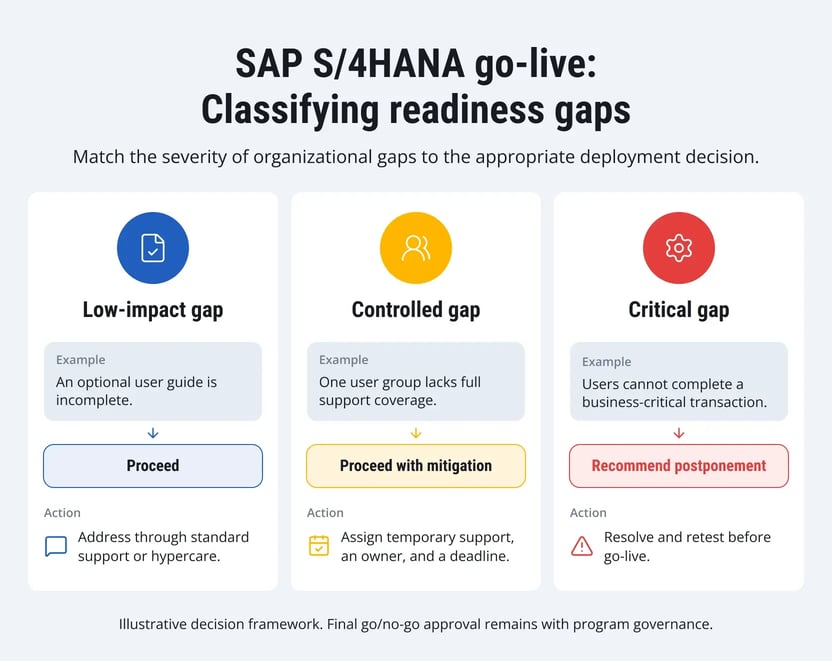
Organizational readiness should inform the overall deployment recommendation. The final decision belongs to the designated business governance body and must consider technical, operational, compliance, and business continuity risks together.
Readiness reviews should align with the implementation schedule and relevant project milestones rather than follow a fixed meeting cadence. This helps business leaders address adoption risks while there is still time to influence deployment decisions.

Which KPIs Measure SAP S/4HANA Adoption After Go-Live?
Adoption measurement shows whether employees are using the new processes effectively and where additional intervention may be needed.
Organizations should distinguish three dimensions:
- System and process adoption: Are employees using the intended solution and workflows?
- User proficiency: Can employees complete their work correctly?
- Business outcomes: Are operational results moving toward the objectives defined in the transformation business case?
Useful measures include:
Process utilization: Whether relevant users perform designated activities through the intended SAP S/4HANA workflows rather than relying on unauthorized workarounds.
Task completion and error rates: The percentage of selected transactions completed correctly, including rework and failed attempts where these can be measured reliably.
Process cycle time: The time required to complete activities such as invoice approval or goods receipt, compared with an appropriate baseline.
Support demand: The volume, type, severity, and resolution time of user issues.
User proficiency: Results from practical assessments and follow-up evaluations for critical roles.
Adoption indicators should not be treated as a substitute for business outcomes. Employees may use the new system consistently while process cycle times, error rates, or operating costs remain unchanged.
Review adoption metrics alongside the business KPIs defined in the transformation case. This helps determine whether further improvements are needed in user capabilities, process design, or the solution itself.
Measures should reflect the processes affected by the implementation. A finance transformation may prioritize invoice-processing accuracy and financial close activities, while a warehouse deployment may prioritize goods-movement accuracy and operational throughput.
Where comparable baseline data is available, collect it before go-live. When workflows change substantially, establish how old and new measures will be compared rather than assuming they represent identical activities.
Use Hypercare to Turn Measurement Into Action
Hypercare is the period of enhanced support immediately following production deployment. It brings business representatives, functional consultants, technical specialists, and support teams together to address early operational issues.
Support requests should be classified by their underlying cause. A user who cannot find the correct application may need additional guidance. A transaction that repeatedly fails because of authorization settings requires a different response.
Not every reported problem is a training issue. Some may arise from master data, configuration, integrations, process design, or unclear responsibilities.
Organizations should review adoption and operational indicators during hypercare and adjust support accordingly.
The transition to normal support should depend on agreed exit criteria, such as the resolution of critical incidents, stable execution of priority processes, documented ownership of remaining issues, and adequate support-team readiness.
What Should an SAP Implementation Partner Contribute to Change Management?
An SAP implementation partner can provide the methodology, expertise, and resources needed to organize change management throughout the project. Depending on the engagement scope, activities may include change impact assessments, training development and delivery, super-user enablement, and adoption measurement.
Before signing the statement of work, organizations should agree on who will develop communications, prepare training materials, deliver training, coordinate super-users, and provide post-go-live support.
Responsibilities should be clearly assigned, particularly when several business functions, local project teams, or external providers are involved.
Deliverables should have defined acceptance criteria and deadlines. For example, a commitment to provide user training is less useful than an agreed curriculum, defined user groups, specified delivery responsibilities, and a documented process for addressing readiness gaps.
Prospective partners should also be able to explain how their change management activities connect to process design, testing, deployment, and ongoing support.
For SAP S/4HANA Cloud programs delivered through RISE with SAP, the division of responsibilities should account for the relevant subscription, service, and support arrangements. Organizations should clarify which change management and user enablement activities remain with internal teams, which are assigned to the implementation partner, and how these arrangements fit into post-go-live support.
Questions to Ask Before Signing With an SAP Implementation Partner
Before selecting a partner, ask:
- How will you assess the impact of the new system on business roles and processes?
- Which change management deliverables are included in the proposed scope?
- Who is responsible for communications, training, and super-user preparation?
- How will training reflect the configured solution and actual business workflows?
- How will organizational readiness be measured and reported?
- How will critical readiness gaps be escalated before go-live?
- What support will be available during hypercare?
- How will responsibilities transfer from the implementation team to ongoing support?
Clear answers help establish realistic expectations and reduce the risk of leaving important adoption activities unassigned.
How LeverX Supports SAP S/4HANA Change Management
LeverX combines SAP implementation expertise with practical experience supporting the organizational side of ERP transformations.
Our work with Eurasia Group illustrates how collaboration between implementation teams and business stakeholders can support a structured transition to SAP S/4HANA.
Case Study: Supporting Organizational Change During SAP S/4HANA Migration
LeverX supported Eurasia Group migration from SAP ECC to SAP S/4HANA, working alongside 25 client specialists to complete the project in 8.5 months.
The teams used SAP Activate to structure the implementation, with the client actively involved in requirements alignment, testing, organizational change management, and end-user preparation.
Key activities included stakeholder communication planning, key-user training, and the development of user manuals and training materials.
The broader migration delivered reported improvements, including a 15% increase in data consistency and a 10% reduction in system maintenance costs. These results reflect the overall SAP S/4HANA transformation and should not be attributed to change management activities alone.
The project demonstrates the importance of involving business stakeholders in the transition, preparing users for new processes, and coordinating organizational activities with technical delivery.

Conclusion
SAP S/4HANA go-live readiness depends on more than a technically stable system. Employees must also be prepared to execute the processes the business relies on.
Identifying changes early, involving process owners, providing practical training, and measuring adoption give organizations a stronger basis for deployment decisions.
Start with a role-level change impact assessment. Use its findings to define communications, training, readiness checks, and support arrangements, with clear ownership for every activity.
When change management is integrated into the implementation lifecycle, organizations are better positioned to identify adoption risks early, address capability gaps, and support a more controlled transition to SAP S/4HANA.
Frequently Asked Questions
How does change management differ between an SAP S/4HANA new implementation and a system conversion?
A new implementation often introduces redesigned workflows, new responsibilities, and broader process standardization, requiring extensive communication and user preparation.
A system conversion may preserve more existing processes, but changes to applications, authorizations, custom transactions, and business procedures can still affect employees.
In both scenarios, the scope of change management should reflect the actual impact on business roles rather than the technical migration approach alone.
How do you assess an SAP implementation partner's methodology before signing?
Review the partner's proposed scope, implementation approach, governance model, deliverables, and responsibilities. Ask how change impact assessments, training, communications, readiness reviews, and post-go-live support will be coordinated with technical delivery.
Also confirm how progress will be measured, how critical issues will be escalated, and which activities remain the responsibility of your internal teams.
What should organizations do if critical users are not ready for SAP S/4HANA go-live?
First, identify the cause and business impact of the readiness gap. The issue may require additional training, practical exercises, clearer procedures, revised access, or a change to the solution or process design.
Assign an owner and remediation deadline to each critical gap, then reassess readiness before the go/no-go decision. The designated governance body should consider unresolved gaps alongside technical, operational, compliance, and business continuity risks.
Who owns quality assurance when an SAP program uses SAP Activate?
Quality assurance responsibilities should be explicitly defined in the program governance model. The implementation partner may lead or support testing and quality activities, but the organization remains responsible for business acceptance and operational readiness.
Process owners, business stakeholders, and designated governance bodies should participate in reviewing results and determining whether the solution is ready for deployment.
How can organizations measure whether change management is working?
Use a combination of readiness indicators, training assessments, process adoption measures, support trends, and business performance metrics.
Training attendance alone does not demonstrate proficiency, and system usage alone does not prove that the transformation is delivering its intended benefits. Compare multiple indicators against appropriate baselines and use the findings to guide further support and improvement.
Disclaimer: This article is for informational purposes only and does not constitute legal, tax, or professional advice. Change management requirements and best practices for SAP S/4HANA programs may vary depending on an organization’s business processes, implementation scope, deployment model, and specific needs. Organizations should consult their SAP implementation partner and relevant SAP documentation to determine the approach best suited to their circumstances.