SAP EWM Basic or Advanced? Our article explains the key differences and helps you choose the right setup for your warehouse operations.
For U.S. companies managing manufacturing warehouses, distribution centers, and fulfillment operations, warehouse management is directly connected to inventory accuracy, order fulfillment, and supply chain performance.
SAP Extended Warehouse Management (SAP EWM) connects warehouse activities with core business processes and supports inventory visibility, task execution, and control over material movements.
But SAP EWM offers two functional scopes for embedded deployment: Basic Warehouse Management and Advanced Warehouse Management. Which one makes sense for your operations? Will Basic cover your requirements without unnecessary licensing and implementation costs? Or will its functional limitations prevent you from introducing essential automation and optimization capabilities?
The answer depends on more than warehouse size. Process complexity, automation requirements, integration architecture, and future growth all influence the right choice.
This guide explains the actual differences between SAP EWM Basic and Advanced, what each option supports, where additional functionality matters, and when investing in Advanced is justified.
Before You Compare: What SAP EWM Really Is
SAP Extended Warehouse Management (EWM) is a system designed to manage complex warehouse operations directly within the SAP environment. It enables businesses to control, monitor, and optimize all key warehouse activities, from goods receipt to goods issue, with real-time integration into core logistics and supply chain processes.
SAP introduced EWM as an alternative for warehouses that required more advanced functionality than traditional SAP Warehouse Management (SAP WM) could provide.
While SAP WM covered standard warehouse tasks, EWM introduced broader capabilities for complex material flows, warehouse resource management, automation, and cross-system coordination.
EWM is now a strategic warehouse management option within the SAP S/4HANA landscape. However, the transition from SAP WM requires understanding the distinction between classic LE-WM compatibility, SAP Stock Room Management, and SAP EWM.
Classic SAP WM in SAP S/4HANA was available under compatibility-scope usage rights through December 31, 2025. SAP Stock Room Management provides an alternative for selected legacy warehouse processes beyond that date, but does not include every classic WM extension.
For SAP Business Suite 7 core applications, mainstream maintenance ends on December 31, 2027, with optional extended maintenance available through December 31, 2030 under specific conditions.
A migration to EWM is not automatically required for every business using SAP S/4HANA. Stock Room Management may remain sufficient for simpler warehouse scenarios. Companies should assess its functional scope against their actual requirements before choosing a replacement.
How EWM Impacts Warehouse Operations
Now, let’s look at how SAP EWM improves the way businesses work.
Faster, more accurate order fulfillment
SAP EWM supports end-to-end control over picking, packing, staging, and shipping processes. It helps reduce errors by guiding users through tasks and enabling real-time updates across the system. This accuracy translates into fewer delivery issues and fewer returns due to fulfillment mistakes.
In one of our SAP EWM implementation projects for a pharmaceutical company, we saw a 35% increase in warehouse staff productivity, largely due to better task prioritization and reduced manual coordination, facilitated by EWM's wave management and route optimization.
Better inventory visibility and control
With SAP EWM, inventory information is maintained at storage-bin level, allowing warehouse managers to track stock quantities, locations, and material movements.
The system supports inventory counting, replenishment, putaway, and stock removal strategies, helping reduce discrepancies and improve warehouse space utilization.
For U.S. distribution centers managing high SKU volumes, multiple fulfillment channels, and inventory across several facilities, consistent stock visibility can also improve order allocation and replenishment decisions.
More efficient operations through automation
SAP EWM can support warehouse automation at different levels, from mobile radio frequency (RF) devices to integration with conveyors, automated storage and retrieval systems (ASRS), and other material-handling equipment.
Its Material Flow System (MFS) can coordinate supported automated warehouse processes by communicating with programmable logic controllers (PLCs).
Advanced warehouse functionality also supports more sophisticated task orchestration, including wave management, labor management, slotting, and advanced material flow control.
Data-driven decision-making
SAP EWM provides warehouse monitoring and reporting capabilities that help managers track operational KPIs, workload, inventory movements, and process statuses.
Deeper analytical requirements can be addressed through additional SAP analytics capabilities and integration with SAP Analytics Cloud or other reporting platforms.
This helps organizations identify warehouse bottlenecks, underutilized resources, delayed orders, and slow-moving inventory.
Connected, transparent warehouse processes
SAP EWM is not a standalone operational silo. It can integrate with production, procurement, transportation, and sales processes.
This integration reduces duplicate data entry and helps warehouse activities support upstream and downstream business operations.
For U.S. companies operating manufacturing plants, retail distribution centers, and third-party logistics (3PL) networks, this connectivity can support more consistent inventory and fulfillment processes.
In regulated industries, such as pharmaceuticals and medical devices, warehouse traceability and documentation may also support applicable FDA requirements. However, implementing EWM does not automatically establish regulatory compliance; the relevant processes and controls must be configured and validated for the organization's requirements.
SAP EWM Basic or Advanced - Which One Fits Your Warehouse?
Now let’s go through the SAP EWM versions and how they differ in deployment, scope, and cost.
Overview
SAP EWM comes in two main versions: Basic and Advanced. Both support core warehouse processes, but they differ in terms of available features, deployment flexibility, and licensing requirements.
- Basic Warehouse Management provides core warehouse functionality for inventory management, inbound and outbound processing, internal goods movements, physical inventory, and reporting.
- Advanced Warehouse Management adds the extended functionality required for more complex warehouse processes, including wave management, yard management, labor management, value-added services, cross-docking, and advanced automation.
These are not two completely separate warehouse management products. In supported SAP S/4HANA deployments, organizations can define individual warehouses as Basic or Advanced. This means that one SAP S/4HANA environment can support different functional scopes across its warehouse network.
The availability and licensing depend on the SAP S/4HANA edition and deployment model.
Deployment models
Basic (embedded) EWM
Basic EWM runs embedded inside the SAP S/4HANA system. It shares the same technical stack and database as the ERP system, which simplifies data access and reduces integration overhead. This model suits businesses that are:
- Migrating from SAP WM
- Running on a single ERP system
- Looking for a unified system landscape without complex interfacing.
Because it's embedded, there's no need for additional hardware or system replication. However, scalability and isolation are limited compared to a decentralized setup.
Basic Warehouse Management is often a practical option for organizations with relatively straightforward warehouse processes, even when the physical facility itself is large. The deciding factor is functional complexity, not just square footage or inventory volume.
Advanced (embedded) EWM
Advanced Warehouse Management can also run embedded within SAP S/4HANA.
It uses the same general architecture as Basic but provides the extended warehouse functionality required for more complex operations.
This model is suitable when businesses need capabilities such as:
- Wave management and advanced picking strategies.
- Labor management and resource optimization.
- Slotting and warehouse space optimization.
- Value-added services and kitting.
- Cross-docking and advanced internal material flows.
- Material Flow System integration for supported warehouse automation scenarios.
Companies do not necessarily need decentralized EWM to access Advanced functionality. Advanced Warehouse Management can also be implemented within the existing SAP S/4HANA environment.
Advanced (decentralized) EWM
Advanced EWM can be embedded in the SAP S/4HANA system or deployed in a decentralized setup, separate from the core ERP system. It connects to S/4HANA or other ERP systems (including non-SAP systems like Oracle or Microsoft Dynamics) via standard integration interfaces.
Decentralized EWM is a better fit when:
- Multiple ERP systems are involved
- Warehouse operations need to run independently of ERP downtime or load
- Complex logistics networks require flexible system scaling.
This setup adds complexity and requires additional infrastructure, but it allows more control and independence for warehouse operations.
A separate EWM system can help maintain local warehouse processing during certain ERP interruptions, provided the required data, interfaces, and recovery procedures are designed accordingly. It does not eliminate all connectivity dependencies or guarantee uninterrupted execution during every outage.
Important: Decentralized EWM always uses the full Advanced Warehouse Management functionality. It is not a separate third licensing tier.
What About SAP S/4HANA Cloud Public Edition?
SAP S/4HANA Cloud Public Edition uses an embedded warehouse management solution based on SAP EWM with a basic functional scope. It does not provide a decentralized EWM deployment option.
Businesses considering Public Edition should therefore check whether the available warehouse functionality covers their operational requirements before choosing this deployment model.
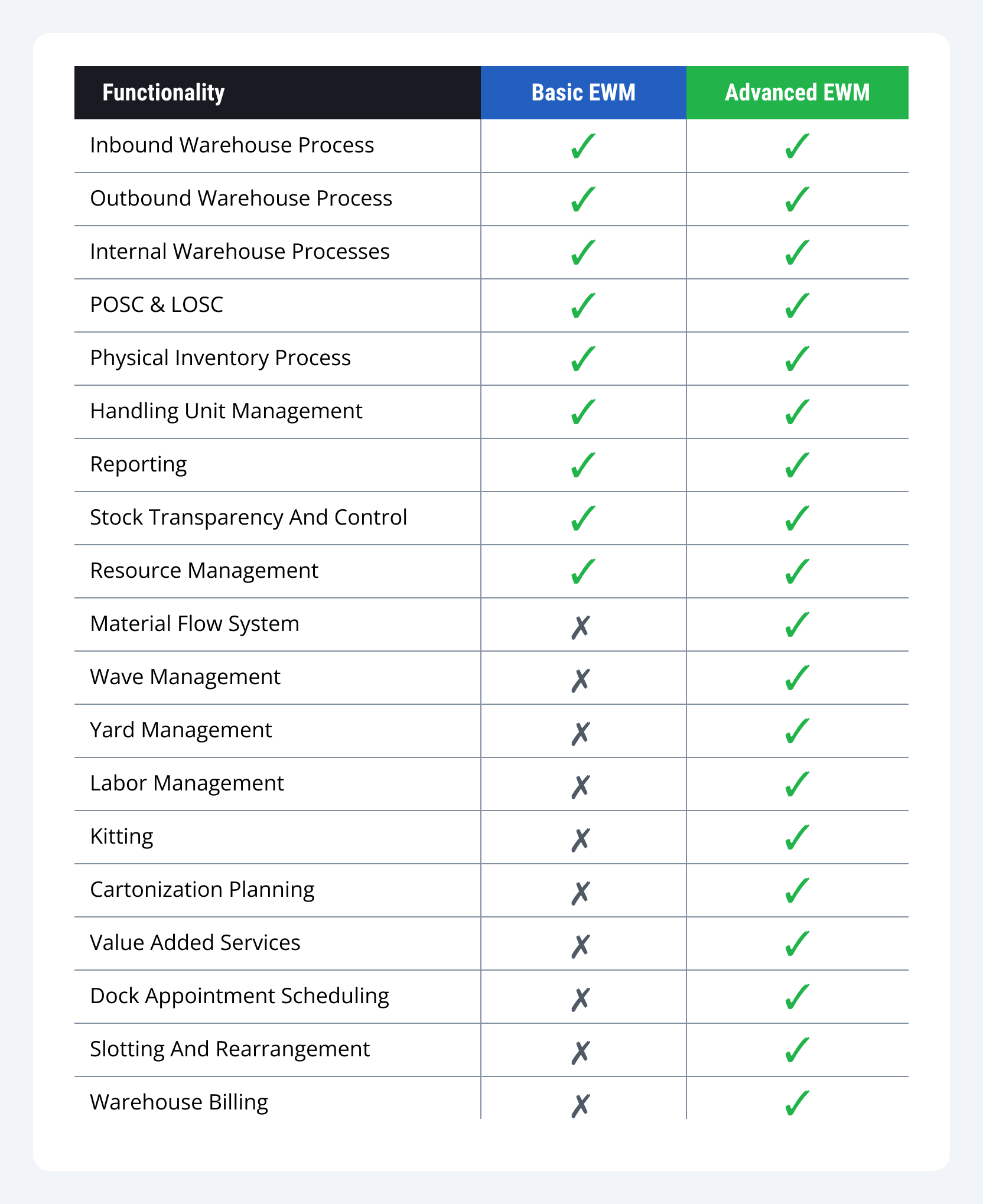
Functionality: What does Basic include, and what does Advanced add?
The main difference between Basic and Advanced EWM lies in the scope of available features. Both versions support end-to-end warehouse processes, but only Advanced provides extended functions needed for complex or highly automated operations.
Let’s look at the features both options offer:
Use cases
Below are the typical scenarios where each version serves as a better fit, based on scale, process complexity, automation level, and ERP landscape.
When Basic EWM is enough
Basic EWM supports the core warehouse functions needed for straightforward operations. It suits companies with stable logistics patterns, limited need for real-time optimization, and minimal automation.
This version is often the right choice when:
- Warehouse operations are mid-sized and predictable, with no need for dynamic task orchestration.
- Processes are primarily manual, and the warehouse does not rely on conveyors, ASRS, or robots.
- The company runs exclusively on SAP S/4HANA, with no plans to connect external systems.
- Functionality similar to legacy SAP WM is sufficient, and the goal is to maintain continuity while migrating to S/4HANA.
When Advanced EWM is the right fit
Advanced EWM unlocks functions designed for warehouses with high throughput, complex layouts, and automation-heavy environments (typically found in large enterprises or fast-scaling mid-sized companies). It supports coordination across decentralized systems, advanced planning, and high levels of customization.
Advanced EWM is the better option when:
- Warehouse scale and throughput require more structured workload management, such as wave planning or slotting strategies.
- Automation plays a key role in operations, including MFS integration, conveyor systems, or robotic workflows.
- Labor resources must be tracked, analyzed, and balanced, requiring labor management functionality.
- The business operates in a hybrid ERP environment, or logistics systems must stay operational even when ERP is down.
- Industry-specific processes like kitting, VAS, or just-in-time production delivery are in place, and cannot be supported by Basic features.
In practice, the choice depends on whether the warehouse needs more than just process execution. If the goal is task automation, workload optimization, or deep system integration, Advanced EWM provides the required flexibility.
But for standard warehouse processes with limited complexity, Basic EWM offers a simpler, lower-cost option without unnecessary overhead.
Licensing and cost
Basic EWM is included with your SAP S/4HANA license, meaning there are no additional EWM-specific fees. This makes it a cost-effective choice for fundamental warehouse needs. However, it comes with limited functionality and no support for advanced automation or optimization tools.
Advanced EWM requires a separate license. Pricing depends on system size, warehouse volume, and number of users or managed stock units. While it often refers to traditional Engine Metric models (like counting warehouse tasks or stock units), SAP increasingly offers negotiated licensing, especially for cloud, RISE, or large deployments. Licenses may be based on usage, user count, or system scale, depending on contract terms.
The decision should weigh not only license cost, but also the cost of inefficiencies. For example, in high-volume environments, missing functionality like wave management or yard control can lead to increased labor hours, shipping delays, and reduced throughput, all of which carry costs far beyond the license itself.
Full comparison of SAP EWM Basic and Advanced
| EWM Basic | EWM Advanced | |
| Deployment | Embedded only (within SAP S/4HANA) | Embedded or standalone (decentralized) |
| ERP compatibility | SAP S/4HANA only | SAP and non-SAP ERPs (e.g., Oracle, Dynamics) |
| Core functionality | Inbound/outbound, inventory, physical inventory, production, quality, Basic MFS (via IDoc only) | All Basic features, plus wave management, yard management, VAS, labor mgmt., slotting, kitting, JIT, warehouse billing, advanced MFS, etc. |
| Automation support | Limited (basic MFS via IDoc only) | Full support for automated systems (MFS, ASRS, robotics) |
| Best fit for | Standard warehouse processes, mid-size operations, SAP WM replacement | High-volume, complex, automated, or multi-system warehouses |
| License type | Included with SAP S/4HANA | Separate license required |
How to Get Started With SAP EWM
By now, you’ve seen how SAP EWM Basic and Advanced differ in features and deployment options. But there’s another factor that often shapes the decision: whether to run EWM in a decentralized setup.
What about the decentralized setup?
While most businesses focus on features, the system architecture also matters. That’s where the decentralized deployment model comes in.
Here’s the key point: decentralized SAP EWM is not a third license level. It’s a deployment option and it always uses the Advanced license.
In contrast to the embedded model, where EWM runs inside the SAP S/4HANA system, decentralized EWM runs as a separate instance. It can still connect to SAP S/4HANA or even older SAP ERP systems — and in some cases, non-SAP ERPs.
So why choose decentralized deployment?
Performance isolation and system stability: Running warehouse operations in a standalone system helps avoid performance bottlenecks in the core ERP, especially in high-transaction environments. ERP updates or slowdowns don’t affect warehouse execution and vice versa.
Multi-ERP and multi-warehouse integration: Decentralized EWM can serve multiple ERP systems at once, which is useful for companies managing logistics across different divisions, subsidiaries, or platforms. It centralizes warehousing without restructuring the entire ERP landscape.
Flexibility in upgrades and rollouts: With decentralized deployment, EWM can be upgraded, scaled, or customized independently of the ERP core. This reduces testing overhead and enables phased rollouts of new features in warehouse operations without interfering with other business processes.
So, how do you know which path to choose?
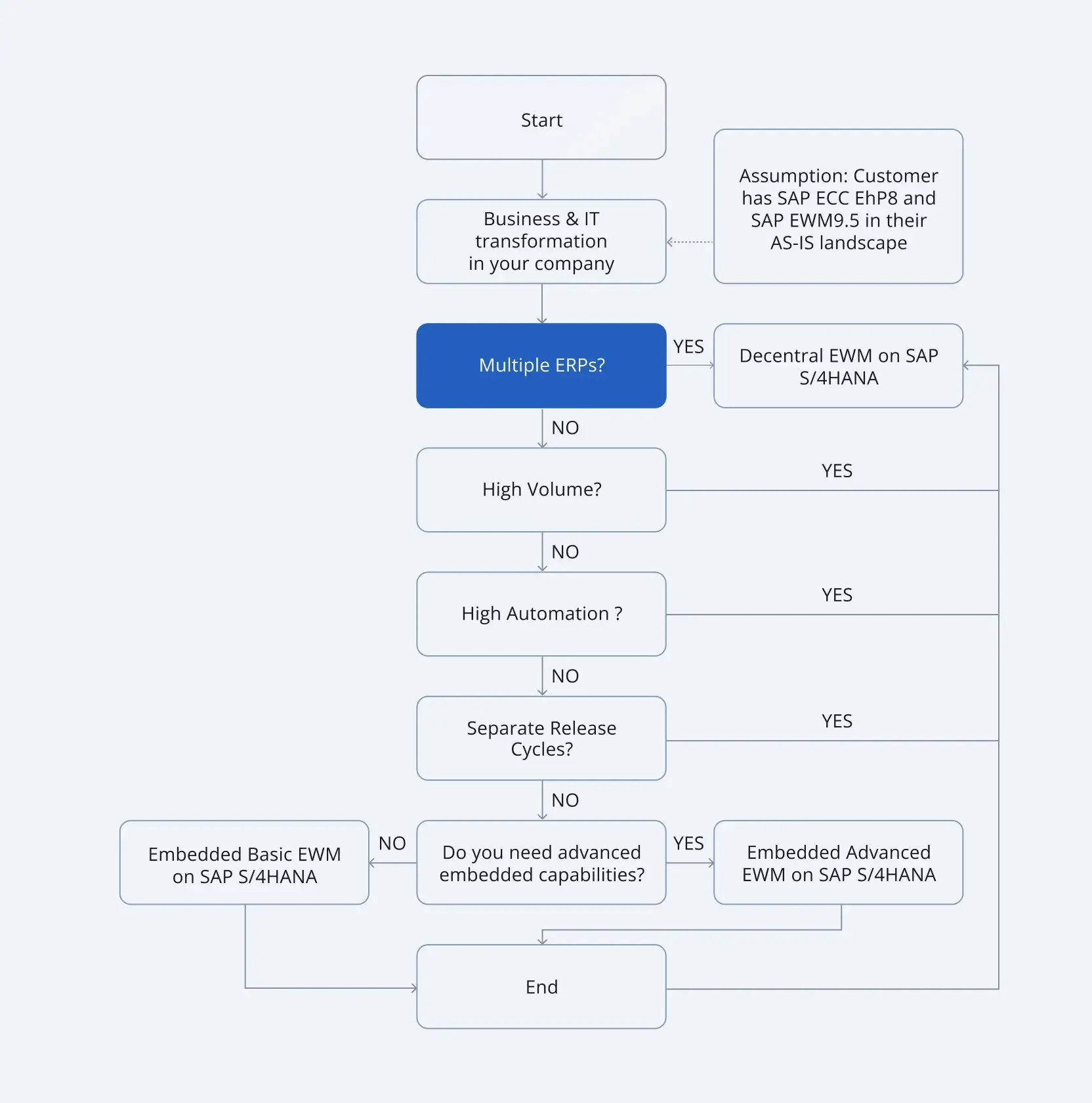
If your business already runs SAP S/4HANA and your warehousing needs are moderate, embedded EWM with a Basic license might be sufficient — simple setup, low integration effort, and aligned with your ERP.
But if your operations involve high volume, automation, or multi-site logistics, Advanced EWM is likely a better match. And if performance isolation or phased ERP migration is a concern, a decentralized setup, whether on SAP S/4HANA or SAP ERP (ECC), provides the technical flexibility to adapt.
Use the decision tree below to match your scenario against real deployment paths.
Full Comparison of SAP Warehouse Management Options
It is also important not to confuse SAP EWM Basic and Advanced with the separate warehouse management options available in SAP S/4HANA.
| SAP option | Typical use | Main consideration |
| Inventory Management (MM-IM) | Basic stock quantity and value management at storage-location level | Does not provide detailed EWM warehouse execution |
| Stock Room Management | Selected legacy warehouse processes in SAP S/4HANA | Limited functionality compared with EWM |
| Basic Warehouse Management | Core embedded warehouse execution | Suitable for straightforward warehouse processes |
| Advanced Warehouse Management | Complex and automated warehouse execution | Supports extended EWM capabilities |
| Decentralized Advanced EWM | Separate warehouse execution environment | Requires additional integration and Advanced EWM entitlement |
For organizations moving from SAP WM, the assessment should distinguish between retaining Stock Room Management for supported processes and transitioning to EWM for a broader warehouse management scope.
How LeverX Can Help You Choose and Implement SAP EWM
Selecting between Basic and Advanced is only one part of a successful warehouse transformation.
LeverX helps organizations assess existing warehouse processes, choose the appropriate EWM functional scope, design deployment architecture, and implement the solution in line with operational requirements.
Our SAP EWM implementation services for U.S. companies cover warehouse assessment, solution design, configuration, ERP integration, automation, testing, and go-live support.
We can support your team with:
- Warehouse assessment: Review warehouse layouts, stock flows, throughput, automation requirements, and current process bottlenecks.
- SAP EWM architecture design: Evaluate embedded and decentralized deployment options and define the appropriate Basic or Advanced scope.
- SAP EWM implementation: Configure inbound, outbound, internal warehouse, inventory, and resource management processes.
- ERP and automation integration: Connect SAP EWM with SAP S/4HANA, SAP TM, manufacturing systems, warehouse control systems, and equipment.
- Data migration and testing: Prepare warehouse master data, validate stock balances and bin locations, and test end-to-end execution.
- Go-live and ongoing support: Prepare users, support warehouse cutover, resolve issues, and optimize performance after deployment.
SAP EWM Implementation in Practice: U.S. and Global Warehouse Projects
Global warehouse template across 13 facilities
LeverX developed and deployed a global SAP EWM template for an industrial manufacturer across 13 facilities in the United States, the United Kingdom, and Mexico.

The rollout covered 10 U.S. warehouses and production sites, alongside additional locations in Mexico and the UK.
The solution supported production supply, inventory management, returns, inbound quality control, and Kit-to-Stock and Kit-to-Order workflows. It also integrated SAP EWM with SAP S/4HANA, supplier systems, and e-commerce platforms.
The project demonstrates how a global EWM template can standardize warehouse execution while accommodating local operational and regulatory requirements.
Explore the global SAP EWM template implementation case.
Pharmaceutical warehouse transformation
In a separate project for an international pharmaceutical company, LeverX implemented SAP EWM across three warehouse divisions and integrated warehouse operations with quality control and manufacturing processes.
Results included:
- Up to 35% higher warehouse staff productivity.
- Up to 15% less time spent processing material transfers.
- Up to 40% fewer warehouse material movements.
- Improved traceability of pharmaceutical raw materials and supplies.
Read the pharmaceutical SAP EWM implementation case.
Need an expert opinion on what works best for your warehouse? Book a consultation with LeverX's SAP EWM experts to evaluate your requirements and identify the right implementation approach.
Bottom Line
SAP EWM Basic and Advanced share the same foundation, but they differ in the functional scope available to warehouse operations.
Basic is suitable for standard inbound, outbound, and inventory processes. Advanced supports more complex operations that require additional planning, resource management, warehouse automation, and logistics optimization.
The right choice depends on the processes your warehouse needs to support, not simply its size or transaction volume.
LeverX helps organizations evaluate their warehouse requirements, select the appropriate SAP EWM architecture, and implement the solution in a way that supports current operations and future growth.
Looking Beyond SAP EWM? Explore the Broader WMS Landscape
SAP EWM Basic and Advanced are not the only options companies consider when selecting a warehouse management solution.
Other platforms offer different approaches to deployment, automation, fulfillment, and integration, depending on business size, existing technology, and warehouse complexity.
To compare the alternatives, explore these LeverX guides:
- SAP EWM vs. Microsoft Dynamics 365 SCM
- SAP EWM vs. Manhattan Associates WMS
- SAP EWM vs. Blue Yonder WMS
- SAP EWM vs. SAP TM
These comparisons can help determine whether SAP EWM or another warehouse platform better aligns with your operational requirements and long-term technology strategy.
Disclaimer: This article is intended for informational purposes only and does not constitute legal, licensing, or professional SAP advice. SAP EWM functionality, deployment options, and licensing entitlements may vary by SAP S/4HANA release, edition, hosting model, and customer agreement. Specific features should be verified against the applicable SAP Feature Scope Description and commercial documentation. U.S. regulatory requirements, including FDA, DEA, and OSHA requirements, apply depending on the industry and business activities involved. Implementing SAP EWM does not automatically guarantee regulatory compliance.