Find out how Nordic companies are rethinking supply chains to handle disruptions, improve visibility, and meet sustainability expectations using SAP.
Nordic companies rarely operate in a single country. A Swedish manufacturer might depend on suppliers in Germany and China. A Danish retailer coordinates logistics across the EU. Norwegian energy companies operate offshore and work with global partners. Finnish businesses rely on stable import flows while exporting to multiple markets. This setup works well until something breaks.
And lately, things break more often. Routes change, suppliers fail to deliver on time, and energy costs jump without warning. What used to be exceptions now happen regularly, and planning around them is getting harder. At the same time, there’s another layer of pressure. In the Nordics, companies are expected to know exactly how their supply chains work — not just in terms of cost and speed, but also in terms of sustainability — where materials come from, how suppliers operate, and what impact logistics has. All of this matters.
This combination changes the rules. It’s no longer enough to fix problems when they appear. You need to see them coming, understand the impact, and react quickly. This is where traditional supply chain setups start to struggle with too many disconnected systems, insufficient visibility, and decisions made too late.
More companies in the region are starting to rethink how their supply chains actually work. Instead of relying on fragmented legacy systems and disconnected processes, they’re moving toward more integrated, digital environments — often built around SAP.
When planning, logistics, suppliers, and data are brought together in one environment, it becomes much easier to see what’s happening, respond to issues earlier, and manage exceptions without constant manual effort.
Without that kind of setup, staying resilient — and meeting sustainability expectations — is becoming increasingly difficult.
Why Supply Chain Resilience Has Become a Strategic Priority in the Nordics
For Nordic companies, supply chain resilience is no longer just something for operations teams to worry about — it’s become a business-level concern. There are simply too many things outside a company’s control now, and when something goes wrong, the impact is too big to treat as a one-off issue.
Heavy reliance on global suppliers
Most Nordic companies don’t operate locally — their supply chains stretch across multiple countries and regions. This is partly driven by the structure of Nordic economies, which rely heavily on international trade and cross-border supply chains within the EU and beyond. Materials, components, and finished goods often pass through several hands before they reach the end customer. A Swedish manufacturer might depend on suppliers in Asia, Finnish companies rely on steady import flows, while Danish and Norwegian businesses coordinate partners across Europe and beyond.
This setup works well when everything runs smoothly — it gives companies flexibility and access to global resources. But it also makes them more exposed. If something goes wrong in one part of the chain, the effects don’t stay local — they quickly spread across countries, teams, and operations.
Disruptions are no longer rare
Over the past few years, disruptions have no longer been isolated events and have become a significant risk factor.
|
Type of disruption |
Impact on Nordic companies |
|
COVID-19 aftermath |
Supplier instability, delays |
|
Geopolitical tensions |
Trade route changes, uncertainty |
|
Energy crisis |
Rising costs, unstable production planning |
|
Logistics bottlenecks |
Longer lead times, missed deliveries |
Sustainability and ESG expectations are increasing
At the same time, Nordic companies operate in an environment with some of the highest sustainability expectations in the world. Businesses are expected to go beyond efficiency and cost control. They need to understand where materials come from, how suppliers operate, and what environmental impact is associated with each stage of the supply chain.
A big part of this pressure now comes from regulation. Requirements like the EU Corporate Sustainability Reporting Directive (CSRD) mean companies have to track and report environmental and social data across their supply chains. So visibility isn’t just useful anymore — it’s something companies are expected to have.
This creates a new level of responsibility. Supply chains must be transparent, traceable, and aligned with ESG requirements, not only internally but across the entire network of partners.
Faster decision-making is critical
With disruptions happening more often, speed becomes critical. Companies need to:
- React to delays immediately
- Adjust plans across multiple countries
- Coordinate with suppliers and logistics partners in real time
Waiting for manual reports or fragmented data slows everything down and increases risk.
What this means for Nordic companies
All of this is changing what supply chain management actually means. It’s no longer just about cutting costs or running things a bit more efficiently. Companies need supply chains that can adjust on the fly, give a clear view across partners, and support decisions as things happen, not after the fact.
In this environment, resilience stops being a nice-to-have and becomes something you rely on every day. Without it, keeping operations stable — and meeting sustainability expectations — gets a lot harder.
.jpg)
Common Weaknesses in Traditional Supply Chain Models
Many of the challenges Nordic companies face today are not new, but the way supply chains are built makes them harder to manage. Traditional SCM setups were designed for more stable environments. In today’s conditions, their limitations become very visible.
Lack of end-to-end visibility
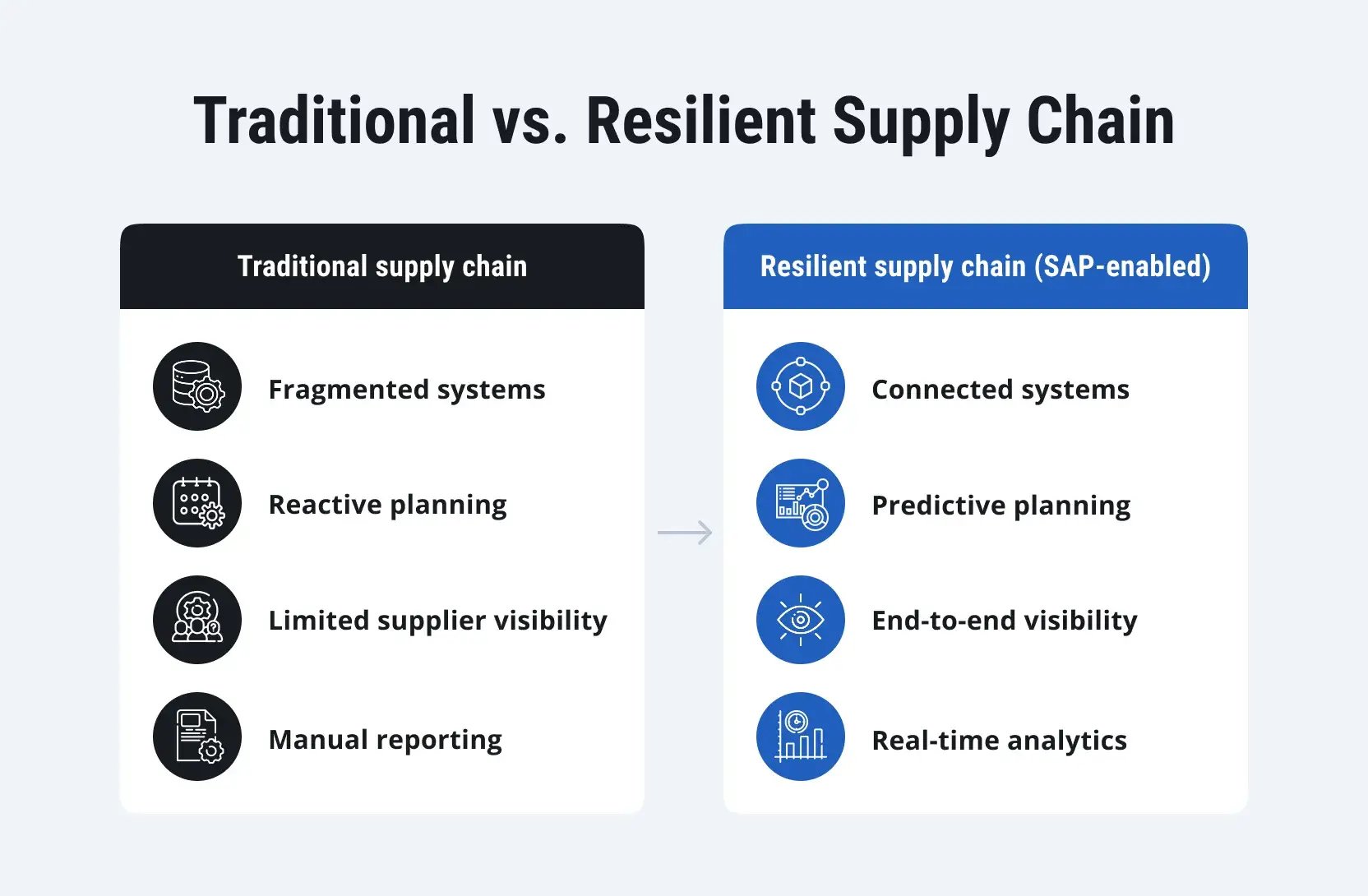
One of the biggest problems is simply not seeing the whole picture. Data is scattered — across systems, teams, sometimes even countries. Planning lives in one tool, logistics in another, supplier information somewhere else — and it rarely comes together in a way that’s easy to use.
As a result, companies don’t see the full flow of goods and information. Problems only become visible when they’ve already started affecting operations — for example, when a delivery is delayed, or production is interrupted.
Reactive rather than predictive planning
In many organizations, planning is still reactive. Teams respond to issues after they happen instead of anticipating them.
Without real-time forecasting and scenario planning, companies struggle to anticipate disruptions. As a result, operations become reactive, focused on managing exceptions rather than avoiding them.
Fragmented systems and data silos
Another common problem is how disconnected the systems are. Planning, procurement, warehousing, and transportation often run on separate platforms that don’t fully communicate with each other.
This creates data silos. Teams work with different versions of the truth, and aligning decisions across functions becomes slow and complicated.
Limited supplier transparency
Supplier networks are often complex, but visibility into them is limited. Companies may know their direct suppliers, but not always what happens further down the chain.
When you don’t have enough visibility, it’s much harder to catch risks early or stay on top of compliance. This is becoming more important as due diligence requirements expand across the EU, pushing companies to look beyond direct suppliers and understand risks across multiple tiers.
In the Nordics, that’s a bigger issue than in many other regions — companies are expected to really understand what’s going on across their whole supplier network, including environmental and social impact. And that’s not easy when parts of the supply chain are still hard to see. That’s why supplier transparency becomes so important — without it, risks tend to surface too late, and compliance becomes much harder to manage.
Inability to scale across countries
Many Nordic companies operate across several countries, but their processes are not always unified. Different regions may use different systems, workflows, or standards.
This makes coordination more difficult and limits scalability. What works in one country cannot easily be replicated in another, slowing down both growth and response to disruptions.
Why the Nordic Context Changes Supply Chain Strategy
Supply chains in the Nordics are a bit different from what you see in many other regions. It’s not only about cost or efficiency — local expectations, regulations, and market realities all influence how supply chains are set up and run.
Sustainability as a core requirement
In the Nordics, sustainability is part of everyday decision-making. It’s not something companies handle separately or add later — it’s already built into how operations run.
Companies are expected to know what impact their supply chains actually have. That includes emissions, transport decisions, and logistics setups, and making changes where needed. These factors often shape planning as much as cost or timelines.
High regulatory and ESG expectations
Regulation is only part of it — expectations from customers and partners matter just as much. Companies are expected to be transparent about how their supply chains actually work. With regulations like CSRD and upcoming supply chain due diligence requirements, this transparency is no longer optional — it needs to be structured, consistent, and auditable.
That means knowing where materials come from, how suppliers operate, and whether everything meets ESG standards. When that visibility isn’t there, it becomes much harder to stay compliant — and harder to build trust.
Global dependency with regional complexity
Nordic companies rely on global supply networks, even though they operate in a small and highly regulated region.
Raw materials often come from outside the Nordics, while finished goods are shipped across Europe and beyond. That means when something goes wrong globally, it quickly shows up in local operations — and companies have to deal with both at once.
Digital maturity and expectations
The Nordics are highly digital, and expectations reflect that. Companies rely on real-time data, automation, and tools that help them act quickly.
Manual workarounds and delayed reporting don’t really fit anymore. Supply chains are expected to be connected, responsive, and manageable across different countries without adding complexity.
What Supply Chain Resilience Should Actually Include
Resilience doesn’t come down to one capability. It’s determined by how the supply chain operates as a whole, including visibility, responsiveness, and the level of integration across countries and partners.
At a high level, it comes down to three things:
- Clear visibility across the network
- The ability to make decisions quickly
- Strong alignment between planning and execution
End-to-end visibility
A lot of supply chain problems start with the same issue: you don’t see the full picture. Data is often spread across systems, teams, and countries, so getting a clear view takes time — and by then, it’s often too late. For Nordic companies working across multiple markets and partners, this becomes even more complicated. Without a shared, up-to-date view, issues tend to show up only after they’ve already affected operations.
Predictive and scenario-based planning
Planning can’t be reactive anymore. It’s about thinking in advance — what happens if demand changes, a supplier is late, or costs suddenly go up? When scenarios are ready, teams don’t have to scramble when something goes wrong.
Supplier risk management
Suppliers are one of the biggest unknowns in the chain. It’s not just about whether they deliver on time. In the Nordics, companies also need to consider compliance, ESG requirements, and how stable supplier regions are. When that information isn’t clear, risks tend to build up quietly and appear at the worst moment.
Integrated planning and execution
In many companies, planning and execution still don’t fully connect. Plans are created in one place, while logistics and operations run somewhere else. That gap slows everything down. When systems are connected, changes in demand or supply can be reflected immediately — without manual fixes or delays between teams.
Sustainability tracking and reporting
In the Nordic environment, sustainability is a core part of supply chain resilience. Companies are expected to track emissions, supplier practices, and environmental impact across the entire network. This becomes increasingly complex in multi-country operations, and without structured tracking, reporting often becomes unreliable.
Real-time analytics
Speed matters when something goes wrong. If decisions rely on outdated data, the response will always lag behind. Real-time supply chain analytics help spot issues earlier, understand what’s happening, and act before problems grow. This is what turns data into something useful — and helps keep operations stable even when conditions change.
When everything is connected, supply chains become less reactive and more adaptable — easier to manage and better prepared for change.
How SAP Enables Supply Chain Resilience
Resilience doesn’t come from tools alone. It comes from how well the different parts of the supply chain work together in practice.
SAP approaches this differently. Instead of keeping planning, operations, and logistics separate, it brings them together in one environment where data is aligned, and decisions are based on what’s really happening.
SAP Integrated Business Planning (IBP)
SAP IBP is used for demand, supply, and inventory planning, but its real value is in how it handles uncertainty. It allows teams to:
- Model different scenarios in advance
- Compare scenarios and keep plans aligned across sales, operations, and supply chains
- Respond to changes without rebuilding plans from scratch
- Automate exception handling, so teams can focus on the issues that actually require attention
This helps move away from reactive planning toward more stable, forward-looking decisions.
SAP S/4HANA Supply Chain
SAP S/4HANA acts as the operational core of the supply chain. It connects:
- Procurement
- Production
- Order fulfillment
When something changes, it doesn’t stay in one place — it carries through the whole process. That matters a lot for companies working across several countries.
SAP Extended Warehouse Management (EWM)
Warehouses are often where operational bottlenecks become visible. Issues in planning or inventory management tend to surface here as delays, shortages, or imbalances in stock.
SAP EWM provides:
- Real-time visibility into inventory and movements
- More structured and automated warehouse processes
- Better coordination between inbound and outbound flows
This makes it easier to respond when supply or demand shifts and keeps warehouse operations aligned with upstream decisions.
SAP Transportation Management (TM)
Transport is one of the most unstable parts of the supply chain. SAP TM helps companies:
- Plan and optimize routes
- Manage carriers and freight costs
- Adjust quickly when transport conditions change
In the Nordics, where logistics costs can fluctuate, this becomes a key control point.
SAP Business Network for supply chain
Supply chains extend beyond internal systems. SAP Business Network supports:
- Collaboration with suppliers and logistics partners
- Visibility across the supplier base
- Better tracking of risks and ESG factors
This matters even more when transparency and compliance are expected across the whole network. When everything is connected, the supply chain simply becomes easier to run.
Planning, execution, and collaboration stay aligned and rely on the same data. That’s what allows companies to stay in control, even when conditions are changing.

Typical Use Cases in the Nordics
Supply chain resilience in the Nordics takes different forms depending on the industry, but the underlying challenge is always the same: keeping operations steady while conditions keep shifting.
Manufacturing
In manufacturing, most of the pressure sits in planning. Balancing demand, production capacity, and supply is a constant challenge, especially when predictability is limited. In Sweden and Finland, where global suppliers and energy price volatility play a big role, plans tend to change frequently.
In practice, this comes down to a few things:
- Being able to adjust production quickly
- Reacting to supply disruptions without stopping operations
- Keeping output stable even when costs fluctuate
Planning becomes less about setting targets and more about staying flexible.
Retail
Retail is driven by speed — and uncertainty. Demand doesn’t stay still for long. It changes with seasons, promotions, or outside factors. And when forecasts miss the mark, it shows right away — excess stock here, shortages there, and rising logistics costs.
Better forecasting helps retailers:
- Stay closer to actual demand
- Avoid unnecessary stock buildup
- Keep shelves filled without overcompensating
It’s a constant balancing act between availability and efficiency.
Energy
In the energy sector, the focus shifts from demand to stability. This is also influenced by European and regional energy frameworks, such as the Norwegian Transparency Act, which increases the need for transparency and coordination across operations and supply networks.
For many Nordic energy companies, especially in Norway and Denmark, resilience also means balancing supply and demand with a growing share of renewable inputs. That adds another layer of complexity, where variability in production needs to be managed alongside traditional supply chain considerations.
Operations are built around complex assets, and any disruption — whether technical or logistical — can be expensive. Everything needs to stay coordinated, even when external conditions change.
Resilience here depends on:
- Keeping assets available and maintained
- Aligning logistics with operational needs
- Balancing supply and demand with variable renewable inputs
- Reacting quickly when something goes off track
In practice, this comes down to optimization — especially when it comes to asset performance. Predictive maintenance, better planning, and coordinated execution help prevent disruptions before they happen and keep operations running reliably.
Multi-country supply chain coordination
Many Nordic companies operate across several countries, which adds another layer of complexity.
Different regulations, suppliers, and logistics setups can easily pull processes in different directions. In practice, this often comes down to handling cross-border requirements — from Incoterms and delivery responsibilities to tax reporting and compliance obligations like Intrastat. Without proper coordination, these differences quickly lead to inconsistencies and delays.
Stronger coordination helps:
- Bring consistency across countries
- Keep data and processes aligned
- Manage Incoterms, tax, and compliance requirements more consistently
- Avoid situations where one market creates issues for another
In practice, it’s what keeps the whole system from drifting apart.
Expected Business Outcomes
When supply chains start working as one connected system, the difference is noticeable pretty quickly. It’s not just about smoother operations — teams begin to react faster, coordinate better, and make decisions with more confidence.
Instead of dealing with issues once they’ve already caused problems, companies can catch them earlier and keep them under control. Decisions are based on current data, and working with suppliers — along with managing compliance — becomes much more straightforward.
In practice, this usually shows up in a few areas:
|
Area |
What changes |
|
Disruption impact |
Problems are caught earlier and resolved faster, so they don’t turn into major disruptions |
|
Decision-making |
Teams act quicker and with more confidence, relying on real data instead of guesswork |
|
Supplier collaboration |
Communication improves, and risks are easier to manage thanks to better visibility |
|
ESG compliance |
Environmental and social data is easier to track and report across the supply chain |
|
Operational agility |
Plans can be adjusted more easily, and operations stay stable even when conditions change |
Over time, this leads to a supply chain that’s easier to manage and less demanding day to day. Instead of constantly dealing with urgent issues, teams can focus on keeping things running and adjusting when needed.
What Must Be Assessed Before Starting
Before making any changes, it helps to step back and look at how the supply chain actually works today — not on paper, but in day-to-day operations.
Current supply chain setup
Most supply chains didn’t start as a clean, unified setup — they grew over time. New systems were added, processes changed, and teams developed their own ways of working. That’s why planning, logistics, and purchasing don’t always line up. Some areas are automated, others still depend on manual steps or local knowledge. Until you see how it actually works, it’s hard to improve anything.
Key risk areas
Risk is distributed across the supply chain rather than concentrated in one area. It can come from suppliers, transport, planning gaps, or external factors like energy prices and geopolitics. Some risks are known — others surface only under pressure.
The goal here is simple: understand where things are most likely to go wrong and how painful that would be.
Data availability and quality
The issue usually isn’t the lack of data — it’s how scattered it is. Planning, logistics, and supplier data sit in different systems, get updated at different times, and don’t always line up. As a result, teams spend time aligning numbers instead of acting on them.
Supplier network complexity
For many Nordic companies, the supplier landscape is wide and not always easy to map. There are multiple tiers, different regions, and dependencies that aren’t always visible. What looks like a stable setup on the surface can be more fragile underneath. Without a clear view of that network, issues tend to appear unexpectedly.
ESG and compliance requirements
On top of everything else, there’s growing pressure around ESG. Companies are expected to know not just what they buy, but where it comes from, how it’s produced, and what impact it has. That’s not always easy when the supply chain spans multiple countries and partners. Clarity here matters; reporting becomes a constant struggle.
This kind of assessment isn’t about formalities. It’s about getting a clear picture of what’s unclear, where risks are, and what won’t hold under pressure. Once that’s in place, moving forward becomes much simpler.
Common Mistakes in Supply Chain Transformation
Most supply chain transformations start with the right goals: to make operations more efficient, reduce risk, and bring systems up to date. But in reality, many of them don’t deliver what was expected. The issue is usually not the technology itself, but how the transformation is approached from the start.
When cost becomes the only focus
Cost matters, but when it becomes the main priority, other things get pushed aside: flexibility, resilience, supplier reliability. In the Nordics, where disruptions and sustainability requirements are part of everyday operations, cost-cutting on its own rarely leads to lasting results.
When data stays fragmented
New tools are often introduced, but the underlying data doesn’t change. Planning data sits in one place, logistics in another, supplier data somewhere else. Teams end up aligning numbers instead of acting on them, and the expected improvements never fully materialize.
When supplier risks are only partially visible
Many companies have a good view of their direct suppliers, but visibility tends to drop beyond that. In multi-tier supply chains, risks don’t always sit at the surface. They build up quietly and usually show up when there’s already a disruption.
When ESG is treated separately
ESG often sits outside of day-to-day operations. Instead of being part of supply chain decisions, it becomes a reporting task. That makes it harder to track consistently and almost impossible to act on in real time.
When tools come before the approach
Another common pattern is starting with systems. New tools are expected to fix existing issues, but if processes, roles, and priorities aren’t clearly defined, the same problems simply carry over into the new setup.
In the end, these situations tend to follow the same pattern:
- Cost is prioritized over resilience.
- Tools are added without fixing data and process gaps.
- Supplier risks aren’t fully visible.
- ESG is treated as reporting, not operations.
- Implementation starts without a clear direction.
Avoiding this isn’t about doing something completely different. It’s about stepping back and looking at the whole supply chain — how things actually work, where the gaps are, and what needs to change first.
Recommended Implementation Approach
Building supply chain resilience takes time. It usually happens step by step — starting with what’s already there and fixing the weakest points first.
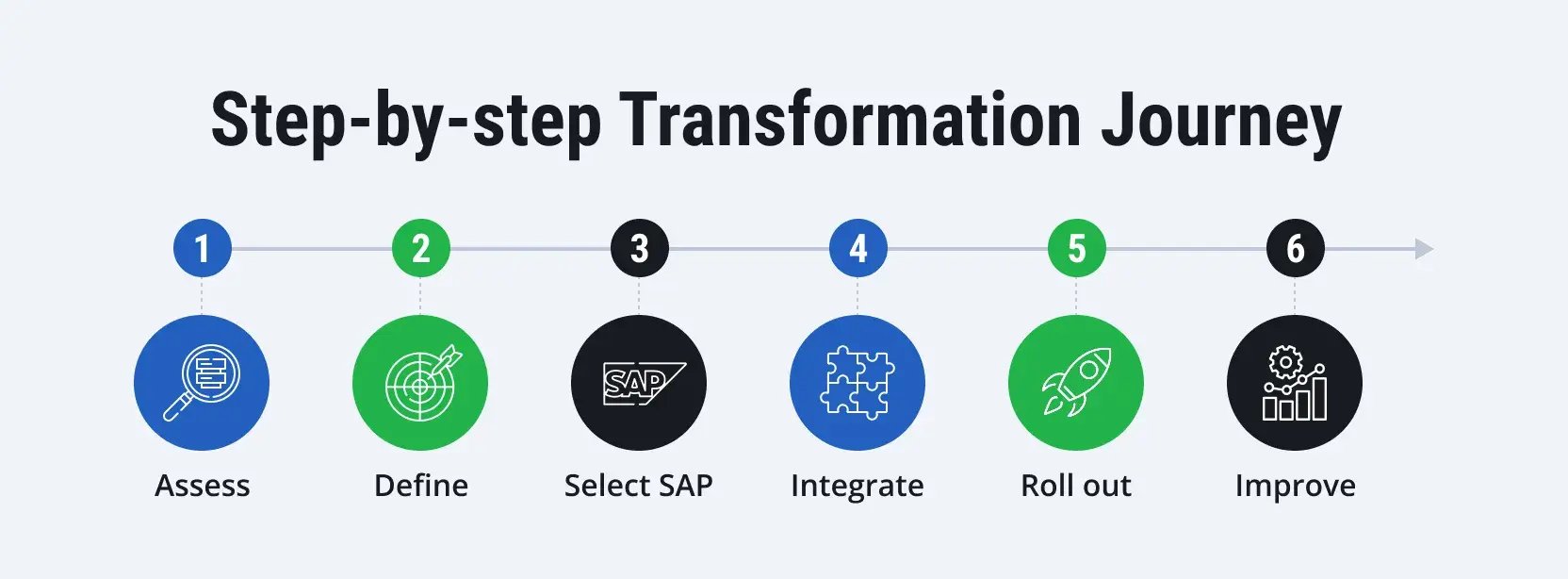
Step 1: Understand how the supply chain works today
Before changing anything, you need to see how it actually works today. How planning, logistics, procurement, and data fit together, and just as importantly, where they don’t.
Step 2: Start by deciding what resilience means in your case
Resilience isn’t the same for everyone. For some companies, it’s about handling disruptions. For others, it’s visibility, ESG, or managing operations across countries. The key is to be clear on priorities before moving forward.
Step 3: Choose the right SAP landscape
Once you understand what needs to change, the question becomes which SAP tools actually help. Not everything at once — just the parts that support your priorities, whether that’s planning, logistics, or supplier collaboration.
Step 4: Connect data and processes
This is where most transformations either work or don’t. Data and processes need to be connected so that planning, operations, and partners are aligned. Without that, even good tools won’t change much.
Step 5: Implement step by step
Changing everything at once usually adds more problems. Moving step by step makes it easier to manage things and make changes along the way.
Step 6: Keep improving
Putting the foundation in place helps, but it doesn’t make things static. Supply chains keep shifting, so you end up adjusting how things run over time.
At a practical level, this approach is fairly straightforward:
- Start with a clear understanding of the current state.
- Define what actually needs to improve.
- Focus on integration, not just tools.
- Move in manageable steps.
- Keep adjusting as conditions change.
That’s what makes it realistic to maintain over time, instead of becoming another short-term fix.
LeverX Services for SAP Supply Chain Resilience in the Nordics
LeverX works with Nordic companies that are trying to get more control over their supply chains, not in theory, but in how things actually run day to day.
The starting point is usually different. Some companies are dealing with planning issues, others with fragmented systems, others with supplier visibility or ESG pressure. So the work doesn’t follow a fixed template.
Getting a clear picture first
Most projects start by figuring out what’s actually going on. Not how it’s meant to work, but where things get delayed, where data doesn’t line up, where decisions take too long. You usually find more problems than you planned for, but at least you know where to start.
Fixing planning where it breaks
For many companies, the biggest gaps sit in planning. Demand shifts, supply changes, and plans don’t keep up. This is where SAP IBP is usually introduced, not as a standalone tool, but as a way to make planning more flexible and easier to adjust when conditions change.
Bringing processes together
When companies move to S/4HANA, the focus is often on how disconnected things have become. Planning, procurement, and execution don’t always line up, and a lot of manual work fills the gaps. The goal is to smooth that out and make everything work more consistently.
Cleaning up logistics
Warehousing and transportation are common trouble spots. This is where EWM and TM usually come in, helping bring more clarity and making sure these areas are properly connected to planning.
Making suppliers more visible
Supplier networks are rarely as transparent as they need to be. Companies often see their direct suppliers, but not much beyond that. Improving collaboration and visibility helps reduce surprises and makes it easier to manage risks across the chain.
Making ESG part of operations
ESG is no longer something separate. Companies are expected to have a clear view of emissions, supplier practices, and environmental impact. That only works when the data is actually used in daily processes, not just stored for reporting.
In the end, it’s about clarity and control — making the supply chain easier to run.
Why Work With LeverX
LeverX has been working with SAP supply chain solutions for years, including complex setups where multiple systems, processes, and countries are involved. This isn’t just about knowing the tools — it’s about understanding how they work in real business environments.
Strong SAP SCM expertise
The team has hands-on experience with SAP supply chain solutions, from planning to execution. That includes IBP, S/4HANA, EWM, TM, and supplier collaboration tools — and, more importantly, how they fit together.
Experience with complex environments
Many Nordic companies operate across multiple countries, systems, and supplier networks. LeverX is used to working in these conditions, where processes aren’t always straightforward, and standard approaches don’t always apply.
End-to-end delivery
Projects aren’t handled in isolation. From assessment and design to implementation and rollout, LeverX supports the full cycle, making sure that decisions made early on actually work in practice later.
SAP and non-SAP integration
In most cases, SAP is only part of the landscape. LeverX works with both SAP and non-SAP systems, connecting them where needed so that data flows consistently and processes don’t break between platforms.
Conclusion
In the Nordics, supply chain resilience is quickly becoming a real competitive advantage, not just an operational concern.
Companies that invest in visibility, analytics, and sustainability tend to handle disruptions better and adjust faster when things change. Over time, their operations simply become easier to manage. Getting there isn’t about one big change or a single tool. It also helps companies keep up with growing regulatory expectations, where transparency and consistent data are becoming just as important as day-to-day performance.
This is where SAP-based supply chains come in. They provide a foundation that makes it easier to bring everything together and run the supply chain as a whole, not as separate parts.