

Is SAP S/4HANA Public Cloud Edition the right fit for your business? Explore deployment options, financial considerations, readiness factors, and practical scenarios to make an informed decision.
For many growing companies, ERP becomes a topic again long before the existing system reaches the end of its life. The trigger is usually business growth. Problems arise every time a company grows, acquires another business, or enters a new market. Internal processes can't cope with the new volume of work, obtaining accurate reports becomes a huge challenge, and everyone starts demanding new system features to somehow cope with their daily tasks.
At this stage, a much broader discussion begins; simply replacing legacy technology is no longer adequate. Management needs to find the right balance between system flexibility and internal IT costs. More importantly, they need to honestly assess whether their existing business processes are still generating revenue or simply adding unnecessary costs and complexity.
Companies often choose SAP S/4HANA Public Cloud Edition because much of the functionality is available out of the box. Projects can progress faster — with fewer custom developments to design, build, and maintain — and ongoing support typically requires less effort. Organizations also gain regular access to new SAP innovations through scheduled updates. At the same time, the standardized approach may not suit every business. Processes that differ significantly from SAP best practices can require additional adaptation, which is why evaluating organizational fit early in the decision-making process is so important.
Moving to the public cloud isn't a silver bullet. You have to look past the marketing and understand where the model actually hits a wall, along with the internal team shifts needed to make it work. Here is a breakdown of what you actually need to consider before signing a contract.
The Mid-Market Challenge: Growth Without Enterprise-Level IT Costs
Most ERP bottlenecks build up slowly as a company expands. Strategic moves like acquisitions or entering new markets introduce a level of complexity that your original system just can't absorb. Over time, routine workflows slow, consolidating your financial data becomes incredibly painful, and your tech team ends up stuck in pure survival mode rather than helping the business grow.
Mid-market organizations often face challenges such as:
- Expanding into new markets or opening subsidiaries
- Integrating newly acquired companies
- Meeting increasingly complex reporting and compliance requirements
- Supporting employees across multiple locations
- Maintaining custom ERP developments built years ago
For companies in the $100 million to $1 billion revenue range, the challenge often goes beyond technology. Growth creates demand for enterprise-grade capabilities, but few organizations in this segment want to build large internal teams to manage infrastructure, upgrades, integrations, and ongoing ERP support. At the same time, competition for experienced SAP professionals continues to drive labor costs higher across the US market.
This is forcing a massive rethink at the executive level. Leaders are questioning the wisdom of investing huge resources in system maintenance when that same time and money could be used to streamline the business, support expansion, and take care of customers.
As the business grows, the ERP landscape grows with it. New systems are connected, additional requirements appear, and custom solutions that once seemed temporary become part of daily operations. After a few years, teams can end up spending more time supporting the existing environment than working on improvements the business requires.
Finding and retaining highly qualified SAP specialists is a true nightmare today. Due to fierce competition for talent, rapidly rising costs of maintaining on-premises infrastructure, and installing custom updates, the situation is becoming extremely challenging. This is no longer just a local technical issue — it's a serious constraint on businesses, draining budgets and actively slowing growth.
This reality explains why cloud ERP has become part of many executive discussions. The conversation extends beyond software functionality. Leaders want to understand how different deployment models affect operating costs, implementation timelines, governance, and future growth.
For organizations considering SAP's cloud portfolio, the first step often involves comparing programs such as GROW with SAP and RISE with SAP, since they address different business scenarios and transformation goals. It is equally important to understand how deployment models differ in practice. Exploring the advantages and trade-offs of cloud, on-premises, and hybrid ERP environments can help decision-makers identify the approach that best aligns with their business priorities.
At the end of the day, companies want to scale up without their back-office costs scaling up too. The trick is finding a way to support that growth without your ERP maintenance becoming a massive, expensive bottleneck.
.webp)
Understanding SAP S/4HANA Public Cloud Edition
Moving to the Public Cloud Edition often requires significant process and governance changes. You are moving away from the traditional model of building out a highly customized, self-managed software environment. Instead, you adopt a strict, standardized platform where SAP takes on the operational responsibility for updates, security, and maintenance.
A subscription-based operating model
Instead of making large upfront investments in infrastructure, hardware, and periodic upgrade projects, organizations pay a recurring subscription fee that includes access to the software, infrastructure, and ongoing innovation. This can make ERP-related spending easier to forecast and manage over time.
The subscription model also consequently supports a cleaner ERP landscape. Because organizations are encouraged to keep the core application as close to standard as possible and use approved extensibility options for business-specific requirements, SAP S/4HANA Public Cloud Edition provides a strong foundation for Clean Core practices.
SAP assumes full ownership of core infrastructure, automated security updates, and system availability. This native SaaS governance structure eliminates the operational overhead of platform maintenance, allowing internal IT resources to be reallocated to high-value digital projects.
Standardized processes from day one
Another characteristic of the public cloud model is its focus on standardized processes and avoiding the custom coding model. Instead of paying to rebuild legacy processes in a new system, you implement ready-made SAP industry standards. This requires real process discipline at the outset, but guarantees a faster launch and prevents you from getting stuck on an older version of software.
Continuous innovation without major upgrade projects
Regular updates roll out automatically, meaning you get access to new tools without the typical nightmare of a traditional (on-premises) ERP upgrade project. This predictable, low-maintenance operating model forms the foundation of the GROW with SAP offering, which is designed to help net-new SAP customers adopt SAP S/4HANA Public Cloud Edition, using standardized implementation approaches and best practices. Organizations that adopt standard SAP processes often benefit from faster deployments, lower maintenance requirements, and a more consistent foundation for future growth.

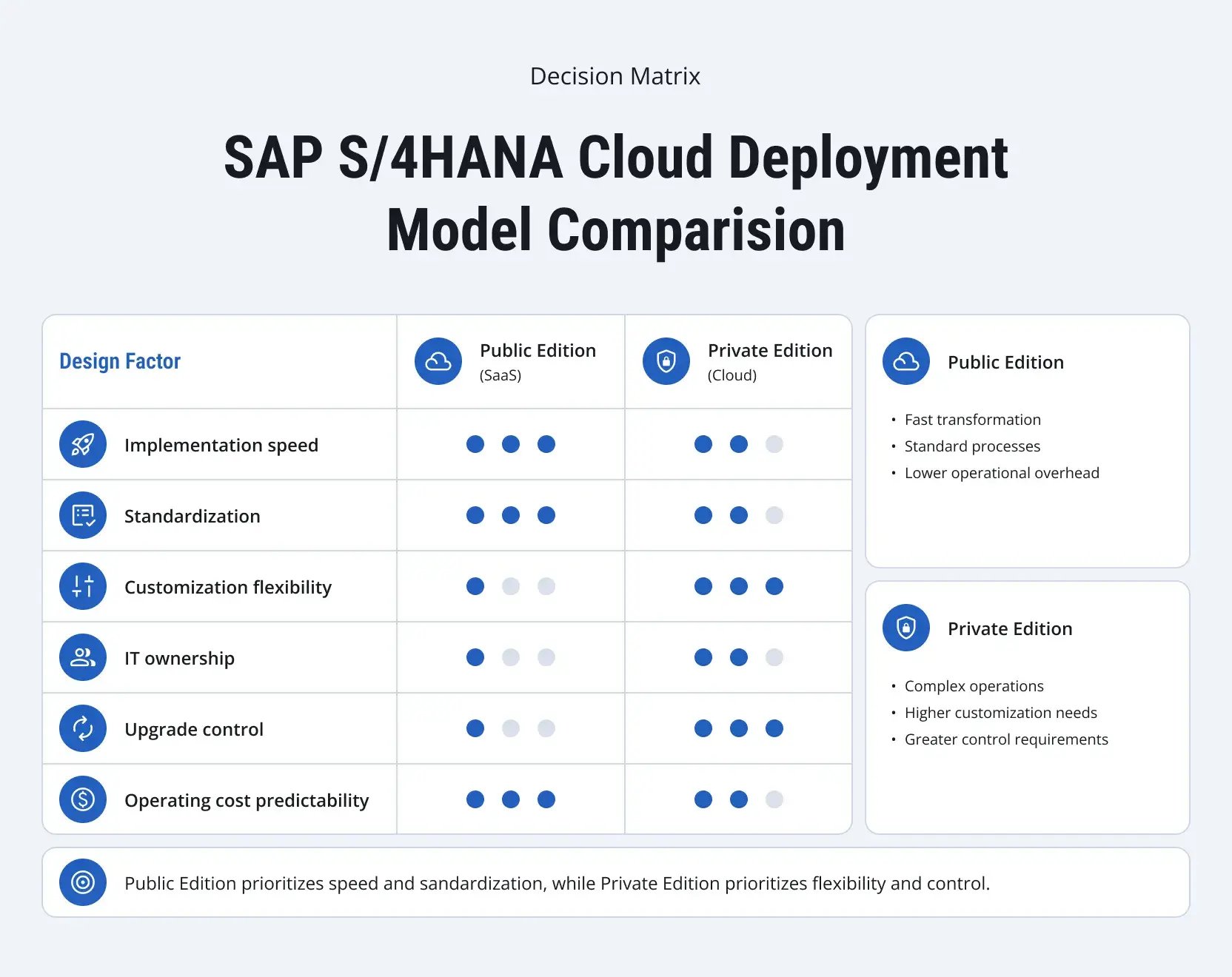
Which SAP S/4HANA Cloud Deployment Model Fits Your Business?
Committing to SAP S/4HANA is just step one. The actual make-or-break decision is figuring out which cloud model to run it on. While public and private cloud editions share the same core software platform, the operational reality of running them is as different as night and day. You are looking at entirely different rules for how much you can modify the code and who handles the upkeep.
|
Area |
SAP S/4HANA Public Cloud Edition |
SAP S/4HANA, Private Cloud Edition |
|
Deployment model |
Multi-tenant SaaS environment managed by SAP |
Dedicated cloud environment for a single customer |
|
Implementation approach |
Fit-to-standard with predefined processes and scope |
Greater flexibility to accommodate existing processes and industry-specific requirements |
|
Upgrade approach |
Regular SAP-managed updates delivered on a fixed schedule |
Customers have more control over upgrade timing and planning |
|
Extensibility |
Side-by-side extensions through SAP BTP and approved in-app options |
Broader customization and extensibility options |
|
Infrastructure management |
Fully managed by SAP |
Managed cloud environment with greater customer control |
|
Cost structure |
Subscription-based model with lower operational overhead |
Higher costs due to increased flexibility and management requirements |
|
Implementation speed |
Typically faster because of standardized processes and predefined scope |
Often requires more time for configuration, migration, and customization |
|
Governance |
Strong emphasis on standardization and Clean Core practices |
Greater freedom to define governance and change-management approaches |
|
Operational responsibility |
SAP handles infrastructure, updates, and much of the technical maintenance |
Responsibilities are shared between SAP, the implementation partner, and the customer |
|
Best fit |
Organizations seeking rapid deployment, standardization, and predictable operating costs |
Organizations with complex processes, extensive customization requirements, or industry-specific needs |
There is no universal right choice here. Instead of getting bogged down in feature lists or focusing solely on flexibility, organizations should evaluate how each deployment model aligns with their business objectives. Among the most important considerations are growth plans, internal IT capabilities, compliance requirements, customization needs, governance expectations, and long-term operating costs.

Evaluating the Financial Impact of SAP S/4HANA Public Cloud Edition
Looking only at software licenses and implementation fees during an ERP transition is a mistake. Those upfront expenses are only a fraction of the actual total cost of ownership. Over the life of the platform, the real budget drivers are infrastructure upkeep, mandatory upgrades, external consultants, and the massive amount of internal tech resources required for daily maintenance.
One of the main reasons growing enterprises consider SAP S/4HANA Public Cloud Edition is the opportunity to shift from a model built around periodic investments and ongoing maintenance to one based on predictable operating expenses. Instead of budgeting separately for infrastructure, upgrade projects, and technical administration, companies consume ERP as a subscription service, while SAP manages much of the underlying environment.
The difference becomes easier to see when comparing how costs are typically distributed.
|
Traditional ERP |
SAP S/4HANA Public Cloud Edition |
|
Infrastructure investments |
Subscription model |
|
Upgrade projects every few years |
Continuous SAP-managed updates |
|
Higher internal maintenance effort |
Reduced technical administration |
|
Separate infrastructure costs |
Infrastructure included |
|
Costs vary by project cycle |
More predictable recurring costs |
For finance leaders, predictability often matters as much as cost reduction. Unexpected upgrade projects, hardware refreshes, and infrastructure investments can make long-term planning difficult. A subscription-based model provides greater visibility into ERP-related spending and reduces the likelihood of large, unplanned technology expenses.
Organizations also tend to realize value sooner. Standardized processes and predefined scope can shorten implementation timelines, allowing teams to focus on adoption and business outcomes rather than extensive system customization. Organizations can often redirect internal resources away from routine platform maintenance and toward business-focused initiatives.
Companies that adopt SAP S/4HANA Public Cloud Edition often cite several financial advantages:
- Reduced spending on infrastructure and system administration
- Less effort dedicated to upgrading planning and technical maintenance
- Faster deployment compared to heavily customized ERP environments
- Earlier access to business benefits and process improvements
- Better visibility into ongoing ERP costs
That doesn't mean the public cloud is always the cheapest route. If your business relies on highly specialized workflows or massive customizations, you're going to spend a lot of time and money redesigning your processes or building cloud-safe workarounds. The point isn't just to find the lowest price tag; it's about building a system that lets you scale without your overhead and system complexity spinning out of control.
Where SAP S/4HANA Public Cloud Edition Delivers the Most Value
The suitability of SAP S/4HANA Public Cloud Edition often depends less on industry and more on what the business is trying to accomplish. Certain situations place a premium on speed, standardization, and ease of deployment. In those cases, the public cloud model can be particularly effective.
Rapid expansion into new markets
Opening a new subsidiary means wading through a mountain of administrative hurdles before you can even make your first dollar. You have to set up the bank accounts, untangle local tax laws, build a reporting pipeline back to headquarters, and hire and train a local team.
If every new branch you open sets up its own processes, your operations will turn into a chaotic mess overnight. When companies expand into multiple regions, they usually push for a single template across all locations so they can prevent everyone from building their own unique, custom workarounds.
Supporting two-tier ERP strategies
Large enterprises do not always need the same ERP environment in every location. Headquarters may require extensive functionality, while regional subsidiaries need a solution that can be deployed quickly and managed with fewer resources.
This is why companies split their ERP into two tiers. Headquarters still gains all the financial data and tracking they want, but the smaller branches get a fast, nimble system they can actually use, rather than being forced to adopt a massive corporate platform that doesn't fit their scale.
Mergers, acquisitions, and operational standardization
Acquisitions create pressure to move quickly. Leadership expects immediate, unified visibility from a new acquisition. The reality is an operational mess: a patchwork of mismatched ERPs, fragmented workflows, and conflicting data structures that completely block consolidated reporting.
Bringing those environments together can take months or even years, if every process is treated as unique. Many organizations use the integration effort as an opportunity to establish a common operating model across their business.
Using standardized SAP frameworks can reduce the implementation time for an acquired company to 14 weeks. However, achieving this ambitious goal depends entirely on a clear definition of the project scope, high-quality legacy data, minimal integration with third-party services, and a team ready to immediately implement standard workflows.
The implementation approach can have a significant impact on both timelines and outcomes. For that reason, companies often evaluate Brownfield and Greenfield migration strategies when planning how existing systems will be incorporated into the future ERP landscape.
Businesses still operating SAP ECC environments face another important decision: how to approach the broader transition from SAP ECC to SAP S/4HANA, while minimizing disruption to ongoing operations.
Predictive financial planning
Corporate growth inevitably complicates financial planning. Managing multiple legal entities, disparate reporting frameworks, and surging transaction volumes quickly turns forecasting and period-end closing into manual, time-consuming bottlenecks that stall strategic decision-making.
SAP S/4HANA Public Cloud Edition provides access to real-time financial data across the organization, helping finance teams improve visibility and make decisions based on current information rather than historical reports. Organizations can also take advantage of embedded AI capabilities, including SAP Joule, to streamline analysis, surface relevant insights, and support planning activities across finance processes.
For complex corporate structures, this means faster closure with zero guesswork. By automating financial consolidation, you secure an airtight audit trail, compliance, and accurate forecasting while entirely eliminating the manual spreadsheet grind.
Supply chain modernization
Many growing organizations still rely on disconnected systems, spreadsheets, or manual processes to manage inventory, procurement, and warehouse operations. As transaction volumes increase, these limitations can affect visibility, planning accuracy, and operational efficiency.
SAP S/4HANA Public Cloud Edition forces supply chain standardization across all locations. Operating on a single, shared database layout instantly links procurement, inventory, and logistics directly to your finance ledger, eliminating operational lag and communication silos completely.

How To Determine Whether SAP S/4HANA Public Cloud Edition Is the Right Fit
An ERP selection should never be treated as a pure software procurement exercise. True readiness is determined by whether corporate workflows are mature enough for automation, and whether leadership can drive the behavioral shift required to accept standard cloud logic over legacy customizations.
This is why many SAP S/4HANA Public Cloud Edition projects begin with a structured assessment. The goal is not to prove that public cloud is the right answer. The goal is to determine whether the organization's requirements align with the operating model that the solution was designed to support.
A typical assessment includes several areas:
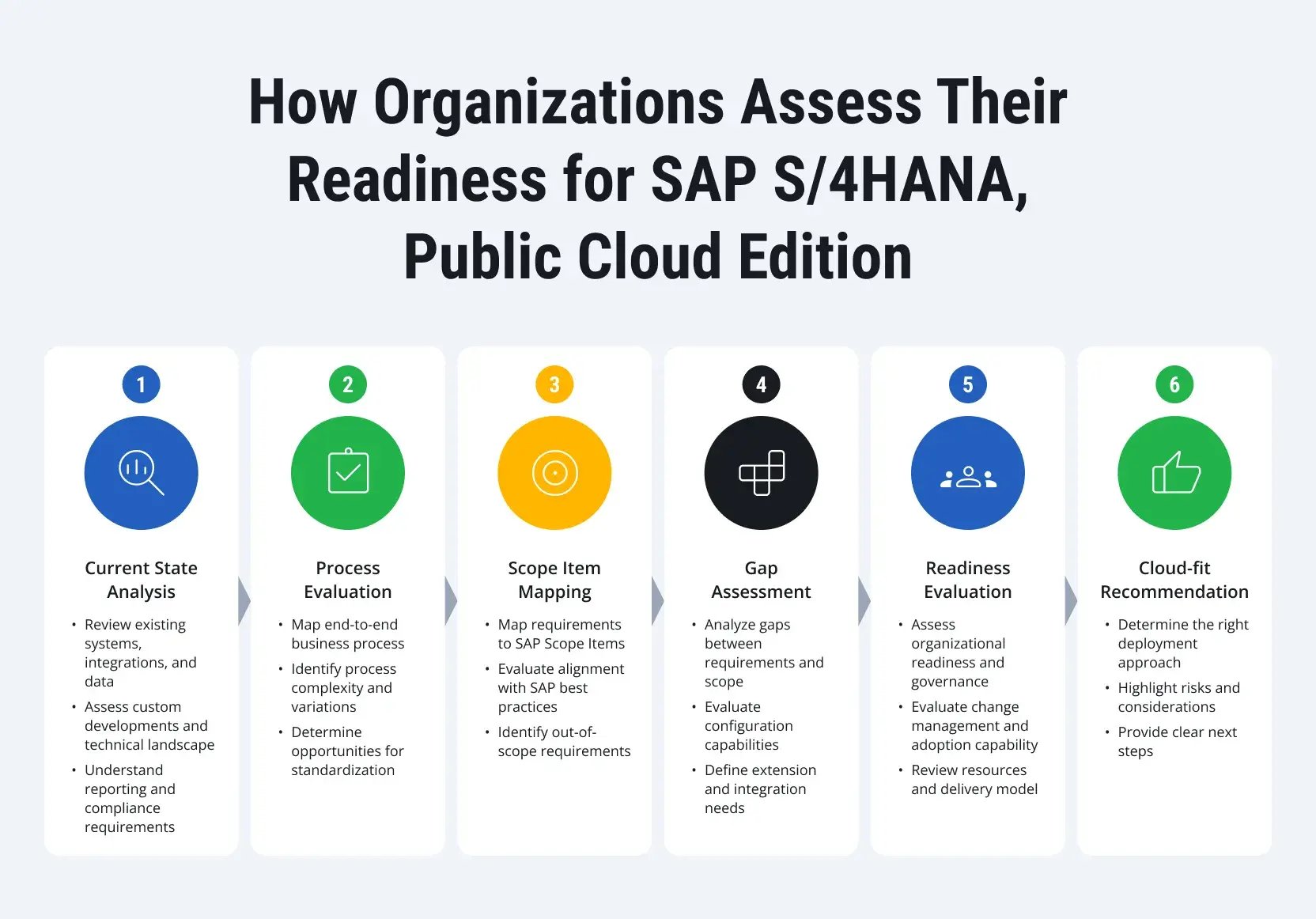
Understanding the current environment
The first step is building a clear picture of the current landscape. This includes reviewing business processes, integrations, reporting requirements, custom developments, data quality, and existing technical dependencies. The goal is to understand how the organization operates today, identify potential risks, and determine which areas may require additional attention during the transition to SAP S/4HANA Public Cloud Edition.
Evaluating business processes
Not every process needs to be unique. During the assessment, organizations examine which workflows provide genuine business value and which have evolved over time simply because the existing ERP system allowed them to do so.
Mapping requirements to SAP scope items
SAP S/4HANA Public Cloud Edition includes predefined business processes known as scope items. These serve as the foundation for fit-to-standard implementations. Mapping business requirements to available scope items helps identify where the solution already supports the organization's needs and where additional consideration may be required.
Identifying gaps and extension requirements
When requirements fall outside the standard scope, the next step is determining whether they can be addressed through process adjustments, configuration options, or extensions built on SAP Business Technology Platform (SAP BTP).
Assessing organizational readiness
Technology is only one part of the equation. Project success often depends on factors such as executive sponsorship, change management capabilities, process governance, and the organization's readiness to adopt new ways of working.
The outcome of this assessment is not a pass-or-fail result. Instead, it provides decision-makers with a realistic view of the effort involved, the potential risks, and the level of alignment between business requirements and the public cloud operating model.
This is also where experienced SAP advisors can add significant value. LeverX works with organizations before implementation begins, helping them evaluate deployment options, challenge assumptions, identify potential roadblocks, and answer critical questions early in the process. The assessment will clearly define your path forward. If your operations align with native best practices, SAP S/4HANA Public Cloud is the ideal fit. If your model demands highly unique customizations or deep infrastructure control, the data will point toward a more flexible deployment approach.
Organizations evaluating broader transformation strategies often benefit from understanding the role SAP consulting plays in digital transformation initiatives and the different forms of expertise involved in successful ERP programs, including technical, functional, and strategic SAP consulting services.
How SAP Handles Business Requirements Beyond the Standard Scope
Customization is always the most common concern when you talk about the public cloud. Most companies have spent a decade shaping their old ERP to fit their exact habits, stacking up custom reports, tweaking approval chains, and hardcoding integrations. Over time, that code gets so woven into daily routines that the business and the software feel like the exact same thing.
That is why standardization concerns are understandable. Few organizations want to invest in a new ERP platform only to discover that important processes no longer fit.
When companies take a closer look, however, they often find that not every customization is equally important. Some support regulatory obligations or industry-specific operations. Others were introduced to solve temporary problems, accommodate individual preferences, or work around limitations that no longer exist.
Which customizations matter?
The challenge is figuring out which customizations the business truly depends on and which ones add complexity without providing a meaningful benefit.
This is one of the ideas behind the Clean Core approach. Rather than modifying the ERP core whenever a new request appears, organizations keep the standard SAP environment intact and make changes only where they create clear business value. Companies that adopt Clean Core principles generally face fewer complications during upgrades and spend less time maintaining custom code.
A review of existing customizations often reveals several categories:
- Business-critical processes that support a competitive advantage
- Industry or regulatory requirements that cannot be standardized
- Integrations with customers, suppliers, or third-party systems
- Historical customizations that no longer serve a clear purpose
- Temporary workarounds that became permanent over time
Extending without changing the core
At the same time, standardization does not mean accepting a one-size-fits-all system. Businesses still need ways to support unique processes, connect external applications, and develop new functionality when required.
This is where SAP BTP enters the picture. Instead of placing every customization inside SAP S/4HANA, companies can use SAP BTP to build extensions and integrations outside the ERP core. New applications, workflows, portals, and automation scenarios can be developed independently while the core system remains easier to maintain.
A manufacturer may need a specialized partner portal. A distributor may require a custom approval workflow. Another company may want to connect SAP S/4HANA with industry-specific software. These scenarios do not necessarily require changes to the ERP core itself.
This separation prevents you from getting trapped. You can still create the unique features your team needs, but since they're outside the core ERP system, software updates won't constantly break your system. This is why companies immediately turn to BTP — they need to determine exactly how to create these custom connections and applications externally without damaging the core database.
Is Your Organization Ready for SAP S/4HANA Public Cloud Edition?
We need to move past the debate over what the Public Cloud can or cannot do. The only metric that matters now is alignment: does this specific software model fit the way your company actually intends to run?
The checklist below won't give you a definitive answer, but it can highlight whether the public cloud approach matches your priorities.
Readiness checklist
Are you comfortable with standardized processes?
The public cloud requires a different approach to customization. Instead of modifying the ERP core, organizations are encouraged to adopt standard SAP processes whenever possible and use approved extensibility options for business-specific requirements. Companies that embrace this model often achieve faster implementations and spend less time maintaining custom code over the long term.
Is simplifying your ERP environment a priority?
Most companies are burdened with decades of custom code development, clunky patches, and one-off workarounds. If your primary goal is to finally shed this complexity, reduce maintenance costs, and stop overcomplicating software, then the public cloud is exactly what you need.
Do you need to move quickly?
Speed is the primary metric for market expansion and system modernization. Rather than wasting time rebuilding bespoke legacy workflows, organizations use SAP S/4HANA Public Cloud to activate a ready-made, pre-configured foundation that allows new operations to scale quickly from day one.
Do your compliance and governance requirements align with a standardized cloud environment?
Many organizations operating under frameworks such as SOX and US GAAP find that standard SAP controls support a significant share of their reporting, audit, and governance requirements. Understanding where standard capabilities meet business needs — and where additional controls may be required — is an important part of the evaluation process.
How to interpret the results
If you answered "yes" to most of these questions, there is a good chance that SAP S/4HANA Public Cloud Edition deserves a closer look.
If several answers gave you pause, that doesn't automatically rule it out. It may simply mean that some areas need further discussion before a decision is made. In many cases, the most valuable outcome of an assessment is not confirming that the public cloud is the right choice — it's identifying potential challenges before the project begins.
Why the Right SAP Partner Matters
SAP S/4HANA Public Cloud Edition shifts the focus from building technology to changing how you work. Its standardized architecture demands a fundamental rewrite of your processes, compliance models, and employee workflows from day one.
Before a project begins, there are often difficult questions to answer.
- Will standard SAP processes support the way the business operates?
- Which customizations are genuinely necessary?
- Is Public Cloud the right choice, or would another deployment model create fewer compromises?
- How much change will the organization need to manage during the transition?
Finding the right answers early can prevent costly course corrections later.
LeverX works with companies long before implementation starts. Before you write a check, we help you pressure-test your strategy. Our discovery workshops and architecture reviews flag potential roadblocks early, giving you a clear, objective deployment roadmap grounded in technical reality, not sales pitches.
Support typically includes:
- Discovery and cloud readiness assessments
- Business process and Fit-to-Standard workshops
- SAP architecture and deployment strategy consulting
- Industry-specific advisory services
- Change management and user adoption support
- Implementation, optimization, and long-term support
LeverX acts as a trusted strategic advisor rather than a transactional delivery provider. Our cross-functional teams engineer clarity before you invest a single dollar, guiding your architectural roadmap through selection, deployment, and long-term operational optimization.
LeverX integrates regional market knowledge with global SAP delivery capabilities to address diverse implementation scopes. Whether navigating the standardized constraints of SAP S/4HANA Public Cloud Edition for a single business unit or orchestrating a comprehensive corporate transformation, clients are supported by cross-functional teams that align technical execution with overarching operational goals.
A successful deployment isn't a single event — it’s an ongoing evolution. As your business grows, you will need new integrations, workflow adjustments, and a roadmap for SAP’s latest features. We stay in the trenches with you, long after launch, to ensure your technology scales at the exact same pace as your business.
Conclusion
SAP S/4HANA Public Cloud Edition can be an excellent option for organizations looking to simplify operations, reduce maintenance overhead, accelerate deployments, and support growth without continuously expanding their IT footprint. At the same time, it is not the right fit for every company.
The best implementations begin long before anyone touches a single line of code. They begin with an honest and objective analysis of how you actually run your business, any custom features you can't live without, and where your team will resist change. Only by accurately identifying where the standard SAP system fits into your workflows — and where it completely clashes — can you avoid unpleasant surprises that could lead to significant financial losses down the road.
That is why the evaluation phase matters as much as the implementation itself. A deployment model that works well for one organization may create unnecessary limitations for another. The goal is not to choose the most popular option or the most flexible option. The goal is to choose the one that supports the way your business plans to operate and grow.
LeverX helps you de-risk your SAP investment before the heavy spending starts. Through targeted scoping sessions and architecture reviews, we evaluate whether SAP S/4HANA Public Cloud is a true operational fit. If it isn't, we will explicitly say so. Our focus is on long-term business performance, meaning that we prioritize honest advisory work over simply chasing implementation milestones.
Whether this is your first step toward S/4HANA or a strategic pivot to support future growth, skipping the deep-dive requirement phase is a massive risk. Doing the heavy analysis upfront is the single best variable for keeping your implementation on time and under budget.


.webp)