

What looks like a straightforward cloud choice often becomes more complex in the Nordic context. Existing systems, compliance requirements, and sustainability goals reshape how SAP environments can be designed. See how these factors influence the choice in practice.
In the Nordic countries, cloud transformation has reached a level where infrastructure decisions are inseparable from business architecture. This means organizations are no longer selecting a deployment option in isolation but first defining how they will manage ERP systems, maintain compliance across jurisdictions, and introduce innovation without destabilizing core operations.
In this context, SAP cloud strategy is shaped by a specific set of regional priorities. Nordic organizations increasingly evaluate cloud through scalability and innovation, as well as through sovereignty, compliance concerns, and sustainability.
This article looks at how these factors influence the choice of SAP cloud models and why, in the Nordics, the discussion rarely comes down to a single option.
How SAP Systems Are Structured Across Deployment Models
Choosing a deployment model for SAP S/4HANA is less about location and more about operating model. On-premise, private cloud, and public cloud each define a different way of managing the system and evolving it over time.
With on-premise, the organization remains fully in charge. Infrastructure, maintenance, and upgrade cycles are handled internally, which supports complex and highly specific system landscapes.
Private cloud shifts infrastructure responsibilities outward while preserving a dedicated environment. This setup supports customization and integration scenarios that require more flexibility, without the need to manage hardware and core infrastructure.
The public cloud is built for standardization and continuous delivery. SAP operates the system in a shared environment and regularly introduces updates, allowing companies to scale and innovate faster, albeit within a more defined framework.
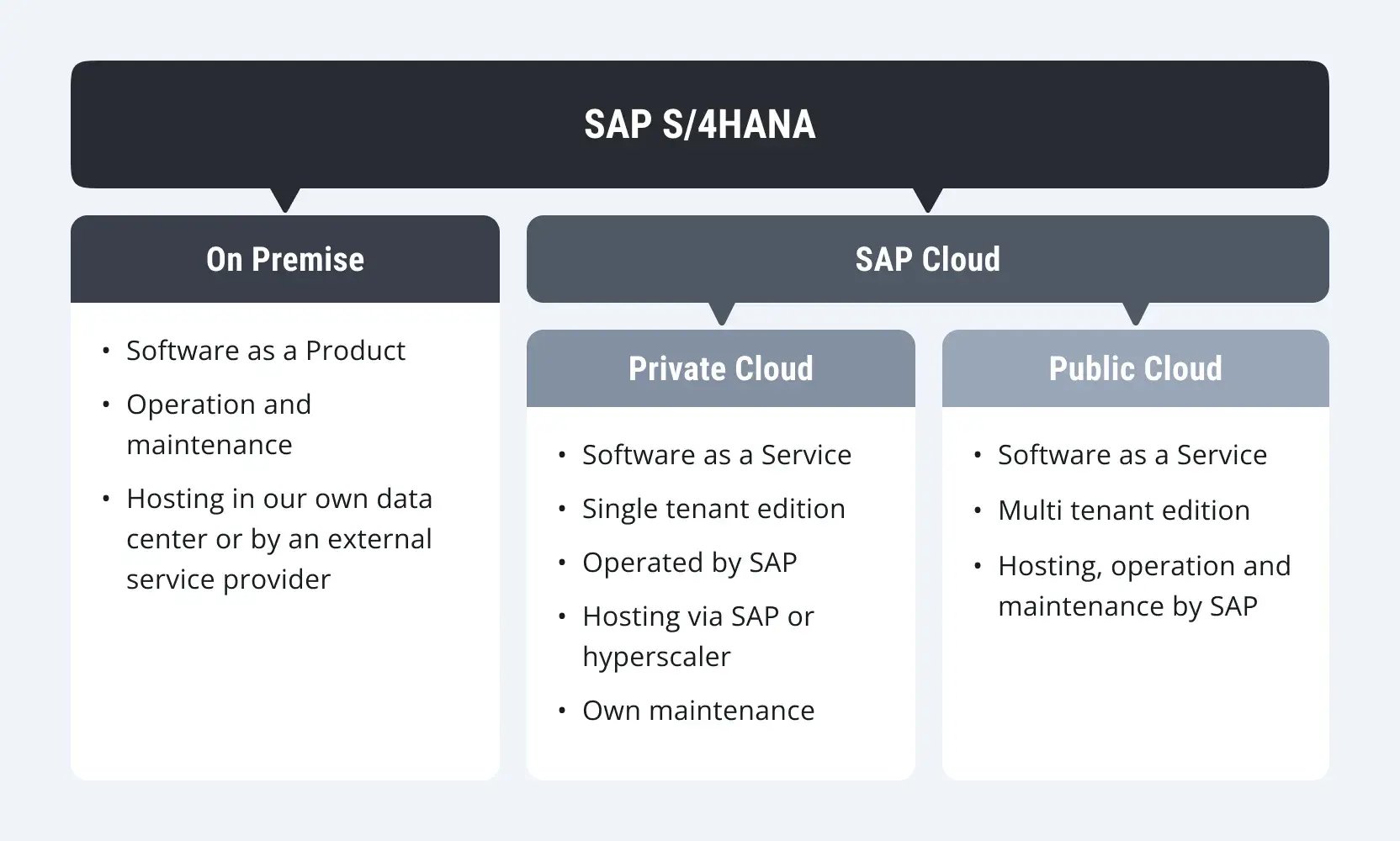
In practice, many Nordic organizations choose a controlled hybrid path instead of committing to a single option, combining different environments to balance standardization, flexibility, and regulatory requirements.
Why Cloud Strategy Looks Different in the Nordics
Cloud strategy in this region is shaped by a combination of the following structural factors:
Mature digital landscapes
In the Nordics, organizations rarely deal with simple IT setups. Most already run interconnected systems, which means any new solution has to fit into an existing, well-developed environment.
Operations across multiple countries
It is common for companies to operate across Sweden, Denmark, Norway, and Finland. This creates a need for aligned governance, consistent data management, and processes that work reliably across jurisdictions.
Transparency as a baseline expectation
There is a strong emphasis on visibility and accountability. Cloud solutions are expected to clearly show how data is handled — from access to processing — rather than treating these aspects as background operations.
Sustainability as a decision factor
In the Nordics, infrastructure choices are frequently assessed in terms of energy efficiency and environmental impact, making cloud strategy part of broader ESG commitments.
Sovereignty and controlled modernization
Organizations place more emphasis on where data resides, under which jurisdiction it is processed, and how cloud adoption can be structured without compromising regulatory alignment or operational control.
Taken together, these factors translate into a specific set of requirements for cloud environments. The next step is to look at how different SAP deployment models address these requirements in practice and what they enable for the business.
What Public Cloud Offers Nordic Companies
|
Faster innovation cycles |
Fit-to-standard transformation |
Lower operational complexity |
Best for low-customization environments |
|
Public cloud provides continuous access to new SAP functionality without long upgrade cycles. This allows organizations to adopt innovations earlier while reducing infrastructure-related overhead. |
It supports standardization across entities, which is relevant for organizations operating across multiple countries. |
Companies can reduce manual landscape management and simplify their support model. This shifts focus from system maintenance to business execution. |
Public cloud is a strong fit for companies with clean process landscapes or those starting with greenfield or transformation-led setups, where standardization and scalability are key priorities. |
What Private Cloud Offers Nordic Companies
|
Fit for complex requirements |
Customization and legacy transition |
More controlled transformation path |
Relevant for regulated industries |
|
Private cloud provides the flexibility to support custom processes, industry-specific scenarios, and integration with other systems. This is relevant for organizations with complex, interconnected landscapes. |
Private cloud is often used when organizations have an ECC footprint or cannot move quickly to a fit-to-standard model. It allows them to retain and adapt existing logic while modernizing the platform. |
This model enables a step-by-step approach to transformation, reducing operational disruption and making it easier to manage change in large organizations. |
Private cloud aligns well with complex governance requirements and industries with stronger compliance expectations, where control over architecture and operations remains critical. |
What the Hybrid Model Offers Nordic Companies
|
Balanced control and standardization |
Flexibility in workload placement |
Step-by-step transformation |
Reduced dependency on a deployment model |
|
Hybrid setups make it possible to combine standardized environments with areas that require more flexibility. Core processes can follow established models, while more complex or sensitive components stay under closer control. |
Workloads can be distributed across environments based on regulatory constraints, integration requirements, or operational priorities. This becomes especially important in multi-country scenarios, where expectations may vary between jurisdictions. |
This approach also allows companies to move forward step by step. Instead of large-scale transformation at once, they can modernize specific parts of the landscape while keeping critical systems stable. |
This gives organizations more flexibility to evolve their architecture over time and helps avoid hard constraints tied to one operating model. |
How SAP Cloud Deployment Models Align with Key Decision Criteria
The table below shows that all three models can address the same set of requirements, but in different ways and with different trade-offs.
|
Decision criterion |
Public Cloud |
Private Cloud |
Hybrid Model |
|
Data sovereignty and jurisdictional control |
✔️ Supported, but within standardized provider-controlled frameworks |
✔️ Strong control over data placement and jurisdiction |
✔️ Allows selective placement of sensitive workloads in controlled environments |
|
Sustainability and infrastructure footprint |
✔️ High efficiency through hyperscaler infrastructure and shared resources |
✔️ Can align with sustainability goals, but depends on setup and hosting model |
✔️ Enables workload placement based on sustainability priorities across environments |
|
Process standardization |
✔️ Strong fit for fit-to-standard and best practices |
❌ Less dependent on standardization, supports existing processes |
✔️ Allows gradual move toward standardization where needed |
|
Custom code and ERP complexity |
❌ Limited support for heavy customization |
✔️ Strong fit for complex logic and legacy-heavy environments |
✔️ Allows retaining complexity in selected areas while simplifying others |
|
Integration landscape |
❌ Best for lighter, API-driven integrations |
✔️ Supports deep and complex integrations |
✔️ Allows complex integrations to remain where needed while simplifying others |
|
Pace of transformation |
✔️ Faster, transformation-driven approach |
✔️ Controlled, step-by-step migration |
✔️ Enables phased transformation with different speeds across the landscape |
|
Multi-country governance |
✔️ Supports standardization across entities |
✔️ Supports local flexibility and country-specific requirements |
✔️ Allows combining centralized and local approaches within one strategy |
|
Operational complexity and governance overhead |
✔️ Lower, due to standardized model |
✔️ Moderate, depends on customization level |
❌ Higher, requires clear governance, defined ownership, and coordination across environments |
Example Scenarios for the Nordic Region
Public cloud scenario: Standardizing cross-country retail operations for faster growth
As the company grows its e-commerce business in Sweden and Denmark, differences between local processes are becoming more visible. Instead of maintaining these variations, the focus is now on bringing them into a more unified model that can support expansion and deliver a consistent experience to customers.
This is happening against the backdrop of a relatively clean IT landscape. Because there is little customization to work around, the company can move faster, scale more easily, and align operations without major restructuring.
In this case, the public cloud aligns well with the strategy. It supports process standardization, provides faster access to new functionality, and removes the need to manage infrastructure.
Another common scenario is a greenfield setup. For example, a Finnish company launches a new digital business unit and chooses not to replicate legacy systems. The public cloud allows the organization to build processes around best practices from the start and avoid accumulating unnecessary complexity.
Private cloud scenario: Operating complex and regulated SAP landscapes without redesign
A Norwegian manufacturing company with tightly coupled production planning, asset management, and shop floor integrations cannot simply move to a standardized model without breaking critical processes. The same applies to energy and financial organizations in Sweden, where auditability, data control, and system behavior are part of regulatory obligations.
In these environments, the question is not how to simplify the system, but how to modernize it without losing what already works. Private cloud supports this by allowing the existing logic, integrations, and control mechanisms to remain intact while the platform itself evolves.
Hybrid model: Moving forward without forcing a single transformation path
A Nordic industrial group with operations in Sweden, Denmark, and Finland is moving to S/4HANA. The Swedish entity has already simplified many of its processes and is ready to move toward a more standardized setup. In Denmark, however, finance and procurement are still heavily customized due to local requirements, and in Finland, logistics relies on country-specific integrations that cannot be replaced quickly.
The initial plan is to define a single target architecture for all countries. In practice, this created delays and internal resistance, as not all entities were ready to move at the same pace.
The company shifts to a hybrid approach. Sweden moves forward with a more standardized model, while Denmark and Finland retain their existing setups for critical processes. Over time, as local constraints are addressed, additional domains are gradually aligned. This allows the program to move forward without waiting for full alignment across all countries.
From Deployment Choice to SAP Cloud ERP Path
Defining the deployment model is only the first step. The next challenge is determining how to execute the move to SAP cloud ERP. At this stage, RISE with SAP, GROW with SAP, and broader modernization approaches become relevant.
These are not standalone choices but different frameworks for organizing transformation. The decision depends on factors such as business readiness, system complexity, and the target operating model.
RISE with SAP: enabling controlled transformation
RISE with SAP becomes relevant when companies need room to maneuver on their way to S/4HANA. In private cloud and hybrid setups, legacy systems, custom developments, and integrations can’t be removed in one step.
The focus shifts to maintaining control throughout the transition. Instead of rushing into standardization, companies move in stages, adjusting the landscape without disrupting core processes.
GROW with SAP: driving standardized adoption
GROW with SAP is more closely associated with public cloud environments. It is designed for organizations that are ready to adopt standardized processes and move faster, often in greenfield or transformation-led scenarios.
Here, the emphasis is on speed, simplicity, and alignment with best practices from the outset.
ERP modernization as a broader strategy
ERP modernization goes beyond specific SAP programs. It defines how transformation is structured across the organization — whether through standardization, gradual transition, or a combination of both.
This includes decisions on how different parts of the landscape evolve, how legacy systems are handled, and how business readiness is aligned with technical change.
Common Mistakes Nordic Companies Should Avoid
Choosing based only on price
Focusing only on subscription or infrastructure cost tends to drive short-term decisions. In the Nordics, where regulation, architecture, and sustainability requirements are tightly interconnected, those decisions rarely scale well. What looks like a cost advantage early on can turn into higher operational effort if the model doesn’t align with real operating needs. Teams that optimize for price first often end up dealing with rework, delays, and unnecessary complexity down the line.
Ignoring sovereignty and governance implications
In multi-country setups, data residency, jurisdiction, and governance shape the way systems are designed from the outset. These are not abstract constraints — they define what can run where and under which conditions. When these factors are addressed too late, they tend to surface as hard limitations. Teams are then forced to adjust the architecture, revisit earlier decisions, or accept restrictions on how the system can operate across different countries.
Underestimating customization debt
The amount of legacy logic embedded in ERP landscapes is often underestimated. What appears to be customization is typically the result of years of adapting the system to real business needs and integrations. When this complexity is overlooked during cloud model selection, the impact shows up quickly — unrealistic timelines, challenges with fit-to-standard, and costly adjustments later in the program.
Treating sustainability as a side topic
In the Nordics, sustainability is no longer a separate discussion — it directly influences how infrastructure choices are made. It’s part of the same decision space as cost, performance, and compliance. When it’s not considered early in the cloud strategy, the gap becomes visible later. Once infrastructure decisions are in place, aligning IT with ESG targets becomes significantly more difficult and often requires revisiting earlier choices.
Copying another company’s model without architectural fit
Following a deployment model used by another organization — even within the same industry — rarely works without adjustment. Differences in process maturity, system complexity, and governance structures mean that the same approach can lead to very different outcomes. In the Nordic context, where multi-country and regulatory factors play a significant role, architectural fit matters more than external benchmarks.
How LeverX Can Help
Our team works with Nordic companies to define SAP cloud strategies, focusing on aligning innovation, governance, sustainability, and architectural constraints within a single operating model. We start each project by understanding how the current landscape operates and what limits or enables transformation in practice.
What we support
Current-state assessment
Analysis of the existing SAP landscape, including system architecture, integrations, custom code footprint, and operational constraints.
Cloud fit analysis
Evaluation of how different parts of the landscape align with public, private, or hybrid models based on business readiness and technical complexity.
Cloud model evaluation
Structured comparison of deployment options in the context of regulatory requirements, process maturity, and long-term operating goals.
Sovereignty and governance review
Assessment of data residency, jurisdictional control, and governance requirements across multi-country environments.
Target architecture design
Definition of a future SAP landscape that balances standardization, flexibility, and compliance across different business units and regions.
Roadmap creation
Development of a phased transformation plan aligned with business priorities, risk tolerance, and organizational readiness.
Migration and implementation support
End-to-end support during transition, including system migration, integration alignment, and stabilization of the new operating model.
Why LeverX?
|
Proven track record |
Industry experts |
SAP partnership |
|
For over 20 years, we have helped businesses worldwide succeed with SAP. We’ve already completed 1,500+ projects for over 900 clients, including top names on the Fortune 500 list. |
The LeverX team includes professionals with hands-on knowledge in 30+ industries, including manufacturing, logistics, and oil and gas. |
We implement SAP projects end-to-end and collaborate with SAP on the development and enhancement of its existing solutions. |
|
Quality and security |
Investment in innovation |
Flexibility |
|
LeverX follows internationally recognized ISO standards for quality management, information security, business continuity, and asset management. |
We actively integrate advanced technologies, such as Data Science, IoT, AI, Big Data, Blockchain, and others, to help clients efficiently address their business challenges. |
Our team is available 24/7, which enables us to quickly deploy projects, maintain process transparency, and adapt each development phase to meet your specific requirements. |
Conclusion
In the Nordics, choosing between public and private cloud rarely comes down to a simple yes-or-no decision. It’s shaped by a mix of factors — governance, sovereignty, sustainability, system complexity, and how fast the organization can realistically move. Miss one of these, and the impact usually shows up later.
Teams that approach this deliberately tend to get more than just a deployment setup. They end up with an ERP foundation that holds up under regulatory change, supports expansion, and doesn’t require constant rework as the business evolves.


.webp)