Learn how SAP Cloud ERP Private works and why enterprises choose it for cloud scalability while maintaining the control and flexibility of on-premises ERP.
For many enterprises running SAP, the move to SAP S/4HANA is no longer a question of if — it’s a question of how. The real challenge isn’t just migration; it’s choosing the right deployment model. On-premises offers full control but demands heavy infrastructure investments, long upgrade cycles, and significant internal IT effort. Public cloud promises speed and lower infrastructure overhead, yet often limits customization and forces standardized processes that don’t always reflect how large organizations actually operate. And this is exactly the tension many teams are feeling right now: they want to move off on-premises, but they’re not ready to accept the constraints that can come with a public cloud-only model. They need control, customization, and speed — at the same time.
The traditional cloud-versus-on-premises framing no longer reflects how large enterprises actually operate. Most organizations are not starting from a clean slate. They manage regional regulatory requirements, complex approval structures, and years of carefully built process logic that support daily operations. SAP environments are tightly connected to finance systems, supply chain platforms, manufacturing solutions, analytics tools, and many other applications that cannot simply be paused or replaced. That’s why the deployment decision is less about preference and more about protecting what’s mission-critical while still moving faster.
That’s where SAP Cloud ERP Private (formerly SAP S/4HANA Cloud Private Edition) comes in. It gives enterprises their own dedicated cloud environment, so they’re not sharing infrastructure or constrained by a heavily standardized setup. They gain the efficiency and scalability of the cloud, but still maintain meaningful control over how their ERP system is configured and extended. In practice, it’s designed to resolve the core conflict: cloud benefits without forcing enterprises to give up the control and flexibility their business depends on.
For many large organizations, this is perceived less as a compromise than as a practical evolution — a way to modernize without disrupting the foundations on which their business is built.
What is SAP Cloud ERP Private
In SAP terms, private means your company gets its own dedicated cloud environment. With SAP Cloud ERP Private, you’re still running ERP in the cloud, but you’re not sharing the core environment with other customers the way you typically do in a public cloud setup. Your landscape is isolated and can be set up around your processes, your integrations, and the way your IT organization needs to run and govern the system.
It’s also easy to mix this up with traditional SAP hosting, but they’re fundamentally different. Classic hosting usually means taking the on-premises system you already have and moving it to infrastructure run by a third party. The system may be in someone else’s data center (or in the cloud), but your team is still responsible for most of the heavy lifting — upgrades, lifecycle planning, and keeping the environment stable. SAP Cloud ERP Private is different because it’s a defined SAP cloud model with a structured operating approach: clear standards, a managed release framework, and SLAs that align with SAP’s roadmap rather than leaving everything to customer-driven operations.
The responsibility model is clearly defined. The infrastructure runs on hyperscale platforms such as AWS, Microsoft Azure, or Google Cloud. SAP manages application-level operations within the agreed-upon scope of work. The customer remains responsible for business configuration, data management, authorization, integration, and extensions. This shared-use model allows enterprises to reduce infrastructure complexity while maintaining control over how the system supports their business.
Architecture and operating principles
SAP Cloud ERP Private runs in a dedicated, single-tenant environment. Your system is not sitting next to other customers in the same shared landscape — it has its own isolated space. That separation matters when you have strict security rules, compliance requirements, or performance expectations, and you want more room to shape how the system is set up.
Because it runs in the cloud, scaling is much less of a process. When you need more compute, more storage, or extra environments — whether for growth, busy seasons, or launching in new regions — you can add capacity without going through the usual cycle of ordering hardware, waiting on delivery, and rebuilding infrastructure.
Reliability is also part of the design, not an afterthought. The setup includes enterprise-level availability and recovery capabilities — with backup, restore, and failover processes covered by defined SLAs. If your ERP supports core finance close, production planning, or supply chain execution, that predictability is exactly what keeps modernization from turning into operational risk.
The operating model follows a shared responsibility approach:
- The hyperscaler manages the physical infrastructure.
- SAP manages core system operations within the agreed service scope.
- The customer governs business logic, integrations, security policies, and compliance.
This structure strikes a balance: infrastructure complexity is reduced, but architectural oversight and process ownership remain with the enterprise.
SAP Cloud ERP Private vs. SAP Cloud ERP vs. on-premises
When evaluating deployment options, the differences between on-premises ERP, SAP Cloud ERP (formerly SAP S/4HANA Cloud Public Edition), and SAP Cloud ERP Private become clear across several practical dimensions.
|
Criteria |
On-premises |
SAP Cloud ERP |
SAP Cloud ERP Private |
|
Infrastructure ownership |
Customer-owned and fully managed internally |
Fully managed by SAP in a shared environment |
Hosted on hyperscaler infrastructure in a dedicated single-tenant environment |
|
System control |
Maximum internal control |
Standardized governance defined by SAP |
High level of control over configuration and architecture |
|
Customization |
Deep customization and modifications are possible |
Standardized processes with in-app extensibility and side-by-side extensions via SAP BTP |
Advanced configuration, ABAP extensions, and SAP BTP side-by-side extensions |
|
Upgrade management |
Fully customer-driven; often complex and delayed |
Mandatory release cycles defined by SAP |
Managed release cycles with controlled planning and testing |
|
Scalability |
Hardware-dependent; scaling can be slow |
Elastic cloud scalability |
Elastic scalability within a dedicated environment |
|
Security model |
Managed internally |
SAP-managed shared cloud security |
Enterprise-grade hyperscaler security with environment isolation |
|
Impact on IT teams |
High infrastructure and basic workload |
Lower infrastructure workload; focus on standard process adoption |
Reduced infrastructure burden; continued architectural and integration oversight |
On-premises provides maximum freedom but also maximum responsibility. Public cloud offers speed and operational simplicity, but within a standardized framework. SAP Cloud ERP Private sits between these two models, combining cloud scalability and managed infrastructure with the flexibility and governance enterprises expect.
%20(1).webp)
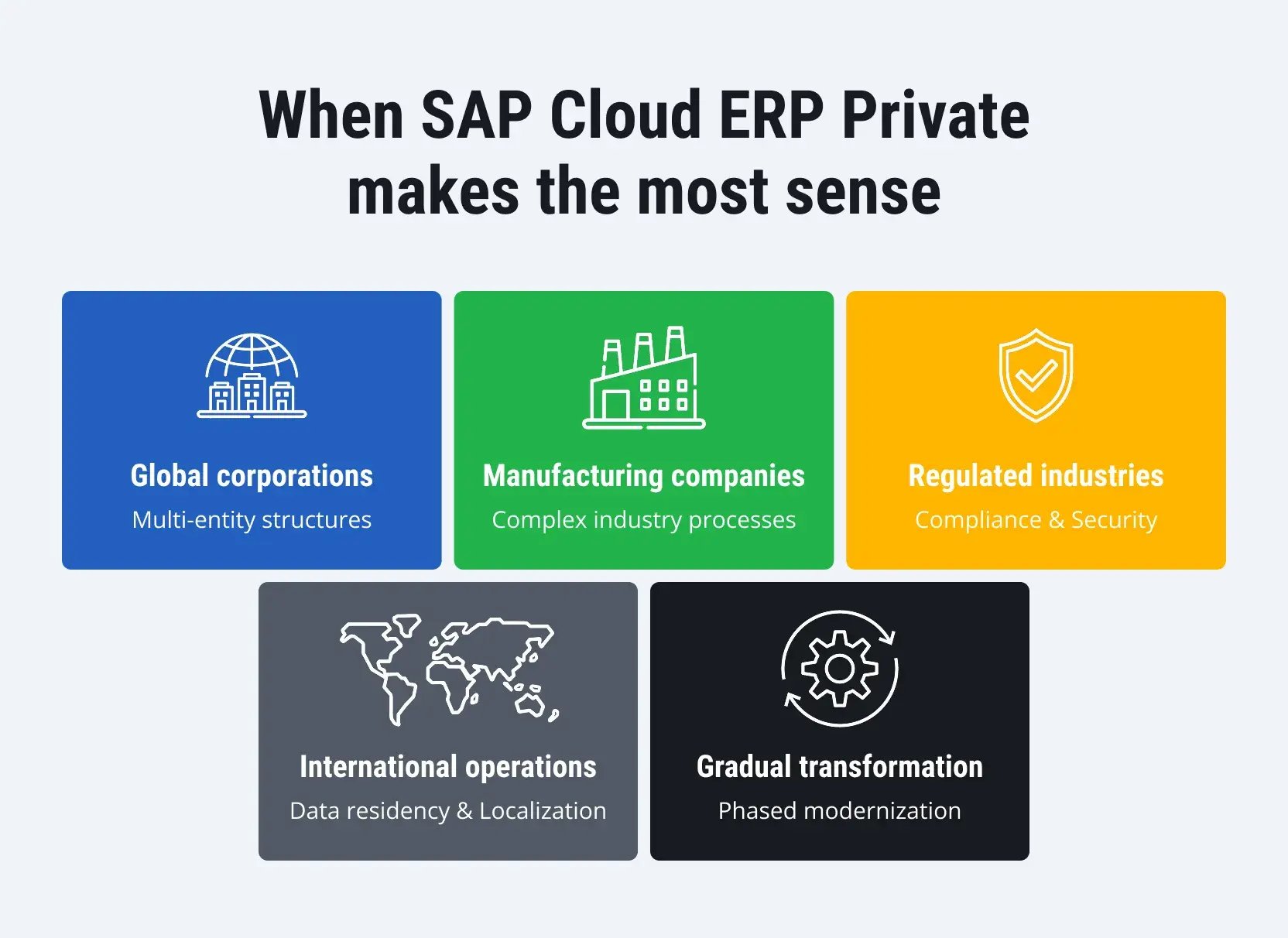
Typical use cases for SAP Cloud ERP Private
For many large organizations, it ultimately comes down to finding the right balance. They want the scalability and convenience that come with cloud infrastructure, but they’re not ready to lose the control and flexibility they relied on in their on-premises environment.
Complex corporate structures
A multinational holding with multiple subsidiaries, diverse reporting requirements, and intercompany processes often needs tailored organizational structures and advanced financial logic. SAP Cloud ERP Private supports this complexity without forcing standardized process models.
Industry-specific ERP scenarios
Manufacturing, utilities, pharmaceutical, and energy companies often rely on deeply integrated industry-specific functions. When these processes are business-critical, maintaining customization becomes essential during modernization.
International companies
Organizations operating across jurisdictions must address data residency rules, local compliance requirements, and multi-currency complexity. A dedicated cloud environment allows centralized governance while supporting regional adaptations.
Regulatory constraints
Highly regulated industries such as finance, healthcare, and defense require strict security controls and auditability. The isolated architecture of SAP Cloud ERP Private supports alignment with corporate and industry compliance standards.
Phased transformation approaches
Some enterprises prefer to modernize infrastructure first and optimize processes gradually. SAP Cloud ERP Private enables this staged approach, delivering cloud benefits without forcing immediate standardization of every business process.
Why Large Enterprises Choose SAP Cloud ERP Private
For many large organizations, the decision comes down to balance. They want the scalability and operational simplicity of cloud infrastructure, but they are not willing to give up the level of control they had in an on-premises world.
SAP Cloud ERP Private brings these elements together:
- Cloud-based infrastructure without hardware ownership or data center management
- Strong control over system configuration and architecture
- Freedom from rigid public cloud standardization
IT can keep shaping processes and extensions as the business changes without having to make everything fit a one-size-fits-all model.
For enterprises with complex operational models, this balance is often the deciding factor.
Advanced business process customization
Large enterprises rarely operate on standard processes alone. Years of optimization, regulatory alignment, and competitive differentiation are embedded in their ERP logic. SAP Cloud ERP Private supports this reality rather than requiring a reset.
Support for existing customizations
In brownfield migration scenarios, organizations often want to preserve critical custom developments that reflect unique business practices. Many existing custom developments can be preserved and adapted rather than completely rebuilt.
This is especially important for:
- Complex approval workflows
- Industry-specific transaction logic
- Custom reporting frameworks
- Advanced financial structures
Modernization becomes an evolution, not a disruption.
ABAP extensions and custom development
Unlike more standardized deployment models, SAP Cloud ERP Private supports embedded ABAP-based enhancements and controlled custom development. Enterprises can:
- Extend core functionality
- Build custom reports and interfaces
- Develop tailored business logic
- Use SAP BTP for side-by-side extensions
This flexibility allows innovation without compromising system integrity or future maintainability.
Integration with third-party systems
Enterprise landscapes are rarely limited to ERP alone. CRM platforms, manufacturing execution systems, treasury tools, data warehouses, and external partner systems must all work together.
SAP Cloud ERP Private supports complex integration architectures, making it suitable for organizations with:
- Large legacy system footprints
- Multi-vendor technology stacks
- Industry-specific external platforms
- Advanced data exchange requirements
For many enterprises, integration flexibility is just as important as core ERP functionality.
Update management and operational risk reduction
ERP systems sit at the heart of financial closing, supply chain execution, and production planning. Uncontrolled updates can disrupt critical operations.
SAP Cloud ERP Private offers a more structured and predictable release approach. Compared to fully customer-driven upgrades in on-premises environments and mandatory cycles in public cloud, this model provides:
- Planned update windows
- Controlled testing cycles
- Alignment with business calendars
- Reduced disruption to core operations
This balance helps organizations stay current with SAP innovation while protecting operational continuity.
Security, compliance, and data governance
For global enterprises, security and regulatory alignment are not secondary considerations — they are foundational.
Environment isolation
Each customer operates in a dedicated, isolated tenant. This separation reduces exposure risk and supports strict internal security policies.
Alignment with corporate governance policies
Organizations often have internal security frameworks that go beyond standard cloud requirements. SAP Cloud ERP Private allows companies to design authorization structures, data access models, and governance controls that reflect internal standards.
Support for regulatory compliance (GDPR, ISO, and others)
Enterprises operating in regulated industries must demonstrate compliance across data protection, auditability, and operational controls. The combination of isolated environments, structured SLAs, and defined operational processes supports alignment with:
- GDPR and data residency requirements
- ISO security standards
- Industry-specific regulatory frameworks
For many large organizations, this level of control over security and compliance isn’t optional — it’s simply the baseline. If they can’t meet internal policies and regulatory requirements with confidence, the deployment model is off the table. That’s why SAP Cloud ERP Private often becomes the preferred choice over more standardized cloud options.
Key Business Benefits of SAP Cloud ERP Private
Moving ERP to the cloud isn’t just a technical upgrade. For large organizations, it affects how the business actually runs — how quickly systems can adapt to change, how reliable day-to-day operations remain, and how manageable IT costs are over time.
SAP Cloud ERP Private enables companies to modernize their infrastructure while retaining control of their ERP environment. The system runs on cloud infrastructure, but businesses can continue to shape it to their own processes and requirements. This allows introducing new functionality without affecting the stability of critical operations.
Accelerating digital transformation without trade-offs
Modernizing ERP is rarely straightforward. Companies want the agility of the cloud, but they can’t risk interrupting the processes their business relies on every day.
SAP Cloud ERP Private helps strike that balance. It combines the scalability and agility of cloud infrastructure with the flexibility enterprises expect from traditional deployments.
Compared to other deployment models, it offers several advantages:
- Transform faster than on-premises environments, without the need to purchase hardware or resolve infrastructure issues.
- More flexibility than public cloud, allowing deeper configuration and extensions
- Direct access to SAP innovations, including integration with modern platforms and services
This allows companies to modernize their ERP landscape without sacrificing stability or control.
Improving operational efficiency
When ERP runs on a modern cloud architecture, many day-to-day activities become easier to manage across areas like finance, supply chain, manufacturing, and procurement.
Process optimization
When systems are built on a unified architecture, and data is easier to access, teams can simplify how work gets done. Many manual tasks and duplicate steps disappear, and processes become easier to manage across departments.
Reduced downtime and operational risk
SAP Cloud ERP Private environments are designed to keep systems stable and available. Built-in backup, recovery, and failover capabilities help limit downtime and support continuous operations.
For businesses that depend on ERP to manage production, finance, or logistics, this reliability is a key requirement.
Improved data transparency
A centralized ERP system increases transparency across departments and regions. Managers gain access to consistent information in real time, simplifying performance monitoring, enabling early detection of problems, and faster decision-making.
Reducing pressure on internal IT teams
Running traditional ERP infrastructure requires significant internal effort — from hardware management to system monitoring and upgrades.
SAP Cloud ERP Private reduces this burden by shifting infrastructure management responsibilities to the cloud environment. This allows IT teams to focus on strategic initiatives.
This typically leads to:
- Less time spent managing infrastructure
- Greater focus on innovation and process improvement
- Lower dependence on specialized hardware expertise
Instead of maintaining servers and data centers, IT teams can concentrate on improving how technology supports the business.
Scalability to support business growth
Large organizations rarely stand still. Expansion, restructuring, and new business models require ERP systems that can adapt quickly.
SAP Cloud ERP Private provides the flexibility needed to support these changes.
Geographic expansion
When entering new markets, companies often need to support additional entities, currencies, tax requirements, and regulatory rules. Cloud infrastructure allows ERP environments to expand without major infrastructure projects.
Mergers, acquisitions, and restructuring
When companies undergo acquisitions, asset sales, or other structural changes, the need to quickly integrate new systems and teams often arises. A flexible ERP system helps make this process smoother and easier to manage.
Launching new business models
When companies launch new services, digital platforms, or product lines, their ERP systems need to keep up. In a cloud environment, adding capacity or setting up additional system environments is much quicker and doesn’t require long infrastructure preparation.
Optimizing total cost of ownership (TCO)
Beyond operational improvements, SAP Cloud ERP Private can also improve the financial model of enterprise ERP systems.
CAPEX vs OPEX
Running ERP on-premises typically means investing heavily in hardware and data center infrastructure from the start. In the cloud, those costs are distributed over time as operating expenses, which makes financial planning much easier.
Transparent cost structure
Cloud environments typically use subscription- or service-based pricing models. That makes IT spending easier to predict and helps companies align costs with actual usage.
Lower infrastructure and support costs
Moving away from physical infrastructure removes many of the costs tied to hardware lifecycle management and data center operations. With fewer systems to maintain and simpler operations overall, IT environments become less expensive to run.
In the long term, this helps organizations control ERP operating costs while continuing to modernize their systems.
SAP Cloud ERP Private as Part of the Intelligent Enterprise Strategy
For many organizations, moving to SAP Cloud ERP Private isn’t just about where the system runs. It’s usually part of a broader plan to modernize the IT landscape and prepare the company for future growth and innovation.
In some cases, a private cloud becomes the long-term setup. Companies with complex processes, strict regulatory requirements, or a lot of custom logic often need the flexibility it provides. They get the benefits of cloud infrastructure but still stay in control of how the ERP environment is designed and operated.
For many organizations, private cloud is one stage in a larger transformation journey. It allows them to modernize ERP infrastructure first, and then gradually introduce additional cloud services or hybrid architectures as the business evolves.
This flexibility is what makes SAP Cloud ERP Private attractive from a strategic perspective. It supports modernization without forcing companies into a rigid long-term architecture.
Integration with SAP BTP and innovation services
The idea behind the Intelligent Enterprise is to connect ERP with modern digital tools and services. This is where SAP Business Technology Platform (SAP BTP) becomes important. It allows companies to add new capabilities and extend their ERP systems without overloading the core system.
Using SAP BTP, companies can introduce new capabilities alongside their ERP system, such as:
- Advanced analytics to gain deeper insights from operational data
- Process automation to reduce repetitive work and improve efficiency
- Artificial intelligence and machine learning to support predictive and data-driven processes
- Industry 4.0 technologies, including connections to manufacturing systems, IoT platforms, and smart factory solutions
This approach allows organizations to innovate around their ERP system while keeping the core stable. New functionality can be developed and deployed through connected services rather than deeply modifying the ERP itself.
In this way, SAP Cloud ERP Private can serve as a strong foundation for the Intelligent Enterprise, supporting both stable operations and continuous innovation.

How LeverX Helps Implement SAP Cloud ERP Private
Transitioning to SAP Cloud ERP Private takes planning. Companies first look at their current ERP landscape, decide on the best migration approach, and prepare the cloud architecture — all while keeping business processes running smoothly. LeverX helps guide this transition from the first planning steps through long-term system support.
Below are the main services LeverX provides when implementing SAP Cloud ERP Private.
ERP landscape assessment and transformation planning
The first step in any project is to review the existing system landscape and determine the most suitable transformation approach.
LeverX supports companies with:
- Assessment of the existing SAP ECC or ERP environment
- Analysis of custom developments, integrations, and system complexity
- Evaluation of data quality and system readiness
- Definition of the target architecture
- Selection of the migration approach (greenfield, brownfield, or hybrid data transition)
This phase helps organizations understand potential risks, define priorities, and create a realistic roadmap for moving to SAP Cloud ERP Private.
Architecture design and cloud environment setup
Once the strategy is defined, the next step is designing the future ERP landscape and preparing the cloud environment.
LeverX provides support with:
- Architecture design for SAP Cloud ERP Private
- Landscape planning (development, testing, and production environments)
- Hyperscaler infrastructure setup (AWS, Microsoft Azure, or Google Cloud)
- Security architecture and governance model definition
- High-availability and disaster recovery configuration
Ultimately, the goal is simple: create an ERP system that supports the business today and can scale as it grows.
System migration and data transition
Migrating to SAP Cloud ERP Private requires careful execution to minimize business disruption.
LeverX supports organizations throughout the migration process, including:
- SAP system conversion to SAP S/4HANA
- Data migration and validation
- Adaptation of custom code and extensions
- Integration adjustments with connected systems
- Testing, quality assurance, and go-live preparation
Depending on business priorities and system complexity, companies may choose different migration scenarios.
|
Migration approach |
Description |
|
Greenfield |
A new SAP S/4HANA environment is implemented with redesigned business processes |
|
Brownfield |
The existing SAP system is converted and moved to SAP S/4HANA while preserving processes |
|
Bluefield |
A hybrid approach combining process redesign with selective data migration |

Extensions, integrations, and system optimization
Enterprise ERP environments rarely operate in isolation. LeverX helps companies integrate SAP Cloud ERP Private with existing systems and extend functionality where needed.
Typical services include:
- Development of custom extensions and enhancements
- SAP BTP-based side-by-side extensions
- Integration with third-party systems and legacy applications
- API architecture and integration design
- Data and analytics integration
This allows organizations to innovate around ERP while keeping the ERP core stable.
Application support and continuous improvement
After launch, ongoing support helps ensure the system runs efficiently and continues to meet evolving business needs.
LeverX provides:
- Application management and support services
- Performance monitoring and system optimization
- Release and update management
- Security and compliance monitoring
- Continuous improvement of business processes
With this approach, companies can focus on business innovation while LeverX helps maintain and evolve the ERP environment.
Conclusion
There is no single right deployment model for SAP S/4HANA. What works for one company may not work for another. Some organizations are comfortable moving fully into the public cloud. Others still need the level of flexibility they had in their on-premises systems.
SAP Cloud ERP Private often becomes the middle ground. It makes sense for companies that have complex processes, a lot of custom logic in their ERP system, or strict requirements around security and compliance. Large international organizations also tend to choose this model because their systems must support multiple regions, entities, and integrations at the same time.
In practice, private cloud allows these companies to move their ERP infrastructure to the cloud without rebuilding everything from scratch. The system can continue supporting the processes the business depends on, while the infrastructure behind it becomes easier to manage and scale.
If you’re evaluating this option, the next step is usually to look closely at your current ERP landscape and the migration paths available. The LeverX team works with companies at this stage, assessing the existing environment, planning the transition, and implementing SAP Cloud ERP Private in a way that keeps operations stable during the change.
Frequently Asked Questions