Explore the key differences between SAP BPC and SAP Analytics Cloud to determine which planning platform best supports your long-term business strategy.
If your business already uses SAP Business Planning and Consolidation (SAP BPC), replacing it isn't necessarily the next logical step. Many companies continue to use mature planning processes in SAP BPC without the need for immediate changes.
At the same time, SAP Analytics Cloud (SAC) has become the planning platform of choice for many companies modernizing their SAP environments. This naturally raises questions. Is it worth the move? What business problems does SAC solve that SAP BPC doesn't? And when does staying where you are make more sense?
The decision goes beyond comparing product capabilities. It requires looking at how planning works today, where your SAP landscape is headed, and what your organization expects from its planning platform over the long term.
Why Organizations Are Reassessing SAP Planning Platforms
For many organizations, the discussion is no longer about replacing an existing planning tool with a newer one. It's about making sure the planning platform can support the business over the next five to ten years. Several factors are driving that conversation.
- Finance teams are expected to do more. Planning has become a continuous process, with rolling forecasts, scenario analysis, and frequent adjustments helping finance teams respond to changing business conditions.
- Cloud adoption is reshaping SAP landscapes. As companies move to SAP S/4HANA and expand their use of cloud solutions, they're reassessing how planning applications fit into their long-term architecture.
- Business users expect greater collaboration. Planning is no longer owned by finance alone. Sales, operations, supply chain, and HR all contribute to planning activities, increasing the need for connected workflows.
- Planning and analytics are becoming closely connected. Organizations want to analyze business performance and adjust plans without moving data between separate applications.
- SAP continues to invest in cloud planning. New planning capabilities are being introduced in SAP Analytics Cloud, prompting many companies to evaluate whether their existing planning platform will meet future requirements.
The decision extends well beyond product capabilities. Enterprises need a planning platform that fits the way they work today and can continue to support the business as planning requirements evolve.
SAP BPC and SAP Analytics Cloud: Two Approaches to Enterprise Planning
SAP BPC entered the market when finance teams were primarily focused on financial planning, management forecasting, and statutory legal consolidation. Planning cycles followed a predictable schedule, and most activities were managed within the finance function.
The planning process hasn't stood still. What was once largely a finance activity now involves multiple business functions, and plans are updated far more often than they used to be. As those expectations have grown, SAC has emerged as a platform built around continuous, collaborative planning rather than periodic planning cycles.
While both solutions support enterprise planning, they differ in several important areas.
|
Category |
SAP BPC |
SAP Analytics Cloud |
|
Primary focus |
Budgeting, forecasting, and financial consolidation |
Enterprise planning, analytics, and forecasting Extended planning and analysis (xP&A), predictive forecasting, and executive analytics |
|
Deployment |
On-premises or hybrid |
Cloud-native |
|
Planning approach |
Finance-led planning |
Cross-functional planning |
|
Analytics |
Separate reporting tools |
Built-in analytics and dashboards |
|
Collaboration |
Limited collaboration outside finance |
Shared planning across business functions |
|
Planning cadence |
Periodic planning cycles |
Rolling forecasts and continuous planning |
|
AI capabilities |
Limited native AI |
Predictive forecasting, smart prediction, and anomaly detection |
|
Best suited for |
Organizations with established planning models |
Organizations modernizing planning processes |
This comparison provides a general understanding of the differences between the two platforms. It's a useful starting point, but it doesn't answer the most important question: which planning approach is best suited for your organization's operations? This decision goes beyond product capabilities alone.
What SAP Analytics Cloud Changes for Planning Teams
Moving to SAP Analytics Cloud isn't really about swapping one planning tool for another. It changes how planning gets done day to day, who's involved in the process, and how quickly a finance team can respond when the business asks a hard question mid-quarter. The shift is procedural as much as technical.
Connected planning across business functions
In a lot of BPC environments, finance owns the plan, and other departments feed numbers into it on a schedule. SAC breaks that pattern. Sales, supply chain, HR, and finance can work off shared models and shared assumptions instead of separate spreadsheets that get reconciled after the fact. A demand forecast built by sales operations can flow directly into the finance team's revenue plan without a manual handoff. When headcount assumptions change in HR, the P&L forecast can reflect that same day instead of waiting for the next monthly cycle. Many companies aim to shorten planning cycles, sometimes cutting weeks off an annual budget process, because the back-and-forth of collecting and reconciling data from disconnected systems mostly goes away.
Faster scenario planning and forecasting
Running a new scenario in BPC often means rebuilding assumptions across multiple models or waiting on IT to adjust a script. SAC handles this differently. A planner can duplicate a model and adjust a handful of drivers to see the downstream impact in minutes:
- Raw material cost increases and their effect on gross margin
- Currency rate swings across regional entities
- Headcount or hiring freeze scenarios and their impact on operating expense
- Demand shocks, either upside or downside, and how they flow through working capital
That speed matters most during events such as supply chain disruptions, sudden shifts in demand, or significant currency movements. When supported by well-designed planning models, reliable data, and appropriate governance, SAP Analytics Cloud can help finance teams evaluate new scenarios much more quickly than traditional planning approaches.
Greater collaboration between finance and business users
BPC's interface, tied closely to Excel, tends to keep planning inside finance's domain. Business users submit numbers but rarely interact with the model directly. SAC's web-based interface and simplified input forms lower that barrier. A regional sales manager can adjust their own forecast, add commentary explaining a variance, and see how their input affects the broader plan, all without finance acting as an intermediary for every change. This doesn't remove finance's role in governance and validation, but it does reduce the volume of manual data entry finance has to manage on behalf of the business. Business users can complete more planning tasks independently, reducing reliance on finance.
AI-assisted planning and predictive capabilities
SAC includes predictive forecasting and anomaly detection built on machine learning, and this changes what planners spend their time on. Instead of manually building a baseline forecast from historical trends, a planner can generate one through Smart Predict and spend their time reviewing and adjusting it based on business context that the algorithm can't see, like a new product launch or a known customer contract ending. Anomaly detection flags unusual variances in actuals against plan automatically, catching issues that might otherwise surface weeks later during a manual variance review. These capabilities can reduce the time planners spend assembling baseline forecasts, giving them more time to review results, evaluate scenarios, and apply business context.
Unified planning, analytics, and visualization
Transforming planning data into a format understandable to executives typically requires a separate reporting layer, often created in a different tool. SAC combines planning, analytics, and visualization in a single environment. A planner can create a forecast and then immediately create a dashboard based on the same dataset, without exporting anything or waiting for the business intelligence team to prepare a report. Management receives a single source for both numerical data and its descriptions, and the finance department spends less time maintaining parallel versions of the same data in different systems.
Worth noting where legal consolidation fits into this picture, since it's a common point of confusion. SAP BPC handled planning and statutory consolidation together, in the same tool. SAP has since split that responsibility apart in the S/4HANA world: Group Reporting serves as the engine for legal, entity-level consolidation, while SAC handles management planning, rolling forecasts, and decision-support analytics. The two are designed to work together, with data flowing between them, but they're no longer a single application the way BPC was. Getting that separation clear early avoids architectural missteps once system design starts.
This consolidation of planning and analytics alone often justifies part of the platform cost for financial organizations that still run BPC alongside a separate business intelligence tool.
.webp)
Beyond Features: Which Planning Operating Model Fits Your Business?
Most platform comparisons stay at the feature level: this tool has predictive forecasting, that one doesn't, this one has a better mobile app. That's the wrong lens for a decision this consequential. Choosing between SAP BPC and SAP Analytics Cloud is less about comparing checkboxes and more about deciding how planning should actually run inside the company: who owns it, how fast it moves, and how much of the business gets pulled into the process versus kept at arm's length.
|
Business Consideration |
SAP BPC |
SAP Analytics Cloud |
|
Planning ownership |
Concentrated in finance, with other functions submitting data on a fixed schedule |
Distributed across finance and business functions, all working from the same shared models |
|
Business participation |
Limited, typically routed through finance as an intermediary |
Direct. Business users interact with the model through simplified input forms |
|
Collaboration |
Largely sequential, driven by email, spreadsheets, and version control between teams |
Real-time. Shared assumptions and visible commentary keep teams working inside the same model |
|
Planning frequency |
Often tied to fixed cycles: monthly, quarterly, annual |
Supports continuous or rolling planning alongside traditional cycles |
|
Scenario modeling |
Possible, but slower, often requiring script changes or IT involvement |
Fast. Planners can duplicate models and adjust drivers on their own |
|
Decision-making speed |
Constrained by the pace of the planning cycle itself |
Closer to real time, since scenarios and forecasts update as conditions change |
|
Governance |
Mature and well understood, built on years of established controls |
Configurable and modern, though it may require rebuilding familiar governance patterns |
|
Scalability |
Solid for established models, but scaling to new business functions can add complexity |
Built for a broader scale across departments and use cases without major rework |
None of this makes one platform objectively better than the other. It just means the two systems support fundamentally different ways of working. BPC fits a company where finance holds tight control over the plan and other departments contribute at defined intervals. That model still works well for companies with stable operations and mature governance already built around it. SAC fits an organization ready to distribute planning more broadly, where business units interact with the model directly, and decisions need to happen faster than a monthly or quarterly cycle allows.
The real question for leadership isn't which platform has more features. It's the operating model that matches where the business is headed. A company planning to keep its current structure, with finance as the central hub and predictable planning cycles, may find that BPC still supports that model well. A company moving toward faster decision-making, broader cross-functional input, and continuous planning will likely find that model harder to build on top of BPC's architecture, no matter how much customization gets layered on. The platform choice follows from that operating model decision. It shouldn't drive it.
Should You Stay on SAP BPC or Move to SAP Analytics Cloud?
Vendor materials often present this as an obvious upgrade path. It isn't. Implementation history, the depth of custom logic already embedded in the current model, available budget, and the timeline for any larger SAP transformation all shape what makes sense for a given organization, and two companies with nearly identical planning needs can land in different places.
When continuing with SAP BPC makes business sense
A finance team that's spent eight or ten years refining its BPC model has built something hard to replicate on a spreadsheet: institutional memory baked into the system itself. Allocation logic reflects how the business actually splits costs. Approval workflows match how budget owners actually sign off. Rebuilding that from zero rarely saves money in year one, and sometimes not in year two.
That logic gets even harder to walk away from when the model carries significant customization: a manufacturer with unusual overhead distribution, a holding company consolidating dozens of entities on staggered fiscal calendars, a retailer running seasonal forecasts tied to store-level data. None of that transfers to a new system without months of rework, and when years of tuning are baked into the model, that's not something to hand off lightly.
There's also a straightforward capital question behind all of this. Someone paid for the BPC license, the consultants who built the cube structure, the training that got finance comfortable with the tool. If the system still performs reliably, retiring it purely because a newer product exists is hard to justify to a CFO focused on return on capital. Sunk cost shouldn't drive the decision, but remaining useful life should, and BPC still has real runway in a lot of organizations.
And not every company is mid-transformation. Steady operations, no major M&A on the horizon, no board mandate to consolidate onto the cloud by a fixed date, these are legitimate reasons to leave the planning platform alone. If S/4HANA isn't on next year's roadmap, migrating the planning layer in isolation doesn't solve a problem the business is actually facing.
Taken together: a recent BPC implementation still finding its footing, heavy custom logic, a stable process, a tight modernization budget, and no S/4HANA timeline in view all point toward staying put, at least for now.
Signs your organization is ready for SAP Analytics Cloud
Other situations point the opposite direction, just as clearly:
- SAP S/4HANA transformation. Aligning the planning platform with a transition already underway avoids running two modernization projects on two timelines.
- A cloud-first IT strategy. Once leadership has committed to cloud across the stack, an on-premise planning tool becomes the exception that needs justifying.
- Rolling forecasts. BPC can be pushed toward continuous forecasting. SAC was built for it.
- Enterprise planning initiatives. Extending planning into workforce, supply chain, or sales needs a platform designed for that scope natively.
- Stronger cross-functional collaboration. SAC's model lets business units work inside the plan directly, rather than submitting numbers through finance as an intermediary.
- Executive demand for self-service analytics. A unified planning and visualization environment removes the wait on finance to build a report.
Decision matrix
|
If your priority is... |
Typical fit |
|
Protecting existing investments |
SAP BPC |
|
Modernizing enterprise planning |
SAP Analytics Cloud |
|
Supporting rapid business growth |
SAP Analytics Cloud |
|
Maintaining stable planning processes |
SAP BPC |
|
Improving collaboration |
SAP Analytics Cloud |
Staying with SAP BPC can be the right decision. Moving to SAP Analytics Cloud can be, too. What matters is whether the platform fits the organization's planning processes, its SAP roadmap, and its actual business objectives, not whether it happens to be the newer name on the slide.
Modernization Doesn't Always Mean Immediate Migration
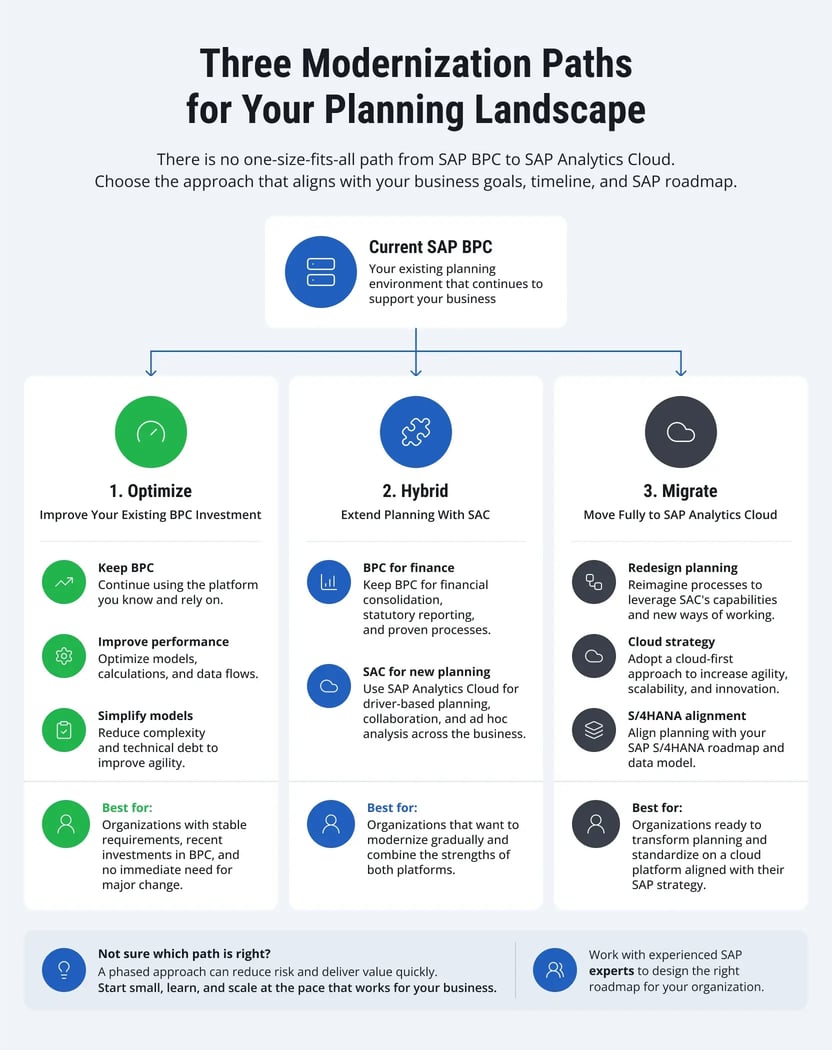
Treating modernization as a binary choice, stay on BPC as-is or migrate to SAC entirely, misses how most companies actually approach it. The real decision usually falls somewhere in between, shaped by budget, risk appetite, and how badly the current process is actually hurting.
Continue optimizing SAP BPC
Sometimes the better return comes from fixing what's already there. A BPC environment with a decade of accumulated script logic often has dead weight in it: unused models, redundant calculations, workflows nobody remembers the reason for. Cleaning up unused models, removing redundant calculations, and improving performance can add years of useful life to the system without opening the platform question at all.
Run SAP BPC and SAP Analytics Cloud together
A fair number of companies don't pick one platform. They run both. SAC handles a specific use case, often rolling forecasts or a new planning initiative outside finance, while core financial planning stays in BPC. It's a low-risk way to test whether SAC actually fits before betting the whole planning function on it.
Modernize planning incrementally
Instead of one cutover event, some companies move a single planning area at a time. Workforce planning first. Revenue next. Consolidation last, once the earlier phases have proven out. Each step delivers value on its own, and nothing forces the team to relearn the entire planning process in one weekend.
Transition to SAP Analytics Cloud
Full transition
A complete migration makes sense when there's a clear business objective behind it, not simply because a newer platform is available. Transformation to SAP S/4HANA, a cloud-first strategy, or planning needs that have outgrown SAP BPC capabilities are all common reasons for completely migrating planning to SAP Analytics Cloud.
Phased transition
A full migration doesn't have to happen all at once. Many enterprises move planning workloads gradually, starting with a single planning area such as workforce planning or revenue forecasting before expanding to additional processes. This phased approach reduces project risk, gives users time to adapt, and allows teams to validate the new planning model before completing the transition.
Common Mistakes When Modernizing Enterprise Planning
Most failed planning transformations don't fail because of the software. Consider a scenario common enough across finance organizations to be almost predictable: a modernization project launches on time and on budget, and six months later, almost nobody is actually using it. That gap, between a project that succeeds on paper and one that actually changes how planning gets done, is where most of these mistakes live.
Treating modernization as an IT project
Planning belongs to finance, with IT as an enabler. Too often, that gets flipped: IT owns the timeline, finance reviews requirements after the fact, and by the time the system goes live, it reflects technical decisions nobody in finance actually asked for.
The workflow details that make a planning tool usable, how approvals route, how commentary gets captured, and how exceptions get flagged, rarely make it into a project charter written primarily by IT. Missing those details doesn't break the system. It just makes it something finance tolerates instead of relying on.
Recreating legacy planning processes
There's a strong pull toward rebuilding the old model exactly as it was, just on newer infrastructure. It feels safer than redesigning from scratch. It's also usually a wasted opportunity, since a process shaped around one platform's limitations doesn't need to survive the move to a different one.
Ignoring organizational change
New input forms and a cleaner interface don't automatically change habits built over years. What actually shifts behavior:
- Clear communication about why the process is changing, not just that it's changing
- Training that covers the new workflow, not just the new buttons
- Support that continues well past go-live, since most resistance shows up weeks later, not on launch day
Skip these, and the technology can be flawless while adoption quietly fails anyway. Usage drops, workarounds appear, and the team drifts back toward whatever spreadsheet habit the project was supposed to replace.
Defining technology before planning strategy
Some companies pick a platform first and figure out the planning process afterward. That sequence rarely works, because a company that hasn't decided whether it wants rolling forecasts or driver-based models can't meaningfully judge any tool against requirements that don't exist yet. Strategy has to come first, or the platform ends up shaping the process instead of the other way around.
Underestimating cross-functional planning requirements
Sales, supply chain, and HR often need things from a planning model that finance doesn't see from the outside: different levels of detail, different timing, different tolerance for how far a forecast can drift before it's a problem. A model built around finance's needs first, then extended to other departments as an afterthought, tends to need expensive rework once those gaps show up in production.
These aren't platform-specific problems. They show up in planning transformations across every vendor and every industry because they're organizational failures wearing a technology costume. Mitigating this risk means defining a planning strategy before evaluating any tool, engaging stakeholders in design discussions early rather than late in testing, and allocating real time to change management rather than treating it as a cost item to be cut when deadlines are missed. If this process is properly established, the underlying platform is typically less important than most vendors would have you believe.
How LeverX Helps Modernize SAP Planning
Deciding between BPC and SAC is only the first question. Getting the answer right for a specific company, then executing on it without disrupting finance's ability to close the books, is where most of the actual work happens. That's the part LeverX gets brought in for.
We typically start with a planning assessment, looking at the current BPC environment, how planning actually runs day to day versus how it's documented, and where the gaps sit between what the business needs and what the system currently supports. That assessment shapes everything that follows, since a recommendation made without it tends to be generic advice dressed up as strategy.
For companies staying on BPC, at least for now, we work on optimization: cleaning up years of accumulated script logic, retiring models nobody uses anymore, and tuning performance where it's degraded. This work alone has extended the useful life of BPC environments by several years for clients who weren't ready to migrate but needed the current system to run better.
Where SAC is the right direction, our consulting covers model design, connected planning setup, and the predictive and self-service capabilities the platform offers, tailored to how a specific finance team actually wants to work rather than a generic template rollout.
A few other areas we get pulled into regularly:
- Planning process redesign, rethinking workflows rather than just replatforming the old ones, which is often where the real value in a transformation actually sits
- Coexistence strategy, for organizations running BPC and SAC side by side and needing a clear plan for what lives where, at least until a fuller transition makes sense
- BPC migration planning, mapping out the sequence, risk points, and timeline before any technical work starts
- S/4HANA planning integration, aligning the planning layer with a broader S/4 transformation instead of treating it as a separate project running on its own schedule
Past go-live, we stay involved through application management, handling ongoing support, performance tuning, and the ongoing optimization that keeps a planning environment, BPC, or SAC, from drifting back into the state that made modernization necessary in the first place.
We treat planning modernization as a business decision with technology consequences, not a technology project that finance has to adapt to. That's the same principle this whole article has been built around, and it's the one we bring into every engagement.
Building a Future-Proof Planning Strategy
Nothing in this article argues that SAP Analytics Cloud is inherently better than SAP BPC, or the other way around. That framing misses the point. The right platform comes from factors specific to that company, not from which system happens to be newer.
A handful of factors drive the decision more than anything else:
Business strategy sets the direction first. A company planning to expand into new markets or extend planning scope across departments needs a platform built for that reach. One focused on steady, predictable operations may not.
Planning maturity matters just as much. A finance team running a well-tuned, heavily customized model has real reasons to protect that investment, at least until there's a clear operational reason to change course.
The finance operating model shapes the decision, too. Centralized, finance-owned planning suits one kind of platform. Distributed planning with business units actively involved suits a different approach.
Cloud roadmap ties the planning decision to everything else happening across the SAP landscape. A platform choice made in isolation, disconnected from where S/4HANA and the broader IT strategy are headed, tends to create rework later rather than saving anyone the trouble now.
Collaboration requirements determine how much of the business needs to sit inside the planning process itself, rather than feeding numbers into it from the outside.
Long-term scalability determines whether the platform chosen today still fits the organization three or five years out, not just at the moment of implementation.
None of these factors points to a single right answer across the board. They point to a right answer for each business, one arrived at by looking honestly at where the business actually stands rather than where industry conversation says it should be headed.
Before committing to a platform decision, it's worth assessing the current planning strategy on its own terms: what's working, what isn't, and what the business actually needs from planning over the next few years. LeverX works with finance and IT leaders on exactly that kind of assessment, helping organizations find the right path before locking in a technology choice. If that's a conversation worth having for your business, we're glad to start there.
Conclusion
SAP BPC and SAP Analytics Cloud aren't competing for the same title. One was built for a world where finance owned the plan and updated it on a predictable schedule. The other was built for continuous planning that pulls in people well outside finance. Both still work, depending on which one matches how a specific organization actually operates. A company with a mature BPC model and no urgent driver for change has good reason to keep running it. A company already moving toward S/4HANA or chasing rolling forecasts has just as good a case for moving to SAC now.
The decision isn't as permanent as it sometimes gets treated, either. Coexistence, incremental modernization, and continued optimization of an existing BPC environment are all legitimate stops along the way, not consolation prizes for companies not ready to commit. Plenty of organizations get years of value out of a "not yet" answer before eventually landing on "now." What tends to go wrong isn't picking the wrong platform. It's skipping the strategy work that should come first: understanding current planning maturity, being honest about budget and timeline, and getting business functions involved before technical decisions get locked in.

-min-1.jpg)