Understand the difference between Chorus Pro (B2G) and France’s B2B e-invoicing reform. Learn how each model impacts SAP processes, data, and compliance.
France’s e-invoicing landscape is entering a new phase, but many companies are approaching it with the wrong assumption: that existing Chorus Pro SAP B2G vs. B2B experience is enough to handle what’s coming next. However, it isn’t.
The confusion stems from mixing two fundamentally different frameworks:
- The established B2G invoicing France SAP model via Chorus Pro
- The upcoming B2B e-invoicing France SAP and e-reporting reform
They may sound related, but from an SAP and operational standpoint, they behave differently across nearly every dimension that matters.
Understanding that difference early is what separates smooth compliance programs from expensive redesigns.
What Chorus Pro Is Used For
Chorus Pro is the long-standing platform for public sector invoicing in France, and it must be integrated directly with SAP processes. It is mandatory for any company supplying goods or services to government entities in France.
Over time, it has become a stable and predictable environment:
- Suppliers submit invoices through a centralized platform.
- Public entities receive, validate, and process them within the same ecosystem.
- Status tracking and feedback loops are standardized.
From an SAP perspective, organizations typically implement SAP Chorus Pro integration to:
- Generate compliant invoice formats, such as Factur-X, UBL, and CII
- Transmit documents directly to the platform
- Receive and process status updates
This setup is mature. Most large organizations operating in France already have it in place. But here’s the critical distinction: Chorus Pro was designed specifically for B2G transactions; it was never intended to scale into a universal invoicing or reporting platform for all business interactions.
What Changes With B2B E-Invoicing and E-Reporting
Starting in September 2026, France will roll out a broader compliance framework under the France invoicing reform, which will affect the SAP landscape for local businesses.
This reform introduces two major components:
- Mandatory e-invoicing for domestic B2B transactions
- Mandatory e-reporting for transactions outside the e-invoicing scope
Key characteristics of this structural shift include:
- Expansion from the public sector to the private sector
- Introduction of the PPF (Portail Public de Facturation) as the central hub and certified PAs (Plateformes Agréées)/PDPs (Partner Dematerialization Platforms) as intermediaries for invoice exchange
- Continuous transaction reporting requirements beyond invoice exchange
Unlike Chorus Pro’s centralized model, the B2B framework is distributed:
- Invoices must be routed through either the PPF (Public Portal) or a certified PA/PDP, depending on the chosen setup.
- Reporting flows must reach tax authorities in near real-time.
- Responsibility is split between companies, platforms, and authorities.
This creates a very different set of requirements for SAP systems, especially when compared to legacy SAP DRC France Chorus Pro setups.

B2G vs B2B: The Operational Differences
At a glance, B2G via Chorus Pro and the upcoming B2B e-invoicing reform may seem like variations of the same idea. In reality, they operate on different assumptions about how invoices move, who is responsible for them, and what data must be captured along the way.
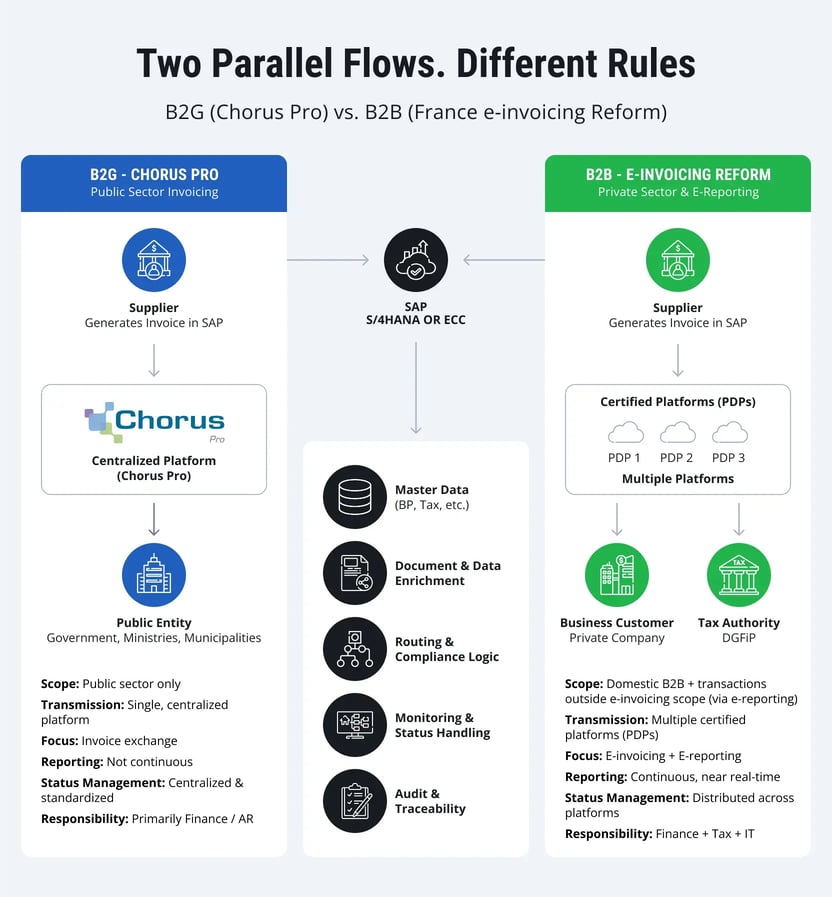
The first major distinction is the type of counterparty involved. Chorus Pro is strictly limited to transactions with public entities — ministries, municipalities, and other government bodies. The B2B reform, on the other hand, applies to domestic private companies. That alone changes the scale and variability of transactions your SAP system must handle.
Closely tied to that is the transmission model. In the B2G world, invoices are submitted through a centralized platform — Chorus Pro. The process is linear and predictable, with static routing based on predefined connections. With B2B, that simplicity disappears. In the French “Y-model”, invoices must be routed through either the PPF or a certified PA/PDP, depending on the recipient’s configuration. Unlike the static routing of Chorus Pro, SAP systems must dynamically query the Annuaire (central directory) to determine each recipient’s delivery channel in real time. This makes routing a live decision point rather than a fixed integration path, significantly increasing the complexity of SAP process design.
The scope of compliance is another breaking point. Chorus Pro focuses on invoice exchange. The B2B reform expands this significantly by introducing mandatory e-reporting. That means your system is no longer just sending invoices. It is continuously reporting transaction data, statuses, and sometimes payment information to tax authorities. The process becomes ongoing rather than event-based.
This leads directly to data requirements. B2G flows rely on structured invoice data defined by public sector standards. B2B flows require a broader dataset — including tax-relevant details, transaction context, and lifecycle updates. If your SAP data model isn’t prepared for that expansion, you’ll end up retrofitting it under pressure later.
Then there is status management, which becomes noticeably more complex. Chorus Pro provides a centralized and relatively consistent set of statuses. In the B2B model, SAP must track and reconcile mandatory lifecycle statuses such as Déposée (submitted), Rejetée (rejected due to technical issues), Refusée (refused by the recipient), and Encaissée (paid). These updates can come from different platforms and intermediaries, which means that maintaining consistent status synchronization inside SAP requires stronger monitoring and exception-handling capabilities.
From an organizational perspective, process ownership also shifts. B2G processes are typically handled within finance or accounts receivable teams. B2B compliance cuts across finance, tax, and IT. That means decisions about process design, data structures, and integrations can’t sit in one department anymore.
All of this accumulates in the most critical difference — the impact on your ERP system. Chorus Pro integrations are often implemented as an additional layer on top of existing SAP processes. The B2B reform goes deeper. It affects how documents are created, enriched, routed, and reported. In other words, it forces changes inside the core logic of your system, not just at the edges.
Put simply, B2G is a controlled, single-channel process. B2B is a distributed, multi-platform compliance model with continuous reporting obligations. Trying to run both through the same logic is where things break. SAP teams need to treat them as two parallel streams — each with its own rules, data flows, and monitoring requirements.
What SAP Teams Need to Change
This is where many organizations underestimate the effort. The B2B reform is not a simple extension of existing processes; it requires structural adjustments.
Separate process logic
Finance and accounting teams need to clearly distinguish between B2G and B2B flows. A single unified process will not handle both scenarios correctly.
Enhanced master data and tax logic
Business partner data must support classification between public and private entities. Tax determination must incorporate new reporting obligations tied to transaction types.
Advanced monitoring and exception handling
B2G and B2B flows introduce different failure points. Monitoring tools must track each route independently and provide clear visibility.
Automated inbound invoice processing
Accounts Payable processes also need to evolve. Instead of manually entering supplier invoices, SAP should be configured to automatically retrieve, validate, and post incoming documents received through the PPF or certified PAs/PDPs. This shifts AP teams toward an exception-based workflow, where users focus on resolving discrepancies and validation issues rather than processing every invoice manually.
Redesigned document output strategy
Invoice generation is no longer just about format. It must include routing decisions, reporting triggers, and lifecycle tracking.
In short, SAP must evolve from a document sender to a compliance orchestrator.
SAP Solutions Relevant to Chorus Pro and B2B Readiness
A robust architecture typically involves a combination of SAP solutions working together, especially when handling both Chorus Pro SAP B2G vs. B2B scenarios in parallel.
- SAP S/4HANA — a central system for transaction processing and compliance logic.
It determines how transactions are classified and processed before anything is sent externally. Managing French compliance requires a clear split between B2G and B2B workflows right from the start. We configure the system to identify the invoice type immediately, ensuring the correct reporting and routing logic before the data even leaves your ERP. - SAP ECC — still relevant in many existing landscapes. Many companies continue to run SAP ECC and already use it for SAP Chorus Pro integration. However, supporting the B2B reform in ECC environments typically requires significant middleware, add-ons such as SAP Document Compliance, or additional integration layers to handle real-time reporting, routing logic, and expanded data requirements.
- SAP Document and Reporting Compliance (SAP DRC) — supports regulatory reporting and localization. This solution plays a key role in generating compliant invoice formats and required reporting structures. With the French reform, it becomes more important as it must handle both structured invoice output and additional e-reporting data aligned with tax authority requirements.
- SAP Business Technology Platform (SAP BTP) — enables extensions and flexible compliance logic. SAP BTP is typically used to build country-specific logic without overloading the core ERP. In France, it can support routing decisions, data enrichment, or adaptations required by different platforms involved in the B2B ecosystem.
- SAP Integration Suite — manages communication with external platforms and PAs/PDPs. It acts as the bridge between SAP and external systems like Chorus Pro or certified PAs/PDPs. While B2G scenarios usually rely on a single connection, B2B setups require more advanced routing and message handling across multiple platforms.
- SAP Application Interface Framework (SAP AIF) — provides monitoring, error handling, and transparency. It helps track document flows, detect errors, and support issue resolution. This becomes especially important in B2B scenarios, where multiple systems are involved and identifying the source of a failure is not always straightforward.
Common Misconceptions
Despite the amount of information already available, many companies in France are still approaching the reform with flawed assumptions. These misconceptions directly lead to poor SAP design decisions and costly rework later.
“We already use Chorus Pro, so we are ready for B2B”
This is the most common — and the most dangerous — assumption. Yes, experience with Chorus Pro gives teams a starting point, especially in terms of structured invoicing and platform-based submission. But the similarity ends there.
The B2B reform introduces a completely different scope. It expands beyond invoice exchange into continuous e-reporting, introduces multiple platform interactions, and requires richer datasets. Companies that assume their existing France Chorus Pro SAP setup can simply be extended usually discover too late that core process logic is missing.
“B2G and B2B use the same logic”
At a high level, both models deal with electronic invoicing. That’s where the similarity stops. The operational logic behind them is fundamentally different.
B2G is centralized, predictable, and limited in scope. B2B is distributed, dynamic, and involves multiple stakeholders. Treating them as one unified process inside SAP leads to incorrect routing decisions, incomplete reporting, and gaps in compliance. In practice, this often shows up as broken integrations or inconsistent data across systems.
“Only invoice output changes”
Many teams initially frame the reform as a formatting exercise — update the invoice, adjust the output, and move on. That approach underestimates the scale of change.
The reform affects how transactions are classified, how data is enriched, and how information is reported throughout the lifecycle of a document. It also introduces new responsibilities for monitoring and reconciliation. In other words, this is about process design.
“This is a tax topic, not an ERP topic”
Tax requirements are the trigger, but SAP is where everything actually happens. Excluding ERP teams from the early planning stages is a recipe for project failure.
This reform forces a deep dive into master data, document architecture, and integration logic. When companies treat this purely as a tax task, they almost always hit a wall during implementation and are forced into expensive, late-stage redesigns.
LeverX Services for France B2G/B2B SAP Scenarios
Supporting both Chorus Pro SAP B2G vs. B2B scenarios requires more than technical adjustments — it requires a structured approach that connects compliance requirements with real SAP execution.
LeverX helps organizations navigate this transition by aligning business processes, system architecture, and regulatory expectations from the start.
We begin with a flow assessment, identifying how current invoicing and reporting processes operate and where they fall short of upcoming requirements. This step often reveals hidden gaps, especially in companies that assume their Chorus Pro setup is sufficient.
From there, we develop B2G and B2B process mapping, clearly separating the two streams and defining how each should function within SAP. This avoids the common mistake of forcing both models into a single process.
Our team provides SAP architecture advisory, ensuring that solutions such as SAP S/4HANA, SAP Document and Reporting Compliance, and integration layers are used correctly and efficiently. The focus is on scalability — not just meeting current requirements, but adapting to future regulatory changes.
We also design the format and routing logic, which becomes significantly more complex in B2B scenarios involving multiple platforms. Getting this right early prevents integration bottlenecks later.
Finally, we support readiness, rollout, and post-go-live stabilization, helping teams transition smoothly and maintain control once the system is live. This includes monitoring setup, issue resolution processes, and continuous optimization.
Business Benefits
Approaching the French reform with a clean SAP design isn’t just about staying compliant. It changes how smoothly the whole operation runs.
Clarity across teams
- When B2G and B2B flows are clearly separated, confusion drops fast
- Finance, tax, and IT stop working off different assumptions
- Fewer internal back-and-forths about ownership and responsibilities
Accurate scope from the start
- Distinguishing Chorus Pro from B2B early prevents under-scoping
- Project timelines and budgets are based on reality, not guesses
- Less risk of unpleasant surprises halfway through implementation
Fewer redesigns mid-project
- A solid setup upfront avoids ripping things apart later
- No need to rework integrations or patch missing logic under pressure
- Teams stay focused on delivery instead of constant corrections
Closer fit to compliance requirements
- SAP processes are aligned with how the regulation actually works
- Lower risk of rejected invoices or reporting inconsistencies
- Interactions with platforms and authorities become more predictable
More stable operations in the long term
- Separate processing paths make the system easier to manage
- Issues can be isolated without disrupting everything else
- Monitoring and error handling become far less chaotic
Closing Thoughts
Chorus Pro remains a critical part of the French compliance landscape, but it represents only one piece of a much larger picture.
Experience with Chorus Pro vs. B2B e-invoicing France scenarios can be valuable, but it does not automatically translate into readiness for the upcoming reform. The two models operate differently, and they demand different approaches inside SAP.
Companies that treat them as a single stream will run into process issues, integration challenges, and unnecessary rework. Those who recognize the distinction early and design their systems accordingly will be in a much stronger position.
In this transition, the difference is not a technical detail. It’s whether the system was designed with the right assumptions from the start.