Discover how companies in France can adapt SAP systems for e-invoicing and e-reporting compliance through PA/PDP integration, SAP DRC, and automated reporting workflows.
France is currently launching one of the most comprehensive tax digitization initiatives in Europe. This reform goes beyond simple invoice exchange by redefining how transactional data is shared, verified, and monitored by the government. For any organization active in the French market, this shift is no longer just a minor accounting concern. It fundamentally impacts ERP structures, integration methods, and daily compliance tasks.
Many firms still rely on fragmented workflows, manual checks, or isolated reporting tools. However, these traditional methods carry significant risk under the new mandate. The reform alters the entire landscape of invoicing and reporting, particularly for SAP users, where data flows through various systems and connections.
The real hurdle is not just creating a digital file. Instead, companies must now manage structured reporting and establish secure connections with a PA (Plateforme Agréée) / PDP (Plateforme de Dématérialisation Partenaire) to meet much tighter delivery schedules. Achieving compliance requires deep integration at the system level to replace manual intervention. Because of these factors, integrating SAP e-reporting in France has evolved into a major strategic initiative instead of a simple technical fix.
Overview of the French E-Invoicing and E-Reporting Reform
The French government pushed this reform forward to modernize VAT reporting and gain a clearer view of business transactions. Officials are looking for faster data access, fewer reporting errors, and a much tighter grip on the tax collection process as a whole.
At the heart of the move is DGFiP, the French tax authority. They are responsible for setting the compliance rules and managing the entire reporting landscape.
The reform introduces three major changes:
- Mandatory B2B electronic invoicing
- E-reporting obligations for specific transactions
- Centralized invoice exchange through PAs/PDPs
Some companies still associate French electronic invoicing primarily with Chorus Pro, which has long been used for public sector invoicing. However, under the new B2B e-invoicing framework, Chorus Pro is evolving into the PPF (Portail Public de Facturation), while the broader B2B e-invoicing model introduces expanded reporting and integration requirements centered around certified PAs/PDPs.
For many organizations, this represents a massive operational pivot. Traditional invoicing—built on PDFs, emails, and slow reporting cycles—no longer meets the requirements of the new compliance model.
Instead, businesses are now required to send invoices and reporting data in specific, structured formats through approved digital channels. This puts immediate pressure on ERP systems, particularly legacy SAP ERP environments that were never intended to handle continuous regulatory reporting.
Key Requirements for Companies Operating in France
Mandatory B2B e-invoicing
Domestic B2B invoices must be exchanged electronically using compliant structured formats.
That sounds straightforward on paper. In reality, many organizations still generate invoices through customized SAP processes involving multiple systems, approval chains, and local adaptations.
The reform forces companies to standardize and automate those workflows.
SAP systems must be adapted to support structured data exchange while ensuring invoice data remains accurate across every stage of processing.
This often affects:
- Invoice creation logic
- Tax determination rules
- Master data governance
- Document validation processes
- Approval workflows
- Integration architecture
The complexity increases quickly in organizations with international entities or heavily customized ERP environments.
E-reporting obligations
Not all transactions fall under mandatory B2B invoicing rules. Certain operations still require separate electronic reporting to French authorities.
These may include:
- B2C transactions
- Cross-border operations
- Payment-related reporting
- Additional VAT reporting scenarios
Unlike periodic tax reporting cycles used in the past, the new framework moves toward near-real-time visibility.
That changes operational expectations significantly. Reporting delays, inconsistent tax codes, or missing transactional data become much harder to hide inside month-end correction cycles.
Integration with PAs/PDPs
Under the French model, companies exchange invoices and reporting data through certified PAs/PDPs; integration with them is mandatory for compliance.
This is where many SAP projects become more complicated than expected. Businesses are not just connecting one system to another. They are building a controlled reporting pipeline involving:
- ERP data extraction
- Format transformation
- Validation logic
- Secure transmission
- Status tracking
- Exception management
In many cases, organizations require additional middleware or integration services beyond core SAP functionality. Organizations typically need middleware, APIs, orchestration layers, or specialized compliance services.
Standardized data formats
France requires invoice and reporting data to follow specific structured formats. That requirement exposes a common problem inside large ERP landscapes: inconsistent data. A company may technically generate invoices from SAP, yet still fail compliance checks because:
- Tax mappings differ between entities.
- Customer master records are incomplete.
- Invoice fields are populated inconsistently.
- Legacy customizations conflict with reporting logic.
This is why automation is essential to reduce errors and ensure reporting accuracy.
What Is a PA/PDP and Why It Matters
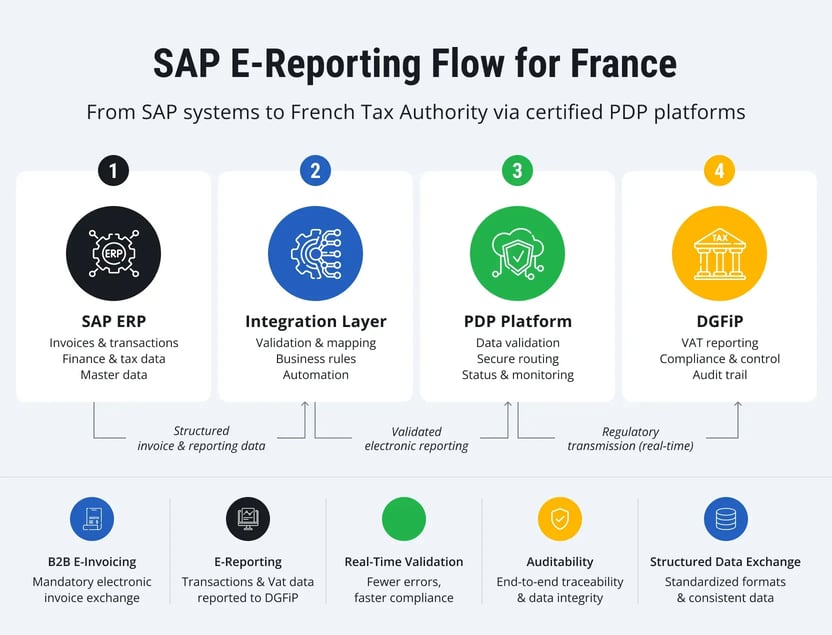
A PA/PDP acts as the intermediary between businesses and French tax authorities. Its role is broader than simple document routing. PAs/PDPs validate invoice content, transmit reporting data, monitor transaction status, and ensure compliant communication with DGFiP.
From a business perspective, a PA/PDP effectively becomes part of the invoicing infrastructure itself. Companies must connect ERP systems to PAs/PDPs in a way that supports:
- Secure data exchange
- Traceable reporting flows
- Validation controls
- Reporting acknowledgments
- Audit readiness
For SAP teams, this creates additional architectural requirements. A typical integration scenario may involve SAP ERP, middleware, tax engines, external validation services, and PA/PDP APIs all working together inside the same reporting process. When one layer fails, invoice processing can stop entirely.
Challenges of SAP E-Reporting Integration
Adapting invoicing processes
Most invoicing workflows were built for internal approvals and generating documents, rather than constant electronic reporting. The French reform fundamentally changes that operational model. Now, invoice data has to be validated much earlier and structured right from the start so it can move through digital channels without anyone touching it. For companies running heavily customized SAP environments, even a tiny data mismatch can spiral into massive reporting issues later on.
Ensuring data quality and consistency
E-reporting involves much more than just submitting reporting data to tax authorities. Your data has to stay consistent and auditable throughout the entire transaction lifecycle. If things like VAT indicators, payment references, or customer IDs don't match up between systems, PA/PDP validation failures are going to happen. In reality, many businesses only realize they have deep-rooted data governance issues once they actually start compliance testing.
Integration complexity
SAP landscapes are often highly interconnected. A standard enterprise setup might juggle several different pieces:
- SAP ECC or SAP S/4HANA
- Third-party billing tools
- CRM systems
- Tax engines and middleware
- External reporting services
Adding PA/PDP integration makes the coordination between these layers a lot more difficult. Even a small mapping error between systems can stall your reporting flow or trigger compliance flags.
Handling real-time requirements
Traditional tax reporting models usually allowed companies time to reconcile discrepancies after transactions had already been processed. That window is narrowing quickly as France moves toward the September 2026 go-live of its Continuous Transaction Control (CTC) framework. Under the new model, invoice and reporting data increasingly need to be validated through certified PAs/PDPs during transmission rather than corrected later during audit cycles. Companies now need pipelines that can handle near-real-time processing, which puts a serious strain on:
- Integration stability
- System performance
- Monitoring and support teams
For high-volume businesses, maintaining this continuity during peak times often requires a major rethink of their underlying architecture.
Why Manual or Partial Solutions Are Not Enough
Some companies initially try to solve compliance gaps with spreadsheets, standalone reporting tools, or semi-manual processes layered on top of SAP. That usually works until transaction volumes increase.
Manual approaches introduce several problems very quickly:
- Reporting delays
- Inconsistent validations
- Operational bottlenecks
- Higher error rates
- Limited traceability
- Audit exposure
Partial solutions also create fragmentation. Finance teams end up reconciling information across multiple systems while IT teams struggle to maintain disconnected integrations. Over time, the operational cost becomes harder to justify than the original automation investment.
How SAP Supports E-Reporting Compliance
SAP Document and Reporting Compliance (SAP DRC)
SAP Document and Reporting Compliance helps organizations manage country-specific electronic invoicing and statutory reporting obligations. For France, SAP DRC can support:
- Electronic document processing
- Compliance reporting workflows
- Structured invoice generation
- Integration with external platforms
- Monitoring and audit capabilities
As the French framework continues to evolve, SAP is also expanding its role within the compliance ecosystem. Since becoming a certified PA in early 2026, SAP can support more native, end-to-end invoicing and reporting scenarios directly within SAP-driven environments.
For multinational companies, this is particularly important because compliance models are expanding across Europe at different speeds and with different technical requirements.
Integration capabilities
SAP provides multiple integration options for connecting ERP environments with PAs/PDPs and external compliance ecosystems. Depending on the landscape, organizations may use:
- SAP Integration Suite
- Middleware platforms
- APIs
- Cloud integration services
- Hybrid integration architectures
The right model depends heavily on transaction volumes, ERP complexity, and existing infrastructure.
Reporting automation
Automated reporting workflows reduce operational overhead significantly. Instead of manually preparing and validating reporting data, companies can automate:
- Invoice extraction
- Compliance checks
- Document routing
- Submission tracking
- Exception handling
This becomes especially valuable in large environments where invoice volumes make manual controls unrealistic.
Data consistency and traceability
One of SAP’s biggest advantages is centralized process visibility. Integrated compliance workflows help organizations maintain:
- Reporting traceability
- Consistent tax logic
- Audit-ready records
- Centralized monitoring
- Controlled exception management
That level of visibility becomes increasingly important as reporting requirements tighten.
Integration Scenarios for SAP Systems
SAP ECC
Many companies in France still operate SAP ECC environments with years of custom development behind them. Those systems can support compliance requirements, but additional integration and transformation layers are often required.
Common focus areas include:
- Middleware implementation
- Invoice mapping logic
- API connectivity
- Reporting orchestration
- Format transformation
SAP S/4HANA
SAP S/4HANA offers stronger integration capabilities and a more modern reporting architecture. Still, compliance is not automatic. Companies typically need to adapt:
- Invoicing workflows
- Reporting configuration
- Tax determination logic
- Integration monitoring
- Governance processes
Even modern ERP platforms require careful localization for French reporting rules.
Hybrid landscapes
Hybrid environments are increasingly common, especially in multinational organizations. A company may process invoicing through SAP while customer data, billing logic, or reporting functions sit in external platforms. That creates an additional challenge: maintaining reporting consistency across systems that were never designed to work together for regulatory reporting.
Typical Implementation Approach
Compliance assessment
The project usually starts with a detailed review of current invoicing and reporting processes. This phase identifies:
- Compliance gaps
- Integration dependencies
- Data quality risks
- Reporting scope
- Architecture limitations
Architecture design
After the assessment, companies define the target integration model. That includes decisions around:
- PA/PDP connectivity
- Middleware strategy
- SAP configuration
- Security requirements
- Monitoring architecture
Integration with PA/PDP
This stage focuses on establishing secure and compliant communication between SAP systems and PAs/PDPs. Typical activities include:
- API integration
- Data mapping
- Orchestration setup
- Validation logic
- Error handling configuration
Testing and validation
Testing is usually more complex than expected. Organizations need to validate not only invoice formatting, but also:
- Reporting consistency
- Workflow behavior
- Integration stability
- Exception handling
- Performance under load
Go-live and monitoring
Compliance does not end at deployment. Once reporting goes live, companies need continuous monitoring for:
- Transmission failures
- Validation errors
- Reporting delays
- Regulatory updates
- Operational bottlenecks
Without proper monitoring, small reporting issues can accumulate quickly.
Common Mistakes in E-Reporting Projects
Several problems appear repeatedly in SAP compliance projects.
The most common include:
- Delaying preparation until deadlines approach
- Assuming existing invoicing workflows are already compliant
- Underestimating PA/PDP integration complexity
- Relying on manual validation processes
- Ignoring master data quality issues
- Treating compliance as only an IT initiative
- Reducing testing timelines to accelerate go-live
A surprising number of projects fail because companies focus on technical connectivity while overlooking operational process redesign. The integration may technically work, yet the reporting process itself remains unstable.
Business Benefits Beyond Compliance
Most organizations start these projects because they have to. But once invoicing and reporting processes become more automated, additional operational benefits usually follow.
Companies often see improvements in:
- Invoice processing speed
- Reporting accuracy
- Audit readiness
- Operational transparency
- Process standardization
- Reporting visibility
More importantly, businesses become better prepared for future digital tax regulations, which are expanding rapidly across Europe. That matters because France is unlikely to remain an isolated case. Similar reporting frameworks are already influencing compliance strategies in multiple jurisdictions.
LeverX Services for SAP E-Reporting Integration in France
LeverX partners with businesses throughout France to align their SAP setups with the shifting e-invoicing and e-reporting landscape. Our experts support your team with the following.
- SAP DRC implementation: We handle the configuration of SAP Document and Reporting Compliance, tailoring it to French-specific reporting logic and document workflows.
- PA/PDP integration projects: We build reliable, secure links between SAP and certified PAs/PDPs. This covers everything from API setups to message orchestration and live transmission monitoring.
- Invoicing process transformation: Our team helps you redesign legacy workflows. The goal is to move toward structured electronic invoicing and automated checks that actually improve control.
- Compliance assessments: We analyze your current ERP setups and reporting models to find where the gaps are. We focus on identifying operational risks before they become a problem.
- SAP integration architecture: We design frameworks that scale. Whether you use SAP ECC or SAP S/4HANA, we ensure your middleware and tax engines work together seamlessly.
- Reporting automation: We aim to cut out manual work. We do this by automating data extraction, validation, and how your system handles reporting exceptions.
- Testing and validation: Before anything goes live, we rigorously test invoice formats and PA/PDP communication to ensure the integration is stable and accurate.
- Ongoing compliance support: After the go-live, we stay involved. We provide monitoring, help with new regulatory updates, and keep your reporting processes running smoothly.
The New Reality for SAP in France
The French e-invoicing reform is changing how companies manage invoicing, reporting, and tax-related data exchange.
For SAP-driven organizations, compliance is no longer limited to document generation or periodic reporting. It now depends on integrated workflows, structured data exchange, PA/PDP connectivity, and automated reporting processes.
Adapting SAP systems is essential to meet today's rigorous data exchange and compliance standards. Companies that start early protect themselves from sudden disruptions and find it much easier to modernize their invoicing. Treating e-reporting as a strategic shift rather than a quick fix consistently leads to superior long-term performance.