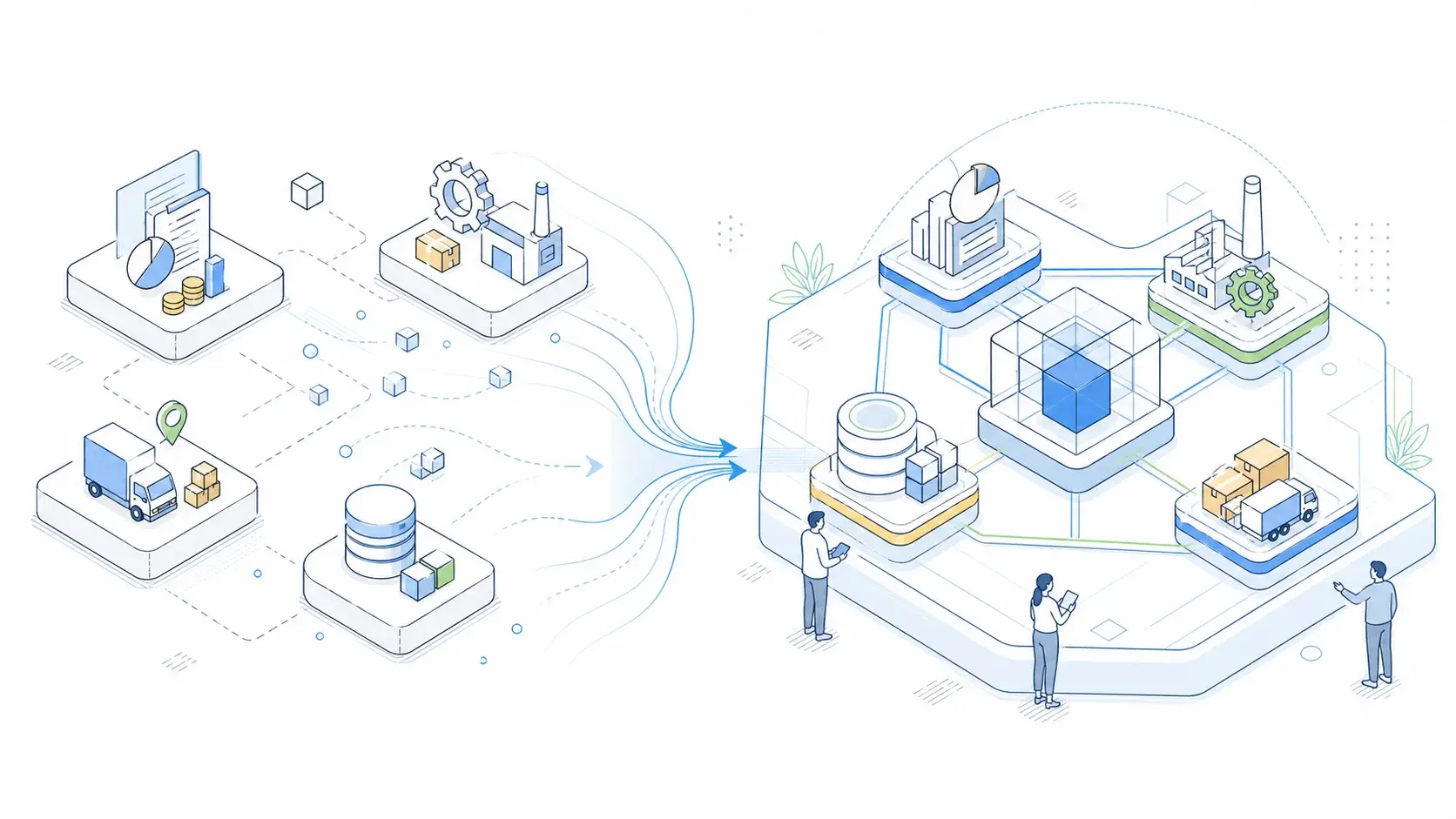
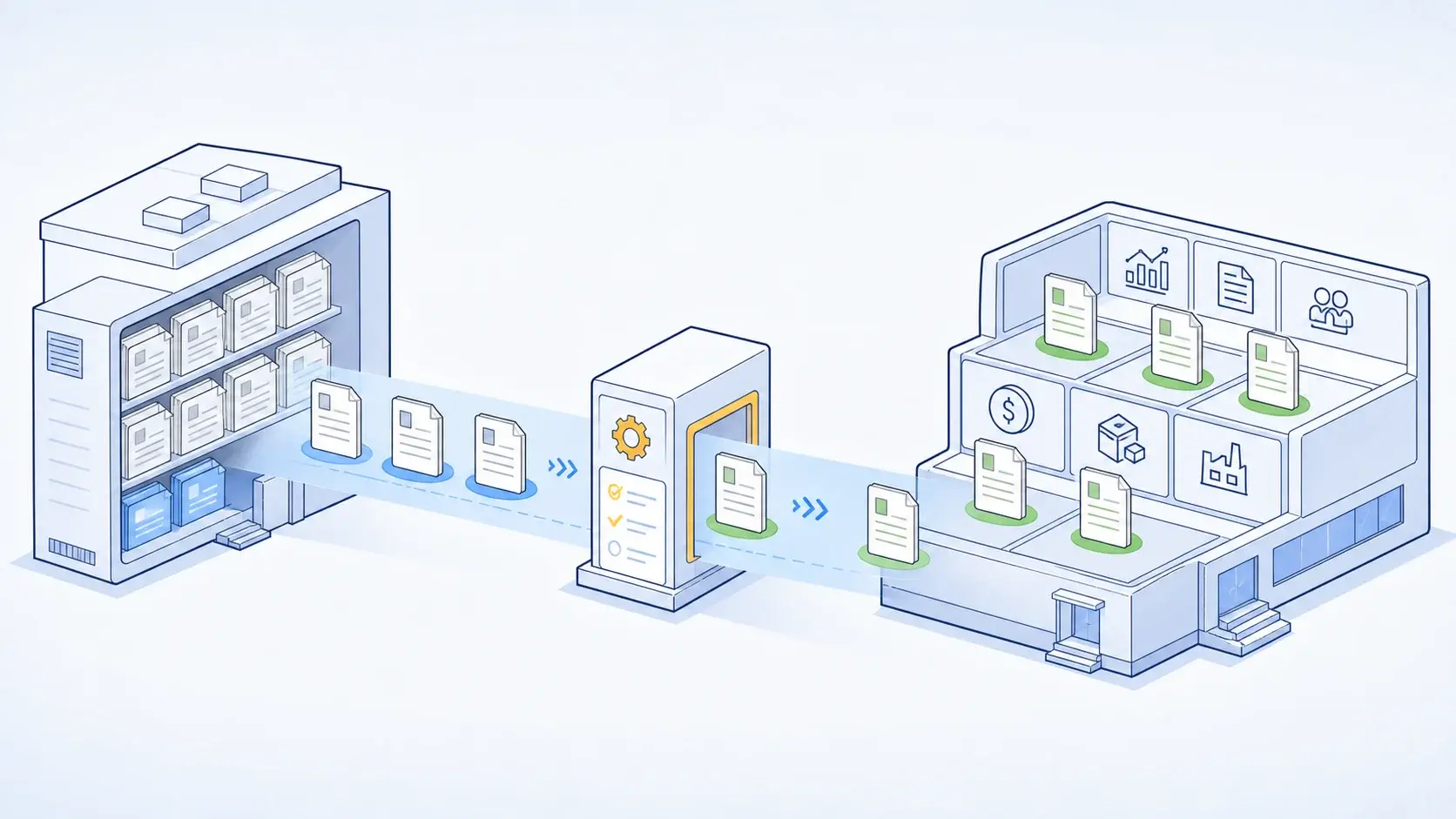
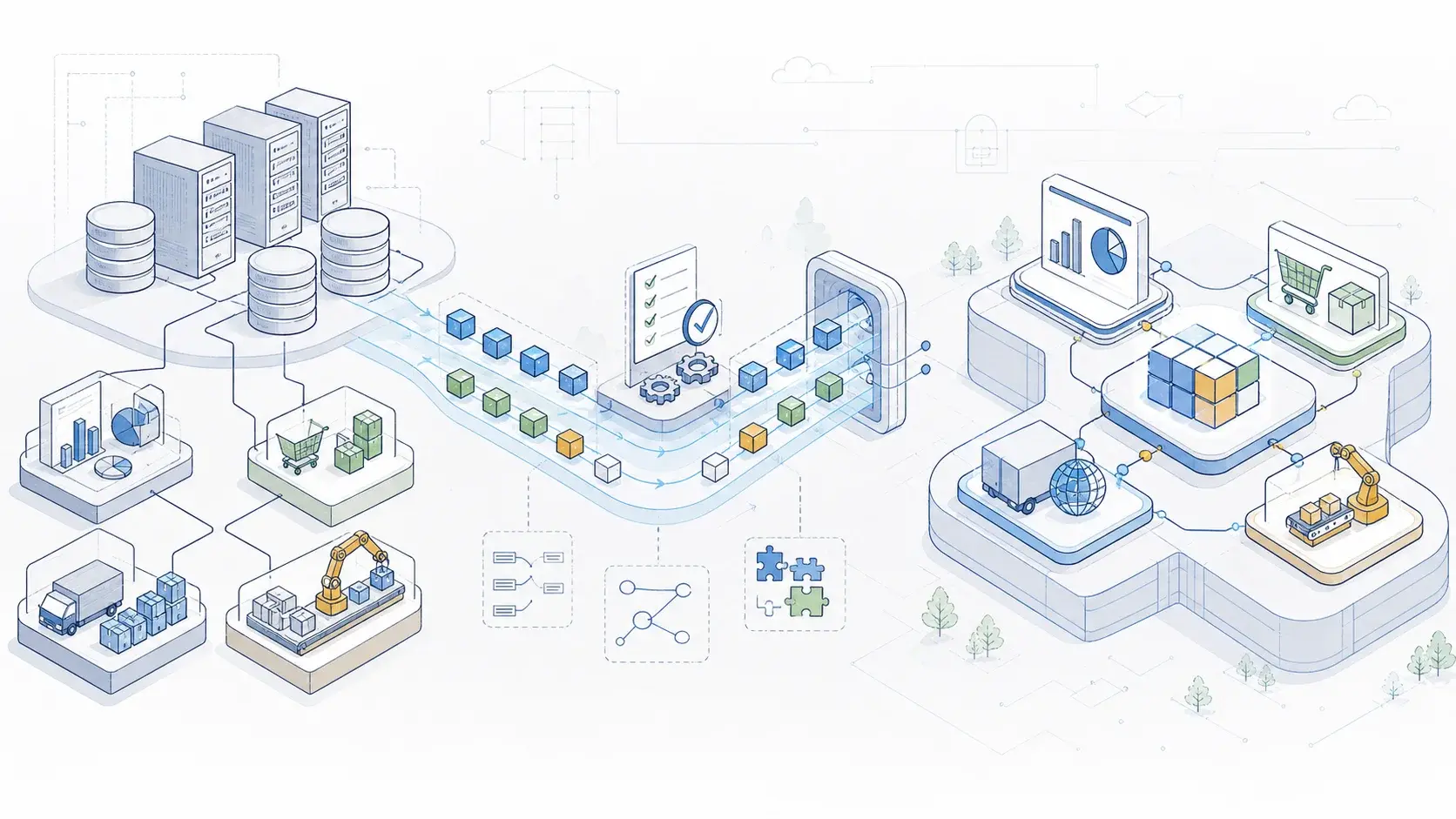
Learn how different SAP S/4HANA migration approaches affect ERP transformation strategy and long-term system architecture.
An SAP S/4HANA project can shape a company's ERP strategy for the next decade. For U.S. businesses, choosing the right migration path is rarely just a technical decision. It can affect business processes, data, integrations, reporting, custom code, operating models, and long-term technology costs.
The decision becomes even more important as companies modernize SAP ECC environments, prepare for the 2027 maintenance milestone, and look for ways to combine ERP modernization with automation, analytics, and AI.
The terminology can also create confusion. Migration, conversion, transition, Brownfield, Greenfield, and selective data transition are often used interchangeably, even though they describe different approaches to moving to SAP S/4HANA.
Using the wrong terminology can lead to the wrong project assumptions. A company may underestimate data work, overlook custom-code dependencies, misjudge the timeline, or compare implementation proposals based on very different scopes.
For growing businesses, the priority may be to establish a scalable ERP foundation without overengineering the transformation. For larger organizations, the decision may involve multiple legal entities, acquisitions, SAP systems, complex integrations, and different operating models.
This guide explains the main SAP S/4HANA migration approaches, how they differ, when each makes sense, and what U.S. businesses should evaluate before selecting a path.
Key Takeaways
- Migration is an umbrella term, not a specific implementation method.
- System conversion (Brownfield) preserves more of the existing SAP environment and can suit companies that want continuity while modernizing the platform.
- New implementation (Greenfield) creates a new S/4HANA environment based on standardized processes and is useful when legacy processes or architecture need substantial redesign.
- Selective data transition sits between the two, allowing organizations to selectively move data, configuration, and business structures.
- SAP S/4HANA Cloud Public Edition follows a new implementation model, while SAP S/4HANA Cloud Private Edition supports multiple transition scenarios depending on the starting environment and target architecture.
- For U.S. businesses, the right path depends on data quality, custom code, integrations, legal entities, business processes, cloud strategy, and the desired future operating model.
- The best migration path is a business decision supported by technical analysis—not simply the fastest route to go-live.
Why SAP S/4HANA Migration Terminology Matters
SAP transformation projects can stall before implementation because stakeholders use different terms to describe the same initiative.
A CIO may refer to the project as an “S/4HANA migration.” An implementation partner may describe it as a “Brownfield conversion.” The business may expect a broader transformation that includes process redesign and data restructuring.
These differences matter because they affect scope, data, custom code, testing, timeline, cost, and business disruption.
Calling a project a “migration” does not tell you whether the organization plans to preserve existing processes, redesign them, selectively move historical data, consolidate systems, or adopt a standardized cloud model.
For U.S. businesses preparing an RFP, the distinction is especially important. Different migration scenarios can result in very different project scopes and implementation proposals.
Define the transition scenario before comparing vendors. Once the current SAP landscape, business objectives, target architecture, data requirements, and expected level of process change are clear, you can evaluate partners against the same criteria. Our guide to choosing an SAP S/4HANA migration partner in the USA covers the key factors, from migration experience and architecture to data, integrations, delivery, commercial scope, and post-go-live support.
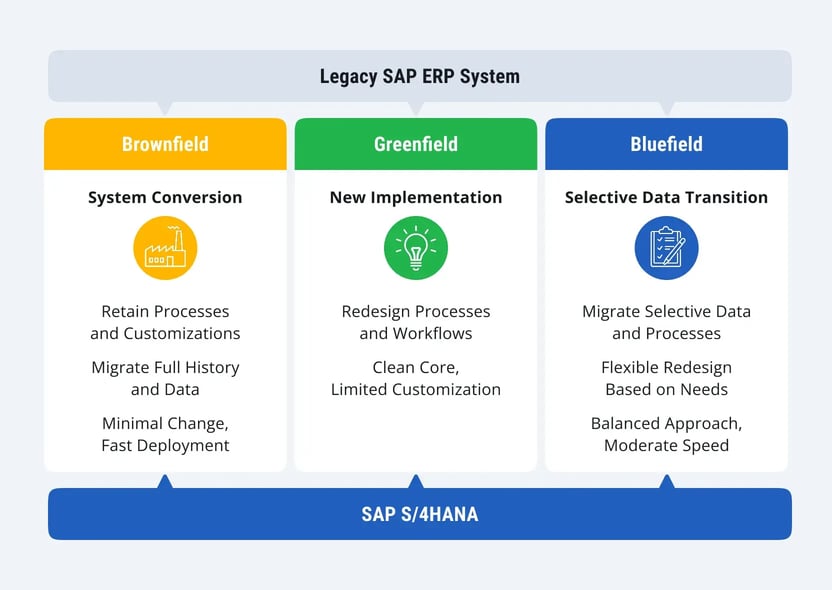
What Do Migration, Conversion, and Transition Actually Mean?
The terminology can be confusing, especially when different teams use the same words to describe different implementation scenarios. At a high level, there are four concepts to keep in mind:
- Migration - the broad term for moving from an existing ERP environment to SAP S/4HANA.
- System Conversion (Brownfield) - transforms an existing SAP ERP system into SAP S/4HANA while retaining much of the current environment.
- New Implementation (Greenfield) - creates a new SAP S/4HANA environment and redesigns processes around the target operating model.
- Selective Data Transition - selectively moves data, configuration, and business structures while removing obsolete complexity.
The right approach depends on what the business wants to preserve, what needs to change, and how much technical debt the current environment contains.
Migration
Migration is the general term for moving from an existing ERP environment to SAP S/4HANA.
It does not describe a specific implementation method. The actual migration scenario determines what happens to business processes, configuration, historical data, custom code, integrations, and organizational structures.
That is why simply calling a project an “S/4HANA migration” is not enough to define its scope.
System Conversion - Brownfield
A system conversion starts with an existing SAP ERP system and transforms it into SAP S/4HANA.
This approach is often called Brownfield because the existing system remains the starting point. The organization can preserve significant elements of its configuration, business processes, data, and organizational structures while adapting them to S/4HANA.
System conversion can make sense when:
- Current business processes largely support the way the company operates
- Historical data needs to remain in the operational system
- Existing custom code is manageable and still provides business value
- Business disruption needs to be minimized
- The organizational structure remains relevant
- A full process redesign would add unnecessary risk
Brownfield does not mean “lift and shift.” Existing custom code, integrations, data structures, and business processes still need to be assessed and adapted to the S/4HANA architecture.
New Implementation - Greenfield
A new implementation creates a new SAP S/4HANA environment instead of converting the existing ERP system.
This approach is useful when an organization wants to redesign its operating model, standardize processes, remove historical technical debt, or consolidate outdated structures.
Greenfield can be particularly relevant for U.S. companies that have:
- Highly customized SAP ECC environments
- Multiple ERP instances
- Major process inconsistencies between business units
- Significant technical debt
- Poor master-data quality
- Recent acquisitions that created fragmented processes
- A strategic goal to standardize operations
A new implementation can also provide a cleaner foundation for analytics, automation, and AI because the organization starts with more standardized processes and a more controlled data model.
Selective Data Transition
Selective data transition provides a middle ground between system conversion and a completely new implementation.
Instead of moving the entire legacy environment, the organization selectively migrates the data, configuration, and business structures it still needs.
This approach can be particularly valuable for companies with:
- Multiple SAP systems
- Acquired or divested business units
- Large amounts of obsolete historical data
- Outdated organizational structures
- Processes that need selective redesign
- A need to balance continuity with transformation
The key advantage is control. Instead of choosing between preserving everything and rebuilding everything, the organization decides what should move forward and what should be left behind.
How Should U.S. Businesses Choose the Right SAP S/4HANA Path?
Selecting the right transformation approach starts with a few strategic questions. First, look at your current ERP environment: which processes, data, customizations, and integrations are still worth carrying forward?
If the existing system is stable and supports the business well, preserving more of it may reduce disruption. If years of custom code, inconsistent processes, or outdated structures are holding the business back, a more comprehensive transformation may make more sense.
Critical questions for your strategy
- Technical debt: How much custom code is sitting in your current SAP system?
- Process gaps: Do you need to fix major workflows across different departments?
- Historical data: Do you really need decades of records inside the new live system?
- Innovation readiness: Do you need advanced analytics or AI automation immediately?
Choosing the right path early helps avoid carrying unnecessary complexity into the new environment. It also creates a foundation that supports both immediate business needs and longer-term digital goals.
SAP S/4HANA path selection matrix
|
Criteria |
System conversion (Brownfield) |
New implementation (Greenfield) |
Selective data transition |
|
Data strategy |
Keep all historical data |
Start fresh with master data |
Selective historical data |
|
Process model |
Existing processes retained |
Best-practice redesign |
Selective process optimization |
|
Technical debt |
Preserved |
Eliminated |
Reduced |
|
AI readiness |
Moderate, requires the Clean Core retrofitting and data cleansing to be effective |
High, relies on standardized processes and clean master data |
Optimized, |
|
Timeline* |
6–10 months |
12–18 months |
9–18 months |
*These are indicative ranges for standard, single-country projects, not fixed delivery timelines. Actual schedules depend on factors such as database size, number of legal entities, custom-code volume, data quality, integrations, process redesign, testing, and rollout scope. Resource availability can also affect delivery timelines as demand for experienced SAP S/4HANA specialists increases ahead of the SAP ECC maintenance deadline.
The target cloud model is another important consideration. SAP S/4HANA Cloud Public Edition follows a new implementation model, while SAP S/4HANA Cloud Private Edition provides more flexibility for organizations moving existing SAP environments to the cloud. Depending on the starting environment and target architecture, Private Edition can support system conversion, new implementation, or selective data transition.
For organizations considering a move to SAP S/4HANA Cloud through RISE with SAP, the deployment model should be evaluated alongside the migration strategy - not as a separate decision.
How Do You Choose the Right SAP S/4HANA Migration Approach?
The right migration approach depends on what you want to preserve, what needs to change, and how complex the current SAP landscape is.
Project timeline is one factor, but it should not drive the decision on its own. As a general planning range, a focused single-country transformation may take 6–18 months, while larger and more complex programs can take 18–24 months or longer.
Typical SAP S/4HANA migration timelines
|
Migration scenario |
Typical timeline* |
|
System conversion (Brownfield) |
6–12 months |
|
Selective data transition |
9–18 months |
|
New implementation (Greenfield) |
12–18 months |
|
Large or complex transformation |
18–24+ months |
*These are indicative planning ranges, not fixed project estimates.
The actual timeline depends on custom code, data quality, integrations, business-process changes, number of entities, testing, resource availability, and rollout scope. A technically faster conversion can take longer overall if the starting environment is highly customized or the business is not ready for the change.
What Is Your Timeline and Target Deployment Model?
The SAP ECC maintenance milestone is an important planning factor, but it should not determine the migration approach by itself. Companies still running SAP ECC should assess their maintenance position early enough to avoid a rushed transformation and give the business time to evaluate data, custom code, integrations, and process changes.
The target deployment model also matters. SAP S/4HANA Cloud Public Edition follows a new implementation approach, while SAP S/4HANA Cloud Private Edition provides more flexibility for organizations that need options such as system conversion or selective data transition.
For a growing business, Public Edition may support a more standardized operating model. Companies with established SAP processes, significant customizations, or complex integrations may need the additional flexibility of Private Edition. RISE with SAP can be considered as part of the broader cloud and migration strategy.
The key is to choose the migration approach based on the business and technology starting point - and then make sure the timeline and deployment model support that decision.
Typical SAP S/4HANA Migration Mistakes
The biggest migration mistakes often happen before the technical migration itself. They usually start with an overly narrow view of the project - treating it as a system upgrade rather than a transformation that affects processes, data, integrations, and the future operating model.
Choosing Brownfield only because it looks faster
System conversion can appear to be the quickest option because it allows organizations to retain much of their existing SAP environment. But the timeline advantage can disappear once teams uncover years of custom code, obsolete interfaces, inconsistent master data, and processes that no longer support the business.
A shorter technical path is not necessarily a shorter transformation. Before choosing Brownfield, organizations should assess how much of the existing environment is still worth carrying forward and whether the expected reduction in disruption outweighs the effort required to remediate legacy complexity.
Treating custom code as an afterthought
Legacy SAP environments can contain large volumes of custom ABAP, much of which may have been developed to address business requirements that have since changed.
During conversion, custom code should be assessed against the S/4HANA architecture and data model. Some developments can be remediated, others may be replaced with standard SAP functionality, and some may no longer provide enough business value to justify carrying them forward.
The objective should not be to reproduce ECC inside S/4HANA. It should be to preserve what still creates value while reducing unnecessary technical debt and moving appropriate extensions outside the core.
Moving data that nobody needs
Historical data can create significant migration, testing, storage, and reconciliation requirements. Moving everything simply because it exists in the legacy system can add complexity without creating additional business value.
Before migration, organizations should classify data based on operational use, reporting, audit, compliance, and retention requirements. This helps determine what needs to be available in the live S/4HANA environment, what can be archived, and what no longer needs to be migrated.
Ignoring master data quality
Migration tools can move data, but they cannot fix underlying data-quality problems. Duplicate customers and vendors, inconsistent material records, incomplete fields, and conflicting organizational structures can all carry legacy issues into SAP S/4HANA.
This becomes especially important as growing companies expand into new locations or larger organizations need to harmonize data across multiple entities. A successful migration therefore starts with understanding what data needs to be cleansed, standardized, reconciled, and governed before it reaches the new system.
Our SAP S/4HANA data migration guide explains how to approach these challenges and prepare data for a reliable transition.
Treating integrations as a technical cleanup exercise
Critical interfaces should be mapped before migration starts. An interface that appears simple may depend on ECC-specific data structures, custom programs, middleware, or business logic that is not immediately visible.
Some dependencies may only become apparent during integration testing, when changes to data structures or processes affect downstream systems. This can create unexpected delays close to go-live.
A migration should therefore include an integration impact assessment early in the planning process - not simply a list of interfaces to reconnect after go-live. The assessment should identify critical dependencies, determine what needs to be redesigned or replaced, and confirm how each integration will work in the target S/4HANA landscape.
AI Readiness: A New Factor in SAP S/4HANA Migration Strategy
The reasons businesses move to SAP S/4HANA are no longer limited to ERP modernization. Many organizations also see the platform as a foundation for automation, analytics, and AI-enabled business processes.
AI capabilities such as SAP Joule rely on reliable business data, well-defined processes, and an architecture that allows information and actions to flow across business workflows. This makes AI readiness an increasingly important factor when evaluating a migration strategy.
A Brownfield conversion can be appropriate when the existing SAP environment is fundamentally sound. However, the organization may still need to clean up custom code, harmonize master data, simplify processes, and establish a Clean Core to support future innovation.
Greenfield starts with a new system architecture and standardized processes, giving organizations an opportunity to reduce legacy complexity and build a cleaner foundation from the outset. Selective data transition can provide a middle ground, allowing businesses to retain valuable data and processes while leaving obsolete structures behind.
The strategic question is therefore not simply:
“Which migration approach gets us to S/4HANA fastest?”
It is:
“Which approach gives us the strongest foundation for how we want the business to operate over the next decade?”
How the 2027 SAP ECC Maintenance Milestone Changes the Decision
SAP provides mainstream maintenance for SAP Business Suite 7 core applications through the end of 2027, followed by optional extended maintenance through the end of 2030.
For organizations still running SAP ECC, this makes the timing of the migration decision increasingly important. The maintenance milestone does not mean every U.S. business needs to complete its S/4HANA transformation on the same schedule. It does mean that companies should understand their maintenance position, assess the condition of their current SAP landscape, and define a realistic transition strategy early enough to avoid a rushed program.
The deadline can also affect project planning. Organizations that wait too long may face tighter timelines, greater pressure on internal teams, and increased demand for experienced SAP specialists.
The key is to treat the maintenance milestone as a planning trigger, rather than as the sole reason to select a particular migration approach.
RISE with SAP and SAP S/4HANA Cloud: Why Deployment Matters
Cloud deployment is not simply an infrastructure decision. It can influence the migration approach, level of standardization, customization strategy, and future operating model.
SAP S/4HANA Cloud Public Edition follows a new implementation approach, with a strong focus on standardized processes and SAP best practices.
SAP S/4HANA Cloud Private Edition provides greater flexibility for organizations that need to preserve existing processes, configurations, and customizations or pursue a more selective transformation. Depending on the starting environment and target architecture, organizations can consider different transition scenarios.
RISE with SAP can provide a framework for organizations moving their SAP environment to the cloud while combining the ERP transition with infrastructure and ongoing operations.
The important point is to evaluate deployment and migration together. Choosing a cloud model first and considering migration implications later can create unnecessary constraints.
Moving From Planning to Execution
Understanding the terminology is only the first step.
The difficult part is determining which scenario actually fits the organization's technology, business processes, data, integrations, and future operating model.
For U.S. businesses, the assessment should cover the full landscape:
- SAP ERP release and modules
- Number of SAP systems
- Legal entities and business units
- Custom code and modifications
- Data volume and quality
- Critical integrations
- Manufacturing and warehouse locations
- Third-party applications
- Cloud requirements
- Compliance and reporting needs
- Target timeline
- Internal resources
- Post-go-live operating model
A company should also define what success looks like before selecting a migration approach.
For one organization, success may mean completing a controlled conversion with minimal disruption. For another, it may mean consolidating multiple systems. A growing business may prioritize scalability and standardization, while a larger organization may prioritize process harmonization, data governance, and global rollout readiness.
The migration path should follow that business objective.
How LeverX Supports SAP S/4HANA Migration in the USA
Choosing a migration approach is only the first step. The implementation also requires close coordination across data, custom code, architecture, integrations, testing, business processes, and go-live.
LeverX provides end-to-end SAP S/4HANA migration services for system conversion, selective data transition, and new implementations. Our teams support the full migration lifecycle, from strategy and data preparation to custom-code remediation, integration, testing, cutover, and post-go-live support.
For U.S. businesses, migration may also involve multiple legal entities, local requirements, complex integrations, and evolving operating models. LeverX's SAP consulting services in the U.S. help align the S/4HANA roadmap with broader business and technology priorities.
|
LeverX capability |
Value for U.S. businesses |
|
SAP S/4HANA migration |
Select and execute the right transition scenario for the existing ERP landscape. |
|
SAP consulting |
Align the migration strategy with business priorities, architecture, and long-term ERP objectives. |
|
Data migration |
Assess, cleanse, transform, reconcile, and migrate critical business data. |
|
Custom-code remediation |
Identify legacy developments that should be remediated, replaced, or retired. |
|
SAP integration |
Connect S/4HANA with cloud applications, legacy platforms, and external systems. LeverX's SAP integration services cover SAP and non-SAP connectivity across cloud, hybrid, and on-premise environments. |
|
Clean Core |
Reduce unnecessary customization and establish a more upgrade-ready ERP foundation. |
|
SAP BTP |
Extend and integrate S/4HANA without unnecessary modification of the core through applications, integrations, automation, and extensions. Explore LeverX's SAP BTP services. |
|
Business process transformation |
Redesign inefficient processes where business value justifies the change. |
|
Testing and cutover |
Validate the target environment and coordinate production transition. |
|
Post-go-live support |
Stabilize the new environment and support continuous improvement through SAP Application Management Services. |
For companies evaluating SAP migration partners in the U.S., selection should go beyond SAP credentials or implementation price. The right partner should demonstrate comparable migration experience, a strong delivery team, credible data and integration capabilities, transparent commercial assumptions, and a clear post-go-live model. See our guide on how to choose an SAP S/4HANA migration partner in the USA for practical considerations.
See how LeverX experts help plan these transformations.
We can help you pick the right strategy before you commit to the full project.
The Bottom Line
There is no universally correct SAP S/4HANA migration path.
Brownfield, Greenfield, and selective data transition solve different business problems.
System conversion can make sense when existing processes and data structures still support the business. Greenfield can create more value when the organization needs to redesign the way it operates. Selective data transition can provide a balance when the company needs to preserve what works while removing obsolete complexity.
For U.S. businesses, the decision should also account for local requirements, legal entities, data and integration complexity, cloud strategy, and long-term plans for automation and AI.
The most important question is not:
“Which migration method is the fastest?”
It is:
“Which migration strategy creates the right foundation for the business we want to become?”
Start with the current landscape. Define the target state. Evaluate the data, processes, integrations, custom code, and cloud model. Then choose the migration path that connects the two.
Disclaimer: SAP maintenance dates, product capabilities, deployment options, and migration scenarios may change over time. The information in this article reflects generally available SAP guidance and common migration practices at the time of publication. Organizations should confirm applicable maintenance terms and available options with SAP before making migration or deployment decisions. SAP product names and services are trademarks or registered trademarks of SAP SE or its affiliates.