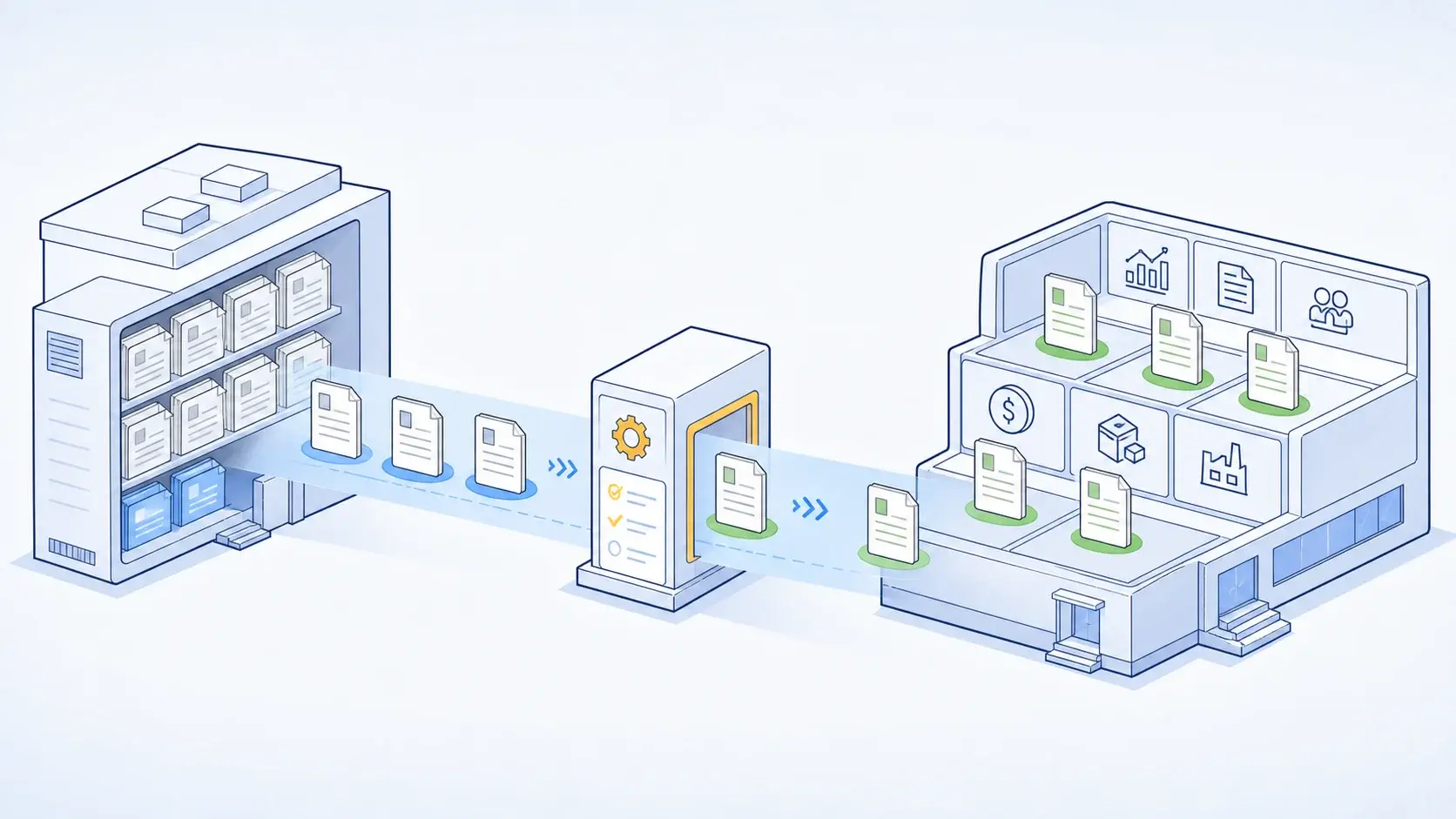
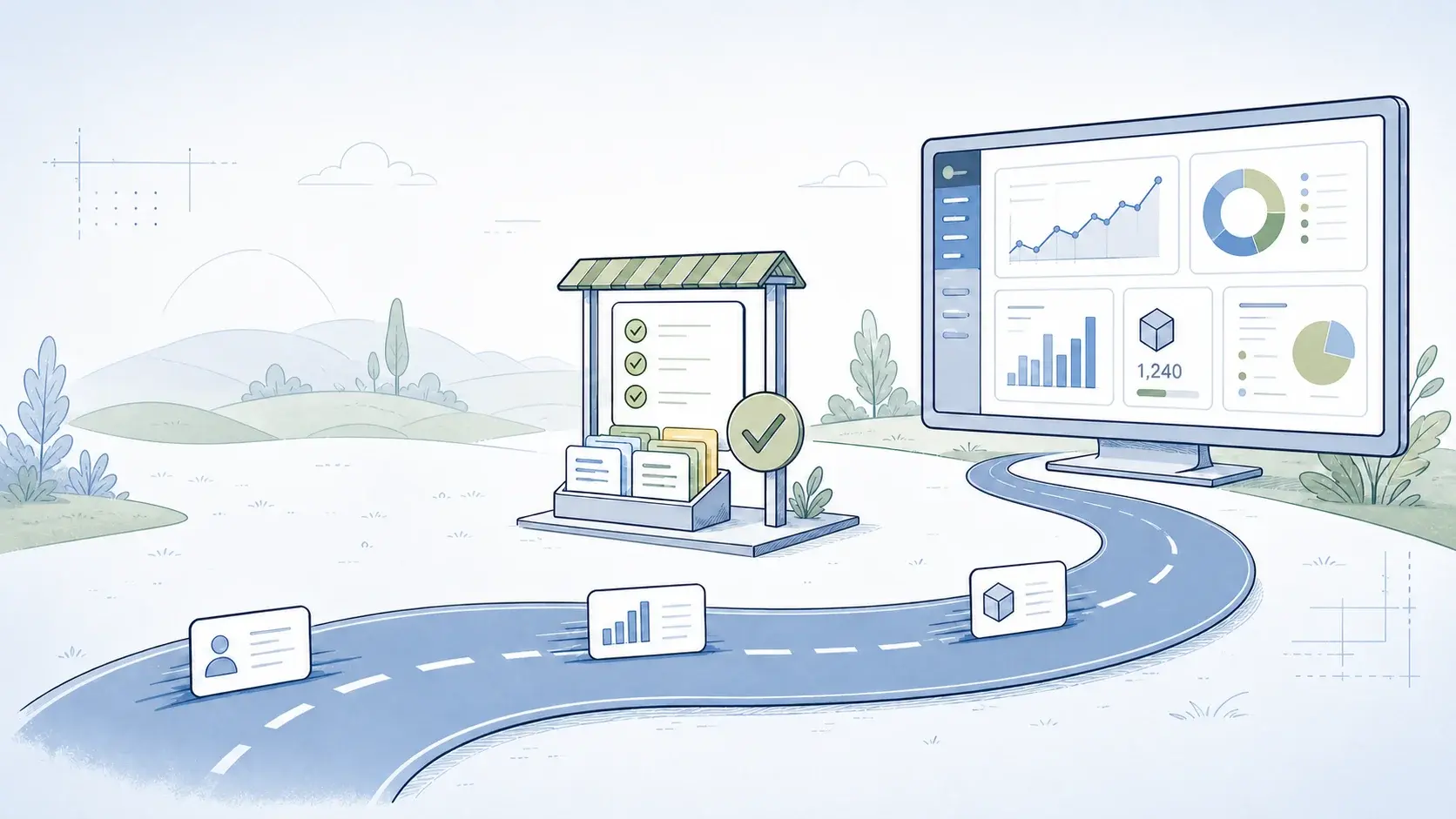
Planning a migration from Oracle to SAP S/4HANA? Explore our 2026 guide on feasibility, architectural transition, TCO analysis, and the Clean Core strategy.
Many U.S. businesses still run finance, supply chain, and manufacturing on Oracle E-Business Suite. The system works, but every change can cost more than it should. Reporting depends on reconciliations. Custom PL/SQL logic lives in places no one wants to touch. Integrations often rely on workarounds built years ago. But is it still reasonable to keep extending Oracle EBS, or is it time to replace it?
SAP S/4HANA often appears to be the logical alternative. Still, the hesitation is real. Will historical financial data survive the move? What happens to years of Oracle custom logic? How should U.S.-specific tax, reporting, and payment requirements be handled? Is the right approach a clean rebuild, a partial transition, or controlled reuse of what already works?
A wrong decision here does not simply slow a project. It can create years of operational debt.
This article walks through how to approach an Oracle EBS to SAP S/4HANA transition. You will see how feasibility is assessed, how target architecture is defined for the current SAP landscape, how U.S. localization, data, and custom code are handled, and how cost compares over time. The goal is simple: help you decide whether the move makes sense and, if it does, plan it without putting business continuity at risk.
Why SAP S/4HANA — and Why 2026 Changes the Equation
The decision to move away from Oracle E-Business Suite is rarely triggered by a single event. It usually starts with accumulated friction.
Oracle EBS continues to run critical processes, but day-to-day work becomes heavier over time. Reporting cycles extend. Custom changes take longer to test and deploy. Integrations rely on reconciliations outside the system. In 2026, these are no longer minor inefficiencies. They can affect audit readiness, internal controls, reporting speed, and the ability to automate finance and supply chain operations.
This leads to a practical question: can the current system support another decade of regulatory pressure, automation demands, and data volume growth?
For many organizations, the answer is uncertain. That uncertainty is what pushes SAP S/4HANA into the discussion.
Among major ERP platforms, SAP S/4HANA is considered not because it replaces Oracle feature by feature, but because it changes how financial and operational data is structured and processed. Its simplified architecture can reduce reconciliation effort, support more consistent reporting, and provide a stronger foundation for automation.
PwC research on S/4HANA transformations also shows that organizations commonly underestimate migration time, training, cost, customization, and legacy-integration challenges. That makes early assessment and realistic planning critical.
What Makes Oracle EBS to SAP S/4HANA Migration Different for U.S. Businesses?
For U.S. businesses, an Oracle EBS to SAP S/4HANA migration is not only a technology change. The target system must support U.S.-specific finance, tax, payment, reporting, and operational requirements while fitting into a broader North American IT landscape.
SAP provides U.S.-specific capabilities for areas such as sales and use tax reporting, withholding tax, 1099-related reporting, and country-specific payment formats.
That makes localization an important part of migration design.
U.S. financial reporting and controls
The target model may need to support reporting aligned with U.S. GAAP as well as strong audit trails, approval workflows, segregation of duties, and internal controls. For organizations subject to SOX requirements, security and control design should be reviewed as part of the migration rather than after the system build.
A technical migration that leaves the control framework unchanged on paper but changes the underlying processes can create gaps in access, approvals, or reporting.
Federal, state, and local taxation
U.S. tax requirements can affect the ERP design at multiple levels. Sales and use tax, withholding, and reporting requirements may vary across jurisdictions and legal entities.
SAP supports U.S.-specific withholding tax keys and reporting scenarios for forms including 1099-MISC, 1099-NEC, 1099-K, 1099-INT, 1099-G, and 1042-S. SAP also provides functionality for Sales and Use Tax Reporting across multiple U.S. jurisdictions.
This does not mean localization can simply be switched on and considered complete. Each business still needs to validate its tax processes, external tax solutions, reporting responsibilities, and jurisdiction-specific requirements.
U.S. payments and banking
Payment processing should be treated as part of the core migration scope. SAP supports U.S.-specific formats for incoming and outgoing payments, but those formats still need to be configured and tested against the organization's banking processes.
Bank connectivity, payment approvals, vendor master data, and exception handling should therefore be included in integration and end-to-end testing.
Multi-entity and multi-state operations
Many U.S. businesses operate through multiple legal entities, shared-service organizations, production sites, distribution centers, or state-level operations.
The S/4HANA target model should standardize what can be standardized while preserving the legal, financial, and operational boundaries that genuinely matter. The goal is not to reproduce every Oracle structure in SAP, but to establish a simpler organizational model with clear ownership and reporting.
Customer and supplier ecosystems
Oracle EBS is rarely an isolated system. The surrounding landscape may include banks, tax providers, payroll applications, CRM platforms, EDI networks, e-commerce systems, WMS, TMS, and industry-specific applications.
These connections need to be evaluated as part of the target architecture. LeverX's U.S. S/4HANA migration framework specifically includes non-SAP ERP replacement and integration with U.S.-specific ecosystems.
The guiding principle is simple:
Start with the global SAP standard → identify U.S. requirements → use supported localization and configuration → keep genuine exceptions controlled and outside the core where appropriate.
This helps U.S. businesses avoid reproducing Oracle complexity inside SAP.
Where Oracle EBS starts to limit change
Oracle EBS was built to grow through modules and extensions. Over the years, this can result in separated sub-ledgers, duplicated financial structures, and large volumes of PL/SQL code spread across reports, forms, interfaces, and batch jobs. A single change in a finance process can affect several technical layers at once. Three constraints appear most often.
-
First, financial data is distributed across multiple structures. Reconciliation between ledgers becomes a recurring task, extending the period close.
-
Second, custom PL/SQL logic is tightly coupled to the Oracle database structure. Even relatively small functional changes can require code adjustments, testing cycles, and specialized database expertise.
-
Third, reporting may depend on extracts or summary tables. Business users do not always work with the same data used for posting, creating timing differences and additional control work.
SAP S/4HANA approaches finance through a simplified data model centered on the Universal Journal. This can reduce the number of separate reconciliation and aggregation steps required across finance. The important point is that migration should not simply reproduce Oracle structures and logic in SAP.
Copying the old architecture into the new platform preserves the old constraints. Redesigning finance and logistics processes gives the S/4HANA architecture room to deliver its intended value. That is why an Oracle-to-SAP migration is better treated as a process and architecture transformation than as a pure data transport exercise.
Regional factors that influence migration priorities
Although SAP S/4HANA is a global platform, migration priorities differ by market.
For U.S. businesses, the key focus is often finance modernization combined with strong control, tax, payment, and integration capabilities.
U.S. Migration Priorities at a Glance
|
Primary priority |
Typical focus |
|
Finance and reporting |
Faster close, consistent management reporting, better visibility into transactional data |
|
Tax and statutory requirements |
Sales and use tax, withholding, 1099-related reporting, jurisdiction-specific requirements |
|
Controls and auditability |
Approval workflows, segregation of duties, traceable transactions, internal controls |
|
Multi-entity operations |
Standardized processes across U.S. subsidiaries, business units, and shared services |
|
Integration |
Banks, tax providers, payroll, EDI, CRM, WMS, TMS, e-commerce, and other non-SAP systems |
|
Scalability |
Support for acquisitions, new entities, additional facilities, and broader North American operations |
In Europe, compliance and data protection may dominate the design. In Latin America, tax localization and payment platforms may be major drivers. In Asia-Pacific, manufacturing automation and high transaction volumes may shape architecture.
These differences explain why there is no universal migration template. The same S/4HANA platform has to support different regulatory, operational, and industry priorities.
What to Check Before Committing to an Oracle-to-SAP Migration
Before approving a migration program, most organizations focus on timelines and cost. Technical feasibility often comes later, when decisions are harder to reverse. This is risky because an Oracle-to-SAP transition succeeds or fails long before the first data load, depending on how custom code, data structures, business processes, controls, and integrations are handled.
Technical Debt as the Main Constraint
In Oracle E-Business Suite landscapes, technical debt is rarely visible at first glance. It accumulates over years of extensions and local fixes. Custom PL/SQL packages replace standard logic, database triggers handle business rules, and reports and interfaces depend on specific table structures.
This level of customization limits migration options. Every custom object must be reviewed, rewritten, replaced, or retired.
On the SAP side, Clean Core is an important architectural principle. Rather than modifying the S/4HANA core whenever a requirement appears, organizations should use standard capabilities where possible and apply approved extension patterns when additional functionality is required.
For many scenarios, side-by-side extensions on SAP Business Technology Platform can keep custom functionality more clearly separated from the ERP core. The objective is not zero customization at any cost, but controlled extensibility that does not turn the new platform into another legacy environment.
Reviewing Oracle Customizations Before the Move
Oracle customizations are commonly grouped around configurations, extensions, modifications, localizations, and integrations. Each category can require a different migration path.
Some configurations map directly to SAP standard functionality. Others need to be redesigned because the underlying process model is different. Modifications and extensions require the most attention because they often embed business rules deep inside the Oracle database.
The migration team should classify each object into one of four practical outcomes:
- Retain
- Remediate
- Replace with SAP standard
- Retire
This prevents the project from assuming that every custom object has to survive.
Process mining can make this assessment more reliable. By analyzing actual production behavior before migration, teams can identify unused workflows, exception-heavy processes, workarounds, and activities that are no longer worth rebuilding.
Where AI Helps and Where It Does Not
Custom code conversion is one of the most time-consuming parts of an Oracle-to-SAP migration. Manual rewriting of PL/SQL procedures, triggers, and reports into ABAP or HANA-compatible logic requires both functional and technical knowledge.
Generative AI can help accelerate this work by supporting syntax conversion, pattern recognition, documentation, refactoring suggestions, and initial technical classification.
But AI does not eliminate the need for expert review. Converted logic still has to be tested for functional correctness, performance, security, and alignment with SAP architecture. AI can shorten preparation time, but it does not replace architectural decisions or business validation.
Mapping Data Structures from Oracle to SAP
One of the most critical technical phases is the structural mapping of organizational units. Oracle and SAP use different concepts to represent legal, financial, and operational boundaries.
In Oracle EBS, Sets of Books define accounting scope and currency, Operating Units support transactional organization, and Flexfields provide flexible attributes.
In SAP S/4HANA, Company Codes represent legal entities, while Sales Organizations, Plants, and other structures define commercial and logistical responsibilities.
| Oracle EBS entity | SAP S/4HANA equivalent | Purpose |
| Set of Books | Company Code | Defines legal entity, currency, and statutory reporting |
| Operating Unit | Sales Organization / Plant | Separates sales, logistics, and operational control |
| Flexfields | Standard or Custom Fields | Stores descriptive and transactional attributes |
The mapping is not one-to-one. Incorrect organizational mapping can create downstream issues in reporting, consolidation, tax, security, and process execution. It should therefore be validated before migration tooling is selected or development begins.
U.S. Business and Compliance Readiness
Technical feasibility is only one side of the assessment. Before moving from Oracle EBS to SAP S/4HANA, U.S. businesses should also validate how the target system will support local financial and operational requirements.
The assessment should answer questions such as:
- Which legal entities and state-level operations will move to SAP first?
- Which Oracle processes support U.S. tax, withholding, payment, and statutory reporting?
- Which controls and approval workflows must be preserved?
- Which integrations connect Oracle EBS to U.S. banks, tax providers, payroll platforms, EDI networks, and third-party applications?
- Which historical transactions need to remain immediately accessible after go-live?
- Which U.S.-specific customizations can be replaced with SAP standard functionality?
- Which requirements should remain as controlled extensions rather than modifications to the S/4HANA core?
Answering these questions early reduces the risk of discovering localization, compliance, or integration gaps late in the testing cycle.
Choosing the Right Path for Your Migration
Once feasibility is confirmed, the next decision defines the program: what target architecture should be used, where the system will run, and how much process standardization the organization is willing to accept.
This choice affects cost, scope, customization strategy, and long-term maintenance.
RISE with SAP: Private Cloud for complex Oracle landscapes
RISE with SAP is positioned by SAP as a transformation journey for existing and complex landscapes. SAP's current guidance describes RISE as a journey for installed-base customers and notes that the resulting landscape can involve private cloud, public cloud, or hybrid scenarios depending on the transformation path.
For complex Oracle-to-SAP programs, a private-cloud-oriented S/4HANA design can be attractive when the business needs greater scope and flexibility than a highly standardized public-cloud implementation allows.
This can be relevant for organizations with:
- Multiple legal entities
- Complex finance processes
- Industry-specific requirements
- Large integration landscapes
- Extensive historical data
- Phased or selective transition requirements
The key is not to assume that complexity automatically means "RISE." The target architecture should be selected after assessing business processes, data, integrations, customization, operating model, and desired transformation depth.
GROW with SAP: Public Cloud and a standardized restart
GROW with SAP is positioned around new ERP customers and public-cloud adoption. SAP describes it as a journey for net-new ERP customers starting with SAP Business Suite in the public cloud.
For an organization moving from Oracle EBS, this approach can make sense when the business is willing to redesign processes around SAP standard functionality and keep customization limited.
The trade-off is clear:
More standardization can mean faster deployment and simpler operations, but it requires greater willingness to change legacy processes.
GROW can therefore be a strong fit for organizations that want to retire Oracle complexity instead of reproducing it.
Hybrid architecture: moving the core, keeping the exceptions
Some organizations choose a hybrid approach.
Core finance and logistics move to SAP S/4HANA, while selected Oracle-based or third-party components remain in place for a defined period.
This can be useful for niche HR functions, local payroll, or country-specific applications that are too costly or risky to replace during the first phase.
A hybrid architecture can reduce initial migration scope, but only when system boundaries are clearly defined.
Otherwise, the organization risks creating duplicate master data, inconsistent reporting, and a permanent dependency on the legacy environment.
Hybrid architecture should therefore usually be treated as a controlled transition state rather than an excuse to leave the target design unresolved.
But data still defines the outcome
Whichever path you choose, data must move.
Historical balances, open transactions, master records, and organizational structures determine whether the new system can operate correctly from day one.
Data readiness is also one of the areas where migration programs frequently underestimate effort. Recent PwC work on SAP S/4HANA programs highlights data profiling, cleansing, transformation, mapping, and validation as central parts of migration readiness.
At LeverX, data preparation can be supported through a dedicated data management approach designed to extract, standardize, validate, and prepare Oracle EBS data before loading it into SAP S/4HANA.
The goal is not simply faster data transfer.
The goal is trustworthy data that supports finance, reporting, reconciliation, compliance, and day-to-day operations after go-live.
U.S. data migration considerations
For U.S. businesses, historical data also has a compliance and audit dimension.
Financial balances, open items, tax-related records, vendor information, and transaction history may need to remain available for reporting, reconciliation, audit, and business reference after cutover.
That means the migration team should define early:
- Which data must be loaded into S/4HANA
- Which data can be archived
- Which data must remain immediately accessible
- How retained history will be searched and reported
- How financial reconciliation will be performed between Oracle and SAP
The decision should be based not only on data volume, but also on U.S. reporting, tax, audit, operational, and retention requirements.

Inside the Oracle-to-SAP Transition Process
After architecture decisions are made, the focus shifts to execution. This is where many programs can lose control. Oracle-to-SAP migrations rarely fail because of a single mistake. More often, problems arise when technical work begins before the current landscape, data, integrations, and business processes are fully understood.
A structured migration process reduces this risk. The goal is not speed alone, but accuracy, business continuity, and an SAP S/4HANA environment that remains stable and supportable after go-live.
Phase 1: System assessment and migration planning
The first phase focuses on understanding the current Oracle EBS landscape in detail. No major code or data movement should begin before this assessment is complete.
The work starts with a technical and functional inventory. All custom objects are identified and classified, including configurations, extensions, database modifications, local logic, reports, interfaces, and external connections.
Process analysis follows. Instead of relying only on workshops, production data can be used to understand how processes actually run. Transaction paths, exceptions, workarounds, and manual interventions become visible.
Based on this assessment, the migration strategy can be selected:
- Greenfield fits organizations ready to redesign processes around SAP standard functionality
- Controlled transition may be more appropriate for Oracle source systems where the goal is to modernize the landscape while limiting unnecessary functional reinvention
- Selective data transition fits complex Oracle environments that need greater control over historical data, scope, and migration timing
Phase 2: Data transition and core build
Once the strategy is set, execution begins with data. For Oracle EBS migrations, selective data transition is often useful when the organization does not need to reproduce the entire legacy database in SAP. Relevant master data, open transactions, balances, and selected historical records can be moved based on business, operational, and compliance requirements, while historical data that is no longer operational can be archived separately with controlled access.
At the same time, the SAP S/4HANA core is configured around the target business processes. Custom functionality is developed using appropriate extension patterns rather than automatically reproducing Oracle modifications inside the core, helping keep the new environment more standardized, maintainable, and easier to evolve.
Phase 3: Validation and controlled testing
Testing in Oracle-to-SAP programs must go beyond basic functionality checks. Financial validation is a priority, with automated reconciliation comparing Oracle balances with SAP postings by company code, ledger, currency, account, and other relevant dimensions.
Performance testing should simulate realistic transaction volumes, period-close activity, integrations, and reporting demand to identify issues before go-live. User acceptance testing should focus on real business processes and daily tasks rather than interface familiarity, ensuring that users can complete critical activities accurately and efficiently in the new SAP environment.
U.S. testing considerations
For U.S. operations, financial reconciliation should be extended to localization testing across key finance, tax, payment, and reporting scenarios. This can include sales and use tax, withholding calculations, 1099-related reporting, payment files and bank processing, intercompany transactions, multi-entity reporting, approval and control workflows, and audit-related reporting.
SAP documents U.S.-specific payment formats, withholding tax functionality, and sales and use tax reporting capabilities, but these scenarios still need to be validated against the organization’s actual configuration, business processes, and external ecosystem.
Testing should also cover the integrations that sit outside the ERP but are critical to U.S. operations. Banks, tax providers, payroll systems, EDI partners, customer platforms, and logistics applications should be validated through realistic end-to-end business scenarios rather than only technical interface tests.
Phase 4: Go-live and post-migration support
For large or distributed organizations, a single cutover is not always the safest option. A phased rollout can reduce operational risk by moving business units, legal entities, or facilities to SAP S/4HANA in controlled waves and incorporating lessons learned into subsequent deployments.
After go-live, monitoring should focus on transaction errors, financial reconciliation, payment processing, integration failures, system performance, user access and controls, data inconsistencies, and month-end close activities.
Early stabilization should be structured and time-bound. The objective is to resolve critical issues quickly, stabilize business processes, and transfer system ownership to internal teams once the platform is operating reliably.
Migration Approach Comparison
|
Feature |
Greenfield |
Controlled transition / selective transition |
|
Best for |
Organizations ready to redesign processes |
Complex Oracle environments needing scope and data control |
|
Process change |
High |
Moderate to high, depending on scope |
|
Data retention |
Usually selective |
Selective and controlled |
|
Customization strategy |
Strong move toward standard |
Retain only justified requirements |
|
Main benefit |
Long-term simplification |
Lower disruption and better control |
|
Main risk |
Higher business change impact |
Greater planning and integration effort |
The right approach is less about selecting a label and more about deciding how much legacy complexity the organization is willing to carry forward.
What Does the Move Mean for Cost and Long-Term Value?
ERP modernization is ultimately a cost and risk decision.
By 2026, many organizations have found that keeping a heavily customized legacy ERP operational becomes increasingly expensive even when no major functionality is added.
SAP S/4HANA can change that cost structure, but only when the migration is designed correctly.
Oracle EBS vs. SAP S/4HANA: Cost drivers in practice
The difference is not limited to software licensing.
It shows up in day-to-day operations.
Oracle EBS environments may involve:
- Ongoing infrastructure and database maintenance
- Dependence on specialized PL/SQL skills
- Separate data structures that require reconciliation
- Reporting delays caused by extracts
- High testing effort for custom changes
- Legacy integrations that are expensive to maintain
A modern SAP S/4HANA landscape can shift the operating model toward:
- Cloud-based infrastructure where appropriate
- Greater use of standard processes
- Simplified financial data structures
- More direct access to transactional data
- Controlled extensibility
- More standardized upgrade and lifecycle practices
The actual TCO outcome depends on deployment model, data scope, process redesign, integrations, licensing, support requirements, and the level of customization carried forward.
There is no universal percentage reduction that can be responsibly promised before the current landscape is assessed.
Practical recommendations before you commit
Some decisions have a direct impact on both cost and stability.
1. Clean the data before moving it.
Migration is an opportunity to address duplicated, incomplete, obsolete, or inconsistent data. Moving poor-quality data only transfers the problem into the new system.
2. Protect the SAP core from day one.
Avoid rebuilding every Oracle customization inside S/4HANA. Use standard SAP functionality where possible and controlled extension patterns where needed.
3. Treat U.S. localization as part of the core design.
Tax, payments, reporting, controls, and legal-entity requirements should not be postponed until the final testing cycle.
4. Map integrations early.
The ERP is only one component of the business landscape. Banks, EDI networks, payroll, tax providers, CRM, logistics, and other systems can determine whether the new architecture works in practice.
5. Prepare users for a new way of working.
The move from Oracle Forms and legacy workflows to SAP Fiori and S/4HANA processes can change everyday tasks significantly. Role-based training and business-led testing reduce post-go-live disruption.
How LeverX Supports Oracle EBS to SAP S/4HANA Migration in the U.S.
For U.S. businesses, Oracle-to-SAP migration requires more than ERP implementation expertise. The program has to connect global SAP standards with U.S. finance, compliance, tax, integration, and operating requirements.
LeverX supports non-SAP ERP migrations to SAP S/4HANA, including Oracle environments, with services covering migration strategy, data migration, process redesign, integration, modernization, and post-go-live support. Its U.S. S/4HANA migration framework specifically references U.S. GAAP and compliance requirements, North American operating models, and U.S.-specific ecosystems.
LeverX can support:
- Oracle EBS assessment and migration strategy
- SAP S/4HANA target architecture and deployment planning
- Data extraction, cleansing, mapping, validation, and reconciliation
- Oracle PL/SQL analysis and custom logic remediation
- U.S. financial and compliance requirements
- Integration with banks, tax platforms, EDI, CRM, supply chain, and other non-SAP systems
- Clean Core and side-by-side extension strategy
- Testing, cutover, and post-go-live stabilization
The objective is not to reproduce Oracle EBS inside SAP.
It is to build a simpler, more scalable S/4HANA environment that preserves the business capabilities U.S. operations need while reducing legacy complexity.
Conclusion
Moving from Oracle EBS to SAP S/4HANA is a major decision, but it does not have to be a leap into the unknown. The strongest programs begin by understanding what the Oracle environment actually does, what the business genuinely needs, and which legacy constraints no longer deserve to be carried forward.
For U.S. businesses, that assessment also needs to cover tax, payments, financial reporting, internal controls, multi-entity structures, integrations, and historical data requirements. The right strategy may be highly standardized, involve selective transition, or use a hybrid architecture for a defined period. What matters is that the target environment is designed around business value rather than legacy structure.
Done well, an Oracle EBS to SAP S/4HANA migration can simplify finance, improve data visibility, reduce technical debt, modernize integrations, and create a stronger foundation for automation and future growth. The goal is not simply to replace one ERP with another.
The goal is to leave legacy complexity behind and build an ERP environment that is easier to operate, scale, and improve.
Disclaimer: SAP product names, cloud offerings, features, and migration approaches can change over time. The information in this article reflects SAP capabilities and guidance available at the time of publication and is provided for general informational purposes only. U.S. tax, accounting, regulatory, and compliance requirements vary by business and jurisdiction and should be validated with qualified legal, tax, and accounting professionals before implementation.