Explore how data scope, system complexity, and decommissioning decisions shape SAP S/4HANA migration outcomes and long-term data architecture.
SAP S/4HANA transformation is often described as a system upgrade. In practice, it requires businesses to reconsider how data is structured, governed, transferred, and accessed across the enterprise.
A successful go-live does not automatically mean the migration is complete. Legacy systems may remain in operation because employees still need historical reports, finance teams require access to old transactions, integrations depend on existing data structures, or audit and tax requests cannot yet be handled without the original platform.
For U.S. businesses, these challenges can span multiple legal entities, state-level operations, financial reporting, tax processes, payment systems, and historical record retention.
A well-defined SAP S/4HANA data migration strategy addresses these requirements before the first data load. It determines what the business needs to migrate, what should be transformed or retired, and how information that remains outside the new system will be accessed and governed.
Key Takeaways
- Define data scope early. Determine which master records, open transactions, balances, and historical information the business actually needs in SAP S/4HANA.
- Treat data quality as a business responsibility. Data cleansing, ownership, and validation should begin well before migration testing.
- Align the migration approach with business goals. Brownfield, Greenfield, and Selective Data Transition create different opportunities and constraints for data retention and process redesign.
- Plan for legacy decommissioning from the start. Historical reporting, audits, tax-related requests, and integrations may remain dependent on legacy platforms after go-live.
- Validate U.S.-specific requirements. Finance, tax, payments, intercompany transactions, and legal-entity reporting should be included in scope and testing where applicable.
What Makes SAP S/4HANA Data Migration Different for U.S. Businesses?
Data migration is not simply about transferring records between databases. Source information must fit the target data model and continue to support the company's financial, operational, and reporting requirements.
For U.S. organizations, migration planning may need to account for:
- Financial reporting structures, charts of accounts, ledgers, and opening balances.
- Federal, state, and local tax processes, including sales and use tax and relevant withholding tax scenarios.
- U.S. tax reporting, including applicable 1099 processes.
- Multiple legal entities, company codes, and intercompany relationships.
- Bank interfaces, payment formats, and payment master data.
- Operations spread across multiple states, sites, and distribution centres.
- Historical financial records, audit evidence, and applicable retention requirements.
SAP provides functionality for U.S.-specific processes, including certain withholding tax reporting and payment scenarios. However, the exact scope depends on the SAP product, release, configuration, and external systems involved. The migration team should validate each requirement against the company's actual processes rather than assume that localization will work automatically after data loading.
The same principle applies to global organizations. A common SAP template can improve consistency, but it must still accommodate justified local requirements without reproducing every legacy variation.
Assess the Legacy Landscape Before Choosing a Strategy
Many businesses discover that their data is spread across a much larger ecosystem than the core ERP system. Separate applications may support finance, tax, banking, payroll, customer relationships, warehouse operations, EDI, and reporting. Some connections are documented; others rely on custom logic developed over many years.
Before choosing a migration approach, teams should establish which systems contain authoritative data, where dependencies exist, and which business processes rely on legacy information.
|
Area |
Typical issues |
Potential impact |
|
Master data |
Duplicated customers, suppliers, and materials |
Inconsistent records and failed transactions |
|
Finance |
Misaligned balances, ledgers, or account mappings |
Reconciliation and reporting problems |
|
Tax and payments |
Inconsistent tax attributes, bank data, or interfaces |
Incorrect processing or reporting |
|
Integrations |
Undocumented interfaces and custom dependencies |
Post-go-live failures |
|
Data ownership |
Unclear accountability across business units |
Slow remediation and inconsistent decisions |
|
Historical information |
Records available only in legacy systems |
Delayed decommissioning and audit-access issues |
This assessment should cover both data and process dependencies. A field that appears obsolete in the source system may still feed a downstream report, payment interface, or regulatory process.
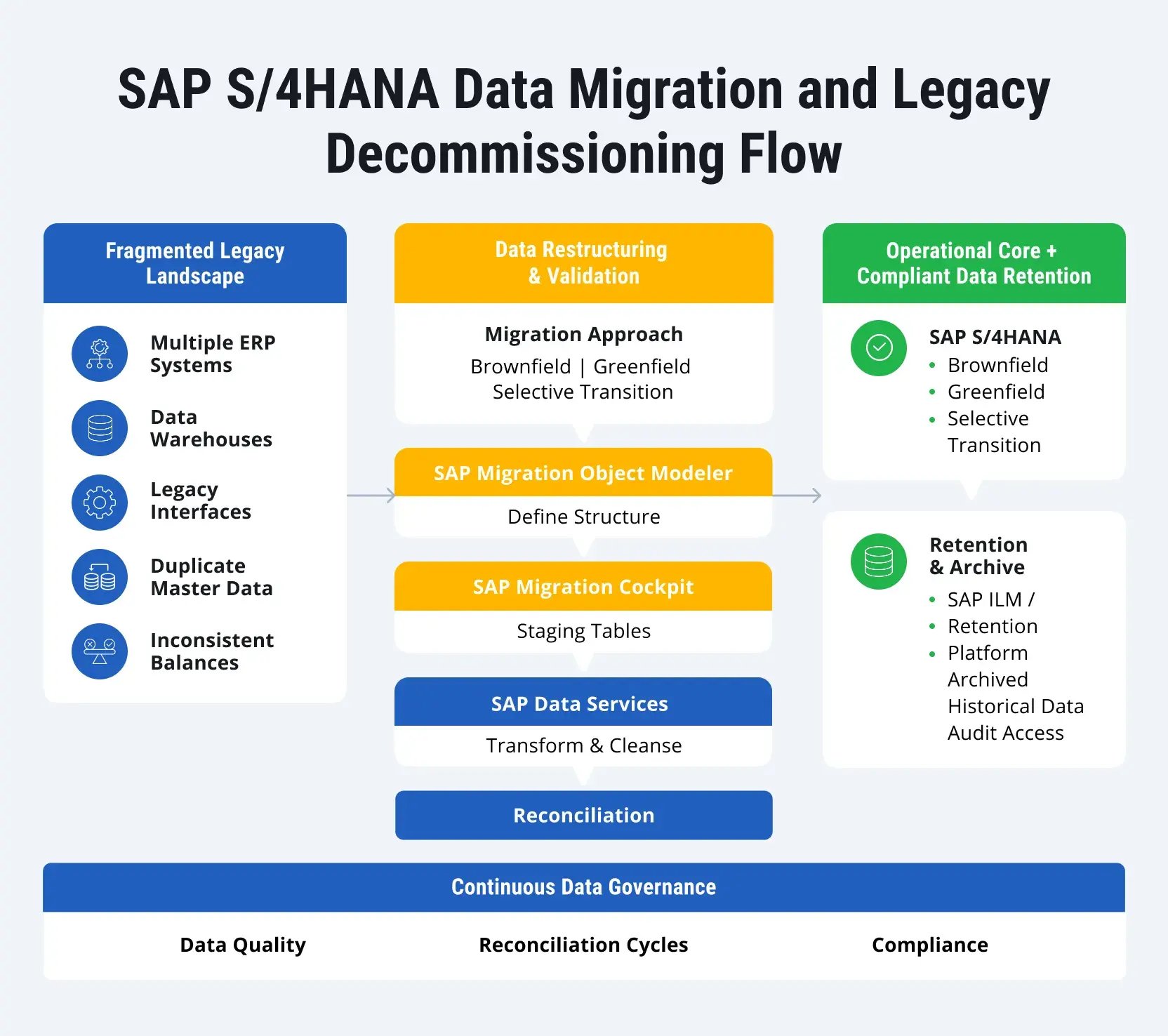
For broader planning considerations, see our SAP ECC to SAP S/4HANA migration guide.
Choose the Right SAP S/4HANA Migration Approach
The migration approach determines how much of the existing environment can be retained, how much process redesign is possible, and which data must move to the target system.
The three main approaches are Brownfield, Greenfield, and Selective Data Transition. Their suitability depends on the current SAP landscape, target deployment model, business objectives, and acceptable level of change.
|
Decision area |
Brownfield |
Greenfield |
Selective Data Transition |
|
Starting point |
Existing SAP system |
New implementation |
Existing landscape with selective transition |
|
Process design |
Most existing processes are retained, subject to adaptation |
Processes can be redesigned more extensively |
Selected processes and structures can be retained or redesigned |
|
Data strategy |
Existing data and history are largely carried forward as part of the conversion |
Data is selected and prepared for the new implementation |
Specific data, organizational units, or periods are selected for transition |
|
Transformation opportunity |
More limited without additional redesign |
Highest opportunity for standardization |
Targeted redesign and harmonization |
|
Main consideration |
Legacy complexity may persist |
Greater design and data preparation effort |
More complex planning, selection, and reconciliation |
These approaches are not interchangeable. Brownfield system conversion, for example, generally carries forward more of the existing environment than a Greenfield implementation. Selective Data Transition can offer a middle path, but it requires clear selection rules and a well-governed transition design.
The target deployment model also affects which scenarios and migration tools are available. Confirm technical feasibility before committing to the strategy.
For a more detailed comparison, read SAP S/4HANA Migration vs. Conversion vs. Transition.
The essential question is not simply how much data can be moved. It is how to preserve the information the business needs while avoiding unnecessary complexity in the target environment.
Define What Data Should Move
Data scope is one of the most consequential decisions in the migration programme. Master records, open transactions, historical information, and configuration each have different business purposes and should not be treated as a single category.
Master Data
Customer, supplier, material, asset, and other master records may be duplicated or inconsistent across source systems. The same business partner might have different identifiers, payment details, addresses, or organizational assignments in different applications.
Before migration, teams should identify authoritative records, resolve duplicates, standardize relevant fields, and confirm target business partner structures. For U.S. operations, this review may also cover tax-related attributes, bank details, company-code assignments, and intercompany relationships.
Migrating poor-quality master data without resolving underlying issues can reproduce them in SAP S/4HANA, affecting reporting and daily transactions.
Open Transactions and Financial Balances
Open accounts receivable and payable items, sales and purchase orders, deliveries, and other active business transactions require particular care. Their status and relationships must remain consistent with the processes that continue after go-live.
The migration team should identify incomplete document chains and define how outstanding items will be handled. Financial validation should cover opening balances and the appropriate reconciliation points between the general ledger and subledgers, as well as intercompany balances and relevant asset accounting data.
Data loads are not successful merely because records appear in the target system. The data must also support the business process and preserve financial integrity.
For more finance-specific guidance, see SAP S/4HANA Finance Migration Errors: 8 Critical Issues and How to Fix Them.
Historical Data and Closed Fiscal Years
Not every historical record needs to be loaded into the operational SAP S/4HANA environment. The right decision depends on how the business uses historical information and what it must retain.
Finance, tax, audit, and business teams should agree on which historical reports and records need to remain available, how quickly users must retrieve them, and whether those needs can be met through an approved archive or reporting environment.
The same applies to closed fiscal years. If users expect to reproduce historical reporting directly in the new system while IT plans to provide archived access, the mismatch should be resolved before migration scope is finalized.
Configuration and Business Rules
Configuration is not the same as transactional data, but it has a direct impact on migration decisions. Reusing existing settings can reduce redesign effort while also carrying forward obsolete process variations and workarounds. Redesigning everything may simplify the target landscape but require more business input and testing.
The objective is to preserve what is necessary, standardize where possible, and explicitly document deviations that remain justified.
Make Data Quality a Core Workstream
Data quality should not be treated as a final cleanup activity. It affects whether the project can move from mapping and preparation to successful testing and go-live.
Common blockers include duplicate business partners, incomplete master records, inconsistent organizational assignments, unresolved Customer-Vendor Integration requirements in applicable source environments, and differences between financial balances.
For U.S. businesses, checks may also need to cover tax classifications, company-code assignments, bank and payment details, and intercompany relationships.
A practical data quality process starts with profiling the source data, establishing measurable rules, assigning business owners, and correcting defects before mock migration cycles. Validation should then be repeated after transformation and loading.
IT teams can identify technical errors, but business owners must decide whether records are correct, which values are authoritative, and how exceptions should be resolved. That distinction is especially important when finance, tax, operations, and shared services work with the same data.
Plan Historical Data Access and Legacy Decommissioning Early
An SAP S/4HANA go-live does not automatically make the old system unnecessary. Legacy environments may continue to support audits, historical reporting, tax-related requests, operational checks, or applications that have not yet been disconnected.
Decommissioning therefore needs its own scope, ownership, and acceptance criteria.
Read-Only Access or a Retention Platform?
Keeping a legacy system in read-only mode can provide a transitional way to retrieve information while the business validates its replacement access model. However, the system may still incur infrastructure, maintenance, security, and support costs.
A dedicated retention or archive environment can reduce that dependency, but only when required records remain searchable and accessible to authorized users.
SAP Information Lifecycle Management (SAP ILM) supports data lifecycle management using retention rules, archiving, legal holds, and controlled destruction in supported scenarios. The exact solution needs to be assessed against the source system, SAP release, and retention requirements.
For U.S. organizations, retention periods and legal holds should be defined with the relevant legal, tax, compliance, and records-management stakeholders. Requirements can vary by record type, industry, jurisdiction, and the circumstances of the business.
Establish Decommissioning Criteria
Before retiring a legacy system, confirm that critical reports can be reproduced or accessed elsewhere, required records remain available, integrations no longer depend on the system, and business owners have approved the transition.
The goal is not to switch off the old environment as quickly as possible. It is to remove unnecessary dependencies without compromising business continuity or access to required information.
Migration Tools and Automation: What Each One Does
Migration tools support execution, but they do not replace decisions about data quality, scope, and business meaning. Tool selection should reflect the source systems, target SAP deployment model, migration objects, data volume, and transformation requirements.
|
Tool or capability |
Role in the migration |
|
SAP S/4HANA Migration Cockpit |
Supports migration using available migration objects, mapping, simulation, loading, and monitoring functions |
|
SAP Data Services |
Can support data extraction, transformation, integration, and processing across multiple sources |
|
Data transformation framework |
Applies consistent mapping, cleansing, standardization, and reusable business rules |
|
Data profiling and quality tools |
Identify duplicates, missing fields, invalid values, and structural inconsistencies |
|
Reconciliation automation |
Compares source and target results to highlight missing records or differences in balances and totals |
The SAP S/4HANA Migration Cockpit documentation explains how migration projects use migration objects, mapping, simulation, and monitoring. Availability and capabilities vary by deployment model, release, and migration scenario, so teams should validate the relevant scope before designing the toolchain.
Automation can make repeatable transformations and checks more efficient. It cannot resolve a business question such as which of two inconsistent customer records is authoritative. That decision needs accountable ownership and a documented rule.
A Practical SAP S/4HANA Data Migration Roadmap
A controlled migration usually proceeds through repeated preparation, testing, and reconciliation cycles rather than one large transfer.
|
Phase |
Main activities |
Expected outcome |
|
1. Assess |
Inventory source systems, data domains, integrations, and historical dependencies |
Agreed baseline and initial risk register |
|
2. Define scope |
Select data to migrate, retain, archive, or retire; assign business owners |
Approved data and retention strategy |
|
3. Profile and prepare |
Measure quality, cleanse records, define mappings, and resolve data ownership |
Data ready for transformation and loading |
|
4. Execute mock migrations |
Transform and load representative datasets; test interfaces and business scenarios |
Repeatable migration procedures and identified defects |
|
5. Reconcile and approve |
Validate record counts, balances, business rules, and reporting outputs |
Evidence that migration results meet agreed acceptance criteria |
|
6. Cut over and stabilize |
Run final loads, verify critical processes, monitor defects, and manage legacy access |
Controlled go-live and an approved plan for ongoing support |
Each cycle should produce measurable results. For example, the project should track unresolved data defects, reconciliation differences, failed migration objects, and outstanding approvals. These measures help the team determine whether the data is genuinely ready for the next stage.
The schedule and effort depend on source-system complexity, data volume, transformation requirements, number of legal entities, and the degree of process redesign. A migration strategy should account for these variables during planning instead of treating migration as a fixed technical task.
Common Migration Risks and How to Reduce Them
The most disruptive issues often stem from assumptions made early in the programme. The following risks deserve particular attention.
|
Risk |
Recommended control |
|
Historical balances do not reconcile |
Profile financial data early and repeat reconciliation across mock cycles |
|
Legacy interfaces depend on undocumented structures |
Inventory integrations and test complete business scenarios end to end |
|
Old and new systems contain diverging records |
Define rules for data ownership, synchronization, and parallel operations |
|
Data quality issues appear late |
Run early profiling and assign business owners to remediation |
|
Historical information becomes inaccessible |
Establish retention, search, authorization, and retrieval requirements before decommissioning |
|
U.S. requirements are handled too late |
Include finance, tax, payments, legal-entity reporting, and audit stakeholders in scope definition and testing |
Reconciliation deserves special attention. It is not a final checkbox, but a recurring control that tests whether transformed information remains complete and accurate. Depending on the migration scope, financial validation may include general ledger and subledger balances, intercompany positions, currencies, asset accounting, and relevant tax-related data.
For a wider view of transformation risks, see SAP S/4HANA Migration Challenges: 10 Biggest Risks for U.S. Businesses.
How LeverX Supports SAP S/4HANA Data Migration in the U.S.
LeverX supports SAP data migration programmes from planning and data readiness through migration execution, validation, and post-go-live optimization. The work can include data from SAP and non-SAP systems, such as Oracle, legacy databases, and other enterprise applications.
For U.S. S/4HANA programmes, the scope may include:
- Migration assessment, planning, and data-scope definition.
- Master and transactional data cleansing, transformation, and migration.
- Data harmonization across systems and legal entities.
- Migration tooling, automation, and repeatable test loads.
- Data reconciliation, validation, and issue remediation.
- Historical data access and legacy decommissioning planning.
- Post-migration stabilization and data quality management.
LeverX also offers its SAP data migration services to help organizations establish a structured approach to complex migration landscapes. The recommended solution and delivery model depend on the company's source systems, target SAP environment, business requirements, and data readiness.
The objective is not to move the maximum amount of data. It is to migrate the data the business needs, preserve access to required historical information, and establish a reliable foundation for SAP S/4HANA.
Frequently Asked Questions
Does all historical data need to be migrated to SAP S/4HANA?
No. Historical information should be migrated when it supports operational processes or defined reporting needs. Other records may remain in an approved archive or retention environment, provided that access, retention, and retrieval requirements are met.
Which SAP S/4HANA migration approach is best for data migration?
There is no universal best option. Brownfield generally preserves more of the existing environment, Greenfield creates greater scope for redesign, and Selective Data Transition allows selected data and processes to move. The appropriate choice depends on business objectives, the source landscape, technical constraints, and the target deployment model.
What is the role of SAP S/4HANA Migration Cockpit?
It supports data transfer through available migration objects and provides functions for mapping, simulation, loading, and monitoring. It does not replace source-data cleansing, business decisions, integration testing, or reconciliation. Its suitability should be confirmed for the specific migration scenario.
How can U.S. businesses protect financial and tax reporting during migration?
Include finance and tax stakeholders in scope definition, mapping, testing, and approval. Validate relevant opening balances, open items, legal-entity assignments, payment data, and tax-related attributes against the target configuration and required reporting outcomes.
When can a legacy system be decommissioned?
When critical processes no longer depend on it, required reports and historical records can be accessed through approved alternatives, integrations have been transitioned, and the relevant business and control owners have approved the shutdown. Retention and legal-hold requirements must also be addressed.
Conclusion
A successful SAP S/4HANA data migration is defined by more than the volume of information transferred. It depends on whether the business can operate, reconcile, report, and retrieve required records with confidence after go-live.
For U.S. organizations, that means addressing financial reporting, tax processes, payments, legal entities, integrations, audit access, and historical data retention as part of the strategy.
Brownfield, Greenfield, and Selective Data Transition each present different opportunities and constraints. Whichever approach the business chooses, early data profiling, clear ownership, repeatable testing, and continuous reconciliation help reduce risk and avoid transferring unnecessary legacy complexity into the new environment.
With the right strategy, data migration becomes a foundation for more reliable reporting, clearer data ownership, lower legacy dependency, and a more adaptable SAP S/4HANA landscape.
Disclaimer: This article is for general informational purposes only and does not constitute legal, tax, accounting, or compliance advice. SAP capabilities and supported migration scenarios depend on the product, release, deployment model, and configuration. U.S. legal, tax, reporting, and retention requirements should be validated with qualified advisers and relevant business stakeholders.