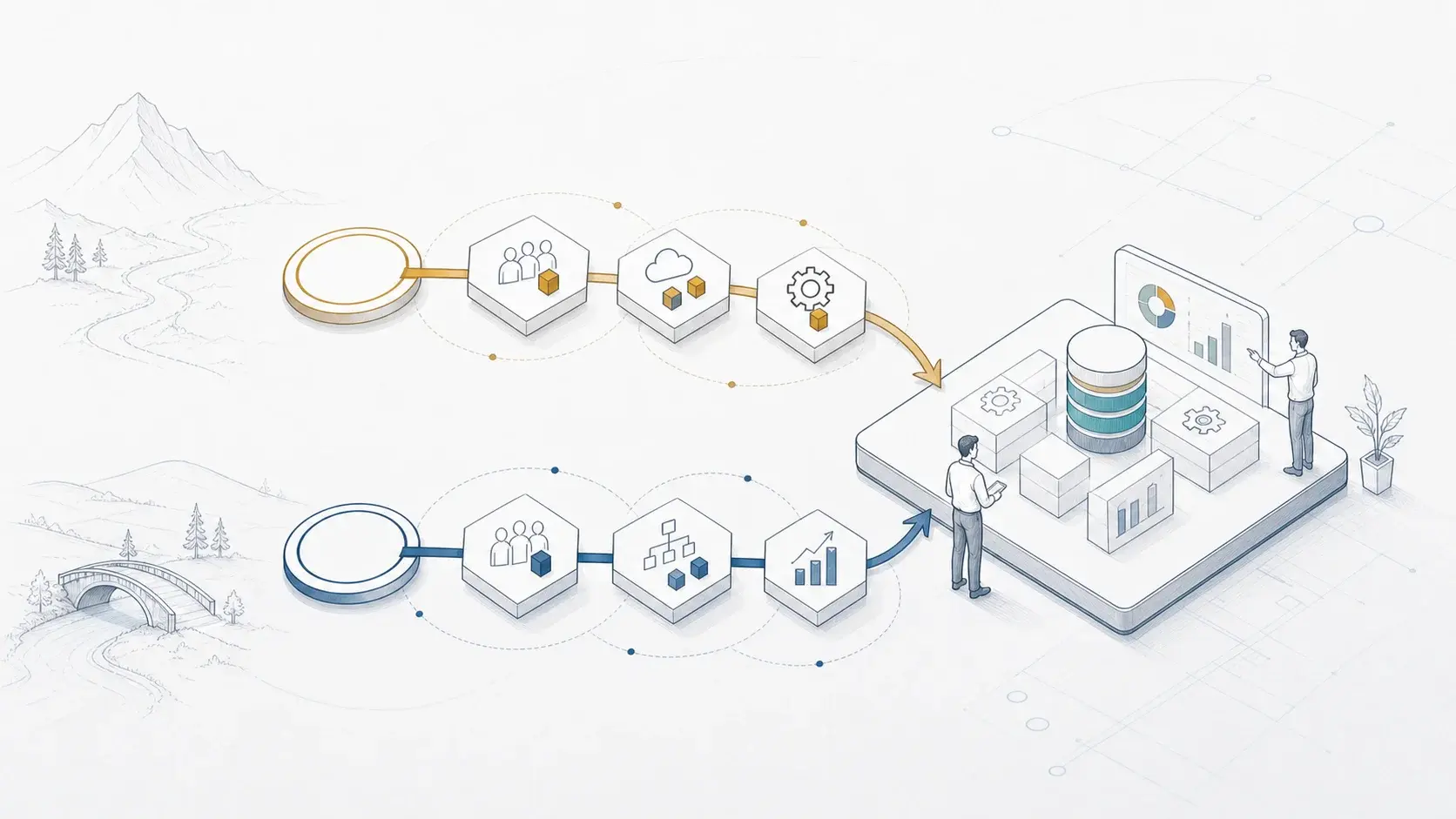
Why it is important to choose an SAP partner wisely in automotive manufacturing. Read about the risks, selection criteria, and delivery models that influence project outcomes.
Choosing the right SAP partner in Canada involves more than comparing certifications, consulting rates, or office locations. Organizations need a provider that understands their business processes, can demonstrate relevant project experience, and has the technical and delivery capabilities to support their SAP landscape over time.
The right choice depends on the organization's objectives. An SAP S/4HANA transformation requires different skills from an integration project, a cloud ERP implementation, or ongoing application management. Companies operating across several provinces may also need to account for different tax requirements, privacy obligations, and language considerations.
Canada's SAP market includes local consultancies, specialist providers, and global system integrators. Each offers a different balance of local engagement, technical depth, delivery capacity, and commercial flexibility.
This guide explains how to evaluate SAP partners in Canada, assess their delivery capabilities, account for Canadian business requirements, and select a provider that fits your organization.
The best SAP partner is not necessarily the largest consultancy or the one with the biggest Canadian office. What matters is whether the provider can demonstrate the right expertise, team, delivery model, and accountability for your specific program.
Start with Your SAP Requirements
Before approaching potential partners, define the scope of the engagement and the outcomes you expect to achieve. This makes it easier to compare providers on relevant capabilities rather than broad claims about SAP expertise.
An organization moving from a legacy ERP system to SAP S/4HANA may need transformation strategy, data migration, integrations, testing, and cutover support. A company already running SAP might prioritize process optimization, SAP Business Technology Platform (SAP BTP), integration modernization, or application management.
Start by identifying the business problem and then determine which capabilities are needed to address it.
| Business requirement | Capabilities to evaluate |
| ERP transformation | SAP S/4HANA strategy, process design, migration, and implementation |
| System integration | SAP BTP, APIs, SAP Integration Suite, and non-SAP connectivity |
| Data modernization | Data migration, quality management, master data governance, and analytics |
| Cloud adoption | Deployment models, extensibility, security, and cloud transformation |
| Ongoing operations | Application management, incident resolution, release readiness, and continuous improvement |
Once the scope is clear, establish which responsibilities the partner must assume and which can remain with your internal IT team or other suppliers.
How to Build a Shortlist of SAP Partners in Canada
SAP's official Partner Finder is a useful starting point. It helps organizations explore providers offering SAP consulting, implementation, integration, solutions, and operational services.
Partner credentials and classifications can help narrow the shortlist, but they should not be treated as proof that a provider can deliver your specific program.
The next step is to evaluate each partner's experience against your requirements. Look for comparable projects, relevant SAP product knowledge, references, and evidence of delivery in environments with a similar level of business and technical complexity.
For an SAP S/4HANA transformation, for example, ask whether the provider has experience with your source ERP, data volumes, custom code, integration landscape, and business processes. A long list of SAP technologies is less useful than evidence of how the partner has applied them in comparable projects.
It is also worth distinguishing between a company's general capabilities and the expertise of the team assigned to your engagement. A provider may have extensive SAP resources globally, but your project's success will depend on the people responsible for architecture, implementation, testing, and delivery.
Local SAP Partner or Global Delivery Model?
A Canadian office can be valuable for stakeholder engagement, workshops, and collaboration with local business teams. However, an address in Toronto, Montreal, Vancouver, Calgary, or another Canadian city does not necessarily indicate where the project will be delivered or which specialists will be available.
A local consultancy may provide close customer engagement but have limited capacity for specialized or large-scale programs. A global SAP partner may offer broader technical expertise, access to specialized resources, and experience with multinational SAP landscapes.
The relevant question is how the delivery model will work in practice.
| Delivery model | Potential advantages | What to verify |
| Local partner | Close stakeholder engagement and familiarity with the local business environment | Specialist resource availability, capacity, and experience with complex programs |
| Global partner | Broader technical expertise and international delivery capacity | Access to senior experts, communication, time-zone coverage, and governance |
| Hybrid model | Canadian stakeholder engagement combined with global specialist resources | Clear responsibilities, coordination, continuity, and delivery accountability |
For multinational organizations and Canadian subsidiaries of global groups, a hybrid model can be particularly useful. It can combine local business engagement with global SAP expertise while maintaining a consistent enterprise architecture.
Before signing, establish who will lead the program, where the solution architects and functional consultants will be based, how decisions will be made, and which team will remain responsible after go-live.
What Makes SAP Projects in Canada Different?
SAP projects in Canada can involve requirements that go beyond the core ERP implementation. Organizations may operate across multiple provinces, work with a U.S. parent company, trade internationally, or maintain different reporting and operating models across subsidiaries.
A prospective partner should understand how these requirements influence solution design, data management, integrations, and ongoing support.
Canadian Tax and Financial Processes
Canadian businesses may need to support federal Goods and Services Tax (GST), Harmonized Sales Tax (HST), and provincial or territorial tax requirements. Depending on where the business operates and the transactions it conducts, separate provincial taxes such as British Columbia's PST or Quebec's QST may also be relevant.
The partner should be able to assess how the target SAP solution will support tax determination, accounting, reporting, and integration with external tax services where required.
The Canada Revenue Agency's GST/HST guidance for businesses explains relevant registration, collection, reporting, and remittance obligations.
During solution design, establish which requirements can be handled through standard SAP functionality, which need configuration, and which may require an integration or extension. The exact scope should be validated against the organization's operations and applicable provincial or federal requirements.
Privacy and Data Protection
Privacy requirements should form part of partner evaluation whenever SAP implementation or support involves personal information, including employee records, customer details, supplier contacts, or migration datasets.
Canada's federal Personal Information Protection and Electronic Documents Act (PIPEDA) applies to certain commercial activities and federally regulated organizations. Alberta, British Columbia, and Quebec also have private-sector privacy legislation that may apply instead of PIPEDA in particular circumstances. Cross-border and interprovincial information flows can affect which requirements apply.
The Office of the Privacy Commissioner of Canada provides guidance on federal and provincial privacy laws.
Organizations should confirm how the proposed provider will manage access controls, personal information, subcontractors, data processing, incident response, and the return or deletion of data when the engagement ends. Legal and privacy teams should determine the specific obligations that apply to the business and its systems.
Quebec and Language Requirements
For organizations operating in Quebec, French-language requirements may affect user-facing materials, training, documentation, and aspects of business operations. The precise obligations depend on the organization and its activities.
Ask whether the partner can support French-speaking stakeholders where required and whether the proposed implementation approach accounts for the organization's language and documentation needs.
This is especially relevant when a Canadian SAP template must serve both English-speaking and French-speaking users or integrate Quebec operations into a wider North American environment.
Cross-Border and Multi-Entity Operations
Many Canadian enterprises operate across provincial borders or as part of a larger North American or global group. Their SAP environment may need to support multiple legal entities, currencies, tax treatments, reporting structures, and integrations with corporate systems.
A strong partner should explain how these needs can be accommodated without creating unnecessary local variations in the global template.
The objective is to balance common enterprise standards with legitimate Canadian and provincial business requirements.
How to Evaluate SAP Expertise Beyond Certifications
SAP credentials can help establish a baseline of technical capability. However, the more important question is whether the provider can combine those skills into a delivery approach that fits your project.
| Evaluation area | What to look for |
| S/4HANA and ERP strategy | Relevant transformation experience and a clear rationale for the recommended approach |
| Data and integration | Data migration, data quality, master data governance, APIs, and SAP/non-SAP integration |
| Architecture and extensibility | Clean Core principles, SAP BTP, supported extensions, and maintainable integration design |
| Industry and business processes | Experience with comparable operating models and sector-specific requirements |
| Testing and cutover | End-to-end testing, migration rehearsals, reconciliation, go-live planning, and stabilization |
| Ongoing support | Application management, incident resolution, upgrades, monitoring, and continuous improvement |
These capabilities are interconnected. Migration decisions affect data requirements; integration and architecture choices affect testing; and decisions made during implementation influence future maintenance and upgrade effort.
For organizations planning an S/4HANA transformation, LeverX's SAP S/4HANA consulting services cover readiness assessment, transformation planning, solution design, and implementation support. For integration-focused programs, SAP integration services can help organizations assess connectivity across SAP and non-SAP environments.
Assess the Actual Delivery Team
Company-wide headcount and certification numbers tell only part of the story. You also need to know who will be responsible for your project and whether those people have relevant experience.
Ask to meet the proposed program lead and solution architect before signing. Clarify which functional, technical, data, and integration specialists will be assigned, whether they will be dedicated or shared, and which activities will be handled by subcontractors.
Establish the escalation path and confirm who will be accountable during testing, cutover, hypercare, and ongoing support.
The provider should explain how its proposed team matches the scope and risk of your program, rather than presenting only a generic organizational chart.
Choosing an SAP S/4HANA Implementation Partner
If your organization is moving to SAP S/4HANA, partner selection should include a structured assessment of the available transformation approaches.
Greenfield creates a new environment and allows the business to redesign processes around its target operating model. Brownfield, or system conversion, retains significant elements of an eligible existing SAP ERP environment. Selective Data Transition offers a more tailored approach to moving selected data, processes, or structures.
None is universally better. The right approach depends on the existing landscape, business objectives, technical debt, data requirements, and acceptable level of disruption.
The partner should explain the trade-offs and identify what will be retained, redesigned, migrated, or retired. It should also demonstrate how the chosen approach affects integration, testing, business readiness, and the future operating model.
Cloud ERP and SAP BTP
Cloud adoption should reflect the organization's requirements for standardization, extensibility, operational control, and integration.
The partner should explain how the selected deployment model affects customization, release management, security, and internal IT responsibilities. It should also demonstrate how extensions can be designed without introducing unnecessary changes to the ERP core.
SAP BTP consulting services may be relevant when the target architecture requires application extensions, automation, analytics, or integration capabilities alongside SAP S/4HANA.
The important point is to assess the wider SAP landscape rather than evaluate the ERP application in isolation.
Compare Commercial Models and Total Cost
SAP consulting engagements can use fixed-price, time-and-materials, milestone-based, managed-services, or hybrid commercial models. The appropriate arrangement depends on how clearly the scope is defined, how much uncertainty remains, and how the work will be governed.
A fixed-price model may improve budget predictability when requirements and deliverables are well defined. Time-and-materials arrangements can offer greater flexibility when scope is evolving, but require active oversight of effort and progress. Managed services are generally more suitable for ongoing operations under agreed responsibilities and service levels.
Compare more than hourly or daily rates. Review the scope, deliverables, assumptions, exclusions, resource mix, project timeline, change-control process, testing responsibilities, and post-go-live arrangements.
The total program cost should also account for data migration, integration, internal business participation, change management, and support. These costs can materially affect the budget even when they are not included in a consulting partner's headline fee.
Ask each provider to explain which responsibilities remain with your organization and how changes to the scope will affect cost and timing. A transparent proposal makes it easier to compare partners and identify commercial risks before the program starts.
A Practical Framework for the Final Decision
After evaluating the shortlist, bring the evidence together into a consistent assessment. Weight each criterion according to your program's objectives: an S/4HANA transformation may prioritize migration, architecture, and data, while an application support engagement may place greater emphasis on service levels, incident management, and continuity.
The final decision should answer four questions:
- Can the partner demonstrate relevant experience and the required technical capabilities?
- Is the proposed delivery team appropriate for the scope and complexity?
- Are responsibilities, deliverables, assumptions, and commercial terms clearly defined?
- Can the partner support the organization beyond the initial implementation?
Support the answers with project evidence, references, named resources, and a realistic delivery plan. This is more reliable than selecting a provider based primarily on brand recognition, office location, or price.
How LeverX Supports SAP Programs in Canada
LeverX brings together SAP consulting, implementation, migration, integration, data management, engineering, and application-management capabilities to support enterprise SAP programs.
Our work spans SAP S/4HANA transformation, SAP BTP, custom development, data migration, integration, and ongoing optimization. We help organizations assess their existing landscape, define a suitable transformation approach, and align technical decisions with business requirements.
For Canadian organizations, the delivery model can combine engagement with local stakeholders and access to global SAP and engineering specialists, depending on the program's scope and requirements. This approach can be useful for businesses that need to address Canadian operational needs while maintaining alignment with a wider North American or global SAP template.
Relevant capabilities include:
- SAP consulting for strategy, readiness, architecture, and transformation planning.
- SAP implementation for solution design, configuration, testing, and deployment.
- SAP integration for connectivity between SAP and non-SAP systems.
- SAP BTP consulting for extensions, application development, and integration.
- SAP data integration services for data movement, transformation, and connectivity.
We focus on building SAP environments that are scalable, maintainable, and aligned with the organization's operating model - not simply completing the initial implementation.
Conclusion
Choosing an SAP partner in Canada requires a balanced assessment of technical expertise, business-process knowledge, delivery capabilities, Canadian requirements, and long-term support.
A Canadian office or SAP credential may help establish an initial shortlist, but neither replaces evidence of comparable project experience and a clear delivery model. Organizations should understand who will deliver the program, how data and integrations will be managed, how provincial requirements will fit into the wider architecture, and what support will be available after go-live.
The right partner is the one whose capabilities, team, and approach fit the organization's actual needs—and whose commitments can be validated before the project begins.
Frequently Asked Questions
How do I choose an SAP partner in Canada?
Define your business and SAP requirements, then compare providers on relevant project experience, technical expertise, the proposed delivery team, Canadian requirements, commercial transparency, and post-go-live support. Validate claims with references and evidence from comparable programs.
Does an SAP partner need to have an office in Canada?
Not necessarily. Local presence can support stakeholder engagement, but it does not guarantee that the required specialists will be available locally. Assess the actual delivery team, resource locations, communication model, and accountability.
What should I look for in an SAP S/4HANA implementation partner?
Look for experience with the relevant transformation approach, data migration, integrations, custom-code assessment, testing, cutover, and change management. The partner should explain the trade-offs of its recommended approach and how it fits your current landscape and target operating model.
What Canadian requirements should an SAP partner understand?
Depending on your business, these may include GST/HST, relevant provincial sales taxes, financial reporting, data protection, multi-entity operations, and French-language considerations for Quebec. Requirements should be validated against your actual locations, transactions, industry, and regulatory obligations.
How should I compare SAP consulting costs in Canada?
Compare the complete commercial proposal rather than a single hourly or daily rate. Review scope, deliverables, assumptions, resource mix, timeline, change control, testing, cutover, and post-go-live support. Also account for internal business effort, data preparation, integration, and change management.
Should an SAP partner provide support after go-live?
For most enterprise programs, post-go-live support should be considered during partner selection. Agree who will handle incidents, application maintenance, upgrades, performance issues, enhancements, and continuous improvement, along with the applicable service levels and escalation process.
Disclaimer: This article is for general informational purposes only and does not constitute legal, financial, tax, regulatory, or professional advice. SAP products, partner classifications, localization capabilities, and implementation requirements may change. Organizations should verify current SAP capabilities and applicable federal and provincial Canadian requirements before making implementation or partner-selection decisions.