Compare SAP Gold and Platinum partners, understand what partner levels really mean, and learn the key criteria for selecting the right SAP consulting partner.
When you're choosing an SAP partner, you may find yourself comparing companies with different SAP PartnerEdge designations, including Gold and Platinum. That naturally raises a practical question: Is a Platinum Partner better than a Gold Partner, and should you choose one over the other?
Not necessarily.
The designation tells you something about a partner's relationship with SAP, but it doesn't tell you how well that partner will handle your specific project. Industry experience, SAP solution expertise, the proposed delivery team, U.S. capabilities, architecture, implementation methodology, and post-go-live support can matter just as much - or more.
For a U.S. business, the goal is not simply to find the partner with the higher designation. It's to understand what the designation means, then determine which partner is best equipped to deliver your project.
Quick answer: If you're choosing between a Gold and Platinum SAP partner, Platinum is not automatically the better choice. It indicates a higher level of strategic engagement with SAP, but both Gold and Platinum partners can have strong implementation capabilities. Compare the two based on their experience with your SAP solution, similar projects, industry, proposed team, U.S. delivery capabilities, architecture approach, and post-go-live support. If the Gold Partner is stronger on the factors that matter to your project, there is no reason to choose Platinum simply because the designation is higher.
What Is an SAP Partner?
SAP doesn't deliver every customer implementation itself. Many SAP projects are delivered with the help of partner companies, ranging from specialized consulting firms to global system integrators.
Companies join the SAP PartnerEdge program to build their expertise in SAP technologies and work more closely with SAP. Depending on the program and solution area, partners may invest in consultant certifications, develop validated competencies, and meet other SAP partner requirements.
For customers, PartnerEdge provides a way to identify companies that have demonstrated capabilities within the SAP ecosystem. It can be a useful starting point when evaluating a consulting partner, but it should be considered alongside implementation experience, industry expertise, solution-specific capabilities, and delivery resources.
What often gets overlooked is that SAP partner is a broad label. It describes a company's relationship with SAP, not necessarily the services it provides or how well it can deliver your specific project.
That's why the Gold or Platinum designation is only the beginning of the evaluation.
Different types of SAP partners
Not all SAP partners do the same kind of work. Some help businesses plan and implement SAP solutions, while others focus on technology, software development, integration, support, or SAP software sales.
Common partner roles include:
- Consulting partners: provide advisory services, implementation, migration, and business process optimization
- Service partners: provide integration, technical services, application management, and ongoing support
- Build partners: develop applications, extensions, and other solutions that run on or integrate with SAP technologies
- Sell or resell partners: market and sell SAP software and related solutions
Many companies combine several of these roles, while others specialize in a particular area.
This distinction matters when you're evaluating an SAP partner. Being an SAP partner does not automatically mean a company provides implementation or consulting services. A business may have an SAP partnership focused on software, technology, or another part of the ecosystem.
So before comparing Gold and Platinum designations, make sure you're comparing partners that actually provide the services your project requires.
What Do SAP Partner Levels Actually Mean?
SAP's partner program and terminology have evolved over time. While buyers still commonly search for SAP Gold Partner and SAP Platinum Partner, SAP has increasingly focused on competency-based recognition of expertise in specific solution areas.
For buyers, the important distinction is straightforward: Gold and Platinum describe the partner's relationship and level of engagement with SAP, while competencies provide more detail about where the partner has demonstrated expertise.
Historically, Platinum represented a higher level of strategic engagement with SAP than Gold. It was associated with deeper collaboration with SAP and broader investment in the SAP ecosystem.
Today, however, the designation alone is not enough to evaluate a partner's capabilities. A partner's current SAP competencies, certifications, relevant project experience, and proposed delivery team provide a much better indication of whether it can handle your specific requirements.
Gold vs. Platinum at a Glance
| Gold Partner* | Platinum Partner* | |
| Relationship with SAP | Established partner relationship | Higher level of strategic engagement |
| SAP ecosystem investment | Demonstrated investment in SAP capabilities and partnership | Broader and deeper engagement with SAP |
| Solution expertise | Can have strong expertise across specific SAP solutions | Can have broad expertise across multiple SAP solutions |
| Project scale | Can support regional and enterprise projects | Often positioned for large enterprise and global programs |
| What the designation tells you | The partner has an established relationship with SAP | The partner has a deeper strategic relationship with SAP |
| What it does not tell you | Whether the partner is right for your project | Whether the partner is right for your project |
*SAP has updated its partner program over time, and the names of partner levels have changed. Gold and Platinum remain widely recognized terms, so they are used here to illustrate the general differences buyers are most likely to encounter.
The last point is the most important.
A Platinum designation does not guarantee better implementation quality, stronger industry expertise, or a more experienced project team. Likewise, a Gold designation does not mean a partner lacks the capabilities needed for a complex SAP transformation.
When comparing two partners, use the designation as context, then look at their relevant SAP competencies, comparable projects, industry experience, proposed team, delivery model, and post-go-live support.
In other words, the question is not simply which level is higher. It's which partner is better equipped for your project.
What Partner Status Doesn't Tell You
Partner status is a useful starting point when evaluating SAP consulting companies, but it shouldn't be the deciding factor. It tells you something about a company's relationship with SAP, while leaving many of the questions that will actually affect your project unanswered.
In practice, the designation can tell you about the partner as a company. It can't tell you how that company will deliver your project.
| Partner status can tell you... | Partner status can't tell you... |
| Whether the company meets SAP's partner program requirements | Who will actually work on your project |
| That the company invests in SAP certifications and solution competencies | How experienced the proposed team is with projects like yours |
| That the company has recognized capabilities within the SAP ecosystem | Whether the partner has relevant experience in your industry |
| Something about its relationship and level of engagement with SAP | Whether it has experience with U.S. business, regulatory, and operational requirements |
| That it has invested in SAP technologies and expertise | Whether the proposed architecture and implementation approach fit your business |
| That it has an established relationship with SAP | How the project will be governed, tested, migrated, and delivered |
| That it has capabilities recognized within the SAP ecosystem | What level of post-go-live support you will receive |
This distinction matters because partner status reflects the consulting company at an organizational level. Your project's outcome depends on the people, experience, and delivery approach assigned to it.
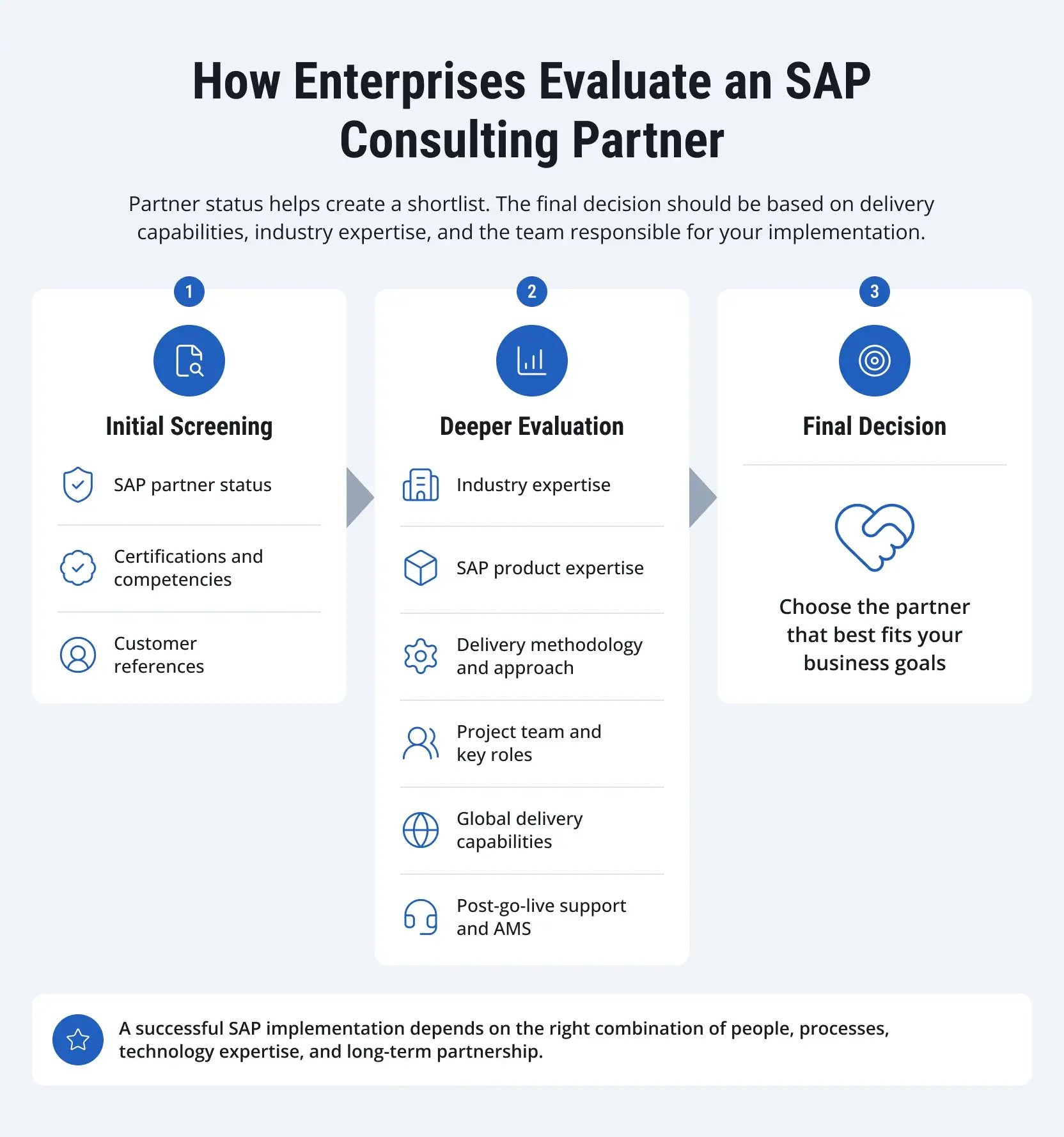
A Gold or Platinum designation can help you build a shortlist. From there, evaluate the factors that directly affect your project's delivery and long-term success.
SAP Partner Levels vs. SAP Competencies
Once you know what an SAP partner is, the next distinction is between partner level and competency.
A partner level gives you a broader view of the company's relationship with SAP. A competency is more specific: it shows where the partner has developed recognized expertise in a particular solution or area.
SAP's competency framework includes levels such as Essential, Advanced, and Expert, depending on the relevant solution or area. For a buyer, these provide a more specific signal of expertise than the overall partner designation.
For example, if you're implementing SAP S/4HANA, a Platinum designation gives you context about the partner's relationship with SAP. Relevant S/4HANA competencies, certifications, implementation experience, and customer references give you a clearer picture of whether the partner can deliver your project.
The same logic applies to SAP BTP, SAP EWM, integration, data, and other areas.
Partner level gives you the broader context. Competencies help you assess specific expertise. Neither replaces a review of relevant project experience, the proposed team, and customer references.
Because SAP partner programs and terminology can evolve, verify a partner's current designation and competencies through SAP's current partner resources rather than relying on an old badge or third-party description.
How Do You Verify SAP Partner Credentials Before Shortlisting?
Once you understand what SAP partner credentials represent, verify them before adding a company to your shortlist. Partner designations and capabilities can change over time, so a badge on a company website or in a sales presentation should not be your only source.
Start with SAP Partner Finder, SAP’s directory for finding partners and reviewing their capabilities. Check the partner’s current SAP standing and look for competencies and specializations relevant to your SAP solutions and business processes.
For a U.S. project, also verify the partner’s experience in the U.S. market. Look for relevant work with U.S. companies and experience with the business, regulatory, tax, compliance, or industry requirements that apply to your organization. If the project spans multiple countries, confirm that the partner can support both U.S. and global operations.
Once the credentials check out, validate them against actual delivery experience. Ask for recent customer references and comparable projects, then confirm that the proposed team has the relevant SAP and industry experience. Company-level credentials are useful, but they do not tell you who will actually deliver the project.
LeverX is an SAP Gold Partner with more than two decades of experience in the SAP ecosystem. Learn more about LeverX’s SAP partnership credentials and global capabilities.
What to Look for Beyond SAP Status
Once you've established that both partners are credible SAP providers, look beyond their SAP status. The more important question is whether a partner has the right expertise, experience, delivery model, and resources for your project.
SAP Product Expertise and Customer References
Start with the SAP solutions your project actually requires. Look for demonstrated expertise in products such as SAP S/4HANA, RISE with SAP, SAP BTP, SAP EWM, or SAP Integration Suite, depending on your scope.
Don't rely on a partner's general list of SAP services. Ask how that expertise applies to projects like yours and request relevant customer references. A partner that can point to comparable implementations, specific solution competencies, and measurable project outcomes gives you much stronger evidence than a broad portfolio of SAP capabilities.
Industry Expertise
Industry experience matters because SAP implementations have to reflect how a business actually operates. Manufacturing, retail, financial services, life sciences, and other industries can have very different processes, regulatory requirements, and integration needs.
Look for a partner that understands your industry well enough to anticipate these requirements rather than learning them during the implementation. References from companies with similar business models or operating environments can help validate that experience.
Comparable Project Experience
The strongest references are not necessarily the largest or most impressive ones. They are the ones that resemble your project in meaningful ways — for example, in business scope, SAP landscape, number of entities or locations, integration complexity, data migration, or transformation goals.
Ask the partner to show how it has handled similar challenges and what it learned from those projects. This is more useful than simply hearing how many SAP implementations it has completed.
Delivery Approach and Project Management
A partner's delivery approach can have as much impact on project success as its technical expertise. Understand how it manages governance, scope, risks, testing, data migration, cutover, change management, and communication.
You should also understand who is accountable for the engagement and how decisions and escalations are handled. A well-defined delivery model reduces the risk of gaps between business, functional, and technical teams.
Global Delivery and Support
For companies operating across multiple countries or regions, global delivery capabilities can be particularly important. A partner may combine U.S.-based resources with specialized teams in other locations, but the model should provide clear accountability, communication, and coordination.
The same applies after go-live. Ask how global support is organized, what coverage and SLAs are available, how critical issues are escalated, and whether the partner can continue supporting optimization and future SAP changes.
The Actual Team
Finally, evaluate the people who will deliver the project, not just the company presenting the proposal.
Ask to meet the proposed project leadership, solution architects, functional and technical leads, and other key specialists relevant to your scope. Their experience with your SAP solutions, industry, and project type may tell you more about the likely outcome than the partner's Gold or Platinum designation.
SAP status can help you build a shortlist. Product expertise, industry knowledge, comparable experience, delivery capabilities, and the actual project team should determine who makes the final cut.
Questions To Ask Before Choosing an SAP Partner
Many implementation issues can be avoided by asking the right questions before the project begins. The goal is to understand how the partner will actually operate, who will be responsible for the work, and whether its experience matches your requirements.
|
Area |
Questions to ask |
|
SAP expertise |
What specific SAP competencies and certifications apply to our project? |
|
Experience |
How many projects similar to ours have you completed? Can you share customer references? |
|
Industry |
Which customers have business and regulatory requirements similar to ours? |
|
Team |
Who will lead the project, and what comparable projects have they delivered? |
|
Delivery |
How will you manage project risks, scope changes, testing, and cutover? |
|
Architecture |
Who owns the solution architecture? How will you approach integration, extensions, and Clean Core requirements? |
|
Data |
What is your approach to migration, validation, and reconciliation? |
|
U.S. and global delivery |
How will U.S. and global resources work together, and who owns accountability for the engagement? |
|
Support |
What support model and SLAs will be available after go-live? |
|
Commercials |
What assumptions, exclusions, and potential additional costs should we understand? |
The answers should give you a much clearer picture of the partner than the designation alone. They will also help you identify potential delivery risks before they become contractual or implementation problems.
What Should U.S. Businesses Look for in an SAP Partner?
U.S. companies have some additional considerations when selecting an SAP consulting partner.
Depending on the organization, these may include U.S. GAAP, SOX controls, federal and state tax requirements, EDI, security and data governance, industry-specific regulations, and requirements related to multiple legal entities or states.
For companies operating globally, the challenge can be broader. The SAP environment may need to support U.S. requirements while also accommodating international entities, global processes, acquisitions, and changing supply chains.
U.S. Experience and Global Delivery
A U.S. presence can be valuable, particularly when business stakeholders, project leadership, and key decision-makers are based in the United States.
At the same time, global SAP programs often benefit from access to specialized resources in multiple locations.
The important question is not simply whether a partner has U.S.-based consultants. Ask how the delivery model will work in practice:
- Who owns the U.S. engagement?
- Who makes architectural decisions?
- How are global and local teams coordinated?
- What resources are available during critical testing and cutover periods?
- Who provides post-go-live support?
A strong U.S. delivery model combines local accountability with access to the broader expertise needed for the project.
Common Mistakes When Choosing an SAP Partner
Choosing Platinum Simply Because It Is Higher
A higher designation does not guarantee a better project outcome.
Compare the actual capabilities relevant to your business.
Treating Partner Status as a Substitute for References
A designation tells you about the partner's relationship with SAP. Customer references tell you what it is like to work with that partner.
You need both.
Looking Only at the Company's Reputation
A well-known consulting company may have a strong overall reputation but still assign a team with limited experience in your particular solution or industry.
Meet the actual delivery team.
Choosing Based Only on Price
The cheapest proposal may not have the same scope, staffing model, or level of support as a more expensive proposal.
Compare the total delivery model and expected long-term cost.
Assuming Local Means Better
A U.S.-based team can be valuable, but global delivery can provide access to specialized SAP expertise and broader capacity.
Evaluate accountability, communication, and resource quality rather than location alone.
Treating Go-Live as the End
SAP systems require ongoing support, optimization, upgrades, and adaptation.
Consider the post-go-live relationship before you select the implementation partner.
Why U.S. Businesses Choose LeverX
If you're evaluating SAP partners based on solution expertise, delivery capabilities, industry experience, and long-term support, LeverX brings these capabilities together in one engagement.
With more than 20 years of SAP experience and a global delivery model, LeverX supports complex SAP transformations across S/4HANA, SAP BTP, integration, implementation, migration, and application management.
For U.S. businesses, this means access to local engagement and global SAP expertise throughout the project - from planning and implementation to integration and ongoing support.
Conclusion
Choosing between an SAP Gold Partner and a Platinum Partner is not really a question of which designation is higher. It is a question of which partner can deliver the results your business needs.
Platinum can indicate a deeper strategic relationship with SAP, but that alone does not make a partner the better choice. A Gold Partner with stronger experience in your industry, SAP solution, business requirements, and delivery model may be a better fit for your project.
For U.S. businesses, the decision should also account for local expertise, global delivery, implementation governance, and the partner’s ability to support the business after go-live.
Use SAP partner status to narrow your options - then choose based on evidence: relevant projects, customer references, the proposed team, and a delivery approach that fits your business.
The right SAP partner is not necessarily the one with the highest designation. It is the one best equipped to make your SAP investment work.
FAQ
What is the difference between an SAP Gold Partner and a Platinum Partner?
Gold and Platinum are SAP PartnerEdge designations that reflect different levels of engagement with SAP. Platinum represents a higher level of strategic engagement, while Gold represents an established partner relationship. The designation itself does not determine which partner is better for a particular project.
Is an SAP Platinum Partner better than a Gold Partner?
Not necessarily. Platinum may indicate a deeper strategic relationship with SAP, but a Gold Partner can be a better choice if it has more relevant experience, stronger industry expertise, or a better delivery team for your project.
What does SAP Gold Partner mean?
A Gold designation indicates an established relationship with SAP and investment in SAP capabilities. Buyers should still evaluate the partner's specific competencies, project history, certifications, references, and proposed team.
What does SAP Platinum Partner mean?
Platinum represents a higher level of strategic engagement with SAP. It can be a useful indicator when evaluating a partner, but it does not guarantee stronger implementation capabilities in every SAP solution or industry.
What are SAP Essential, Advanced, and Expert competencies?
These are levels within SAP's competency framework that provide more detail about a partner's capabilities in specific solution areas. They can help buyers evaluate expertise that is more directly relevant to their project than the overall partner designation.
Can a Gold Partner implement SAP S/4HANA?
Yes. Gold status does not prevent a partner from implementing S/4HANA. What matters is the partner's demonstrated S/4HANA, migration, architecture, integration, and industry experience.
How should a U.S. business evaluate an SAP consulting partner?
Look at relevant SAP expertise, comparable projects, industry experience, the actual delivery team, U.S. and global delivery capabilities, architecture, integration, data migration, and post-go-live support. Partner status should be one factor rather than the deciding factor.
Does SAP partner status affect SAP licensing?
Partner designation and SAP software licensing are separate considerations. Licensing depends on your SAP agreement, products, purchasing model, and other commercial terms. Discuss licensing directly with SAP or your authorized SAP sales channel.
How can I verify an SAP partner's current status?
Use SAP's current partner resources to verify the partner's designation and relevant competencies. You should also validate the partner's capabilities through customer references, certifications, case studies, and discussions with the proposed project team.
What should I ask an SAP partner before signing a contract?
Ask about comparable projects, relevant SAP expertise, the proposed team, delivery methodology, architecture, migration, testing, cutover, U.S. resources, post-go-live support, SLAs, commercial assumptions, and potential additional costs.
When should I involve an SAP consulting partner?
For a complex SAP transformation, involving a partner during the planning and assessment stage can help you evaluate the target architecture, scope, migration approach, risks, timeline, and required resources before implementation begins.
Disclaimer: SAP partner programs, designations, competencies, and related requirements may change over time. The information in this article is provided for general informational purposes and reflects the information available at the time of publication. Always verify a partner’s current SAP status, competencies, and capabilities through SAP’s official resources before making a business or purchasing decision.