SAP SuccessFactors and Workday both deliver enterprise-grade HCM capabilities, but they solve different business challenges. This comparison explores architecture, integration depth, global scalability, and long-term transformation value to help enterprises choose the right platform for their HR strategy.
In the evaluation of enterprise cloud HCM platforms, SAP SuccessFactors and Workday are the most frequently selected solutions for global workforce management. Both applications offer comprehensive functional suites for core HR administration, talent retention, employee experience management, and HR data analytics.
However, each product fulfills a different role within corporate IT environments. Workday's core design relies on a unified cloud-native codebase that establishes direct data synchronization between human resource records and accounting ledgers. This architecture is often chosen by growing companies to reduce implementation timelines, standardize workflows, and maintain agility.
SAP SuccessFactors is a multi-module Human Experience Management (HXM) suite configured for complex corporate legal structures, international regulatory compliance, and extensive HR infrastructure modernization. The platform's utility is highest in global operations that demand strict local data compliance, system scalability, complex integration mapping, and centralized process control.
Both applications share a common baseline of core HR capabilities, including global payroll, talent lifecycles, advanced workforce analytics, onboarding workflows, learning management systems, and employee self-service tools. However, the platforms differ significantly in their configuration philosophies, deployment models, integration pathways, and overall enterprise architecture compatibility.
This article compares both platforms across key enterprise HR requirements and long-term transformation goals.
Enterprise Architecture
A primary architectural differentiator centers on the core enterprise system design. Unlike standalone HCM platforms that depend on custom integration layers to bridge human resources with operational and financial ledger systems, SuccessFactors contains native data mapping for SAP S/4HANA and associated SAP applications. This technical alignment allows HR data points to flow directly into enterprise business processes, eliminating the requirement for third-party middleware or fragmented API integrations. This design establishes an operational model built on a centralized data model.
|
How do companies benefit from this approach? |
|
|
Organizations can align workforce planning with financial forecasting, link labor costs directly to performance, and gain cross-functional visibility into workforce-related expenses across departments, regions, and business units. |
Businesses create stronger data consistency and reduce silos that often emerge when HR systems operate independently from core ERP platforms. |
What about Workday?
Workday delivers native HCM and financial management modules within a singular codebase, which serves enterprises focused on rapid deployment, interface standardization, and cloud-native workflows. Despite these internal capabilities, organizations with established SAP infrastructure incur additional integration overhead when importing Workday components into an SAP-centric software topology.
For enterprises utilizing SAP as the core transactional ledger, SuccessFactors functions as the preferred deployment choice for long-term planning. This approach allows corporations to utilize existing SAP software licensing, maintain architectural consistency across the IT landscape, and base their digital transformation roadmaps on a unified backend infrastructure.
Global Scale and Localization Capabilities
The primary operational constraint for multinational deployment is balancing centralized corporate consistency against regional regulatory variations, independent payroll engines, national labor laws, taxation frameworks, and local workforce practices. This division represents a core functional focus for SAP SuccessFactors.
The product architecture natively accommodates complex international footprints through explicit pre-configured localization packages covering global regions, languages, currencies, and legislative compliance rules. The platform processes localized human resource workflows, maintains compliance with country-specific statutes, builds required regional reporting outputs, and bridges the data gap between global and localized payroll providers.
|
This allows multinational companies to: |
||||
|
Maintain consistent global HR standards. |
Adapt processes to local labor regulations |
Support country-specific payroll requirements. |
Reduce compliance risks. |
Improve visibility across international workforce operations. |
What about Workday?
Workday continues to expand its global capabilities. Despite these updates, the platform has historically been optimized for US market requirements, creating operational friction in deployment scenarios that require extensive, multi-tier localization configurations across diverse regulatory environments.
When an organization operates across varied geographic regions and independent compliance models, SuccessFactors functions as a strong platform for scalable global HR management. Its software design integrates deep localization packages, multi-vendor payroll integration pathways, and structured enterprise governance tools to handle high-volume workforce complexity at scale.
Integration Depth and Hybrid Landscape Flexibility
Large-scale corporate operations are typically anchored to complex IT environments that combine legacy human resource databases, localized payroll architectures, third-party applications, and custom workflows inherited via business expansion and acquisitions.
In these environments, SAP SuccessFactors relies on a comprehensive integration architecture to ensure consistent data connectivity between SAP components and non-SAP software. The platform architecture supplies prebuilt integration components, web APIs, dedicated connectors, and automated integration flows, which lowers the development overhead associated with custom interface construction.
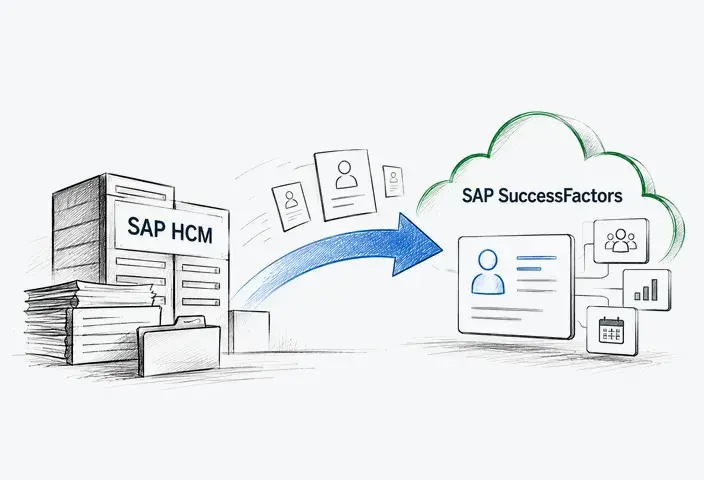
The product design also features native coexistence capabilities with legacy on-premise SAP HCM environments during extended digital transformations. Total replacement of legacy core HR infrastructure in a single deployment cycle is frequently blocked by risk profiles, statutory compliance demands, or regional infrastructure dependencies. SuccessFactors supports a phased modernization approach, allowing cloud human resource applications to interface directly with on-premise legacy systems over multi-year timelines.
Additionally, the platform handles hybrid deployment strategies across different global regions and business units. This execution model serves multinational enterprises that operate across regions with different levels of maturity, distinct regional regulatory frameworks, and software diversity driven by corporate acquisitions.
|
How do companies benefit from this approach? |
||
|
Organizations protect previous investments and minimize disruptions. |
Integrations remain standardized and governable. |
Data consistency improves across systems. |
What about Workday?
Workday is often praised for its simplicity and unified cloud-native design, particularly in organizations pursuing greenfield implementations or streamlined technology stacks. However, highly complex enterprises with deeply embedded SAP infrastructure frequently require greater flexibility around coexistence, phased transformation, and hybrid integration models.
For these organizations, SAP SuccessFactors offers a more robust architectural foundation capable of supporting enterprise-scale transformation without forcing immediate standardization across every system and region.
HR and Finance Alignment
In data-driven business models, workforce allocation directly affects corporate profitability, operational thresholds, fiscal budgeting accuracy, and overall business performance. The native data bridge between SuccessFactors and SAP S/4HANA establishes tight alignment between workforce analytics and financial operations.
Organizations use this integration to reconcile employee profiles, organizational matrices, cost centers, salary data, and headcount forecasts with centralized financial reporting and budget models in near real time. This allows business leaders to evaluate the exact consequences of hiring plans, corporate restructuring, compensation changes, or expansion strategies on budgets and profit margins before making decisions.
|
How do companies benefit from this approach? |
||
|
This creates a more unified view of workforce-related costs across the enterprise. |
Real-time cost center alignment improves financial transparency across complex organizational structures. |
Labor expenses can be mapped more accurately to business units, projects, entities, or geographic regions. |
What about Workday?
Workday also offers strong alignment between HCM and financial management within its own ecosystem. However, for organizations already relying on SAP as the digital core of enterprise operations, SuccessFactors provides a more deeply embedded approach to cross-functional workforce and financial integration.
SAP enables enterprises to build HR transformation directly into existing business processes, financial governance models, and enterprise planning frameworks. The result is a more connected foundation for long-term enterprise transformation.
Scalability for Complex, Multi-Entity Enterprises
For large-scale enterprises, human capital management scalability requires managing operational dependencies across diverse geographic regions, corporate legal entities, and subsidiaries while maintaining data uniformity and centralized oversight. SAP SuccessFactors provides a dedicated functional framework to manage these complex matrix environments.
The underlying platform architecture handles intricate corporate hierarchies, multi-entity legal structures, regional operating setups, and high-volume international human resource workflows. This system design allows organizations to enforce uniform global personnel processes while adapting configuration parameters for local statutory labor codes, domestic payroll processing, localized language interfaces, and regional employment customs.
|
How do companies benefit from this approach? |
||
|
SAP SuccessFactors enables standardized workflows and centralized reporting across multiple subsidiaries and entities. |
Enterprises can scale HR transformation alongside all lines of business. |
Businesses get deeper control over HR workflows and regulatory alignment. |
What about Workday?
Workday delivers strong scalability as well, particularly for organizations prioritizing streamlined cloud operations and rapid modernization. However, for organizations managing enterprise complexity across regions, regulatory systems, and business structures, SuccessFactors offers a foundation designed for sustainable control at scale.
Summary Comparison of SAP SuccessFactors and Workday
| SAP SuccessFactors | Workday HCM | |
| Domestic payroll | Yes | Yes |
| Global payroll | Yes | Yes (limited native options) |
| Recruiting | Yes | Yes |
| Onboarding | Yes | Yes |
| Time-tracking | Yes | Yes |
| Performance management | Yes | Yes |
| Employee engagement | Yes | Yes |
| Sentiment analysis | Yes (Qualtrics partnership) | Yes |
| Reporting and analytics | Yes | Yes |
| Advisory services | Yes | Yes |
| Mobile app | Included | Included |
| Support for contractors | Yes | Yes (VNDLY integration) |
When Workday May Be Considered
There are also scenarios where Workday represents the baseline deployment choice:
Organizations with a non-SAP ERP landscape
Workday is selected primarily by enterprises that do not utilize the SAP ecosystem as their core transactional backbone.
Companies prioritizing simplicity and speed
Organizations seeking to update human resource operations rapidly, minimize administrative overhead, and shorten user onboarding timelines often choose Workday because of its cloud-native architecture.
Standalone HR transformation initiatives
In specific corporate environments, human resource modernization is executed independently of broader, enterprise-wide operational infrastructure overhauls. Under these deployment parameters, Workday’s singular HCM application suite matches requirements for a dedicated HR platform that combines talent management, headcount forecasting, employee self-service tools, and data reporting within a consolidated framework.
Employee experience and usability priorities
Enterprises that prioritize uniform interface navigation, decentralized self-service access, and standardized workflows for personnel teams and staff view this design as a key important advantage, particularly when rapid user onboarding is a central deployment goal.
Mid-sized and fast-growing enterprises
While deployed within large-scale corporations, Workday is also utilized by mid-market and scaling businesses focused on corporate agility. Its standardized cloud delivery model accommodates organizations that need to expand human resource capabilities without increasing internal IT headcount or adding administrative overhead.
Why SAP SuccessFactors Is the Strategic Choice for SAP-Centric Enterprises
For enterprises already operating within the SAP ecosystem, SAP SuccessFactors provides specific deployment advantages:
Better operational continuity
Within SAP-dominated landscapes, SuccessFactors minimizes data silos between human resources and core workflows. Updates to personnel structures, employee records, organizational hierarchies, or staffing models synchronize directly across connected enterprise databases.
Lower integration complexity
SuccessFactors utilizes existing SAP infrastructure and data communication standards, eliminating the requirement for proprietary middleware layers, parallel system governance, or complex long-term maintenance models.
More consistent global governance
The platform architecture standardizes compliance approaches while simultaneously accommodating regional operational variables, which improves corporate transparency, audit verification, and process control across international setups.
Better alignment with enterprise growth strategies
SuccessFactors handles the onboarding of new business units, organizational alignment, standardized HR workflows, and centralized visibility across changing corporate systems without requiring a reconstruction of the core technology foundation.
LeverX Expertise in SAP SuccessFactors Transformation
LeverX executes SAP SuccessFactors deployment programs for multinational corporations operating within complex, rapidly expanding infrastructure environments.
The LeverX deployment reference includes the system integration completed for Girteka Group, an international transportation and logistics enterprise employing over 15,000 personnel across multiple European jurisdictions.
During Girteka’s HR infrastructure modernization, LeverX deployed a multi-module SAP SuccessFactors environment that consolidated core workforce administration, applicant tracking, employee onboarding, performance evaluation, corporate learning, compensation planning, and advanced time management features. The architecture required direct data mapping with SAP S/4HANA, localized payroll systems, and external third-party enterprise applications to process high-volume workforce transactions across multiple geographic regions.
LeverX utilizes this deployment methodology to deliver enterprise-wide SAP SuccessFactors modernization across several functional areas.
SAP SuccessFactors implementation
LeverX executes complete SAP SuccessFactors deployment programs, enabling organizations to update human resource operations, standardize personnel workflows, and unify workforce administration across international environments.
Integration with SAP S/4HANA
The technical team maps data connections between SuccessFactors, SAP S/4HANA, and associated enterprise infrastructure to establish data consistency, operational visibility, and cross-functional process alignment.
Global rollout programs
LeverX manages multi-country SAP SuccessFactors rollouts across international corporate divisions, allowing businesses to maintain centralized governance while satisfying regional data residency and legal localization rules.
Hybrid HR landscape design
For organizations running mixed cloud and on-premise HR environments, LeverX engineers hybrid HR topologies that accommodate multi-phase modernization strategies and protect long-term operational flexibility.
Payroll harmonization
LeverX restructures and standardizes payroll processing operations across complex international corporate setups, providing specific support for local taxation compliance, system integration, and scalable workforce operations.
FAQ
Primary system advantages include:
- Direct compatibility with the broader SAP ecosystem
- Built-in global compliance modules and country-specific settings
- Core database scalability
- Integrated headcount forecasting features
- Modular flexibility for hybrid infrastructure blueprints
- Direct synchronization between human resources and corporate financial ledgers.
How useful was this article?
Thanks for your feedback!