In this article, you'll learn what SAP PI/PO end of support means, how to assess migration readiness, and what to expect when moving to SAP Integration Suite.
|
Key takeaways: Definitive support deadlines: Mainstream maintenance for SAP PI/PO 7.5 ends definitively in December 2027, requiring immediate transition strategies. Architectural decoupling: Shifting from centralized local Java processing servers to dynamic, API-driven cloud edge routing engines. Automated regression auditing: Utilizing automated migration tooling to extract, convert, and test legacy interface mappings with minimal manual intervention. Clean Core alignment: Moving complex routing customizations off local layers to enable friction-free upgrades across the modern SAP S/4HANA Cloud network. |
If your organization runs SAP PI/PO, one date matters right now: December 31, 2027. That is when SAP ends mainstream maintenance for PI/PO 7.5.
Does that mean PI/PO simply stops working? No. Can you keep using it after 2027? Technically, yes. Will it affect your operations? It will. How seriously your organization will be affected depends on decisions you make before that date arrives.
Detailed answers to these questions, along with a clear look at what migration to SAP Integration Suite actually involves, are in this article.
What "End of Support" Means in Practice
SAP PI/PO 7.5 will not shut down on January 1, 2028. The software continues running. What stops is SAP's obligation to maintain it. After December 31, 2027, SAP will no longer issue security patches, regulatory updates, or fixes for newly discovered vulnerabilities.
There is an extended support available until December 31, 2030. But it carries additional licensing costs and covers an increasingly narrow scope of issues.
Organizations that remain on PI/PO past these thresholds face a specific set of operational risks:
- Security vulnerabilities discovered after the cutoff date will go unpatched by SAP
- Regulatory or compliance changes that require middleware updates will need to be handled internally or through expensive custom development
- Finding consultants with working knowledge of legacy PI/PO Java stack architecture becomes progressively harder and more costly
- Audit and certification processes grow more complex when core infrastructure runs on software the vendor no longer supports
The architectural reality behind the deadline
SAP PI/PO was built for a different era of enterprise IT. It runs as a centralized, on-premise Java-based system where integration logic, message routing, and adapter engines all execute on hardware that the organization owns, patches, and scales manually. That architecture made sense when most business systems lived in the same data center.
SAP Integration Suite operates on SAP Business Technology Platform (BTP) as a cloud-native integration platform. Integration flows run in managed cloud infrastructure. Connectivity to on-premise systems occurs through the SAP Cloud Connector, which establishes encrypted outbound tunnels without requiring open inbound firewall ports. Platform updates apply automatically. Scaling happens at the infrastructure level, not through hardware procurement.
The gap between these two models is wide enough that migration requires structured planning, not just a technical conversion exercise. Most enterprise PI/PO landscapes contain hundreds of interfaces, custom Java mappings, and business process flows built up over many years. Some migrate with tooling support. Others require redesign. A portion will need to be rebuilt from scratch in the new environment.
Why SAP Integration Suite, and Not Something Else
The end of SAP PI/PO support raises an obvious question 一 why migrate to SAP Integration Suite instead of continuing with the existing platform or selecting another integration solution?
The answer starts with SAP's product strategy. SAP Integration Suite serves as SAP's primary integration platform for cloud, hybrid, and on-premise environments. New integration capabilities, API management services, event-driven messaging features, and SAP application connectors are being developed within this platform.
Integration Suite provides a migration path for organisations with a significant SAP footprint, aligned with broader SAP initiatives (including SAP S/4HANA, SAP Business Technology Platform (BTP) and Clean Core programs).
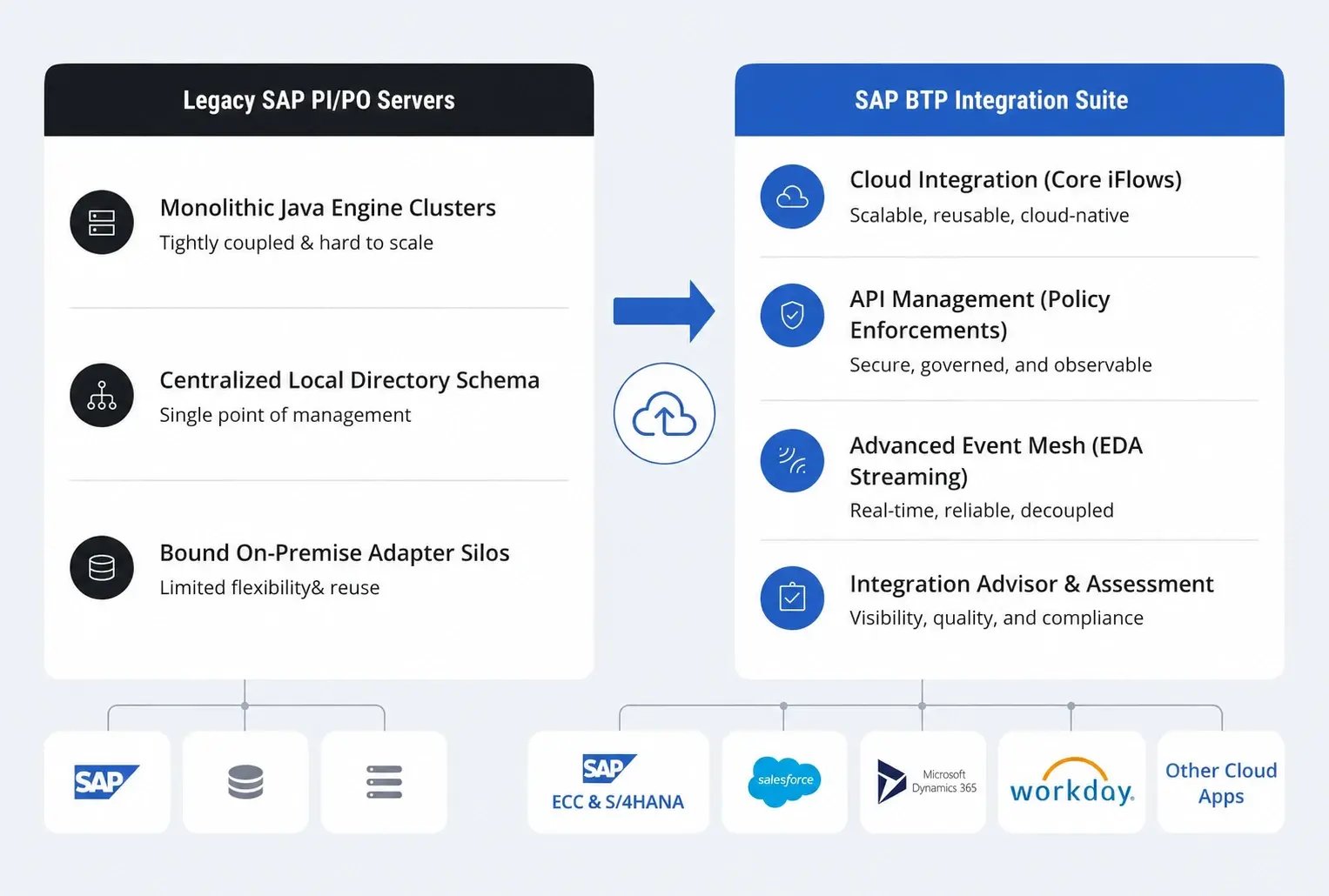
Changes that occur when moving from SAP PI/PO to SAP Integration Suite
This change impacts integration development, deployment, monitoring and maintenance. Therefore, a migration project is typically part of a larger modernisation roadmap, and not just a middleware replacement.
The Cost of Delaying the Decision
Organizations do not need to replace SAP PI/PO immediately. Existing systems can continue operating after the end of mainstream maintenance and, if required, after the end of extended maintenance.
However, postponing migration planning can introduce several challenges over time:
- Support options become more limited as the product approaches the end of its lifecycle.
- Finding experienced SAP PI/PO specialists may become more difficult.
- Integration landscapes continue to accumulate custom developments and technical debt.
- Connecting new cloud applications may require additional workarounds and custom solutions.
- Large migration projects become harder to schedule when preparation starts close to support deadlines.
These factors alone do not pose an immediate operational problem. However, together they impact long-term planning, budget allocations, and technology roadmaps. This is the reason many organizations begin migration assessments several years before the end of support.
What a PI/PO Migration Actually Involves
Migration from SAP PI/PO to SAP Integration Suite follows five phases:
- Assess the existing landscape
- Plan migration waves
- Migrate or rebuild individual interfaces
- Test against production behavior
- Deploy.
The phases are straightforward. The effort required to complete them depends on what has accumulated in the PI/PO environment over the years.
Most enterprise landscapes contain a combination of standard SAP interfaces and heavily customized objects: custom Java mappings, legacy BPM orchestrations, non-standard adapters, and business logic embedded directly in the integration layer.
SAP provides migration tooling that automatically converts a subset of standard scenarios. Migrated artifacts still require review and validation before they are production-ready. Customized objects, complex routing logic, and B2B scenarios fall outside what automated tooling can handle and require partial redesign or a full rebuild in Cloud Integration.
SAP Integration Suite: Three core components replacing one monolith
SAP PI/PO processed everything through a single centralized runtime. SAP Integration Suite separates those responsibilities across three distinct components. Each handles a specific category of integration work.
- Cloud Integration (formerly CPI) executes integration flows, handles message mapping and format conversion, and manages transport protocols through the SAP Cloud Connector.
- API Management controls access to integration endpoints through proxy layers, enforces rate-limiting policies, and handles OAuth 2.0 authentication to protect internal systems from unauthorized requests.
- Advanced Event Mesh manages asynchronous, event-driven message exchange between systems. It is used where point-to-point processing creates volume or latency constraints.
Each component is deployed and scaled independently, which differs structurally from how PI/PO concentrated all processing in one runtime.
Where Migrations Encounter the Most Resistance
Understanding the recurring technical challenges helps set realistic expectations for timeline and effort.
- Mapping refactoring is consistently the most labor-intensive part. Java, XSLT, and graphical mappings built with User-Defined Functions do not transfer directly into the Cloud Integration runtime. They require adjustment, simplification, or complete rewriting to align with how SAP Integration Suite processes data.
- Adapter and connectivity differences add further scope. Legacy adapter scenarios built around File, FTP, SOAP, RFC, and IDoc protocols need to be redesigned using Cloud Integration's supported adapter set, the SAP Cloud Connector, or REST and OData APIs where appropriate.
- Security configuration cannot be migrated as-is. Authentication and authorization settings from PI/PO need to be rebuilt using current mechanisms: certificate-based authentication, OAuth 2.0, and secure credential storage in the BTP credential store.
- Testing and cutover require more planning than teams typically anticipate. Confirming that a migrated interface produces the same business outcome as its PI/PO predecessor involves payload validation, mapping comparison, and end-to-end process testing. For high-volume or business-critical interfaces, this work is substantial. Cutover sequencing needs to account for dependency chains across interfaces so that migration of one does not break another still running on PI/PO.
- Operational procedures need to be rebuilt, not just updated. Teams familiar with PI/PO monitoring will find that Cloud Integration handles runtime behavior, message tracing, and log retention differently. Error handling, alerting thresholds, and support escalation paths all require revision before go-live.
Deeper Technical Challenges for High-Complexity Landscapes
The challenges covered above apply broadly across most PI/PO migrations. Three additional technical problems surface specifically in larger or more customized environments, and they carry disproportionate impact on the timeline if they are discovered late.
- Memory management in large-volume interfaces: Cloud Integration processes messages in memory. Interfaces handling large payloads, such as bulk IDoc transfers or high-volume batch files, can exhaust available memory if the original PI/PO design relied on processing entire messages at once. These scenarios require profiling during the assessment phase and redesign for chunked or streaming processing before migration.
- Dynamic configuration and runtime parameters: PI/PO interfaces frequently pass runtime values between processing steps using dynamic configuration objects. Cloud Integration handles this through Groovy scripts and exchange properties. Interfaces built on dynamic configuration need individual analysis and rewriting, and the resulting behavior requires careful validation to confirm the logic transfers correctly.
- Legacy ccBPM orchestrations: Cross-component BPM flows coordinate multi-step, stateful processes across systems. Cloud Integration has no direct equivalent construct. These flows need to be redesigned as event-driven integration flows, which means rethinking the process logic rather than converting it directly.
None of these represents a migration blocker. Each one represents scope that needs to be identified during the assessment phase, not discovered during testing.
LeverX note: Use migration to reduce future complexity
Migration projects often focus on moving existing functionality to a new platform as quickly as possible. That approach can preserve technical debt that accumulated over many years.
A detailed assessment provides an opportunity to identify business rules, validations, and data transformations that have gradually moved into the integration layer. Some remain necessary, while others can be simplified, consolidated, or replaced with standard platform capabilities.
Organizations that review these customizations during migration often achieve a cleaner integration landscape after go-live. This approach aligns with SAP's Clean Core principles, which encourage keeping custom logic outside the ERP core and relying on standardized interfaces wherever possible.
Before You Decommission PI/PO: A Pre-Cutover Validation Guide
Technical migration work and production cutover are two separate events. Interfaces can be rebuilt, tested, and validated in SAP Integration Suite while PI/PO continues running in parallel. The point at which PI/PO is decommissioned and production traffic moves permanently to Cloud Integration is where the real operational risk occurs.
The following five areas require explicit validation before that cutover happens. Gaps discovered after go-live in any of these areas can affect transaction integrity, security posture, or regulatory compliance.
Cloud Connector availability
The SAP Cloud Connector offers the encrypted tunnel between on-premise systems and SAP BTP. One Cloud Connector instance is a single point of failure. Before cutover, make sure Cloud Connectors are deployed in high availability pairs and that automatic failover is configured and tested. The tunnel architecture is outbound only, so no inbound firewall ports need to be opened. The connector instances themselves must be redundant.
Certificate and keystore migration
Cryptographic keys, x.509 certificates, and third-party SSL certificates used in PI/PO need to be transferred to the BTP Keystore before cutover. Certificates that expire or are missing in the new environment will cause interface failures immediately after go-live. Each certificate should be validated for expiry date and correctly assigned to the relevant integration flows.
API rate limiting configuration
API Management policies controlling rate limits on public-facing endpoints need to be active before production traffic arrives. Without explicit throttling rules, back-office systems are exposed to uncontrolled request volumes from external partners or high-frequency internal processes. Rate limit thresholds should reflect actual production traffic patterns, not default values.
Idempotency controls on critical flows
Duplicate message delivery is a known risk during cutover periods, particularly where systems are processing messages from both PI/PO and Cloud Integration simultaneously. Integration flows handling financial transactions, inventory updates, or order confirmations should include deduplication logic using unique message identifiers before cutover begins.
Data residency verification
The production region you choose must meet any applicable data protection requirements, such as GDPR for European operations or sector-specific regulations such as banking privacy frameworks. This validation should be done at the planning stage, but an explicit verification must be completed before any production data is moved into the new environment.
|
Pre-Cutover Checklist: Five Questions to Answer Before Go-Live
|
One More Thing to Check
One more question remains after all technical planning is done. Do you have a professional by your side who has already taken SAP PI/PO landscapes through migration to SAP Integration Suite?
SAP integration migration is not only a design task. It is also sequencing, testing, and cutover decisions that directly affect running business processes. That is where experience matters in practice, not in theory.
At LeverX, we work with SAP systems daily and support organizations migrating complex PI/PO landscapes to SAP Integration Suite. We are an SAP Gold Partner that focuses on maintaining stability of core processes while moving integration logic to modern architecture.
If you are already planning migration, or even if you are still evaluating options, the first step is simple. We review your current integration landscape and identify what can be moved, what needs redesign, and where risks appear.
Book a strategy session, and we will walk through your setup and migration path together.

-min-2.jpg)