Learn how enterprise master data harmonization helps organizations reduce transformation risk and build scalable SAP governance models.
Enterprise SAP transformations rarely become difficult because the platform itself lacks capabilities. In many cases, the bigger challenge comes from years of inconsistent master data spread across different systems, regions, and business units.
Customer records evolve differently across subsidiaries. Material structures follow local logic. Finance teams maintain separate reporting hierarchies shaped by operational needs that have developed over time. These inconsistencies may remain manageable for years inside disconnected environments, but they become much harder to ignore once organizations begin consolidating ERP landscapes or implementing SAP S/4HANA Cloud.
At that stage, master data stops being a technical detail in the background. It starts influencing reporting quality, process consistency, governance models, and even the pace of the transformation itself.
Modern SAP transformation strategies depend on enterprise data harmonization to succeed. Failing to build this unified data layer makes it incredibly difficult for organizations to scale workflow standardization, deploy automated processes, or maintain cross-functional visibility across the new landscape.
Why Master Data Harmonization Is the Hidden Risk in SAP Transformations
Most SAP transformation programs begin with a strong focus on infrastructure, rollout timelines, integrations, and process redesign. Data harmonization usually receives less attention during the early planning stages, partly because many inconsistencies remain hidden inside daily operations for years.
The situation changes once organizations start preparing enterprise data for migration. Organizations often discover that fragmented master data affects much more than reporting consistency alone. Procurement workflows become harder to standardize. Supply chain visibility weakens. Integration projects grow more complicated because systems interpret business objects differently across regions.
In some cases, the technical migration itself turns out to be less complicated than aligning the organization around common enterprise data standards. That is usually the point where harmonization stops being viewed as a cleanup task and becomes a broader operational transformation effort.
Migration vs. Harmonization: Understanding the Difference
In many SAP transformation programs, data migration and data harmonization are treated as if they describe the same activity. In practice, they solve different problems and require different types of decisions from the organization.
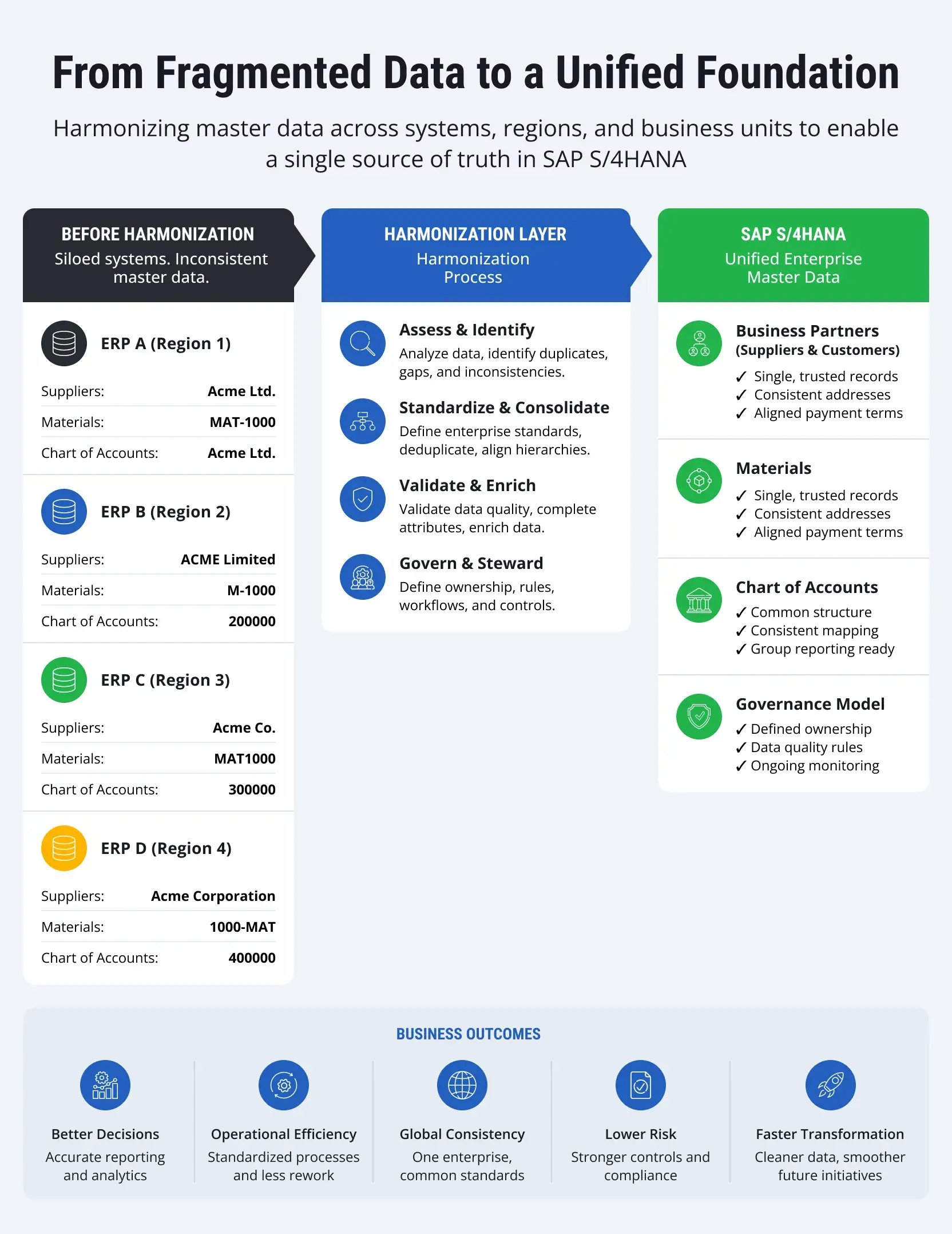
Migration is largely technical. The goal is to move information from legacy systems into the future SAP environment without losing relationships, structures, or historical records. Teams extract data, convert formats, validate mappings, and prepare objects for loading into SAP S/4HANA. A project may complete this process successfully while still transferring years of inconsistency into the new landscape.
That usually becomes visible fairly quickly after go-live. The same supplier may still exist under several records across regions. Material definitions may continue following different local standards. Finance teams may technically operate inside the same platform while relying on reporting structures that were never fully aligned in the first place.
Harmonization starts where migration stops. The discussion shifts from how data should be moved to how it should function across the enterprise moving forward. Organizations begin reviewing naming logic, classifications, hierarchies, approval structures, and duplicate records that have accumulated gradually over time. In multinational environments, that process is rarely straightforward because local operational models often evolved independently for years.
What works well in one region may not align with another region’s procurement structure, reporting model, or compliance obligations. Some business units classify suppliers differently. Others maintain separate product hierarchies shaped around local manufacturing or distribution processes. These differences are not always mistakes. Many were created for practical operational reasons at the time.
That is one reason harmonization initiatives tend to become more operational than technical, surprisingly quickly. Governance adds another layer entirely. Even organizations that complete large harmonization programs successfully can see data quality deteriorate again after transformation if there are no sustainable controls around ownership, approvals, validation, and ongoing maintenance.
Core Master Data Domains That Drive Enterprise Risk
Not all master data domains cause equal amounts of trouble. The SAP Business Partner (BP) data model is typically where the operational processes fail first during a system consolidation. It is incredibly common for separate subsidiaries to run completely different customer IDs, messy billing addresses, and conflicting payment terms for the same exact account. When you finally try to tie your finance, logistics, and procurement workflows together, these mismatched data fields hit multiple departments at the exact same time.
Material master data presents significant operational challenges of its own. Over time, operations naturally accumulate duplicate part numbers, mismatched units of measure, and localized naming habits. This data clutter ruins your inventory visibility, warehouse tracking, and production scheduling much faster — and harder — than project teams ever expect.
Financial master data introduces a different kind of friction. Here, you are forced to balance high-level corporate reporting needs with strict local accounting rules. Regional charts of accounts, distinct cost center layouts, and localized accounting logic usually reflect decades of independent local habits rather than any unified corporate standard.
Employee and organizational data quickly become a bottleneck when a company tries to roll out automated workflows or cross-functional analytics. If your internal reporting lines and employee hierarchies are messy across different systems, your security roles, user permissions, and basic operational visibility will be completely skewed.
Finally, messy supplier data is a massive liability for global operations. When vendor records are fractured, you end up with massive purchasing inefficiencies, double payments, and zero visibility into your total vendor spend. As global audit rules and regulatory demands keep tightening, the quality of your supplier data directly dictates your compliance risk.
Harmonization in Multi-System and Multi-Country Landscapes
Let's be realistic: cleaning up and aligning your enterprise data turns into an absolute nightmare the moment your business operates across multiple borders, separate legal entities, and disconnected ERP systems.
Global businesses rarely maintain perfectly aligned operational models. Regional finance teams adapt reporting structures around local regulations. Procurement processes evolve differently across markets. Acquired entities often preserve legacy governance practices long after the acquisition itself is complete. As a result, harmonization initiatives constantly balance two competing priorities: enterprise-wide consistency and local operational flexibility.
This becomes particularly visible in financial structures. Large organizations often maintain regional variations in the chart of accounts logic, tax reporting models, and legal entity structures. A highly rigid global template may simplify enterprise consolidation while creating operational difficulties for local teams that still need to satisfy country-level obligations.
Shared services environments introduce additional pressure for standardization. Centralized procurement, HR, or finance operations depend heavily on consistent master data structures. Without aligned business partner definitions, approval models, and reporting hierarchies, shared services operations become harder to scale efficiently.
Mergers and acquisitions just compound the mess. Every new company you buy brings an entirely separate ERP platform, an unmapped local vendor network, unique governance rules, and overlapping master data. You cannot just run an automated script to smash these disparate structures together and expect it to work.
Deals like this force a hard choice: do you blindly dump every scrap of legacy history into your new SAP setup, or do you take a more surgical approach? This is exactly where selective migration strategies pay off. It acts as a filter, allowing you to combine multiple systems under one roof while creating a cleaner foundation for master data harmonization.
But don't assume the job is done once the systems are technically merged. The pressure to keep master data consistent never actually goes away. This reality is exactly why smart enterprises stop viewing data harmonization as a one-off IT project and start treating it as a permanent, active operational capability. Successful harmonization strategies usually avoid forcing complete global uniformity. Instead, organizations establish a controlled enterprise core while allowing carefully governed local extensions where operationally necessary.
SAP Master Data Governance as an Enabler
SAP Master Data Governance lets you take control over how your core data gets created, checked, approved, and mirrored across your IT landscape. But people constantly misunderstand what it actually does. If you treat SAP MDG like just another central database repository, you are missing the point. The platform is actually a governance framework. Its real job is to force your business to figure out who owns which data fields and formalize the approval steps around your critical records.
The big issue for large companies is not that data lives in separate systems. The real problem is that different departments have totally different priorities, standards, and tasks when it comes to the exact same record.
Think about how a single vendor record gets pulled in separate directions:
- Procurement cares about onboarding the supplier and getting the sourcing terms locked in.
- Finance only cares about the bank routing, tax info, and ledger mapping.
- Compliance needs to verify regulatory files and legal checkmarks.
- Regional branches keep injecting local data requirements based on their specific country rules.
SAP MDG stops this data decay by acting as a strict gatekeeper. It forces compliance using:
- Automated workflow loops that route data straight to the correct department
- Hard validation blocks that reject bad or incomplete data before it enters the system
- Bulletproof audit trails showing exactly who changed a field and when
- Smart replication tools to make sure clean data streams into all your target systems smoothly
But remember: buying software won't automatically fix broken internal politics. Plenty of companies install a high-end governance platform while leaving data ownership muddy and roles completely fractured across separate silos. If you do that, you are just layering expensive technical controls over a chaotic, broken operational baseline.
Data Governance Operating Model
Technology can support governance, but long-term data quality depends much more heavily on operational accountability.
Mature enterprise harmonization programs usually establish governance as an ongoing operating model rather than a temporary transformation workstream.
That starts with ownership clarity. Each master data domain requires a clearly defined business accountability. Without ownership, governance decisions slow down, approval processes become inconsistent, and regional exceptions gradually reappear across the landscape.
Stewardship structures are equally important. In large organizations, governance activities require continuous operational coordination rather than occasional administrative oversight. Data stewards often monitor quality metrics, coordinate approvals, manage validation activities, and support exception handling across business units.
Approval workflows also need to remain practical. Overly restrictive governance structures often create unintended consequences because operational teams eventually bypass cumbersome processes through spreadsheets, local databases, or unofficial workarounds. Effective governance balances control with operational usability.
Lifecycle management introduces another dimension that organizations sometimes overlook during transformation planning. Governance does not end once records are created. Enterprises also need consistent processes for updates, mergers, archival policies, deactivation rules, and ongoing quality monitoring.
Auditability continues to become more important as well. Regulatory expectations around transparency, traceability, and reporting accuracy are expanding across industries and jurisdictions, especially in multinational environments.
Common Harmonization Pitfalls
Let's be precise: while software limitations are rarely the primary cause, data harmonization initiatives most frequently stall because corporate leadership underestimates internal politics and operational issues hiding inside their own legacy data.
Take the data cleansing phase itself. This is always a massive blind spot during early project planning. Teams look at their legacy environments and assume they just have a few duplicate or messy files. Then they open the hood and discover thousands of corrupted, incomplete, or diametrically opposed records. Automated cleanup scripts can fix basic formatting issues, but software cannot make business decisions. You still need actual humans from different departments to sit in a room and agree on which data is correct, and that takes a lot of time.
Another recurring issue is letting IT run the whole show. When a harmonization project is treated strictly as a tech deployment, it is practically dead on arrival. Your IT department can configure the fields, but they don't own the data, and they can't force separate business units to change their habits. If the actual business leaders aren't driving the conversation around standard rules and approval models, governance decisions will completely stall out the moment a disagreement pops up.
Then there is the trap of the hyper-rigid global template. This happens when corporate teams pursue total standardization without caring about how local branches actually operate or what country-specific tax laws they have to follow. If you build a system that is too stiff, it might look beautiful and orderly on a corporate slide deck, but it will cause severe regional friction because local teams can't do their day-to-day jobs or pass local compliance audits.
Finally, the biggest failure usually happens the day after go-live. Companies spend millions to scrub their data clean for the big launch, but they treat it like a one-off event. They don't set up a permanent team to police the system once the integration consultants pack up and leave. Predictably, old habits creep right back in. Within six months, local teams start making up their own shortcuts again, naming standards drift, duplicate records multiply, and the entire system slowly decays back into a fragmented mess.
Our Experience in Enterprise Data Harmonization Programs
Data harmonization is almost never a standalone project. In the real world, cleaning up master data is completely tied to system consolidation, process standardization, internal governance, and the painful process of getting people to change their daily habits.
LeverX steps in to help organizations handle these exact friction points across complex, messy SAP landscapes. Our hands-on background covers:
- Simplifying systems by merging multiple disconnected ERP setups into one unified layout
- Managing data migration specifically tuned for SAP S/4HANA environments
- Aligning global templates to replace years of chaotic regional customizations
- Deploying SAP Master Data Governance as a functional gatekeeper, not just a database
- Designing cross-border governance that keeps international operations compliant
- Auditing and fixing data quality issues to clean up legacy technical debt before the move
- Building data governance operating models so teams actually know who owns which fields
- Providing post-go-live support to stop data quality from decaying after the consultants leave
When you look at actual implementations, the technical challenge of merging data from different databases is only half the battle. The harder part is establishing common data standards that actually stick across separate regions, business units, and future acquisitions — all without making the system so complicated that local teams can't do their jobs.
That is why we don't believe in just doing a one-time data cleanup. A successful program has to lock in the governance structures that define clear ownership, automated approval loops, and long-term accountability. Our goal is to help you build a clean data foundation that stays stable and manageable long after the initial transformation project wraps up.
Business Impact of a Unified Master Data Foundation
Companies often assume that cleaning up their data only matters for generating better corporate reports. In reality, the day-to-day operational payoff goes much deeper than basic analytics.
When your master data structures are completely aligned, you instantly wipe out the massive manual reconciliation effort that usually plagues finance and analytics teams. Your purchasing departments finally get a single, clear view of total vendor spend. Your supply chain managers can trust that product data is identical across every warehouse. Even your IT team benefits—scaling new software integrations becomes infinitely easier because every system across your landscape finally speaks the exact same data language.
Future expansion also moves at a much faster pace once these enterprise data standards are locked in. When you roll out the system to new regions or newly acquired subsidiaries, you no longer have to waste months rebuilding governance models or redefining core data fields from scratch. You just map them to the existing core.
This cleanup is also a prerequisite for advanced tech initiatives. As businesses try to scale up automation, predictive analytics, AI workflows, and real-time compliance reporting, fragmented data quickly becomes a massive bottleneck. You cannot automate a process if the underlying data models are broken. A unified data foundation is what actually creates the stable environment required to scale a digital transformation across your SAP ecosystem.
Your legal and regulatory exposure drops dramatically as well. Stronger data governance means bulletproof audit trails, total transaction traceability, and flawless compliance consistency. This is vital in international markets where tax authorities and regulators are demanding increasingly real-time, granular reporting.
Ultimately, master data harmonization is a strategic effort to inject operational stability into an increasingly complex, interconnected enterprise network.