

More and more companies realize that digital transformation is a key component for business success today and are actively looking for innovation capabilities.
Procurement isn’t a support function anymore. From 2026 to 2030, procurement will be about much more than getting purchases through faster. It will shape how resilient a business is, how well it protects margins, how reliably it meets regulatory and ESG expectations, and how quickly it can adjust when conditions change. Supply chain disruption is now part of everyday reality, cost pressure isn’t going away, and compliance demands keep growing. In reality, procurement in many organizations still runs on a patchwork of systems and spreadsheets, with supplier communication scattered across inboxes. It’s hard to get a clear view of spend, decisions take longer than they should, compliance becomes uneven, and costs increase as complexity grows.
To move digital transformation forward, companies need procurement to work as one connected flow — from sourcing and contracts to buying, invoicing, and day-to-day supplier collaboration — tightly linked to the ERP core in real time. That’s where SAP Ariba comes in: it has grown beyond procurement automation into a platform for enterprise-wide procurement transformation, as part of SAP Business Network for Procurement and end-to-end spend orchestration.
In this article, we'll explore what SAP Ariba is today, how it integrates with SAP S/4HANA and multi-ERP environments, what its architecture looks like (including SAP Integration Suite, managed gateway for spend management and SAP Business Network, formerly SAP Ariba Cloud Integration Gateway), and how it delivers measurable business value across key industries — from energy and retail to chemicals, consumer goods, and financial services.
What Is SAP Ariba: From Procurement Tool to Business Network Platform
SAP Ariba has moved well beyond basic purchase order processing. Today, it sits at the heart of SAP Business Network for Procurement and helps companies run procurement as a single connected process. Rather than improving sourcing, contracting, buying, invoicing, and supplier collaboration as separate activities, it brings them together into one operating flow that works across regions, business units, and legal entities. Many organizations also compare SAP Ariba with other solutions when defining their procurement strategy.
SAP Ariba as part of SAP Business Network
SAP Ariba brings supplier collaboration into one workflow. It cuts down on email chains and file sharing back and forth. You don’t have to wonder which version is current, and it’s easier to see where things stand.
This approach allows companies to:
- Work with suppliers in real time across regions
- Standardize procurement processes company-wide
- Exchange transactional documents digitally
- Monitor supplier performance and risk more consistently
- Maintain transparency from sourcing through settlement
When suppliers are connected through one network, it’s much easier to collaborate at scale. Procurement gains better oversight of suppliers and spend, finance works with aligned data, and fewer hours are lost to correcting errors or checking progress.
SAP Ariba and SAP S/4HANA: end-to-end spend orchestration
SAP S/4HANA holds the company’s core data, including finance, inventory, and operational records. SAP Ariba links the ERP core to suppliers, so procurement updates flow through the process without people re-entering data or passing files back and forth.
Sourcing decisions move directly into contract execution. Contracts guide purchasing behavior. POs and invoices update SAP S/4HANA automatically, keeping finance and operations aligned and reducing reconciliation work.
With this setup, controls are easier to maintain, and the numbers line up across systems. What procurement does shows up in the ERP system right away, so leaders aren’t making decisions based on outdated or conflicting data.
Key SAP Ariba capabilities across industries
The specifics vary by industry, but the basic procurement building blocks stay consistent.
Strategic sourcing
Strategic sourcing helps teams run sourcing events in a structured way, compare supplier bids, document decisions, and award business with clear approvals and traceability.
Contract management
Centralize contracts, manage versions, and directly link agreements to procurement activities to ensure agreed terms are met.
Buying and invoicing
Simplify operational purchasing with managed purchasing, automated purchase order processing, and electronic invoicing, reducing errors and manual work.
Supplier management
Onboard suppliers, validate them, track performance, and manage risk in one place, with built-in support for compliance and sustainability.
In practice, it standardizes procurement across the business, reduces compliance risk, and supports ongoing improvement as the company grows.
SAP Ariba Integration and Architecture Overview
Technology decisions around procurement are rarely about features alone. For most enterprises, the real question is how well the solution fits into an existing landscape — often complex, often hybrid, and rarely limited to a single ERP system.
SAP Ariba is designed to work as part of that landscape, not alongside it. Its integration model connects cloud-based procurement processes with ERP cores, finance systems, and external partners in a structured and supported way.
SAP Integration Suite, managed gateway for spend management and SAP Business Network
For companies running SAP S/4HANA or SAP ECC, SAP Integration Suite, the managed gateway for spend management, and SAP Business Network provide a standard way to connect SAP Ariba to the ERP environment.
The managed gateway supports the exchange of both master and transactional data, including:
- Suppliers, materials, cost centers, and other master records
- Purchase orders, confirmations, goods receipts, and invoices
Because it is delivered and supported by SAP, organizations do not need to build and maintain custom point-to-point integrations. Updates align with SAP release cycles, reducing long-term maintenance effort and helping keep integrations stable over time.
The managed gateway also includes monitoring and testing capabilities. Integration flows can be tracked, errors identified early, and test scenarios validated before go-live. This lowers the risk of disruptions once procurement processes move into production.
SAP Integration Suite for complex industry landscapes
Not every organization runs a single SAP ERP. Many operate in multi-ERP environments or use a mix of SAP and non-SAP systems across regions and subsidiaries.
In these cases, SAP Integration Suite plays a broader role. It allows companies to connect SAP Ariba with:
- Non-SAP ERP systems
- Legacy platforms
- Industry-specific applications
- Third-party finance or logistics tools
It also supports more advanced routing and transformation logic. You can route data to different systems based on business rules, company codes, or regions. This matters in global organizations where local procurement requirements vary, but central teams still need consistency and control.
Instead of creating custom integrations for each system, companies can manage connectivity through a structured integration framework.
Clean core and extensibility with SAP BTP
Architecture decisions today are closely tied to the clean core strategy. The goal is to keep the ERP system as close to standard as possible and avoid heavy customizations that make upgrades difficult.
SAP Ariba supports this approach. Core procurement processes remain standardized, while specific requirements can be handled using parallel extensions on SAP Business Technology Platform (SAP BTP).
This means companies can:
- Follow fit-to-standard best practices
- Build extensions without modifying the ERP core
- Adapt processes as regulations or business models change
The result is an architecture that supports innovation without increasing technical debt. The procurement process can evolve with the business, while the core ERP system remains stable and easier to upgrade over time.
-min-2.jpg)
SAP Ariba for Oil, Gas, and Energy
In oil, gas, and energy, procurement is part of keeping the business running. When a part shows up late or a supplier doesn’t deliver, maintenance slips, equipment sits idle, and the consequences can be serious. That’s why procurement here is about reliability and control, not just pushing orders through.
Industry-specific procurement challenges
This industry runs on asset-intensive operations. Refineries, drilling sites, pipelines, and power generation facilities depend on steady maintenance and a constant flow of MRO materials and technical services. The procurement load is heavy, the categories are complex, and the consequences of delay are expensive.
Common challenges include:
- Repair and maintenance of power systems with thousands of items, multiple locations, and urgent demand
- Technical services and long-term vendor contracts with strict requirements
- Supplier risk, especially when vendors are highly specialized or hard to replace
- Tight regulatory and safety standards that require traceability and documentation
- Growing ESG and sustainability expectations that extend to the supplier base
Supplier risk is a major factor. Many critical components and services come from a limited pool of vendors, so disruptions can ripple across multiple facilities. At the same time, sustainability requirements are becoming more practical and measurable. Companies need clearer supplier data, stronger controls, and audit-ready documentation, not just policy statements.
How SAP Ariba supports energy companies
SAP Ariba helps bring order to this complexity by making procurement processes more connected and easier to manage across sites and business units.
Strategic sourcing capabilities support structured sourcing events, supplier evaluation, and contract award processes. For high-value equipment and service contracts, that structure matters because it improves comparability, documentation, and approval control.
Supplier collaboration through the SAP Business Network reduces dependence on email-based coordination. Orders, confirmations, and invoices move through a consistent process, and both sides have clearer visibility into what’s needed and when.
Real-time visibility into spend and contracts also becomes more practical. Contract terms are tied to purchasing activity, which helps reduce off-contract buying and improves compliance with negotiated conditions. For large organizations managing multiple locations, that visibility supports better planning and stronger negotiation leverage.
Business value for oil, gas, and energy
When procurement is structured and connected, the benefits are easy to measure.
Sourcing cycles can move faster because workflows are standardized and supplier communication is clearer. That helps teams respond more quickly when operational needs change.
Inventory availability improves when procurement and supplier collaboration are aligned, especially in MRO purchases, where missing parts often cause the biggest delays. Better visibility reduces last-minute firefighting and helps prevent shortages.
Working capital also becomes easier to manage. With clearer insight into spend commitments and invoice status, finance teams can plan cash flow with more confidence. Stronger contract compliance and fewer manual corrections also reduce cost leakage.
For oil, gas, and energy companies, SAP Ariba supports a procurement model that is less reactive, more transparent, and better suited to the operational reality of asset-intensive businesses.
SAP Ariba for Retail
Retail is evolving rapidly. Trends change, promotions instantly alter demand, and product lifecycles are constantly shortening. Procurement teams feel this pressure every day. If the procurement process slows down or suppliers miss deadlines, the consequences are immediate — product shortages, launch delays, or reduced profits.
In retail, procurement needs to respond quickly, but it can’t lose control over spending or how suppliers perform.
Retail procurement challenges
Retailers deal with a mix of speed and complexity.
Demand volatility
Forecasts don't remain stable for long. Promotions, seasonal peaks, weather changes, and online trends all impact demand. Purchasing departments must respond quickly, but excessive purchasing creates excess inventory and ties up capital.
Short product lifecycles
In many retail segments, especially fashion and consumer goods, timing is critical. If sourcing or contracting takes too long, the selling window can close before products even reach stores.
Global supplier base
Global supplier networks add complexity. Time zones, currencies, and compliance rules all require coordination, and without structure, small issues don’t stay small for long.
These pressures typically lead to familiar problems:
|
Retail challenge |
What it causes |
|
Rapid demand shifts |
Stockouts or overstocks |
|
Slow sourcing cycles |
Missed market opportunities |
|
Weak contract enforcement |
Margin leakage |
|
Poor supplier visibility |
Delivery delays and disputes |
SAP Ariba capabilities for retailers
SAP Ariba helps retailers bring more structure and clarity into this environment.
Demand-driven sourcing
Procurement departments can quickly launch sourcing campaigns and compare supplier proposals in one place. This simplifies adjusting purchasing decisions as forecasts change.
Supplier collaboration via SAP Business Network
Orders, confirmations, and invoices move through a defined digital process. Suppliers see clear requirements, and buyers can track progress without relying on email chains.
Contract compliance
Contracts are linked directly to purchasing activity. Negotiated prices and terms are applied automatically, which reduces off-contract buying and protects margins.
Here’s how these capabilities connect to retail needs:
|
Retail need |
SAP Ariba support |
|
Faster reaction to demand changes |
Structured sourcing workflows |
|
Better coordination with global suppliers |
Network-based collaboration |
|
Protection of negotiated margins |
Contract-driven purchasing |
Business outcomes for retail companies
When procurement is structured and connected, the benefits are practical:
Faster time-to-market
Shorter sourcing and contracting cycles help new products reach stores sooner.
Cost optimization
Better visibility into spend and stronger contract compliance reduces margin leakage.
Improved supplier performance
Clear processes and shared visibility make it easier to monitor delivery reliability and resolve issues early.
Retail will always operate under pressure. The difference is whether procurement reacts to problems or manages them with visibility and control. A connected procurement model makes that shift possible.
SAP Ariba for chemicals
In the chemical industry, procurement is closely linked to production stability. If raw material deliveries are delayed or the supplier fails to meet regulatory requirements, production doesn't just slow down — it can even stop. That's why procurement here is built on control, documentation, and reliability.
Procurement challenges in the chemical industry
In the chemical industry, regulation isn't just a hurdle — it’s the baseline. Everything from how you buy materials to how you move them is dictated by environmental standards and safety codes. You can't just pick any supplier; they have to meet a high bar, and the paperwork has to be airtight and ready for an audit at a moment's notice. The key is that compliance happens in real-time; it’s checked at every single step, not just tacked on at the end.
Supply stability is another constant concern. Raw material availability, logistics constraints, and geopolitical risks all influence procurement decisions. Even short interruptions can affect production schedules and customer commitments.
How SAP Ariba Addresses These Challenges
SAP Ariba supports chemical companies by structuring sourcing and supplier management processes in a way that is easier to control.
Sourcing runs through clear steps with approvals and documentation built in. Supplier checks can include regulatory and sustainability criteria from the start, so compliance is handled as part of the process, not something reviewed later.
Spend information is gathered across sites and entities in one place. That makes it easier to see whether purchases follow contract terms and to spot exceptions early. Procurement and finance work from the same data, which means less manual reconciliation.
Supplier performance and risk indicators are managed in one system. That helps identify potential problems earlier — whether related to compliance status, financial stability, or delivery reliability.
From challenge to practical impact
|
Chemical industry reality |
What structured procurement changes |
|
Strict regulatory oversight |
Clear audit trails and documented approvals |
|
Specialized supplier base |
Centralized qualification and performance tracking |
|
Supply volatility |
Better visibility into spend and supplier exposure |
For chemical companies, structured procurement is not about optimization alone. It is about reducing uncertainty and protecting production continuity in a highly regulated and technically demanding environment.
Value delivered to chemical companies
When procurement runs in a structured and transparent way, the benefits are practical.
Lower procurement costs
When teams can clearly see what’s being purchased and under which contracts, it’s easier to catch pricing inconsistencies and off-contract orders. Negotiations rely on actual numbers, not estimates. Over time, that helps reduce unnecessary spending and strengthen cost control.
More efficient processes
When the procurement steps are clearly laid out, and approvals are part of the flow, there’s less need for manual fixes and document searches. Teams don’t have to retrace their steps before audits. The process becomes more predictable, and everyday tasks take less time.
Stronger compliance control
Regulatory and safety requirements are addressed as part of supplier qualification and sourcing, not checked at the end. Documentation is available when needed, and audit preparation is less disruptive. Compliance becomes part of daily operations rather than a separate burden.
For chemical companies, this means fewer disruptions, more stable production support, and greater confidence in the organization of procurement.
SAP Ariba for Consumer Products
In consumer goods, procurement hits where it matters: profit and brand trust. Margins are thin, demand shifts quickly, and expectations for quality and delivery are high. Sustainability can’t be just a claim either; it has to be supported by what suppliers actually do. When issues happen, they surface quickly.
That’s why procurement here is not only about getting the right price. It is also about protecting the brand and keeping the supply predictable.
Consumer products procurement drivers
In consumer products, procurement decisions go far beyond purchasing. They affect margin protection, how credible sustainability claims are, and how well the brand holds up when something goes wrong in the supply base.
Margin pressure
Consumer products companies rarely have much room to raise prices. Even small cost increases in materials or packaging can affect profitability, especially at scale. Procurement teams are expected to hold the line on costs while keeping supply stable.
Sustainability
These days, sustainability has to be backed up. Partners want transparency, regulators want documentation, and customers expect brands to know their supply base. Procurement teams need a working process for supplier checks, tracking commitments, and keeping everything organized.
Brand protection
If a supplier slips on quality or compliance, it doesn’t stay quiet for long. It leads to delayed shipments, product complaints, and unpleasant questions for the brand. Procurement’s job is to set the bar for suppliers and make sure it’s actually met.
SAP Ariba use cases for consumer products
In consumer products, these SAP Ariba use cases help procurement protect margins and supply stability by tightening supplier controls, keeping purchasing aligned with contracts, and reducing inventory volatility.
Supplier qualification
SAP Ariba helps teams onboard suppliers in a structured way, using clear qualification criteria. That can include quality expectations, compliance requirements, and sustainability checks. The goal is simple: fewer surprises after a supplier is already in the chain.
Contract-driven buying
Purchasing tied to contracts helps keep terms consistent across teams and locations. It also reduces off-contract buying, which is a common source of cost leakage in large, decentralized organizations.
Inventory optimization
When purchasing is tied to supplier commitments and contract terms, planning becomes much easier. Teams are less likely to swing between overstock and emergency orders. Better coordination keeps inventory steadier and reduces last-minute purchases.
Put together, they reduce supplier-related surprises, limit off-contract spend, and make buying and inventory planning more predictable across the business.
Business benefits for consumer products companies
Reduced inventory costs
More predictable buying and clearer supplier coordination help reduce excess stock and expensive rush replenishment.
Improved spend control
With contracts connected to purchasing, it’s easier to apply negotiated terms consistently and keep spending in check.
Better supplier collaboration
Structured communication and shared visibility reduce friction with suppliers and improve reliability over time.
In the consumer goods sector, SAP Ariba enables faster procurement with tighter controls, profit protection, supply chain continuity, and brand reputation.
SAP Ariba for Banking and Financial Services
In financial services, procurement has a direct impact on cost discipline and governance. Institutions operate with complex vendor ecosystems, heavy indirect spend, and strict regulatory oversight. Procurement is expected to deliver speed, transparency, and control at the same time.
Procurement challenges in banking
In banks, procurement is mostly about indirect spend. Think IT services, software licenses, consulting, facilities, marketing, and outsourced operations. The problem is that this spending is spread across departments, so it’s easy for it to become inconsistent and hard to track.
Indirect spend complexity
Indirect categories are less predictable than direct materials. Different business units may negotiate separately, which leads to inconsistent pricing and contract terms. Without clear oversight, spending becomes fragmented and harder to control.
In banking, this complexity now comes with an added layer of pressure: regulatory expectations around third-party digital risk. Under frameworks like the EU Digital Operational Resilience Act (DORA), vendor selection and management is not only a procurement topic. It affects operational resilience, audit readiness, and how well the institution can demonstrate control over ICT third-party risk.
Regulatory pressure
Banks work under heavy regulation. Supplier due diligence, third-party risk checks, audit trails, and documentation aren’t occasional tasks — they’re everyday work. That’s why procurement needs to build compliance in from the start, not bolt it on later.
Cost transparency
Leaders expect a straightforward view of vendor spend, contract adherence, and savings efforts. When data is tracked manually or spread across systems, reporting becomes harder to trust and easier to misstate.
SAP Ariba capabilities for financial institutions
SAP Ariba helps banks structure procurement processes and bring more visibility into indirect spend.
Indirect spend management
Centralized sourcing and contract management support consistent supplier evaluation and wider use of negotiated terms across departments, reducing fragmented spend and strengthening purchasing control.
Supplier risk and compliance management
Supplier onboarding and evaluation can cover financial checks, compliance documents, and third-party risk reviews. With approvals and documentation handled in the process, audits and regulatory reporting become much easier to support.
Real-time analytics
When spending data is consolidated, it’s easier to see where money goes and how vendor relationships are structured. Procurement and finance can track commitments, measure savings, and spot unusual patterns faster.
Business impact for banks
When procurement is structured and transparent, the impact becomes measurable.
Improved cost control
Clearer information on indirect costs and contract compliance helps reduce duplication and off-contract procurement.
Increased transparency
Centralized documentation and reporting support internal governance and regulatory compliance.
Faster procurement cycles
Standardized workflows and clearer supplier processes reduce approval and procurement timelines.
For financial institutions, procurement is closely linked to governance and risk management. A structured approach helps banks maintain control while improving efficiency across their vendor landscape.
Cross-Industry Benefits of SAP Ariba
The specifics vary by industry, but the challenges are generally the same: spend data is stored in different repositories, supplier management is done through email chains, contracts don't always dictate procurement processes, and compliance reviews are performed after the work is completed. SAP Ariba won't make procurement simple, but it will simplify its management without the need for manual oversight.
Cross-industry benefits (what changes in real work)
|
Area |
What improves day to day |
What it helps prevent |
|
Spend visibility and control |
Spend and contract terms are easier to see in one place, so teams can check what’s being bought and under which conditions |
Pricing drift, off-contract orders, duplicate buying across departments |
|
Supplier collaboration at scale |
Orders, confirmations, and invoices follow one process instead of dozens of email threads and attachments |
Missed deliveries due to miscommunication, disputes over “who said what,” slow issue resolution |
|
Compliance and risk management |
Supplier checks, approvals, and documentation are captured during the process, not reconstructed later |
Audit scrambling, missing paperwork, gaps in supplier due diligence |
|
Faster, more flexible procurement |
Less waiting for manual transfers and less renegotiation when something changes |
Slow sourcing cycles, last-minute buying, unnecessary rework |
A similar shift is occurring across industries: procurement management at scale is becoming easier because it's no longer a cycle of exceptions, manual workarounds, and spreadsheets. Teams spend less time tracking status and resolving discrepancies and more time managing spend, suppliers, and risks.
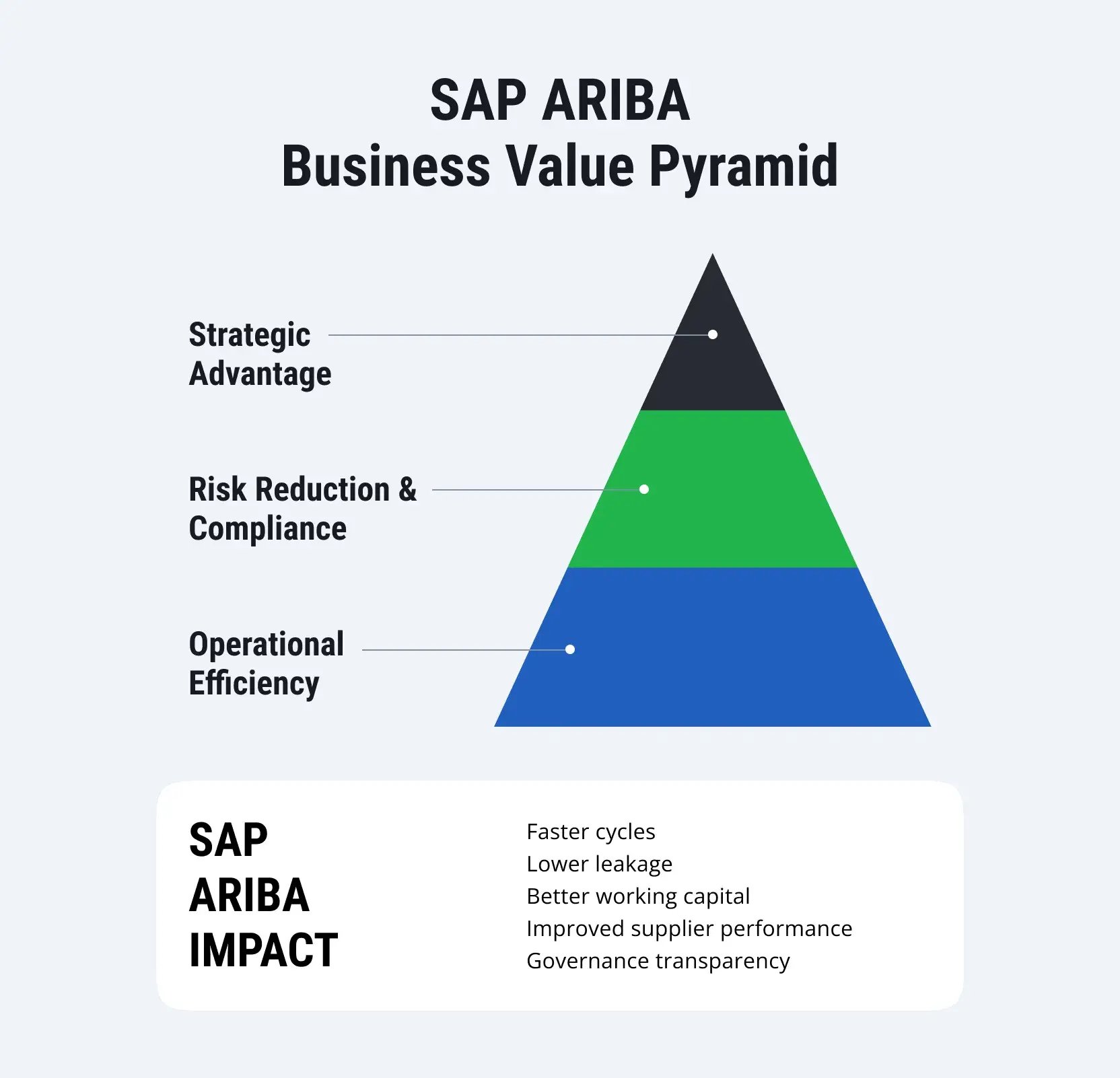
How SAP Ariba Fits Into RISE with SAP and Digital Transformation Programs
Digital transformation programs are rarely successful if they focus on a single function in isolation. Moving to cloud ERP systems, redesigning financial processes, or modernizing supply chains all require the simultaneous development of procurement activities. Otherwise, gaps arise between strategy and execution.
In this context, SAP Ariba is more than a standalone solution. It supports the wider transformation program rather than operating separately from it.
SAP Ariba as a core component of RISE with SAP
RISE with SAP is more than a technical migration. It’s a shift toward standardized processes, a clean core strategy, and cloud operations — and for many organizations, the most immediate driver is the approaching end of mainstream maintenance for SAP ECC in 2027. As that deadline gets closer, companies are making decisions not only about moving to SAP S/4HANA, but also about which processes should be modernized alongside the ERP core.
Procurement is one of the clearest examples. If SAP S/4HANA becomes the digital core under RISE, SAP Ariba extends that core into the supplier ecosystem and supports a more connected operating model from sourcing through invoicing and collaboration. This helps avoid a situation where the ERP core is modernized, but procurement remains a legacy island with manual workarounds and disconnected supplier processes.
SAP Ariba supports:
- An integrated transformation, where procurement processes are aligned with the new ERP core from the outset
- Standardization across entities, reducing custom workarounds that complicate upgrades
- Faster value realization, as procurement, contract management, and supplier interaction processes are modernized simultaneously with finance and operations
Procurement Transformation as Part of Enterprise-Wide Change
Procurement touches multiple functions. Changing how it operates affects more than the procurement team.
Finance
Contract-driven purchasing and clearer spend visibility improve financial reporting and support better working capital management.
Supply chain
When supplier collaboration follows a clear process, deliveries become more reliable and disruptions in logistics and operations are easier to avoid.
Sustainability
Structured supplier qualification and documented monitoring support environmental and social compliance, providing companies with a factual basis for sustainability claims.
When procurement transformation is aligned with finance, supply chain, and sustainability initiatives, the result is a more coherent transformation across the enterprise. Instead of separate improvement projects running in parallel, organizations move toward a more connected operating model.
In RISE with SAP programs, SAP Ariba helps ensure that procurement is not an afterthought, but a coordinated part of long-term transformation.
Common Challenges in SAP Ariba Adoption
Implementing SAP Ariba goes beyond simply installing a new system. Suppliers must adapt, integrations must work seamlessly, and internal teams often need to change their established work practices. Even when the "why" is obvious, some challenges almost always arise.
Recognizing them early makes the transition smoother.
Supplier onboarding
One of the first hurdles is supplier adoption. Moving from email and PDF documents to a structured digital process requires effort on both sides.
Common issues include:
- Suppliers unfamiliar with the SAP Business Network
- Delays in registration or qualification
- Resistance from smaller vendors with limited digital maturity
- Incomplete or inconsistent supplier data
Without a clear onboarding plan and communication strategy, supplier activation can slow down the overall rollout.
Integration complexity
SAP Ariba rarely operates in isolation. It needs to exchange data with SAP S/4HANA, legacy ERP systems, finance tools, and sometimes industry-specific applications.
Challenges often include:
- Inconsistent master data between systems
- Custom integrations built over time
- Multi-ERP landscapes across regions
- Limited visibility into existing interfaces
Even with standard integration tools like managed gateway, landscape complexity can affect timelines if not assessed early.
Change management
Procurement transformation changes how people work. Approval flows become structured, contracts are enforced more strictly, and manual shortcuts are reduced.
Typical friction points:
- Business units used to autonomous purchasing
- Managers adjusting to standardized workflows
- Resistance to increased transparency
- Lack of clear communication about new processes
Successful adoption depends as much on communication and training as on configuration.
Data quality
Clean processes depend on clean data. If supplier records, material masters, or contract information are incomplete or inconsistent, issues surface quickly after go-live.
Typical data challenges:
- Duplicate supplier records
- Outdated contract terms
- Missing tax or compliance documentation
- Inconsistent category structures
Addressing data quality before rollout reduces post-go-live corrections and helps the system deliver value faster.
Most SAP Ariba challenges are manageable, but they require planning beyond technical setup. Supplier engagement, integration clarity, user adoption, and data preparation are just as important as system configuration.
How LeverX Helps Implement SAP Ariba Across Industries
Implementing SAP Ariba is rarely a one-size-fits-all project. The priorities of an energy company differ from those of a retailer or a bank. Integration landscapes vary. Regulatory requirements vary. Internal maturity levels vary.
LeverX approaches SAP Ariba implementation as a business transformation initiative, not just a technical deployment.
Procurement assessment
Every project starts with understanding how procurement actually works today. LeverX evaluates:
- Existing sourcing and purchasing processes
- Contract management practices
- Supplier landscape and risk exposure
- Data quality and system landscape
The aim isn’t to rebuild procurement from the ground up. It’s to see where standard SAP Ariba processes can replace manual fixes and where changes are actually needed. That approach limits unnecessary customization and keeps the future setup aligned with clean core principles.
Integration and architecture
Integration is often the most complex part of the project. LeverX supports:
- SAP Ariba integration with SAP S/4HANA
- SAP Integration Suite, managed gateway for spend management and SAP Business Network configuration
- multi-ERP and hybrid landscapes
- Alignment with SAP Integration Suite and SAP BTP, where needed
The point isn’t to reinvent everything. It’s to replace workarounds with standard SAP Ariba functionality wherever possible and only adjust what really requires it. That keeps customization under control and protects the long-term architecture.
Industry-specific rollout
Procurement priorities differ by sector. LeverX adapts implementation roadmaps to industry realities:
- MRO-heavy environments in oil and gas
- Demand-driven sourcing in retail
- Compliance-focused workflows in chemicals
- Indirect spend governance in banking
Templates and best practices are adjusted to fit operational constraints while maintaining standardization where possible.
Post-go-live optimization
Implementation is not the end of the journey. After go-live, LeverX supports:
- User adoption monitoring
- Process fine-tuning
- Supplier onboarding expansion
- Reporting and analytics improvements
The objective is to ensure that SAP Ariba continues to deliver measurable value and evolves with the organization’s broader digital transformation strategy.
Conclusion
Procurement differs by industry, but one thing is consistent: a patchwork of tools and manual processes doesn’t hold up at scale. It slows teams down, limits visibility, and increases risk.
SAP Ariba brings procurement into one connected flow, aligned with the ERP core and transformation roadmap. Within SAP Business Network and RISE with SAP programs, it supports not only automation but also a more sustainable operating model for the long term.
When procurement is structured and integrated:
- Spend becomes visible and controllable.
- Supplier relationships are easier to manage at scale.
- Compliance is embedded into daily workflows.
- Processes move faster without losing governance.
For organizations operating in complex, regulated, or margin-sensitive environments, that shift is not incremental. It changes how procurement contributes to the business.
.webp)
-min-2.jpg)
.webp)
