In this article, you’ll learn about supply chain management, key operational processes, and how ERP systems, cloud platforms, AI, and Industry 4.0 technologies change planning, production, logistics, and delivery performance.
Most products look simple from the outside. You order an asset. It arrives. That's the visible part.
Behind it is a chain of decisions, contracts, movements, and systems that can span dozens of countries, hundreds of suppliers, and thousands of individual transactions. One delay anywhere in that chain and the product doesn't arrive. One miscalculation in demand forecasting and a warehouse fills with inventory nobody needs.
This is the reality that supply chain professionals manage every single day.
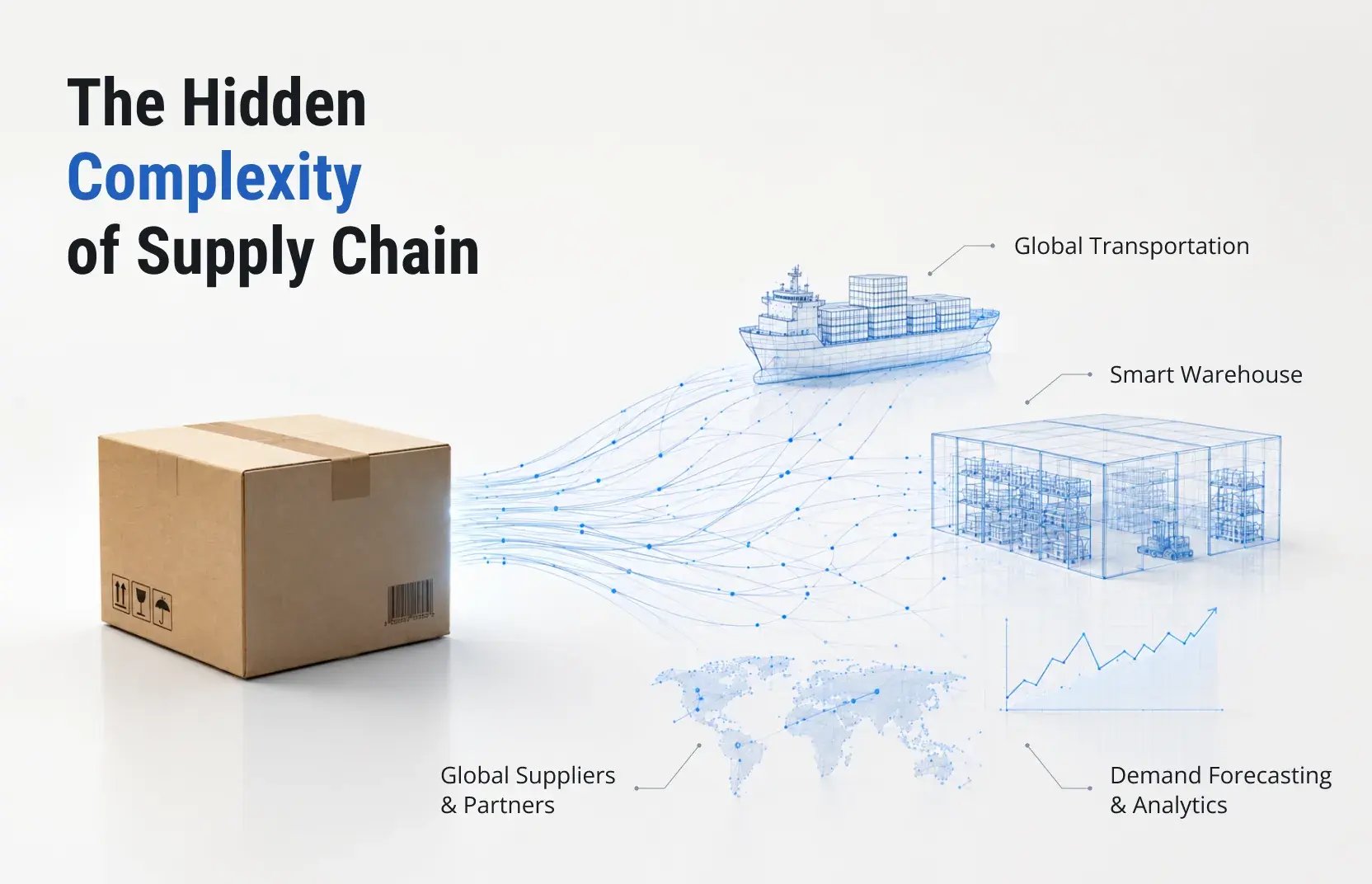 The hidden complexity of supply chainSupply chain management has become one of the most strategically important disciplines in modern business. It is no longer a back-office operational concern. Boards discuss it. Investors scrutinise it. And the companies that get it right consistently outperform those that don't. This is because their operations are built on accurate data, well-structured processes, and technology that connects every part of the chain in real time.
Yet many organisations are still running SCM operations on fragmented systems, manual processes, and assumptions that made sense a decade ago but carry real commercial risk today.
This article explains what supply chain management actually is, how its core components work, what separates a resilient SCM operation from a fragile one, and what modern technology makes possible that wasn't feasible before.
If you are evaluating your current SCM setup, or building the case for investment in new infrastructure, this is the context you need.
Supply Chain Management: What It Covers and How It Changes
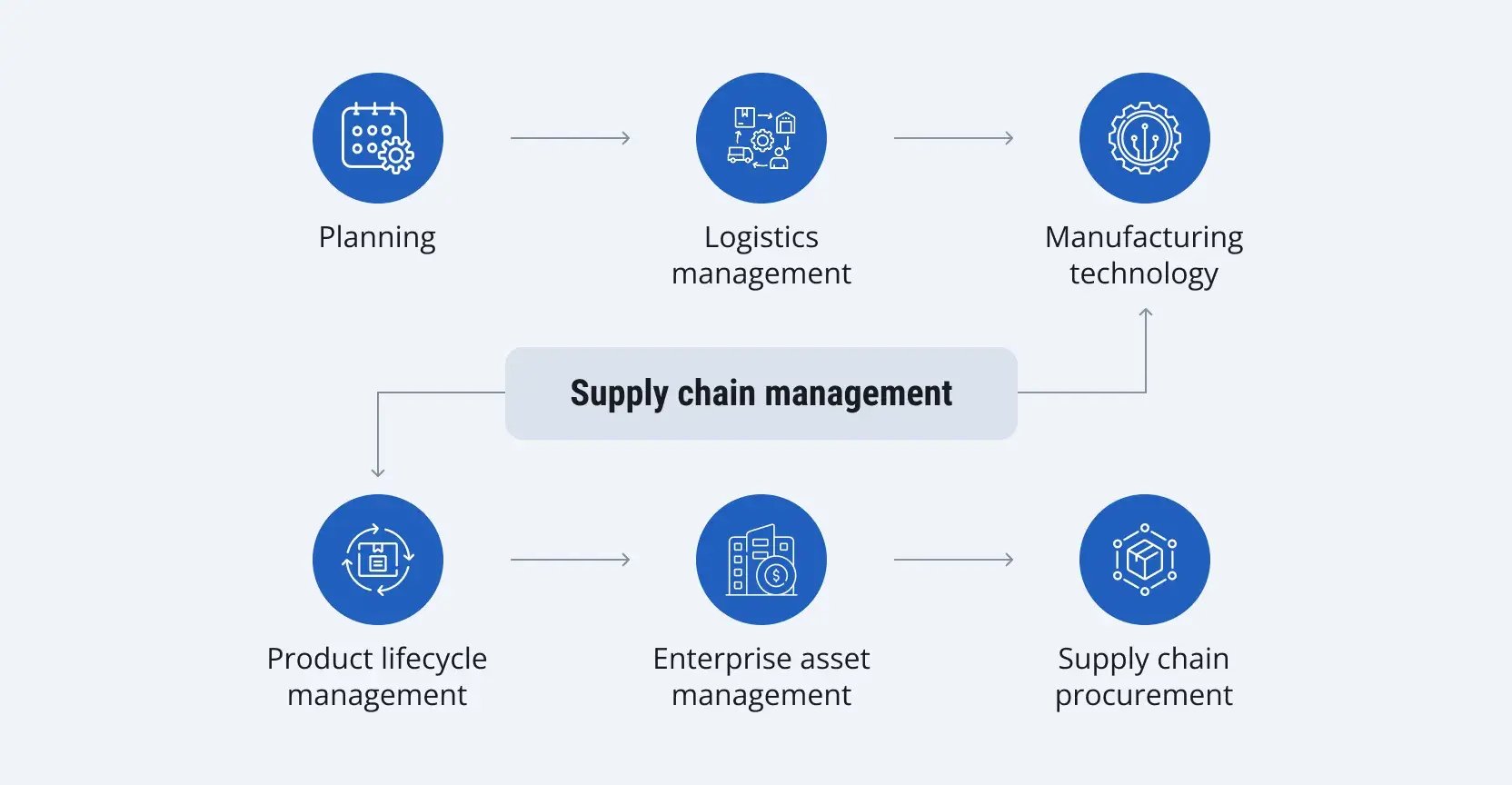
Supply chain management covers the full path from raw material intake to finished product delivery. It includes sourcing components, coordinating product design, planning production, managing warehouses, arranging transport, and distributing goods to customers.
Each stage depends on data from the previous one. Procurement decisions define what enters production. Production output defines warehouse load. Inventory levels define transport planning.
The system works only when these stages share consistent and up-to-date information. If one layer is delayed, the rest follows.
 What supply chain management includes
Global Supply Chain Management: History and Evolution
Supply chains do not operate in stable conditions. Transport costs change. Trade rules shift. Weather events disrupt logistics routes. These factors affect planning at every level.
Production location is no longer a fixed decision
Companies now reassess where production takes place. Distance alone is not the main criterion. Lead time, supplier stability, and transport predictability carry more weight.
Planning systems process supplier data and demand signals in shorter cycles. This allows companies to adjust procurement volumes and production schedules based on current conditions rather than static forecasts.
Some production is moving closer to end markets. This reduces dependency on long transport routes. It also reduces exposure to delays in cross-border logistics.
Supply chain data now includes traceability requirements
Supply chain management now includes tracking product origin and material sources. Companies record where components come from and how goods move between production and delivery stages.
This data is required for compliance reporting in many industries. It also supports internal audits of supplier performance.
Customer expectations add another requirement. Orders often move between online and offline channels. Inventory must stay consistent across both. Stock accuracy becomes a shared requirement between sales, logistics, and warehouse systems.
This level of coordination depends on continuous data exchange between systems. Without it, companies lose visibility over inventory status and delivery progress.
Why Supply Chains Matter in Modern Economies
Supply chains support every physical product in daily use. Food, electronics, medical devices, and industrial equipment all move through structured supply networks.
These networks also support a large share of global employment. Manufacturing, logistics, procurement, and warehousing depend on coordinated supply chain operations.
Despite this scale, many organisations still rely on legacy processes. Some systems were designed decades ago. They were not built for real-time data exchange or multi-channel distribution models.
New supply chain practices and data-driven technologies change this situation. They reduce excess inventory through demand-based planning. They support cost control through better procurement visibility. They improve order accuracy by aligning inventory data across systems.
Automation also changes execution speed. Order processing, stock updates, and transport planning can run on predefined rules instead of manual coordination.
What Processes Keep a Supply Chain Running?
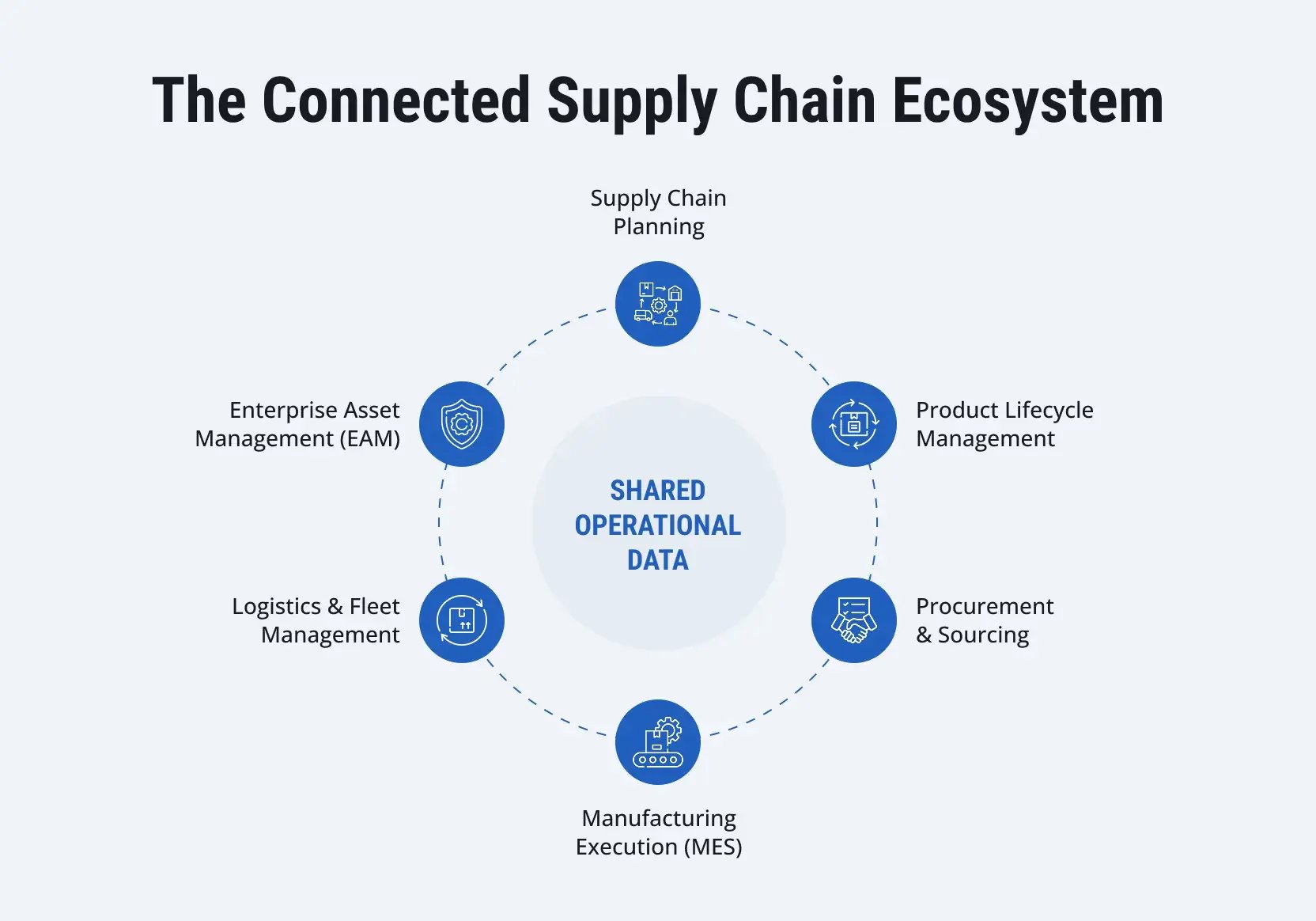
Supply chains depend on a set of connected operational processes. Each process handles a different part of the product journey. They work only when data flows between them without delay.
 Pillars of the connected supply chain ecosystem
Supply chain planning
Supply chain planning defines what should be produced, when it should be produced, and in what quantity.
It starts with demand forecasting. Companies analyse historical sales data and current order trends. They then translate this into supply requirements.
Material requirements planning defines what components are needed for production. Production planning schedules manufacturing capacity. Sales and operations planning aligns demand forecasts with available supply.
When planning is inaccurate, the effect is immediate. Stock shortages delay fulfilment. Excess stock increases storage costs.
Product Lifecycle Management (PLM)
Product lifecycle management tracks a product from concept to retirement.
It starts with design specifications. Engineering teams define materials, structure, and functionality. These inputs move into manufacturing preparation. After production, the same data supports maintenance and product updates.
PLM systems store this information in a structured format. They allow engineering, production, and service teams to work with the same product data. This reduces inconsistencies between design intent and manufacturing execution.
Procurement
Procurement manages how materials and services are sourced from suppliers.
It includes supplier selection, contract management, order creation, and delivery tracking. Procurement teams must balance two variables. Material shortages disrupt production. Excess purchasing increases inventory costs.
Some companies use statistical forecasting models to estimate order volumes. These models analyse historical consumption and demand patterns. The goal is to reduce manual estimation errors in purchasing decisions.
Logistics management
Logistics management controls how goods move and where they are stored.
It includes inbound transport from suppliers, warehouse operations, outbound delivery to customers, and reverse logistics for returns. It also includes fleet coordination and route planning.
Warehouse systems track stock location and movement. Transport systems monitor delivery status. Inventory systems synchronise stock levels across locations.
The accuracy of these systems directly affects delivery reliability.
Manufacturing execution management
Manufacturing execution systems manage production on the factory floor. They track work orders, machine status, production output, and quality checks. They also collect data from industrial sensors and connected machines.
This data supports production control. It helps identify machine downtime, production delays, and quality deviations during manufacturing.
Some factories use automated production lines that adjust settings based on sensor input. This reduces manual intervention in repetitive processes.
Enterprise asset management
Physical assets across the supply chain, from factory robotics to delivery vehicles, degrade over time. Enterprise asset management (EAM) is the discipline of maintaining those assets in a way that maximises uptime and extends operational life.
IoT sensors and machine-to-machine connectivity have fundamentally changed what EAM is capable of. Assets can now report on their own condition in real time. In some cases, connected equipment can identify an impending failure, schedule its own maintenance, and initiate the parts order required to carry it out, without human intervention.
Connecting the entire supply chain
Supply chain processes do not operate independently. Planning, procurement, production, logistics, and asset management depend on shared operational data.
Modern systems connect these processes through integrated platforms. Data moves between functions without manual transfer. This reduces delays caused by fragmented reporting structures.
The result is more consistent execution across the supply chain. Decisions rely on current operational data instead of delayed reports.
What Improvements Come From Modern Supply Chain Management?
Every business has a supply chain. The question is whether it is working for the business or quietly working against it.
Outdated processes and fragmented systems do not announce themselves as problems. They show up as margin erosion, delayed shipments, inventory write-offs, and customer complaints that seem unrelated until you trace them back to their source. The cumulative cost is significant. It is also largely avoidable.
Modern SCM replaces the hidden costs of dysfunction with measurable operational improvements. Here is what those improvements look like in practice.
Operations that run closer to capacity
Production equipment that is poorly maintained or reactively repaired creates bottlenecks that are difficult to predict and expensive to resolve. EAM systems with predictive maintenance capabilities change that equation. By monitoring asset condition in real time, they identify deterioration before it causes failure, allowing maintenance to be scheduled at the least disruptive moment.
The result is higher equipment uptime, more consistent throughput, and production schedules that hold.
Lower cost through fewer planning errors
Cost in supply chains often comes from inaccurate planning rather than transport or production itself.
Demand forecasting models reduce reliance on manual estimation. They use historical sales data and order patterns to calculate expected demand. This reduces overproduction and excess stock.
Inventory systems connected to real-time sales data help avoid stock accumulation in low-demand locations. This lowers storage costs and reduces capital tied up in unused goods.
Transport planning tools analyse delivery routes and vehicle capacity. They reduce partially filled shipments and inefficient routing. This lowers fuel consumption and improves fleet utilisation.
The capacity to absorb disruption
Market conditions shift. Supplier relationships break down. Demand spikes without warning. A supply chain designed purely for efficiency in stable conditions has no mechanism to handle any of these situations.
Resilient SCM systems are built with responsiveness in mind. Real-time visibility across the network allows managers to reallocate resources, adjust production schedules, and reroute logistics before a disruption compounds. Virtual inventory management keeps supply and demand in closer alignment without requiring physical buffer stock at every node in the chain.
Agility is not a feature. It is a structural property that has to be designed in from the start.
Quality that reflects what customers actually want
Product quality is not defined solely on the production floor. It is defined by whether the product meets the customer's expectations at the point of use.
Connecting customer feedback directly to R&D and manufacturing teams closes the loop between what customers report and what engineers respond to. Machine learning applied to returns data, warranty claims, and usage patterns surfaces design issues that manual review would miss. The outcome is a product development cycle that is informed by evidence rather than assumption.
More controlled customer delivery
Customer service in supply chains depends on accuracy rather than speed alone.
Order management systems track product availability across channels. This ensures that stock information remains consistent between online and offline sales systems.
Fulfilment systems coordinate delivery timing, warehouse selection, and transport assignment. This reduces cases where customers receive delayed or incomplete orders.
Clear visibility of order status also reduces manual communication between support teams and logistics operators.
Transparency as an operational requirement
Full visibility across a supply chain, from raw material sourcing through to last-mile delivery and returns, is increasingly a regulatory and commercial requirement.
Businesses that can trace the provenance of their materials, document their labour practices, and report on the carbon output of their logistics operations are better positioned to meet the compliance demands of the markets they operate in. Those that cannot are accumulating a liability they may not yet have quantified.
Transparency is not a sustainability initiative sitting alongside SCM. It is a function of SCM, and it requires the same data infrastructure as every other function described above.
What Is Changing in Supply Chain Management Today?
The fundamentals of SCM have not changed. You still need to source materials, manage production, move goods, and deliver on time. What has changed is the technology infrastructure available to do all of that, and the competitive gap between organisations that have adopted it and those that have not is widening every year.
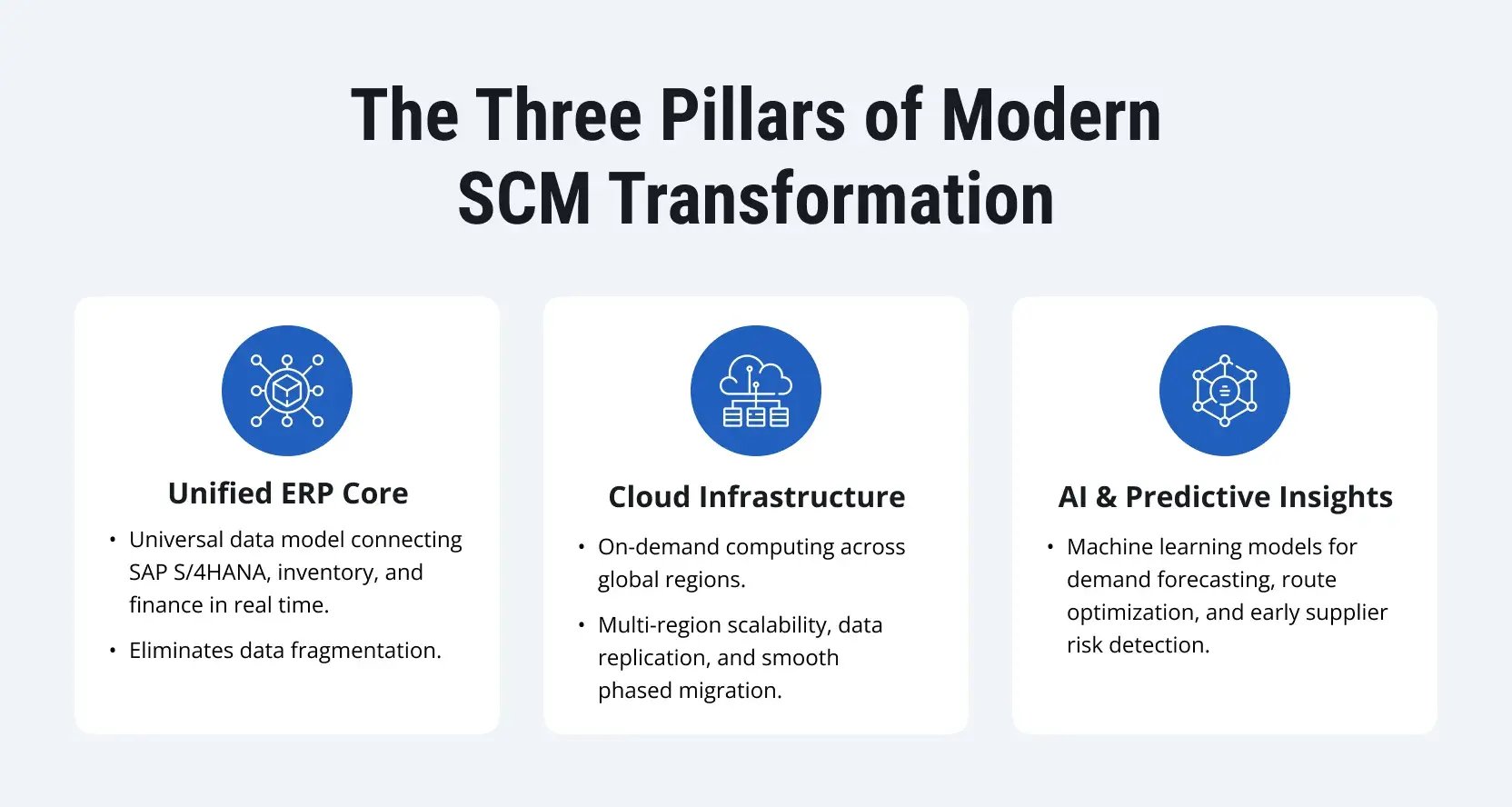
Three developments in particular are reshaping how serious SCM operations are built and run.
 What modern SCM transformation includes
How ERP systems connect supply chain operations
Supply chain systems do not operate in isolation. They depend on financial, production, procurement, and HR data.
ERP platforms centralise this information. Systems such as SAP S/4HANA connect inventory, procurement, manufacturing, and finance data in one model. This allows supply chain teams to work with the same data used for accounting and operational reporting.
Inventory levels update alongside sales and procurement activity. Production schedules reflect material availability and demand forecasts. Order status is linked to financial settlement and delivery tracking.
This reduces the need to reconcile separate reports from different departments. It also reduces errors caused by inconsistent data versions.
Integration between ERP and SCM systems also improves planning accuracy. Supply chain decisions use current operational data instead of delayed extracts. This supports more consistent execution across procurement, production, and logistics.
Why supply chain systems are moving to the cloud
Cloud deployment changes how supply chain systems are maintained and scaled.
Companies use cloud platforms to access computing resources on demand. This removes the need to maintain fixed infrastructure for peak workload periods.
Supply chain applications in the cloud can process inventory updates, transport data, and demand signals across distributed locations. This supports operations that span multiple regions and time zones.
Scalability is handled through system configuration rather than hardware expansion. This allows companies to adjust capacity when transaction volumes increase.
Cloud systems also support phased migration. Companies can move selected supply chain functions first and integrate them with existing systems over time. This reduces disruption during transition.
Security and backup functions are built into most enterprise cloud environments. This includes data replication and recovery mechanisms for system failures or outages.
How AI is used in supply chain operations
AI is used to process operational data at a scale that manual analysis cannot handle.
In demand forecasting, machine learning models analyse historical sales data and external factors such as seasonality and market trends. This improves planning accuracy for inventory and procurement.
In logistics, AI systems evaluate transport routes, delivery times, and vehicle capacity. They recommend routing options that reduce empty mileage and improve load utilisation.
In warehouse operations, AI supports automated picking systems and robotics. These systems follow predefined rules based on order structure and inventory location.
SAP S/4HANA environments often connect AI-driven analytics with core transactional data. This allows forecasting and execution to use the same data foundation.
AI is also used for risk detection. It identifies supplier delays, production bottlenecks, and transport disruptions based on early signals in operational data.
In customer operations, AI analyses order history and delivery preferences. This supports more consistent order fulfilment across different channels.
The main shift is not automation alone. It is earlier detection of operational changes and faster adjustment of supply chain plans based on live data.
How Industry 4.0 Is Reshaping Supply Chain Operations
Supply chain operations are now closely linked to digital production technologies.
Industry 4.0 connects machines, sensors, software, and data systems across factories and logistics networks. Supply chain management sits directly on top of this infrastructure.
The result is a shift in how companies plan and control physical goods movement. Decisions are increasingly based on live data from production and transport systems rather than static reports.
What changes when supply chains connect to Industry 4.0 systems?
Industry 4.0 connects machines and logistics assets to digital systems through IoT sensors and automation tools.
These sensors collect data from production equipment, transport vehicles, and warehouse systems. They track location, condition, and operational status.
This data flows into supply chain systems in near real time. It supports faster identification of disruptions such as delayed shipments, equipment downtime, or storage constraints.
AI and automation systems then use this data to adjust operational plans. This includes production scheduling, transport routing, and inventory allocation.
Planning platforms such as SAP Integrated Business Planning use this input to align supply and demand planning with actual operational capacity.
Why supply chain management is moving from reaction to control
Traditional supply chains respond after problems occur. Industry 4.0 systems allow companies to act while processes are still running.
This is based on continuous data collection from sensors and transactional systems. Predictive models analyse this data to identify early signals of disruption.
For example, changes in machine performance data can indicate potential production delays. Temperature changes in transport containers can indicate product risk during transit.
These signals allow companies to adjust supply chain plans before failures affect delivery schedules or product quality.
SAP Integrated Business Planning (SAP IBP), for example, is built specifically for this kind of predictive coordination. It connects demand planning, supply planning, inventory optimisation, and sales and operations planning in a single, cloud-based environment.
How automation and data reduce operational cost
Automation reduces manual work in repetitive supply chain processes.
Order processing, inventory updates, and transport coordination can run through system rules instead of manual input. This reduces delays caused by administrative processing.
Predictive analytics improves resource allocation. It uses historical and real-time data to estimate demand, production needs, and transport capacity requirements.
This reduces excess inventory and limits underutilised transport capacity.
Machine data also improves maintenance planning. Equipment issues can be detected earlier, which reduces unplanned downtime in production and logistics operations.
The combined effect is more stable operations with fewer interruptions and more predictable resource use.
Where Supply Chains Are Heading Next
Supply chains are no longer hidden systems
Supply chains are now visible to customers. People want to know where products come from. They also want to know how they are produced and delivered.
This includes materials, labour conditions, transport routes, and packaging. Companies now collect and store this information across suppliers and logistics partners.
Regulatory requirements also reinforce this shift. Sustainability reporting requires structured data on emissions and resource use.
Data volume is not the problem. Response time is.
Supply chains generate large amounts of operational data. This includes inventory levels, production output, supplier status, and delivery tracking.
The issue is not data availability. The issue is delay in action. Modern systems process this data continuously. They update planning and execution based on current operational conditions.
This reduces the time between a change in operations and a change in decision.
Supply chain systems are moving toward continuous control
Supply chain conditions change frequently. Demand shifts. Transport capacity changes. Suppliers adjust output.
Systems must reflect these changes while operations are still running. This requires integration between planning, execution, and analytics. It also requires automated responses based on live operational signals.
The direction is consistent across industries. Supply chains are moving from static planning cycles to continuous adjustment.
Where to Go From Here
Understanding SCM at a conceptual level is useful. Knowing where your own operation stands relative to what is now possible is more useful.
LeverX has worked with manufacturing, distribution, and logistics organisations across multiple industries to assess, design, and implement SCM solutions built on SAP technology. That includes SCM and ERP integration, cloud migration, AI-driven planning, and end-to-end supply chain visibility programmes. The work is specific to each organisation's operational context, existing infrastructure, and commercial priorities.
If this article has raised questions about the current state of your SCM operation, or about the gap between what your systems can do today and what your business will require in the next two to three years, those are exactly the right questions to be asking.
Speak with LeverX SCM specialists to assess where your supply chain stands and identify the highest-priority areas for improvement.