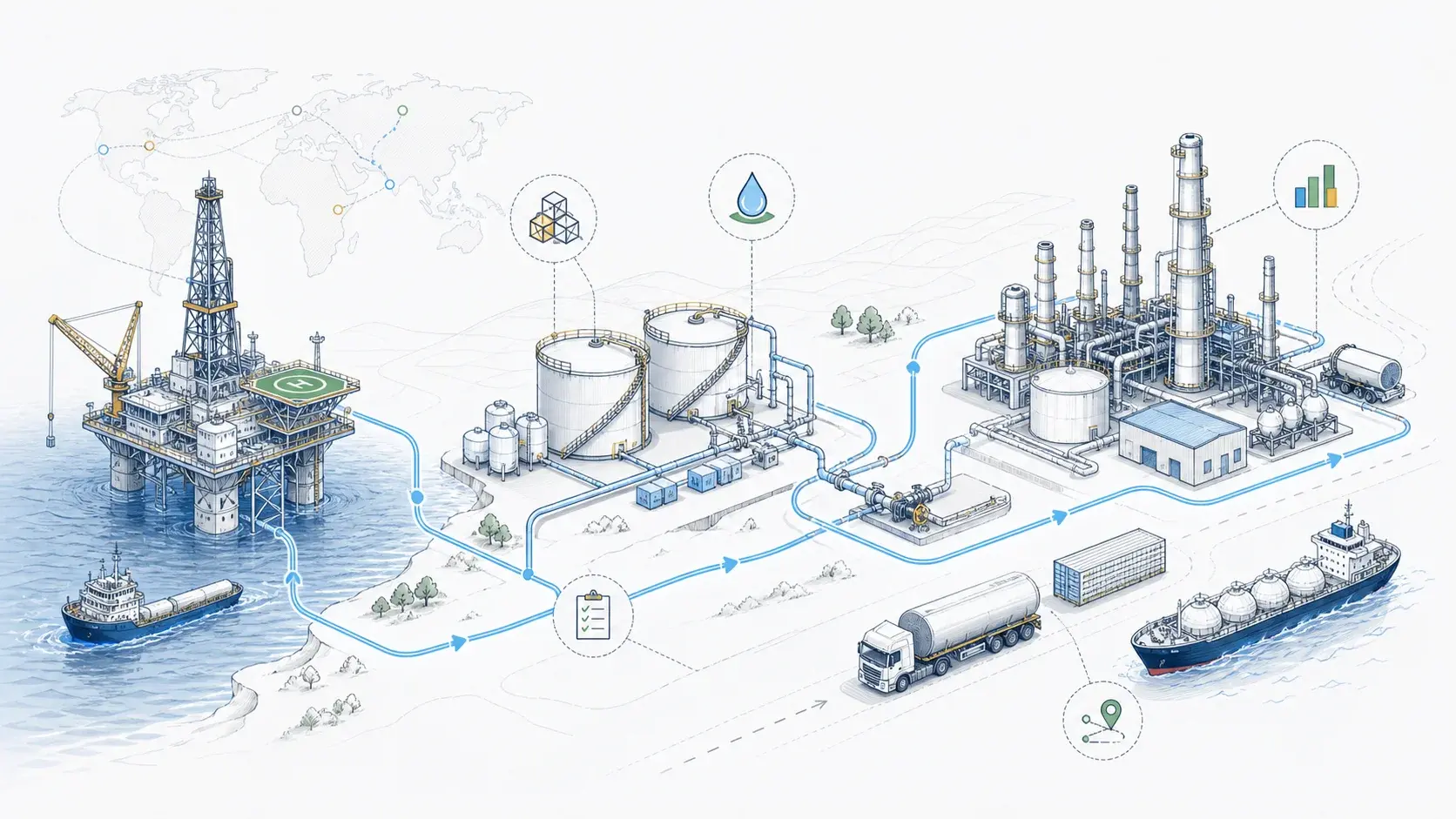
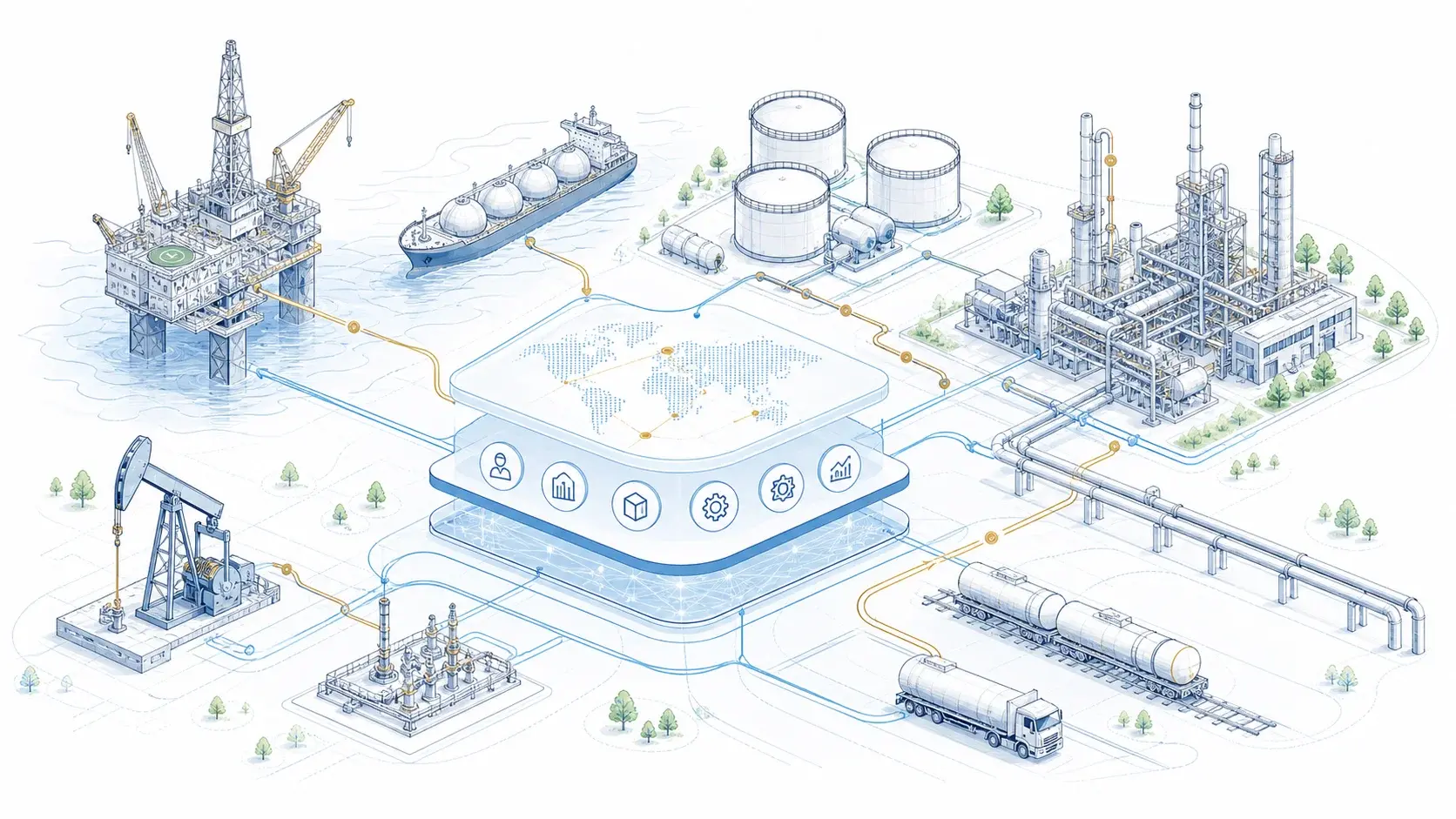
In this article, we break down SAP IS-Oil modules and explain how they support production, logistics, and accounting across the oil and gas value chain.
Oil and gas companies in the United States manage complex networks of wells, gathering systems, pipelines, processing facilities, storage terminals, refineries, and distribution points. Each stage generates operational and commercial data, from production volumes and product quality to custody transfers, inventory movements, transportation charges, and royalty payments.
These records need to remain consistent across operational, logistics, commercial, and financial systems. A difference between a measured volume and a booked quantity, for example, can affect inventory balances, revenue calculations, partner settlements, and regulatory reporting.
Standard ERP functionality supports core business transactions, but oil and gas operations also require specialized capabilities for hydrocarbon measurement, production allocation, bulk logistics, and revenue accounting. SAP Oil & Gas industry capabilities, historically associated with SAP IS-Oil, address many of these requirements within supported SAP environments.
For U.S. operators, the requirements can be particularly demanding. Upstream companies may need to account for working-interest ownership, mineral-rights royalties, state production and severance taxes, and federal or Indian lease reporting. Midstream businesses may need to coordinate pipeline nominations, custody transfers, terminal inventory, and transportation records. Downstream organizations must also manage product distribution and commercial settlement.
This guide explains how SAP Oil & Gas capabilities support upstream logistics, Production and Revenue Accounting (PRA), midstream and downstream transportation, Hydrocarbon Product Management (HPM), asset integration, and Clean Core modernization.
What Is SAP IS-Oil, and Why Do U.S. Oil and Gas Companies Use It?
SAP IS-Oil is a long-standing name for SAP's industry-specific functionality for oil and gas. Depending on the SAP product, release, deployment model, and licensing, relevant capabilities can include hydrocarbon measurement, production allocation, revenue distribution, remote-site logistics, bulk transportation planning, and downstream distribution.
The purpose is to connect physical hydrocarbon operations with the business transactions that record ownership, inventory, revenue, and costs.
Standard ERP systems can record inventory movements, purchase orders, sales orders, and financial postings. Oil and gas operations introduce additional variables. Liquid hydrocarbon quantities can change with temperature and density, gas measurements may require specific conversion methods, and ownership may change at defined measurement or delivery points.
Why Oil and Gas Operations Require Industry-Specific Functions
Several processes distinguish hydrocarbon operations from conventional manufacturing and distribution.
-
Hydrocarbon quantity conversion. Measured liquid volumes may need to be corrected to standard reference conditions before commercial settlement. Gas transactions may require appropriate volume or energy conversions.
-
Product quality and pricing. Density, API gravity, composition, and other product characteristics can affect valuation, pricing, blending, and commercial settlement.
-
Custody transfer. When hydrocarbons move between operators, pipeline systems, terminals, or commercial counterparties, the parties need agreed measurement records and reconciliation procedures.
-
Production allocation. A producing well or property may involve several working-interest owners. Production and revenue must be allocated according to the applicable ownership and contractual arrangements.
-
Royalty and tax accounting. U.S. upstream operations may require calculations for mineral-rights owners, state production or severance taxes, and applicable federal or Indian lease obligations.
SAP's oil and gas capabilities can connect these processes to the wider SAP business environment. The precise functionality available depends on the target product and release, so a project assessment should confirm the applicable scope rather than assume all legacy IS-Oil components are available in every SAP deployment.
Connecting Physical Flow and Financial Records
Oil and gas companies need to reconcile physical movements with commercial and accounting data. A mismatch between operational measurements and financial records can create inventory discrepancies, settlement disputes, and reporting issues.
An integrated operating model can connect:
- Production measurements from wells and processing facilities with production accounting.
- Pipeline, truck, rail, or terminal movements with custody-transfer documentation.
- Storage and tank movements with commercial inventory balances.
- Delivery and sales information with invoicing and settlement.
- Ownership and contractual allocation with royalty and revenue distribution.
This creates a traceable relationship between production, movement, delivery, and financial settlement.
U.S. Regulatory and Financial Reporting Considerations
U.S. oil and gas companies operate under different federal and state reporting frameworks depending on their business activities, assets, and contracts.
For example:
- The Federal Energy Regulatory Commission (FERC) requires certain jurisdictional oil pipeline companies to file financial and operational reports, including FERC Form No. 6 where applicable.
- The Office of Natural Resources Revenue (ONRR) administers revenue reporting and payments for federal and Indian oil and gas leases, including the ONRR-2014 reporting process.
- State oil and gas agencies administer their own production reporting and tax requirements. Rules and calculation methods can differ among producing states.
- Environmental reporting, including applicable EPA requirements, may require additional operational and emissions data. Applicability depends on the facility, reporting program, and current regulations.
- Publicly traded companies may have separate disclosure obligations related to their financial statements and oil and gas operations.
SAP can provide data, controls, and transaction records that support these processes. It does not automatically ensure compliance with every federal or state requirement. Reporting obligations, applicable forms, interfaces, and validation rules must be assessed and configured for each business environment.
What Is Upstream Logistics Management in SAP Oil & Gas?
Upstream operations depend on the timely availability of drilling equipment, replacement parts, chemicals, supplies, and specialized services. Production sites may be hundreds of miles from centralized supply facilities, and offshore platforms may depend on carefully coordinated vessel or other transportation schedules.
Delays can interrupt drilling, well servicing, maintenance, or production activities. Upstream logistics therefore needs to coordinate procurement, inventory, shipment planning, field receipts, returns, and the movement of materials between base and remote locations.
SAP's Remote Logistics Management (RLM) capabilities support the supply of materials from base locations to remote locations. The exact supported functions and prerequisites depend on the SAP environment and release. See the SAP Help documentation for Remote Logistics Management.
Why Upstream Logistics Requires Dedicated Process Support
Upstream logistics differs from conventional warehouse distribution in several ways.
-
Remote operating locations. Offshore platforms, remote production facilities, and dispersed well sites can have long or unpredictable replenishment lead times.
-
Specialized equipment. Drilling, completion, and maintenance activities may require equipment and replacement parts that cannot easily be substituted.
-
High-volume consumables. Depending on the operation, water, drilling fluids, treatment chemicals, and other consumables may need coordinated delivery and inventory control.
-
Downtime exposure. A missing component or delayed shipment can affect a planned maintenance window or interrupt an operating activity.
For U.S. shale, offshore, and other remote operations, the relevant logistics design should reflect the actual site network, transport modes, field inventory, service contractors, and materials requirements.
Remote Logistics Management in SAP
Where RLM is available and appropriate, it can support processes such as:
- Tracking equipment and container shipments from a base location to a remote site.
- Recording receipts and material movements at remote locations.
- Monitoring field inventory of parts, supplies, and consumables.
- Coordinating outbound shipments, holding, returns, and repairs.
- Connecting field logistics with SAP materials-management and maintenance processes.
A simplified flow can look like:
Demand at Remote Site → Inventory Check → Procurement or Replenishment → Shipment → Receipt at Remote Site → Consumption or Return
This helps logistics teams maintain visibility of material movements and replenishment requirements without managing every transaction in disconnected spreadsheets.
Managing Contractors and Field Services
Upstream operations frequently rely on external drilling contractors, well-service providers, equipment suppliers, and logistics companies.
The enterprise may need to connect contractor assignments, purchase orders, service confirmations, materials consumption, invoices, and compliance documentation.
These processes may involve SAP procurement, maintenance, external-workforce platforms such as SAP Fieldglass, or other contractor systems. The integration depends on the products in use and should be defined as part of the target architecture rather than assumed to be automatic.
A connected model can help teams understand which contractor services are associated with a field operation, what has been delivered, and which costs need to be recorded.
Operational Benefits
When upstream logistics and enterprise transactions are connected, companies can improve visibility into:
- Material availability at remote operating sites.
- Shipment status and expected replenishment.
- Equipment and replacement-part movements.
- Inventory records and material consumption.
- Procurement and contractor-service costs.
- Dependencies between logistics, maintenance, and operations.
The result depends on accurate data, appropriate configuration, and adoption of the defined processes. SAP does not replace the physical planning, safety, and operational controls required at a field location.
How Production and Revenue Accounting Works in SAP Oil & Gas
Production generates the physical product. Revenue accounting determines how the resulting value is allocated, recorded, and distributed among the parties entitled to receive it.
In U.S. upstream operations, a well or property may involve multiple working-interest owners, royalty-interest owners, operators, and other entitled parties. Each party's share depends on ownership records, agreements, production volumes, pricing, and applicable accounting rules.
SAP Production and Revenue Accounting (PRA) supports processes such as production-volume allocation, division-order management, sales-contract allocation, valuation, royalty and working-interest revenue distribution, payment processing, and state or federal reporting. The available scope and licensing should be confirmed for the chosen SAP product and release. See the SAP PRA documentation.
Why Revenue Distribution Is Complex in the United States
The revenue-accounting model must accommodate multiple ownership and contractual relationships, as well as state-specific tax requirements.
For example, an operator may need to:
- Calculate revenue attributable to each working-interest owner.
- Calculate royalties payable to mineral-rights owners.
- Apply contractual pricing and valuation rules.
- Determine applicable production or severance tax amounts.
- Produce revenue statements and payment records.
- Reconcile production quantities with financial postings.
- Support required state or federal reporting processes.
Tax treatment and royalty obligations vary by jurisdiction, lease, contract, and production characteristics. Texas and New Mexico, for example, have state-specific oil and gas tax frameworks. A system must use the rules and data appropriate to the applicable jurisdiction rather than relying on generic tax assumptions.
SAP PRA can support configured calculations and reporting, but the organization remains responsible for maintaining accurate ownership and tax data, validating calculations, and confirming compliance with current requirements.
What SAP PRA Can Support
Depending on the product, release, and configuration, PRA capabilities can include:
|
Process |
Business purpose |
|
Production allocation |
Assign measured volumes or entitlements to relevant properties, interests, or partners |
|
Division-order and ownership management |
Maintain ownership and revenue-distribution attributes |
|
Valuation and pricing |
Apply relevant contracts, pricing conditions, and valuation methods |
|
Royalty distribution |
Calculate and record amounts payable to entitled royalty-interest owners |
|
Working-interest distribution |
Calculate and allocate revenue to working-interest participants |
|
Tax reporting |
Support configured tax calculations and reporting processes |
|
Payment processing |
Generate and manage payments and related accounting records |
|
Financial integration |
Connect production and revenue processes with financial accounting |
The appropriate functionality must be checked against the specific SAP solution. Certain capabilities may require separate licensing.
Integration With Production Data
PRA is part of a broader operational and financial process, not an isolated accounting calculation.
A typical process can include:
Production Measurement → Volume Validation → Ownership or Contractual Allocation → Valuation → Royalty and Revenue Distribution → Tax Reporting → Financial Posting
The quality of the result depends on the underlying measurement data, master data, contractual arrangements, and accounting configuration.
If a production volume is revised or an ownership record changes, the organization needs controlled procedures to determine whether prior-period calculations, payments, or reports require adjustment.
Why PRA Matters for Upstream Financial Control
Revenue allocation must be accurate and auditable. Errors in ownership data, pricing, royalty calculations, or tax treatment can trigger partner disputes, payment corrections, and compliance issues.
A well-configured PRA environment can reduce repeated manual calculations, maintain clearer links between production records and accounting, and improve the traceability of revenue-distribution decisions.
The objective is not to eliminate professional review. It is to provide consistent calculations and records that finance and revenue-accounting teams can validate and explain.

How SAP Oil & Gas Supports Midstream and Downstream Logistics
After hydrocarbons leave production sites, midstream and downstream operations take over. Crude oil, natural gas liquids, refined fuels, and other products move through gathering systems, pipelines, processing facilities, storage terminals, trucks, rail, and marine transport.
Each movement may involve a scheduled quantity, an actual measured quantity, quality information, ownership changes, transportation charges, and commercial documentation. The logistics system must connect those records with inventory and financial transactions.
Trader's and Scheduler's Workbench (TSW)
SAP Trader's and Scheduler's Workbench is a logistics planning and execution capability for bulk commodities. Depending on the target SAP release and system architecture, it can support processes involving nominations, scheduling, shipment planning, and execution.
A representative pipeline or bulk-commodity process may look like:
Supply Plan → Nomination → Transportation Schedule → Shipment or Movement → Actualization → Inventory and Settlement
For example, an operator or scheduler may need to coordinate planned volumes between supply points, pipelines, terminals, and customers. Actual quantities must then be reconciled against the schedule and relevant measurement records.
TSW can be part of the design for organizations whose transportation and commodity processes require these functions. The target-state assessment should verify availability, licensing, integration requirements, and the fit of TSW for the specific operating model.
See the SAP Help documentation for Trader's and Scheduler's Workbench.
Downstream Distribution and Replenishment
Downstream operations must maintain product availability across terminals, distribution centers, retail fuel networks, and commercial customers.
Depending on the SAP environment, Secondary Distribution and Replenishment (SDR) and related downstream capabilities may support the scheduling and execution of product deliveries and replenishment activities.
Typical process requirements can include:
- Planning fuel deliveries from terminals to retail locations.
- Coordinating tanker-truck schedules and delivery quantities.
- Maintaining inventory balances across depots and retail sites.
- Reconciling deliveries with sales or inventory information.
- Connecting delivery activity with invoicing and settlement.
A simplified distribution process can look like:
Terminal Inventory → Replenishment Requirement → Load Planning → Delivery → Receipt and Reconciliation → Inventory Update
The target design should reflect how the company currently manages terminals, carrier relationships, retail locations, inventory ownership, and product movements. Availability and supported scope for specific legacy downstream components should be confirmed against the selected SAP release.
Connecting Logistics With Commercial Records
For midstream and downstream operators, integration needs to preserve the relationship among:
- Planned and actual quantities.
- Measurement and custody-transfer records.
- Product and location identifiers.
- Inventory ownership and balances.
- Delivery, invoicing, and transportation charges.
- Financial postings and reconciliation.
This provides a consistent record of how the product moved, how quantities were established, and which commercial transactions followed.
What Is Hydrocarbon Product Management (HPM) in SAP?
Hydrocarbon products require specific measurement and quantity-conversion processes. A liquid volume measured at one temperature may differ from the volume at a standard reference temperature. Density and other physical characteristics can also affect how quantities are expressed and valued.
SAP Hydrocarbon Product Management (HPM) provides industry-specific capabilities for handling these measurement requirements in supported SAP environments.
Quantity Conversion Interface (QCI)
The Quantity Conversion Interface (QCI) supports the standardization of oil and gas measurements by applying configured conversion parameters and routines. It can process readings from connected measurement systems, well-test data, manual entries, and other supported sources.
For U.S. companies, relevant measurement and commercial units may include:
- Barrels and gallons for liquid hydrocarbons.
- Cubic feet and related units for natural gas.
- Product density and API gravity.
- Temperature and other measurement parameters required by the applicable conversion method.
- Energy quantities where required by the commercial process.
QCI depends on appropriate configuration, parameter mappings, and the availability of the required conversion routines. SAP documentation describes integration with measurement data and standards-based routines, including those associated with organizations such as API and AGA. See the SAP Help documentation for QCI integration.
Why Measurement Accuracy Matters
Custody transfer can occur when crude oil enters a pipeline, a product moves into or out of a storage terminal, or refined fuel is delivered to a commercial customer.
The involved parties need to establish which measurement methods, reference conditions, and contractual rules govern the transaction. The resulting quantity may affect inventory, invoices, payments, and settlement statements.
Industry standards from the American Petroleum Institute (API), including the API Manual of Petroleum Measurement Standards, are relevant to many U.S. petroleum measurement processes. Applicable standards and methods vary by product, measurement equipment, contract, and transaction.
HPM and Quantity Reconciliation
HPM and QCI can support consistent quantity conversion where configured appropriately. That can help connect physical measurements with inventory and commercial records and make discrepancies easier to investigate.
However, SAP does not eliminate the need to validate measurement equipment, calibration, sampling, contractual measurement rules, and operational procedures. Those controls remain essential to reliable custody-transfer and settlement processes.
How SAP Supports Integration of Newly Acquired Oil and Gas Assets
Mergers and acquisitions are common in the oil and gas sector. Companies may acquire producing wells, gathering systems, pipelines, processing facilities, or storage terminals. Each acquisition can introduce new asset records, ownership structures, measurement methods, logistics processes, contracts, and reporting requirements.
Integrating these assets into the enterprise SAP environment requires more than adding new locations and accounts. The acquired operations must fit the company's data model, accounting policies, operating procedures, and integration architecture.
Standardizing Operational Data
The first challenge is aligning the information used to describe assets and operations.
Depending on the acquisition, the target data set may include:
- Wells, fields, properties, and producing entities.
- Production facilities and measurement points.
- Ownership and revenue-interest information.
- Pipelines, terminals, storage locations, and delivery points.
- Materials, equipment, and maintenance records.
- Suppliers, service providers, and contracts.
- Production, tax, royalty, and financial-reporting data.
The project should establish how each source data set maps to the target SAP model. Records need to be validated before they support production allocation, revenue accounting, logistics planning, or corporate reporting.
Integrating Acquired Operations Into Existing Processes
Once data is aligned, the acquired operations must be connected to the company's processes.
Examples include linking well-production measurements with production accounting, assigning ownership attributes for revenue distribution, connecting pipeline or terminal transactions with inventory records, and integrating procurement and logistics at acquired facilities.
The target architecture must also account for differences in measurement methods, reporting practices, system ownership, and historical data quality.
A phased transition may be appropriate when assets need to remain operational while the integration is underway. The cutover plan should define which systems remain authoritative during the transition and how transaction history will be reconciled.
Supporting Post-Acquisition Reporting
After an acquisition, management needs a consistent view of production volumes, logistics activity, revenue, costs, and asset performance.
Operational and financial data can be incorporated into company-wide reporting once the underlying master data, organizational assignments, integrations, and reporting requirements have been configured and validated.
The objective is to establish a shared operational and financial view across existing and acquired assets without losing the detail required for property-level, partner-level, and regulatory analysis.
Why Oil and Gas Companies Aim for a Clean Core in SAP
Oil and gas companies may have accumulated custom ABAP developments, modifications, interfaces, and reporting logic over many years. Some support important industry-specific requirements, while others reflect old processes or limitations that have since changed.
Excessive custom code can increase testing and upgrade effort and make system changes harder to manage. Clean Core principles aim to keep the ERP core closer to standard SAP functionality and use supported extension approaches where additional logic is genuinely needed.
Assess Custom Code Before Moving It
A Clean Core initiative should begin with a review of existing custom functionality.
For each development, the organization should determine whether to:
- Retire functionality that is no longer needed.
- Adopt standard SAP capabilities.
- Use supported configuration or extensibility options.
- Redesign an integration.
- Build an extension on SAP BTP where the requirement and architecture support it.
- Retain custom logic in the core when it is necessary and appropriate for the target environment.
The goal is not to move all industry-specific logic outside the core. Some capabilities depend on supported SAP product functions or tightly integrated transactional processing. The right design depends on the product, release, and available extension points.
Using SAP BTP for Extensions and Integration
SAP Business Technology Platform (BTP) can support application development, integration, workflows, automation, APIs, and data services around SAP S/4HANA.
In an oil and gas environment, a BTP-based extension may be appropriate for a new workflow, an external application, an integration, or a service that can operate through supported interfaces. Industry-specific measurement or revenue-accounting functionality should not be moved merely to achieve a theoretical Clean Core target.
The provider should explain where each extension will run, how it connects to SAP, how it is secured and monitored, and who will maintain it after go-live.
A well-designed Clean Core strategy should balance upgradeability with the actual requirements of production, logistics, measurement, and revenue accounting.

Comparing Upstream and Downstream SAP Operations
SAP Oil & Gas capabilities address different operational pressures across the hydrocarbon value chain. Upstream logistics focuses on field supplies and remote-site operations. Production and Revenue Accounting connects production volumes with ownership and financial settlement. Midstream and downstream logistics focuses on bulk transportation, terminal inventory, distribution, and commercial transactions. HPM supports measurement and quantity conversion where configured.
Upstream vs. Downstream Operations in SAP IS-Oil
|
Operational aspect |
Upstream logistics and PRA |
Midstream and downstream |
Business impact |
|
Primary operational pressure |
Timely equipment and supply availability; accurate production allocation and partner settlement |
Transportation capacity, product availability, inventory and custody-transfer reconciliation |
More controlled logistics and financial operations |
|
Operational focus |
Remote-site supply, production records, ownership, royalties, and revenue distribution |
Pipeline scheduling, bulk movements, terminal operations, fuel distribution, and sales |
Better coordination across the hydrocarbon lifecycle |
|
Data accuracy requirements |
Production measurements, ownership interests, contracts, taxes, and royalty data |
Quantity conversions, shipment records, inventory balances, and delivery reconciliation |
Lower risk of measurement and accounting discrepancies |
|
Regulatory and reporting needs |
Applicable state production and tax reports, federal or Indian lease revenue reporting |
Applicable pipeline reports, transportation records, and other regulatory obligations |
More consistent supporting records and reporting processes |
|
Operational scaling |
New wells, properties, remote sites, and ownership structures |
New pipelines, terminals, distribution locations, and trading relationships |
More repeatable asset integration and process expansion |
The appropriate module configuration depends on the SAP environment and the company's operating model. Not all capabilities are required in every upstream or downstream business, and the solution scope should be validated against current SAP documentation and licensing.
SAP Oil & Gas Modernization Roadmap
An SAP Oil & Gas implementation or modernization should begin with business requirements and the existing landscape rather than a predetermined module list.
Phase 1: Assess the Current Environment
Document the SAP product and release, licensed capabilities, custom code, integrations, data sources, measurement systems, reporting, and operational processes.
Identify the most important gaps in logistics, production allocation, revenue accounting, bulk movements, measurement, inventory, and financial reconciliation.
Phase 2: Define Business and Regulatory Requirements
Map the requirements that apply to the actual operating model. These may include field-supply workflows, production and revenue allocation, state-specific tax calculations, federal lease reporting, pipeline reporting, measurement standards, or downstream distribution.
Confirm which obligations apply to the company and which SAP or external systems provide the necessary records.
Phase 3: Define the Target Architecture
Determine the roles of SAP S/4HANA, available Oil & Gas capabilities, standard Finance and Materials Management, logistics, measurement systems, external applications, reporting, and SAP BTP.
Define ownership of key data objects and determine which systems remain authoritative for measurements, production volumes, ownership records, inventory, and settlement.
Phase 4: Clean and Govern Data
Validate well and property records, ownership interests, contracts, measurement points, products, materials, locations, supplier data, and financial mappings.
Decide which historical records must be migrated, transformed, archived, or retained in legacy systems.
Phase 5: Configure and Integrate
Configure relevant SAP capabilities and build the required interfaces. Test the connection between production measurements, logistics transactions, quantity conversions, revenue accounting, financial postings, and applicable reporting processes.
Phase 6: Test End-to-End Scenarios
Test real operating scenarios instead of isolated transactions. Examples include remote-site replenishment, production-volume adjustments, revenue-distribution calculations, custody-transfer discrepancies, terminal inventory reconciliation, and integration failures.
Validate exception handling, audit trails, and the process for correcting prior-period records.
Phase 7: Deploy and Optimize
Deploy according to the organization's operational constraints, asset structure, and readiness. Monitor unresolved issues, financial and operational reconciliation, processing performance, and user adoption after go-live.
Use the results to refine processes, reduce unnecessary customizations, and expand the solution where the business case supports it.
How to Measure Success in SAP Oil & Gas
Success should be measured through operational, financial, and data-quality outcomes rather than system go-live alone.
|
Area |
Example KPI |
|
Upstream logistics |
On-time material availability at remote sites |
|
Inventory |
Inventory accuracy and unresolved reconciliation differences |
|
Production accounting |
Time required to reconcile production volumes |
|
Revenue accounting |
Revenue-distribution cycle time and adjustment volume |
|
Tax and royalties |
Reporting completion timeliness and identified data exceptions |
|
Hydrocarbon measurement |
Volume-conversion exceptions and custody-transfer discrepancies |
|
Midstream logistics |
Schedule adherence and shipment reconciliation |
|
Downstream distribution |
Delivery accuracy and inventory reconciliation |
|
Integration |
Failed transactions and time to resolution |
|
Acquisition integration |
Time required to align master data and reporting |
Targets should be established against the company's baseline and business objectives. Regulatory compliance should be measured through controls and evidence appropriate to each applicable requirement, not inferred from operational KPIs alone.
How LeverX Supports SAP Oil & Gas Initiatives
LeverX supports SAP implementation, integration, modernization, and related enterprise transformation work. For oil and gas companies, an engagement may involve assessing the current SAP landscape, reviewing industry-specific capabilities, defining the target architecture, improving data governance, connecting operational and financial processes, and planning an implementation or upgrade.
Depending on the project scope, support can cover:
- SAP Oil & Gas assessment: Review the current SAP environment, business requirements, modules, custom code, and integration dependencies.
- Architecture and modernization: Define the target environment, Clean Core approach, integration model, and appropriate extension strategy.
- Upstream and downstream process integration: Connect relevant logistics, procurement, measurement, inventory, and accounting workflows.
- Production and Revenue Accounting: Assess the data, ownership structures, tax and royalty rules, and financial interfaces needed for the target process.
- Data migration and governance: Validate master data, operational records, financial mappings, and historical information.
- Integration and testing: Define interface ownership, monitoring, end-to-end tests, reconciliation controls, and exception handling.
- Go-live and support: Plan deployment, cutover, stabilization, and ongoing improvements.
The appropriate scope depends on the company's SAP products, licensed components, asset portfolio, and business requirements. A technical discussion can help establish which capabilities are relevant and which dependencies need closer assessment.

Conclusion
Oil and gas operations require consistent relationships between physical product movement, measurement, ownership, logistics, revenue distribution, and financial records. SAP Oil & Gas capabilities can support these relationships across upstream supply, production accounting, bulk transportation, hydrocarbon measurement, and downstream distribution.
For U.S. companies, the target architecture also needs to reflect state-specific tax rules, working-interest and royalty structures, applicable federal lease reporting, pipeline obligations, and operational measurement requirements.
The most effective approach starts with the business process and the data it depends on. From there, the organization can determine which SAP capabilities are appropriate, how they should connect to the wider landscape, and which requirements need additional integration, configuration, or specialist systems.
The goal is a maintainable SAP environment that supports reliable operations, traceable measurements, consistent revenue accounting, and better control across the hydrocarbon value chain.
Frequently Asked Questions
What is SAP IS-Oil?
SAP IS-Oil is a long-standing name for SAP industry-specific functionality for oil and gas. Depending on the SAP product, release, licensing, and deployment model, relevant capabilities can include remote logistics, hydrocarbon measurement, production allocation, revenue accounting, bulk logistics, and downstream distribution.
Is SAP IS-Oil the same as SAP S/4HANA?
No. SAP S/4HANA is the enterprise ERP platform. Oil and gas capabilities extend or complement the core platform, depending on the product and release. Organizations should validate the required modules, supported deployment options, and licensing before defining the target architecture.
What does Remote Logistics Management do?
Remote Logistics Management can support the movement of materials from base locations to remote operating locations. Depending on the configuration, its functions may include supply-chain processing, goods receipt, shipping, holding, returns, repairs, and material tracking.
What is SAP Production and Revenue Accounting?
SAP Production and Revenue Accounting (PRA) supports upstream processes such as production allocation, ownership and division-order management, valuation, royalty and working-interest revenue distribution, payment processing, and applicable tax or royalty reporting.
How can SAP PRA support U.S. royalty and tax processes?
PRA can support configured revenue-distribution, royalty, and tax-reporting processes. Accurate results depend on ownership records, contractual terms, production data, jurisdiction-specific tax configuration, and validation by the responsible accounting and tax teams.
What is Hydrocarbon Product Management?
Hydrocarbon Product Management supports hydrocarbon-specific product and measurement processes. Its Quantity Conversion Interface can apply configured conversion parameters and routines to standardize measurements from supported data sources.
What does SAP TSW do?
Trader's and Scheduler's Workbench supports logistics planning and execution for bulk commodities. Depending on the target landscape and release, it can be used for processes involving nominations, shipment planning, and execution.
Can SAP support pipeline and terminal inventory reconciliation?
SAP capabilities can connect logistics, measurements, inventory, and financial records to support reconciliation across pipelines, terminals, and related facilities. The appropriate configuration depends on the measurement systems, contractual rules, and operating model.
Does SAP Oil & Gas automatically ensure regulatory compliance?
No. SAP can support data collection, calculations, controls, and records, but organizations must determine which federal, state, and contractual requirements apply and verify that their systems and procedures meet them.
Can SAP BTP support Clean Core in an oil and gas environment?
Yes. SAP BTP can support appropriate side-by-side extensions, integrations, workflows, and applications. However, not every oil and gas function should be moved outside the core. The design must follow the supported extension options and technical requirements of the target SAP environment.
What should an oil and gas company assess before modernizing SAP?
The assessment should cover the SAP product and release, available industry capabilities, custom code, production and measurement data, ownership and revenue-accounting structures, logistics processes, integrations, reporting obligations, security, and ongoing support requirements.
Disclaimer: This article is provided for general informational and planning purposes only and does not constitute legal, tax, regulatory, accounting, measurement, or implementation advice. SAP product functionality, component availability, licensing, and deployment options may vary by release and customer environment. SAP configuration does not by itself establish compliance with applicable laws, regulations, contracts, tax requirements, or measurement standards. U.S. oil and gas companies should validate their specific obligations and system requirements with qualified SAP, tax, accounting, legal, regulatory, and measurement professionals before implementing or changing business processes.