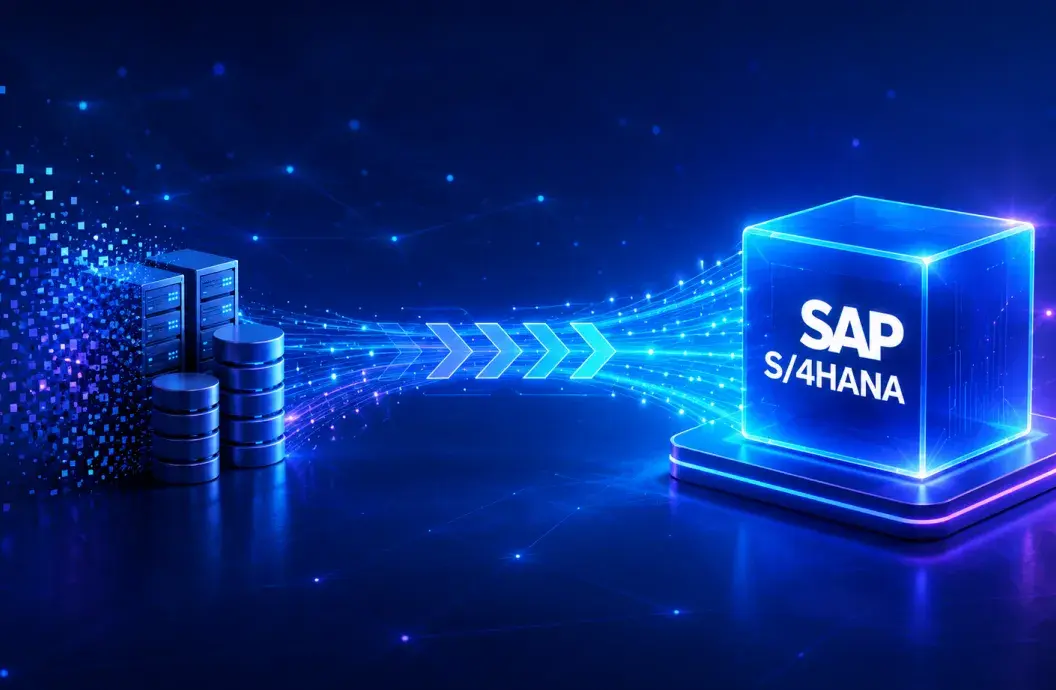
Why businesses migrate from SAP Business One to SAP S/4HANA. Read about reasons, architecture, compliance, and migration strategies in UK market environments.
The rules governing enterprise resource planning (ERP) architecture have not changed: the system that fits a £10 million business will not necessarily fit a £100 million one. This is not a flaw in SAP Business One. It is a question of scope, complexity, and the way a business operates as it grows.
SAP Business One was designed to give growing companies a structured and reliable operational foundation, and for many UK businesses, it continues to do exactly that. The question facing finance directors, IT directors, and business owners is therefore not whether their current ERP system has worked. It is whether SAP Business One can support the company's next stage of growth without increasing operational complexity faster than the business itself.
As organisations expand into new markets, add legal entities, increase transaction volumes, or build more sophisticated supply chains, ERP requirements change. Finance teams may need faster group reporting. Operations may require more granular inventory and supply chain visibility. IT teams may find themselves maintaining an increasing number of integrations between ERP, CRM, warehouse, e-commerce, logistics, analytics, and other business applications.
At the same time, cloud-first technology strategies are changing expectations around enterprise software. Modern ERP platforms are increasingly expected to support real-time business processes, integrated analytics, automation, AI-enabled capabilities, APIs, and scalable multi-entity operations.
For UK companies, the ERP decision also intersects with local requirements such as VAT reporting, Making Tax Digital (MTD), financial controls, and post-Brexit international trade processes. Importantly, these requirements do not automatically mean that SAP Business One is no longer suitable. SAP Business One has UK localisation and supports Making Tax Digital functionality.
The migration question becomes relevant when the overall architecture of the business has outgrown the role that its ERP is expected to play.
In this article, we will look at the differences between SAP Business One and SAP S/4HANA, when a migration may make sense, how the migration approach works, what happens to historical and master data, how UK-specific requirements should be considered, and what factors influence SAP Business One to SAP S/4HANA migration costs and timelines.
Executive Summary: Why Migrate from SAP Business One to SAP S/4HANA?
Moving from SAP Business One to SAP S/4HANA is not simply an ERP version upgrade. It is a transition between two different SAP product architectures designed for different business requirements.
SAP Business One is positioned for small and midsize businesses and can run on either Microsoft SQL Server or SAP HANA, depending on the deployment. SAP S/4HANA, by contrast, is built on the SAP HANA platform and is designed as an enterprise ERP foundation supporting integrated financial, supply chain, manufacturing, sales, and other business processes.
For organisations that have expanded beyond a relatively simple operating model, SAP S/4HANA can provide a broader foundation for:
- Multi-entity and multinational operations
- Integrated financial and operational processes
- Real-time analytics and reporting
- More complex supply chain and manufacturing scenarios
- Enterprise integration and API-based architectures
- Cloud ERP and standardised business processes
- Embedded AI and automation capabilities
- Scalable data and transaction processing
One of the most important architectural differences is SAP S/4HANA's use of the Universal Journal and ACDOCA for accounting data. SAP describes ACDOCA as a single source of truth for accounting processes and reporting, supporting automatic reconciliation between relevant financial areas.
However, the business case for migration should not be reduced to database technology. The strongest reason to move from SAP Business One to SAP S/4HANA is usually organisational complexity rather than database performance alone.
A company with one legal entity, relatively straightforward finance processes, and limited integration requirements may not need S/4HANA simply because it has grown in revenue.
A company with multiple legal entities, international operations, complex manufacturing or supply chain processes, significant integration requirements, and increasing reporting demands may have a much stronger case for an enterprise ERP platform.
Planning your SAP Business One migration strategy? Before selecting a migration approach, companies should assess their current SAP Business One landscape, business processes, master data quality, integrations, reporting requirements, legal entities, and future operating model. Book Your Free Strategy Session
A migration assessment should answer several practical questions:
- What data actually needs to move to SAP S/4HANA?
- Which SAP Business One processes should be redesigned rather than replicated?
- Which customisations and add-ons are still business-critical?
- Which integrations need to be rebuilt?
- What historical data needs to remain immediately accessible?
- Which UK tax and statutory processes must be validated before go-live?
- Which S/4HANA deployment model fits the organisation's requirements?
- What implementation timeline and internal resources are realistic?
The earlier these questions are answered, the less likely the project is to encounter major scope changes during implementation.
Key Takeaways
- SAP Business One and SAP S/4HANA serve different levels of business complexity. The decision to migrate should therefore be based on operating requirements rather than revenue alone.
- A move from SAP Business One to SAP S/4HANA is a transformation project rather than a conventional ERP upgrade. The target system requires its own architecture, configuration, integrations, and data model.
- SAP S/4HANA uses the Universal Journal and ACDOCA as a central accounting data structure, supporting integrated financial reporting and reconciliation.
- Selective data migration can reduce unnecessary historical data in the target system. Master data, open items, balances, and selected historical information should be defined according to business, reporting, and compliance requirements.
- UK compliance requirements should be designed into the migration from the beginning. SAP provides UK-specific functionality in S/4HANA, while SAP Business One also supports UK localisation and MTD, so migration should not be presented as a prerequisite for basic UK tax compliance.
- Cloud deployment is an important part of the target architecture. Organisations evaluating SAP S/4HANA should distinguish between SAP S/4HANA Cloud Public Edition, private cloud options, and other deployment models rather than treating "S/4HANA Cloud" as a single product. SAP positions GROW with SAP around SAP S/4HANA Cloud Public Edition and a packaged set of supporting products and services.
- Migration timelines and costs depend heavily on scope, including legal entities, integrations, data quality, manufacturing and supply chain requirements, customisations, and deployment model.
Why Growing UK Businesses Outgrow SAP Business One
As organisations expand, ERP requirements often shift from core functionality towards operational control, integration, scalability, and governance.
Many UK companies running SAP Business One already have the core processes they need. The challenge emerges when those processes begin to span more systems, locations, users, and legal entities.
A new subsidiary may introduce additional reporting and intercompany requirements. A new distribution centre can increase inventory and logistics complexity. An acquisition may bring a different chart of accounts, master data conventions, business processes, and integration landscape. None of these changes necessarily means that SAP Business One has become inadequate overnight - instead, complexity accumulates.
Over time, the ERP may become one component within a broader operating architecture rather than the central platform connecting finance, supply chain, operations, data, and reporting. That is often the point at which an SAP Business One to S/4HANA migration assessment becomes relevant.
Business expansion creates new technical requirements
Operational complexity rarely arrives through a single event. It tends to build as the organisation introduces new entities, facilities, channels, applications, and processes.
A company may acquire another business, open a distribution centre, expand its e-commerce operation, or introduce additional platforms for planning, customer relationship management (CRM), manufacturing, warehouse management, logistics, or analytics. Each decision can be justified independently. Collectively, however, they increase the volume of data moving through the organisation and the number of integrations, interfaces, and system dependencies that need to be managed.
The result is not necessarily poor ERP performance. More often, it is increasing architectural complexity. Finance teams may require faster consolidation and group reporting. Supply chain teams need visibility across locations. Management expects timely reporting based on consistent data. IT teams need to manage APIs, integrations, security, master data, and dependencies across an expanding technology landscape.
At this point, the question becomes broader than:
“Can SAP Business One handle this transaction?”
A more strategic question is:
“Can the current ERP architecture provide the control, integration, data model, and scalability the business needs over the next five to ten years?”
This distinction is important when evaluating an SAP Business One to SAP S/4HANA migration.
Cloud adoption is reshaping enterprise technology priorities
Cloud adoption is also changing how organisations approach ERP transformation. SAP S/4HANA Cloud Public Edition is delivered as a SaaS ERP offering with SAP-managed updates and standardised business processes based on SAP Best Practices. SAP positions GROW with SAP around S/4HANA Cloud Public Edition together with implementation and adoption services.
For a growing organisation, this can change the implementation discussion. Instead of asking only which SAP Business One functionality should be replicated, the business can evaluate which processes should be standardised, which integrations are genuinely required, and which legacy customisations can be retired. This is one of the key opportunities associated with a Greenfield-style transformation.
The objective is not simply to transfer data and existing processes into a new system. It is to establish an ERP environment that is easier to operate, integrate, govern, and adapt to the company's future operating model.
Common indicators of an architectural transition point
Organisations often begin evaluating SAP S/4HANA when several operational requirements appear at the same time:
- Financial reporting spans multiple legal entities or jurisdictions
- Core business processes depend on a growing number of integrated applications
- Reporting workloads require large-scale data extraction and transformation
- Warehouse, manufacturing, and logistics operations generate increasing volumes of transactional data
- New automation, analytics, or AI initiatives equire reliable access to operational data
- IT teams spend increasing effort maintaining custom integrations and reporting structures
- Acquisitions require standardisation across multiple ERP environments
- Finance teams need faster group reporting and consolidation
- The organisation wants to adopt a cloud ERP operating model
- Existing customisations increasingly constrain process changes or upgrades
These indicators do not mean that SAP Business One has "failed." They indicate that the scale, structure, and technology requirements of the business have changed. That is a more useful way to frame the migration decision for UK companies: the question is not whether Business One can continue to operate, but whether the existing ERP architecture remains the right foundation for the organisation's next stage of growth.
How SAP Business One and SAP S/4HANA Differ at the Architectural Level
The differences between SAP Business One and SAP S/4HANA extend beyond individual features and transaction volumes. The two platforms were designed for different operating models, levels of organisational complexity, and enterprise requirements. These differences become particularly visible in how data is structured, processed, integrated, and used for reporting.
Two different approaches to storing and reading data
SAP Business One can run on Microsoft SQL Server or SAP HANA, depending on the deployment scenario. SAP documentation confirms that SAP Business One Cloud landscapes can use either database platform.
SAP S/4HANA, by contrast, is built exclusively on SAP HANA. SAP describes the S/4HANA family as being built on the SAP HANA in-memory platform and designed to support real-time business processes, analytics, and a simplified data model.
The distinction is therefore not simply a choice between one database technology and another - it is the broader application architecture that matters. S/4HANA is designed to bring transactional processing, financial data, analytics, and enterprise business processes together on a common platform. This architecture is intended to support organisations with more complex legal structures, higher transaction volumes, broader integration requirements, and more demanding reporting needs.
For a growing organisation, this can provide a stronger foundation for connecting operational processes with financial and analytical information.
What the universal journal changes for finance teams
The architectural difference is particularly significant in finance. SAP S/4HANA uses the Universal Journal, represented by the ACDOCA table, as a central accounting data structure. SAP documentation describes ACDOCA as a "single source of truth" for accounting processes and reporting.
By bringing relevant financial and controlling information into a common journal structure, S/4HANA can reduce the need for reconciliation between separate financial data representations and provide a more consistent basis for analysis and reporting. For organisations operating across multiple legal entities, currencies, or business units, this can support more integrated financial reporting and analysis.
However, the Universal Journal should not be presented as an automatic solution to every finance requirement. Consolidation, statutory reporting, tax requirements, master data, business configuration, and group reporting processes still depend on the target solution design and implementation. The key benefit is the underlying architecture: S/4HANA provides a more integrated financial data foundation on which these processes can be designed and managed.
Architectural Comparison: SAP Business One vs. SAP S/4HANA
|
SAP Business One |
SAP S/4HANA |
|
|
Target business profile |
Small and mid-sized organisations |
Mid-sized and large organisations with more complex operational structures |
|
Database foundation |
Microsoft SQL Server or SAP HANA, depending on deployment |
SAP HANA |
|
Data and application model |
ERP designed around core SMB business processes |
Enterprise ERP with an integrated, simplified data model |
|
Reporting |
Operational reporting with optional analytical extensions |
Embedded analytics with access to current operational data |
|
Financial consolidation |
Commonly supported through additional tools or external processes |
Native support for group reporting and enterprise consolidation scenarios |
|
Organisational structure |
Commonly deployed within simpler entity structures |
Supports complex multi-entity and multinational operations |
|
Integration landscape |
Integrates with SAP and third-party applications |
Broader enterprise integration capabilities across SAP and non-SAP systems |
|
Cloud options |
Cloud deployment options vary by SAP Business One landscape |
Public and private cloud deployment options are available depending on product and requirements |
|
Process standardisation |
Core ERP processes for growing businesses |
Enterprise-wide process standardisation and transformation |
|
AI and automation |
Available capabilities depend on edition, extensions, and integrations |
SAP S/4HANA Cloud provides embedded AI capabilities as part of SAP's current cloud ERP strategy |
What this means in practice
For a growing UK organisation, the difference between SAP Business One and SAP S/4HANA is less about whether either system can technically perform a particular transaction. Both platforms can support core finance, procurement, sales, inventory, and other business processes. The more significant difference emerges when an organisation needs to coordinate those processes across multiple entities, systems, locations, and data sources at greater scale.
Consider a UK manufacturer operating across several European subsidiaries. Finance may need consolidated reporting across multiple legal entities and currencies. Procurement may require consistent supplier master data. Manufacturing may need planning across multiple plants. Logistics may depend on integration with warehouse and transportation systems. Sales may operate across multiple channels.
At this stage, the ERP is no longer simply recording business transactions. It becomes a central platform for coordinating processes, data, and financial information across the organisation. This is where the S/4HANA architecture becomes relevant. SAP positions S/4HANA around integrated business processes, real-time transaction processing, analytics, and a common data foundation.
However, the migration case should not rest solely on the promise of “real-time data.” A well-designed SAP Business One environment can already provide reliable reporting, integrations, and operational visibility.
A stronger business case considers the combination of: scale + organisational complexity + integration requirements + process standardisation + future technology strategy.
When these factors converge, migration to SAP S/4HANA becomes less about replacing an ERP system and more about establishing an architecture capable of supporting the organisation's next stage of growth.
.png)
Which Migration Approach Applies When Moving from SAP Business One?
When moving from SAP Business One to SAP S/4HANA, the project should be treated as a new S/4HANA implementation with controlled data migration rather than a conventional ERP system conversion.
SAP Business One and SAP S/4HANA are separate SAP products with different application architectures and data models. A company moving from SAP Business One therefore needs to establish a new S/4HANA target environment, define target business processes, map source data, redesign integrations, and determine which historical information should be migrated or archived.
Why a conventional Brownfield conversion does not apply
A Brownfield system conversion is associated with supported conversion scenarios for SAP ERP systems with the relevant technical lineage and prerequisites.
SAP Business One is a separate SAP product with its own application architecture and data model. Its database can run on Microsoft SQL Server or SAP HANA, but this does not make it an SAP ERP/ECC system that can simply be converted into S/4HANA.
Therefore, a company moving from SAP Business One should not plan the project as though it were an ECC-to-S/4HANA technical conversion.
Instead, the project needs to establish a new S/4HANA target environment, define the target business processes, map source data, and determine which historical information should be migrated or archived.
What Greenfield means in this context
A Greenfield implementation means designing and configuring the S/4HANA environment around the organisation's current and future requirements rather than reproducing the legacy ERP configuration.
For a SAP Business One customer, this can be a major advantage.
The organisation can review:
- Existing business processes
- Customisations
- Add-ons
- Reporting structures
- Master data
- Integrations
- Approval workflows
- Financial structures
- Localisation requirements
The question becomes:
What should the new ERP look like?
rather than:
How do we make the old ERP configuration fit into the new system?
That distinction is one of the strongest arguments for treating the migration as an ERP transformation rather than an upgrade.
The role of selective data migration within a Greenfield project
Selective data migration can still play an important role in a Greenfield project.
The objective is not to transfer every record that has ever existed in SAP Business One.
Instead, migration scope should be based on business continuity, reporting requirements, audit needs, statutory requirements, and the operational needs of the new system.
Typical migration scope may include:
- Validated customer master data
- Vendor master data
- Material and product master data
- Chart of accounts and financial master data
- Open accounts receivable and accounts payable items
- Open sales and purchase orders where required
- Opening balances
- Selected historical transactions
- Relevant organisational structures
- Required reference and compliance information
Historical data that does not need to be active in S/4HANA can remain in an accessible archive.
This is particularly important because data retention and data migration are not the same thing.
A company may need to retain financial records for regulatory purposes without needing to load every historical transaction into the production S/4HANA database.
For UK VAT records, HMRC requirements should be checked against the company's circumstances and record types. HMRC also requires businesses within Making Tax Digital for VAT to use compatible software for keeping digital VAT records and submitting VAT returns.
Data preparation has a direct impact on migration outcomes
SAP Business One environments that have been in use for several years often contain duplicate vendor records, inconsistent product or material naming conventions, inactive customer accounts, and incomplete master data. These issues are common consequences of incremental system changes and manual data maintenance.
A Greenfield migration provides an opportunity to establish a clean and standardised data foundation for the new S/4HANA environment. Customer, vendor, material, and financial master data should be assessed against the target S/4HANA structures before migration. This may include deduplication, field standardisation, inactive-record review, chart of accounts mapping, and reconciliation of financial balances.
Data cleansing should be treated as a defined migration workstream rather than an activity performed only after data has been transferred. Otherwise, inconsistencies in the source system may be carried into the new environment, affecting reporting accuracy, transactional processing, integrations, and downstream business processes.
The objective is not simply to transfer existing data, but to determine which records are still relevant, how they should be structured in S/4HANA, and which historical information needs to remain accessible for business and compliance purposes.
LeverX advisory note on migration approach selection
Migration from SAP Business One to SAP S/4HANA starts with a new S/4HANA environment rather than a technical conversion of the existing Business One system. This makes the definition of the target architecture a key early step in the migration programme.
UK organisations should first establish how the future S/4HANA environment will support current and planned business processes. This should then inform decisions about which master data, transactional data, historical records, integrations, and processes need to be migrated, transformed, replaced, or retired.
A Greenfield approach can support this process by reducing dependence on legacy system design and allowing the target architecture to be defined around current and future operational requirements. It also creates a structured opportunity to standardise master data and incorporate UK-specific requirements, including VAT reporting and Making Tax Digital, into the target solution.
For this reason, Greenfield can provide a practical baseline for SAP Business One to S/4HANA migration where the objective is not simply to reproduce the existing environment, but to establish a cleaner and more sustainable operating model for the future.
How Does SAP S/4HANA Support UK Regulatory and Trade Requirements?
UK regulatory requirements place specific demands on ERP systems. They shape how financial, logistics, and data processes are designed and connected. Tax submission formats, customs declarations, and data protection requirements all influence how information moves through the organisation.
SAP Business One supports UK operations through its UK localisation, including Making Tax Digital functionality and tax reporting capabilities. As transaction volumes and organisational complexity increase, however, companies may also introduce additional reporting, integration, logistics, or customs solutions around the ERP system. SAP S/4HANA provides a broader platform for connecting these processes across finance, supply chain, and international trade.
Making Tax Digital and HMRC reporting
Making Tax Digital requires businesses within scope to maintain relevant tax records digitally and use compatible software to submit information to HMRC. For VAT, HMRC provides an API that allows compatible software to retrieve VAT obligations and submit VAT returns electronically.
SAP Business One supports Making Tax Digital for UK VAT through its UK localisation and integration framework. This means that Business One should not be treated as a platform that is inherently unable to support MTD. The difference in a migration project is more about the overall architecture around tax reporting, especially when a company has multiple entities, additional reporting requirements, or several connected financial systems.
SAP S/4HANA provides a broader financial platform in which VAT calculation, tax reporting, financial postings, and related integration processes can be managed as part of the enterprise finance architecture. Depending on the selected deployment and configuration, additional integration components may still be required for HMRC connectivity.
The operational difference therefore lies less in whether either ERP can support UK VAT requirements and more in how tax data is managed across the wider ERP landscape. For a growing organisation, reducing duplicate data flows and keeping financial information aligned across entities can become an important part of the migration business case.
Cross-border trade after brexit
Trade between the UK and EU requires accurate classification of goods, correct customs information, and consistent handling of logistics and financial data. These requirements affect procurement, inventory, sales, shipping, and accounting processes at the same time.
SAP S/4HANA provides dedicated international trade functionality for product classification and trade compliance, helping organisations manage international trade processes alongside their broader supply chain and financial operations.
SAP Business One also supports UK-specific requirements following Brexit, including localisation capabilities related to reporting and international trade processes. Depending on the company's operating model, additional logistics or customs solutions may still be connected to the ERP environment.
For companies operating across multiple European markets, the challenge is often not a single customs transaction. It is the consistency of trade data across the entire order-to-cash and procure-to-pay process.
Product classification, supplier information, inventory movements, shipping documents, and financial postings need to remain aligned. SAP S/4HANA can provide a more extensive enterprise architecture for managing these processes as the organisation grows.
The key difference appears in the scale and integration of the process. SAP Business One can support UK and international operations, while SAP S/4HANA provides a broader platform for companies whose trade, supply chain, and financial processes have become more complex.
Data residency and UK GDPR
UK GDPR requires organisations to understand how personal data is collected, stored, accessed, processed, and transferred. For companies moving ERP workloads to the cloud, this makes data location and cross-border data flows important parts of the architecture discussion.
The choice of SAP S/4HANA deployment model and cloud provider determines where workloads and data are hosted. UK-based cloud regions can be considered where data-location requirements make this appropriate, but hosting data in the UK is not itself the same as achieving UK GDPR compliance. Organisations still need appropriate access controls, security measures, governance, retention policies, and safeguards for international data transfers.
SAP Business One also supports different deployment models, including on-premise and cloud environments. The resulting data flows depend on the specific architecture, connected applications, and reporting or integration tools used by the business.
During an SAP Business One to SAP S/4HANA migration, this makes data-flow mapping an important part of the discovery phase. Teams need to identify where customer, employee, supplier, and financial information is stored, which systems access it, and whether any data crosses UK borders.
SAP S/4HANA can help establish a more structured enterprise data architecture, but compliance still depends on how the complete environment is designed and operated. The migration should therefore assess data residency, access controls, integration points, retention, and international transfers rather than treating cloud location as a standalone compliance solution.
Operational Comparison Across UK Compliance Areas
|
Area |
SAP Business One |
SAP S/4HANA |
|
Making Tax Digital (VAT submission) |
External tools or middleware prepare VAT data for HMRC submission |
VAT calculation and submission data prepared within SAP financial module using standard APIs |
|
Post-Brexit customs processing |
Relies on external logistics and customs systems with data synchronisation steps |
Logistics and finance data processed in a single system for customs declarations and duty calculations |
|
Multi-currency and financial reporting |
Often requires additional consolidation or reporting tools |
Integrated multi-currency accounting and group reporting functions |
|
Data residency and UK GDPR |
Data flows depend on external integrations and deployment design |
Centralised data model deployed in UK cloud regions with defined data control boundaries |
SAP Business One to SAP S/4HANA Migration: Industry Case Studies
1. Manufacturing Company Scaling Across Europe
The business case
A UK-based industrial manufacturer has expanded from a single production site into a multi-entity business with manufacturing and distribution operations across Europe. Its SAP Business One environment is becoming increasingly difficult to scale as production volumes, inventory complexity, and cross-border operations grow. The company needs a more scalable ERP foundation with real-time visibility across manufacturing, procurement, inventory, and finance, while standardising processes across entities rather than continuing to add local workarounds and integrations to the existing environment.
Why SAP S/4HANA?
The organisation decides to implement SAP S/4HANA to support its next stage of growth. A Greenfield approach allows the company to redesign processes around SAP Best Practices rather than carry legacy configurations into the new platform. S/4HANA brings Finance, Manufacturing, Procurement, and Supply Chain onto a unified digital core, enabling more consistent data and greater visibility across operational processes. Data migration is planned around the information required in the new system: master data, open business transactions, and other agreed datasets are mapped and validated before loading into SAP S/4HANA using SAP's Migration Cockpit, which supports data mapping, simulation, and migration monitoring.
Before / After
| Metric | Before (SAP Business One) | After (SAP S/4HANA) |
| Production & material planning cycle | Planned per site, manually reconciled across entities | Coordinated centrally across all European sites |
| Inventory visibility | Site-level visibility only, ~24–48 hour lag for group-level view | Real-time inventory visibility across all locations |
| Group reporting | Consolidated manually via spreadsheets each month-end | Standardised reporting from a unified digital core |
| New-entity onboarding | Custom configuration and integration work per site | Standard SAP Best Practice template applied per entity |
2. Consumer Goods Company Expanding Internationally
The business case
A UK-based consumer goods company has expanded into several European markets through new subsidiaries and distribution channels. Its SAP Business One environment was originally designed for a simpler operating model and now requires additional integrations and manual processes to support the growing business. Finance needs consolidated visibility across entities, while Sales and Supply Chain teams require more consistent data and faster access to operational information.
Why SAP S/4HANA?
The company decides to implement SAP S/4HANA as part of a broader ERP transformation. The Greenfield approach provides an opportunity to standardise Finance, Sales, Procurement, and Supply Chain processes across the group while building an ERP architecture suited to its international operating model. Rather than replicating the existing SAP Business One setup, the company migrates relevant master data and business information into the new S/4HANA environment and redesigns processes around its current requirements. This approach also creates an opportunity to review historical data before migration — not every transaction from the legacy system needs to become active data in the new ERP, and data selection can be based on business requirements, reporting needs, and statutory retention obligations. For UK VAT records, HMRC guidance generally requires relevant records to be retained for six years, making it important to distinguish between data that must be retained and data that must remain in the operational ERP.
Before / After
| Metric | Before (SAP Business One) | After (SAP S/4HANA) |
| Group financial consolidation | Manual consolidation across multiple entity ledgers, several days per close | Faster, largely automated consolidation from a common data model |
| Order-to-cash visibility | Fragmented across per-entity systems and spreadsheets | Consistent, group-wide order-to-cash view |
| Currency and intercompany reconciliation | Manual reconciliation between subsidiaries | Native multi-currency and intercompany processing |
| Historical data in production system | All historical transactions retained in the live ERP | Only data meeting defined business/statutory criteria migrated; remainder archived |
3. Regulated Company Strengthening Compliance
The business case
A UK-based pharmaceutical manufacturer operates across several European markets and uses SAP Business One for finance, procurement, inventory, and sales. As the company expands, differences in local tax, statutory reporting, and regulatory requirements create increasing compliance complexity. Finance teams rely on manual processes to prepare country-specific reports and maintain audit evidence, while the existing ERP landscape provides limited standardisation across legal entities.
Why SAP S/4HANA?
The organisation decides to implement SAP S/4HANA to create a standardised ERP foundation with stronger support for local legal and regulatory requirements. A Greenfield implementation allows the company to redesign processes around current compliance needs rather than replicate legacy configurations. The new S/4HANA environment standardises financial processes and master data across entities while supporting local statutory reporting, tax requirements, audit trails, and regulatory controls. The migration also provides an opportunity to establish clear rules for which historical data remains in the operational system and which data is retained in an archive — particularly important for regulated organisations where historical information may need to remain accessible even when it is no longer required for day-to-day processing.
Before / After
| Metric | Before (SAP Business One) | After (SAP S/4HANA) |
| Country-specific statutory reporting | Prepared manually per entity, high effort per reporting cycle | Standardised reporting processes across entities with reduced manual effort |
| Audit trail and traceability | Limited standardisation; evidence gathered manually across systems | Consistent audit trail and traceability across financial processes |
| Master data governance | Locally maintained, inconsistent between entities | Centrally governed master data with defined ownership |
| Data retention approach | All records retained indiscriminately in the live system | Defined retention rules separating operational, archived, and disposable data |
Note: These case studies are anonymised, illustrative composites based on typical outcomes seen in comparable UK SAP Business One to S/4HANA migrations. Figures are indicative and will vary by organisation.
How an SAP S/4HANA Migration Is Structured From Start to Go-Live
SAP Business One to SAP S/4HANA migration follows a staged engineering process. Each stage focuses on a specific type of risk. Data structure, system behaviour, integrations, and operational continuity are handled separately.
UK migration programmes usually follow the same logic. The order of execution matters because financial and operational processes cannot simply stop during the transition.
Step 1: Discovery and readiness assessment
This stage defines what the organisation actually runs today.
SAP Business One landscapes are reviewed at database level and process level. Tables, extensions, integrations, and reporting tools are mapped in detail. Finance and operations teams confirm which processes must remain stable after migration.
System load is measured. Active transaction volumes, historical data size, and interface dependencies are documented. This creates a baseline for all later work.
The assessment should also identify which SAP Business One processes will be redesigned rather than replicated. This is particularly important in a Greenfield implementation, where the target system is configured around current business requirements rather than simply reproducing the legacy environment.
Step 2: Master data cleansing
Data quality problems surface early in most SAP Business One systems. Duplicate vendor records appear across subsidiaries. Customer master data often contains inconsistent naming rules. Product catalogues may include outdated or unused entries.
This phase standardises core business records. Customer, vendor, material, and financial master data are checked against SAP S/4HANA structures. Records that do not meet validation rules are corrected or removed.
Chart of accounts structures and cost centre hierarchies are aligned with the target system design. Clean data reduces reconciliation work during testing and lowers the number of errors after go-live.
Data mapping is also defined during this stage. SAP S/4HANA migration tools use migration objects to identify relevant source and target structures and support field mapping and data conversion. Migration projects can be simulated before the final transfer, allowing teams to identify mapping problems before production cutover.
Step 3: Integration mapping
Most SAP Business One environments rely on external systems for logistics, CRM, payroll, or reporting.
Each integration is reviewed individually. Data sources, transformation rules, and transfer frequency are defined for SAP S/4HANA. Some integrations are redesigned. Others are replaced by standard SAP S/4HANA functions.
This stage also defines which processes remain outside the ERP system and which are absorbed into it.
Integration mapping should be completed before the build phase is finalised. Otherwise, an organisation may configure the new ERP around assumptions that later change when external applications are connected.
Step 4: Testing and cutover planning
Testing uses real business scenarios. Financial postings, purchase cycles, sales transactions, and inventory movements are executed in a controlled environment.
Results are compared with expected outputs. Differences are resolved before production deployment.
Data migration is tested as part of this process rather than treated as a single final activity. SAP recommends creating migration projects in a development or test environment, refining them through test migrations, and then transporting the validated configuration to production.
Cutover planning defines the final switch. Data migration steps, system freeze periods, and validation checks are scheduled in sequence. The goal is to reduce downtime and avoid gaps in financial or operational records.
Practical note: SAP HANA keeps active data in memory. System performance and infrastructure cost depend on data volume. During migration preparation, historical SAP Business One data should be reviewed for operational value - only data required for reporting, compliance, or ongoing business processes should move into SAP S/4HANA. Older records can be moved to external archive storage where appropriate, reducing the volume of active data in the target system and simplifying the migration itself. For UK businesses, archiving decisions should also take statutory retention requirements into account: HMRC guidance states that relevant VAT records generally need to be retained for six years, although specific retention rules can vary by record type and circumstance. The objective is therefore not simply to migrate less data - it is to create a clear data-retention strategy that separates active ERP data, archived historical information, and records that can legitimately be removed.
Typical Migration Timeline, Phases & Costs
Transitioning from SAP Business One to SAP S/4HANA is a milestone-driven engineering project. Most UK mid-market migrations follow a structured delivery model, although the exact timeline depends on the number of legal entities, business processes, integrations, data quality, and the selected SAP S/4HANA deployment model.
The project should therefore be planned around business scope and technical dependencies rather than a fixed number of months. A relatively standard single-country implementation can move faster, while a multi-entity organisation with manufacturing, international trade, and several third-party systems will require more time for design, testing, and cutover preparation.
Migration Timeline & Phase Overview
| Migration Phase | Typical Duration | Focus & Primary Deliverables |
| Phase 1: Discovery & Readiness | 4 – 6 Weeks | Database and process analysis, scope definition, integration mapping, and architecture blueprinting. |
| Phase 2: Master Data Cleansing | 1 – 2 Months | Deduplicating vendor/customer records, standardizing material masters, and aligning cost centers with SAP structures. |
| Phase 3: Integration & Build | 2 – 4 Months | Configuring S/4HANA core, configuring SAP BTP API connections, and setting up UK compliance modules (MTD/VAT). |
| Phase 4: Testing & Cutover | 1 – 2 Months | User Acceptance Testing (UAT), mock cutovers, HMRC submission validation, and transaction posting freezes. |
| Phase 5: Go-Live & Hypercare | Ongoing (4+ weeks) | Production deployment, UK business-hours hypercare support, month-end close stabilization, and user enablement. |
These phases can overlap. Data cleansing, integration design, and configuration do not necessarily happen sequentially, which means the total project duration is not simply the sum of every phase.
The most important factor is the quality of preparation before the final cutover. Data mapping, integration testing, and business validation should be completed before the legacy system is switched off.
How Much Does SAP Business One to S/4HANA Migration Cost in the UK?
Implementation budgets depend on business size, number of legal entities, deployment model, business process complexity, data migration scope, and third-party integration requirements.
There is no single standard price for an SAP Business One to SAP S/4HANA migration. A company moving one legal entity with a limited number of integrations has a very different implementation profile from a multinational organisation with manufacturing sites, multiple currencies, complex supply chains, and country-specific reporting requirements.
For this reason, the following figures should be treated as planning ranges rather than fixed SAP implementation prices:
- Mid-Market Enterprise (£15M – £50M Revenue): Typical implementation budgets may range from £120,000 to £350,000, depending on scope and deployment model.
- Large / Multi-Entity Enterprise (£50M – £200M+ Revenue): More complex programmes may range from £350,000 to £850,000+, particularly where several entities, integrations, manufacturing processes, or international operations are involved.
The implementation budget should also be separated from ongoing software subscription, infrastructure, support, and managed services costs.
For businesses evaluating SAP S/4HANA Cloud, the commercial model can differ significantly depending on whether the organisation selects a public cloud or private cloud deployment. The choice affects the available configuration options, implementation approach, operating model, and long-term maintenance requirements.
A proper migration assessment should therefore calculate the total cost of ownership, not just the initial implementation project.
How to Choose the Right SAP Migration Partner
Selecting an experienced SAP migration partner in the UK is critical to ensuring your transition delivers a performant enterprise platform on time and within budget. The right partner should understand not only SAP S/4HANA but also the starting point: SAP Business One, its data structures, integrations, customisations, and business processes.
Use this evaluation checklist during vendor selection:
-
[ ] Proven SAP S/4HANA Mid-Market Track Record: Can the partner demonstrate verifiable case studies of Greenfield S/4HANA deployments for mid-sized or growing enterprises?
-
[ ] Cross-Platform Architectural Knowledge: Do their consultants and data engineers understand both SAP Business One and SAP S/4HANA migration requirements, including data mapping and master data transformation?
- [ ] Data Migration Competency: Can they demonstrate a structured approach to data profiling, cleansing, mapping, validation, test migration, and reconciliation?
-
[ ] SAP BTP Integration Competency: Can they design clean integrations using APIs and SAP Business Technology Platform where appropriate rather than creating unnecessary custom code?
-
[ ] UK Regulatory & Localisation Expertise: Do they understand UK VAT, Making Tax Digital, financial reporting, and the requirements created by cross-border UK-EU trade?
-
[ ] Business Process Expertise: Can the partner challenge legacy SAP Business One processes and identify where standard S/4HANA functionality can replace customisations or workarounds?
- [ ] Dedicated Post-Go-Live Hypercare: Do they provide structured support during the first weeks of production operation and the initial month-end closing cycles?
A migration partner should not simply move data from one system to another. The objective is to create a better ERP operating model for the business. That requires technical expertise, SAP knowledge, data migration experience, and an understanding of how the organisation actually operates.
When ERP Stops Being a System and Becomes a Growth Decision
SAP Business One to SAP S/4HANA migration changes how an organisation handles operations, data, and reporting. The shift usually starts when reporting cycles slow down, integrations multiply, and financial consolidation requires additional effort outside the core ERP system.
SAP S/4HANA introduces a different operating structure. Data flows through an integrated financial and operational model. Reporting, logistics, and accounting processes can work from the same underlying business information. This reduces the need for repeated data transfers between tools and systems.
The decision to migrate usually follows business changes rather than system failure. New subsidiaries, higher transaction volumes, international expansion, and increasingly complex integrations can change what the organisation expects from its ERP platform.
At that point, system design becomes part of business design.
Where migration planning turns into execution
SAP migration projects move through defined stages. Discovery, data preparation, integration design, testing, and cutover planning form the sequence. Each stage focuses on a specific type of risk, from data accuracy to system stability during go-live.
Greenfield implementation is the typical starting model for an SAP Business One to SAP S/4HANA transition because the two platforms do not provide a direct technical conversion path. It allows system design to follow current business requirements rather than reproduce historical configurations.
Historical configurations remain in the legacy environment or in archived storage where appropriate.
Data preparation plays a central role. Master data quality, financial structures, integration dependencies, and transaction history determine how stable the new system will be after deployment.
A successful migration therefore begins well before the technical go-live. The business needs to understand what should move, what should be redesigned, what should remain outside the ERP, and what historical information needs to remain accessible.
How LeverX works with SAP S/4HANA migration programmes
LeverX supports SAP S/4HANA migration programmes across planning, system design, and implementation phases. The work focuses on system architecture, data modelling, integration design, and implementation for SAP landscapes used in mid-market and enterprise environments.
The approach starts with technical assessment of existing SAP Business One systems. This includes data structure analysis, integration mapping, identification of reporting dependencies, and review of existing customisations and add-ons.
The output defines a migration blueprint that guides the implementation sequence.
Engineering teams work on SAP S/4HANA configuration, data migration design, and integration setup with external systems used in UK business environments. This includes financial systems, logistics platforms, CRM applications, and regulatory reporting interfaces.
Experience across SAP ERP landscapes allows structured handling of master data cleansing, system consolidation, integration redesign, and phased deployment planning.
Starting point for a migration discussion
A migration project begins with clarity on system scope and data structure. Most delays in ERP programmes come from incomplete understanding of current system dependencies.
A structured assessment helps define migration approach, data volume, integration complexity, and implementation scope before any system changes begin.
For organisations evaluating SAP Business One to SAP S/4HANA migration, a technical architecture workshop provides a starting point. It focuses on system analysis, migration options, data requirements, and implementation sequencing based on the organisation's actual environment.
Book a discovery session with our SAP engineers to review your current architecture and define a practical migration path.
Frequently Asked Questions
Can SAP Business One be converted directly to SAP S/4HANA?
No. SAP Business One and SAP S/4HANA are separate ERP platforms with different technical architectures and data models, so there is no direct technical system conversion from one to the other using the standard SAP conversion path used for SAP ERP to S/4HANA.
For this reason, an SAP Business One to SAP S/4HANA migration is normally structured as a new S/4HANA implementation, with relevant data and business information transferred from the legacy environment. The exact migration scope depends on the organisation's data requirements, reporting needs, statutory obligations, and business processes.
When should a company migrate from SAP Business One to SAP S/4HANA?
Organisations typically start evaluating SAP S/4HANA when the business model has become more complex than the existing ERP architecture was designed to support.
Common indicators include expansion to multiple legal entities or countries, increasing transaction volumes, more complex supply chains, growing numbers of integrations, slower reporting, and greater requirements for consolidated financial visibility.
The decision does not necessarily mean SAP Business One is no longer capable of supporting the business. In many cases, it means the organisation is reaching a point where a broader enterprise ERP platform can provide better support for its next stage of growth.
How long does an SAP Business One to S/4HANA migration take?
Most UK mid-market Greenfield migrations can take several months, with the exact timeline depending on organisational complexity, number of legal entities, data cleansing requirements, integration scope, and the selected S/4HANA deployment model.
A relatively straightforward implementation may be completed within 4 to 9 months, while larger multi-entity programmes can take considerably longer.
The timeline should therefore be established after a readiness assessment rather than treated as a fixed project duration. Data quality and integration complexity are two of the factors that can have the biggest impact on the schedule.
What data can be migrated from SAP Business One?
Data migration is defined during the discovery and design stages. Typical migration scope can include customers, vendors, materials, financial master data, open items, open sales and purchase documents, and agreed financial balances.
Historical transactional data can also be migrated where there is a clear business or reporting requirement. However, transferring every historical record into the new ERP is not always necessary.
Older information can remain in the legacy environment or be moved to an appropriate archive, provided the organisation can still access records required for reporting, audit, statutory retention, and business reference.
The important principle is to define the data scope before migration begins and validate the result through test migrations and reconciliation.
What is GROW with SAP and is it suitable for SAP Business One users?
GROW with SAP is SAP's offering designed to help organisations adopt SAP S/4HANA Cloud Public Edition using a standardised, cloud-first implementation approach.
For some SAP Business One customers, it can be a suitable option when the organisation is willing to adopt standardised processes and SAP Best Practices rather than heavily customise the new ERP environment.
However, it is not automatically the right choice for every SAP Business One migration. Companies with complex manufacturing, highly specialised processes, extensive integrations, or significant localisation requirements may need to evaluate other S/4HANA deployment options.
The choice should be based on business requirements, process complexity, desired level of standardisation, and long-term ERP strategy.
How does SAP S/4HANA handle UK HMRC Making Tax Digital (MTD)?
SAP S/4HANA supports the financial and tax processes required for VAT reporting, while HMRC connectivity depends on the selected configuration and integration architecture.
Making Tax Digital requires compatible software to maintain digital records and communicate with HMRC through its APIs. SAP solutions and partner integrations can support these requirements, but the exact setup depends on the S/4HANA edition, localisation, and implementation design.
For this reason, MTD should be assessed as part of the wider UK finance and tax architecture, rather than treated as a standalone feature of the ERP.
What happens to our third-party add-ons during migration?
During the discovery phase, your partner will evaluate active add-ons and integrations. Each one should be classified according to whether it is still required, can be replaced by standard SAP S/4HANA functionality, or needs to be redesigned.
Some capabilities that previously required SAP Business One add-ons may be available through standard S/4HANA functionality. Other applications, such as specialised logistics, CRM, manufacturing, or tax solutions, may remain part of the target architecture.
Essential external applications can be reconnected using APIs and modern integration technologies, including SAP Business Technology Platform where appropriate.
The goal is not to reproduce every existing integration. It is to create a simpler and more maintainable target architecture.
How much does an SAP Business One to S/4HANA migration cost in the UK?
Implementation costs vary significantly depending on business size, deployment model, number of entities, data migration scope, customisation, integrations, and industry-specific requirements.
For UK mid-market organisations, planning ranges of approximately £120,000 to £350,000 can apply to more contained implementations, while complex multi-entity programmes can reach £350,000 to £850,000 or more.
These figures should be treated as indicative rather than fixed prices. A detailed estimate should be created after assessing the existing SAP Business One landscape, target S/4HANA scope, data requirements, integrations, and implementation approach.
The most reliable way to establish the actual budget is to complete a migration readiness and architecture assessment before selecting the final implementation scope.
Disclaimer: The information in this article is provided for general informational purposes only and does not constitute legal, tax, financial, or professional advice. SAP features, pricing, regulations, and implementation options may change over time. UK businesses should verify applicable requirements with SAP, HMRC, and qualified professional advisers before making migration or compliance decisions.