

Explore the business drivers, migration strategies, data mapping challenges, and integration considerations involved in moving from Workday Financials to SAP S/4HANA.
Moving from Workday Financial Management to SAP S/4HANA is not simply a matter of transferring financial records between two enterprise platforms. It involves decisions about the financial data model, reporting structures, operational processes, integrations, and the future role of each system.
For some UK organisations, Workday continues to meet finance requirements. The challenge emerges as the business grows, expands its manufacturing footprint, acquires new companies, or needs closer integration between finance and operational processes such as procurement, inventory, production, and logistics.
When these processes span multiple systems, finance teams may spend considerable time reconciling transactions, consolidating reports, and investigating discrepancies between operational activity and financial results.
SAP S/4HANA can provide a different architecture, particularly for organisations that want to connect finance closely with SAP-based manufacturing, procurement, asset management, and supply chain operations. However, the benefits depend on the target design, the quality of the migration, and how effectively the new solution is integrated with the wider enterprise landscape.
A successful Workday Financial Management to SAP S/4HANA migration therefore starts with a business and architecture assessment. The objective is to determine what should move to SAP, how financial data should be structured, which Workday capabilities should remain, and how the resulting environment will support reporting, controls, and daily operations.
Why UK Businesses Consider Moving from Workday Financial Management to SAP S/4HANA
A change in financial platform is rarely driven by one isolated accounting issue. More often, it reflects changes in the wider operating model.
A manufacturing business may need finance to work more closely with production planning and inventory management. A group expanding through acquisitions may want to standardise financial structures across subsidiaries. An organisation with complex procurement and distribution operations may seek to reduce the delays and reconciliation effort associated with transferring information between separate systems.
In these situations, the business case centres on how well the enterprise architecture supports end-to-end processes.
Connecting finance with operational activity
Financial outcomes are closely linked to operational events. A goods receipt affects inventory and accounting. Production activity affects costs. Supplier commitments influence cash-flow planning. Changes in inventory availability can affect fulfilment and revenue.
When these processes are managed across separate platforms, finance teams may need additional interfaces, reconciliations, and reporting layers to understand the full picture.
For organisations that already rely on SAP for operational processes, SAP S/4HANA Finance can provide a more closely integrated foundation for accounting, controlling, procurement, inventory, manufacturing, and related activities.
This does not mean that Workday cannot support broader enterprise processes or that every organisation needs to replace it. The decision depends on which capabilities the business requires, which systems already support them, and whether consolidating processes in SAP would deliver measurable value.
Supporting growth and standardisation
A migration may also provide an opportunity to address inconsistent charts of accounts, duplicated master data, fragmented reporting hierarchies, and local process variations accumulated over time.
The transformation can support several objectives:
- Standardising financial structures across business units and legal entities.
- Reducing avoidable reconciliation between operational and financial records.
- Improving visibility into costs, inventory, and business performance.
- Simplifying the application and integration landscape.
- Establishing a more consistent foundation for acquisitions and future expansion.
The business case should define these outcomes before the project begins. Otherwise, the organisation risks replacing one platform while reproducing the same data and process problems in another.
Workday Financial Management vs. SAP S/4HANA: Understanding the Architectural Difference
Workday Financial Management and SAP S/4HANA use different financial data models. Understanding those differences is essential because they affect how data is mapped, how financial dimensions are represented, and how reporting is designed after migration.
Workday uses its Financial Data Model (FDM), with Worktags providing flexible dimensions for classifying and analysing transactions. SAP S/4HANA Finance uses a different structure, including the Universal Journal for relevant financial and controlling data.
In SAP S/4HANA, the Universal Journal is associated with the ACDOCA table. It brings together several financial accounting and controlling perspectives in a common journal structure, helping reduce reconciliation between those components.
|
Area |
Workday Financial Management |
SAP S/4HANA Finance |
|
Financial model |
Workday Financial Data Model |
SAP financial and controlling data structures |
|
Transaction classification |
Worktags and related dimensions |
General Ledger accounts and relevant accounting and controlling objects |
|
Organisational analysis |
Configured dimensions and reporting structures |
Structures such as Cost Centres, Profit Centres, and Internal Orders |
|
Journal data |
Workday financial business objects |
Universal Journal, including ACDOCA for relevant journal data |
|
Reporting |
Workday reporting and analytics capabilities |
SAP reporting and analytics based on the target configuration and data model |
|
Operational integration |
Depends on the Workday modules and connected systems in use |
Can closely integrate finance with SAP operational processes where those capabilities are implemented |
The principal difference is not that one system provides reporting while the other does not. Both platforms offer financial management and reporting capabilities. The migration challenge is that their data structures and business configurations are not directly interchangeable.
For organisations moving financial operations into an SAP-centric enterprise landscape, the target design must explain how financial information will connect to the processes and data that already exist in SAP.
Learn more about the target platform in LeverX's SAP S/4HANA Finance consulting and implementation overview.
What the Universal Journal changes
The SAP Universal Journal supports a common data foundation for relevant financial accounting and controlling information. This can simplify access to financial and management-accounting data and reduce reconciliation effort between areas that previously relied on separate structures.
However, the Universal Journal does not automatically eliminate every reconciliation requirement. Organisations still need to validate balances, define their accounting and controlling structures, configure reporting, and maintain controls over interfaces and external systems.
The role of SAP HANA
SAP HANA provides the database foundation for SAP S/4HANA, supporting transaction processing and analytics within the target architecture.
The business benefit depends on how the solution is designed. Data quality, reporting configuration, integration architecture, and the use of additional analytics platforms all influence how quickly and reliably finance teams can obtain the information they need.
The important preparation task is therefore to define the required reporting outcomes before mapping Workday data to SAP structures.
Choosing the Right Migration Strategy
A move from Workday Financial Management to SAP S/4HANA differs from a conventional conversion of an existing SAP ERP system. Because Workday uses a different application and data model, the source environment cannot simply undergo a standard Brownfield conversion to SAP S/4HANA.
For many organisations, the central route is a new SAP implementation, supported by a carefully defined migration of financial master data, balances, open transactions, and any required historical information.
The project may also involve the consolidation of existing SAP systems or selective transition of data from other SAP environments. In those situations, different approaches can be combined where technically suitable.
New implementation: designing the target financial model
A new implementation gives the organisation an opportunity to design the target SAP environment around current business requirements.
Finance teams can review the chart of accounts, reporting hierarchies, legal-entity structures, controlling objects, and financial processes before the system is configured.
This is particularly useful when existing structures have become unnecessarily complicated through acquisitions, reorganisations, or years of incremental changes.
The trade-off is that more work is required upfront to define the target processes, prepare data, design integrations, and validate reporting.
Selective migration and landscape transformation
Not all information needs to follow the same path. Organisations may choose to migrate current master data and open items, transfer specific historical balances, retain selected reporting information in an archive, or consolidate existing SAP structures alongside the Workday transition.
For a complex enterprise, the strategy may therefore combine a new S/4HANA implementation with selective data movement and changes to the surrounding application landscape.
The appropriate approach depends on the current systems, data requirements, reporting objectives, and target architecture. Technical feasibility should be assessed before a transition method is selected.
Questions to settle before choosing the approach
The initial assessment should establish which financial processes are in scope, which SAP operational capabilities are already in use, how much historical information must remain accessible, and whether Workday HCM or other Workday functions will be retained.
It should also clarify the reporting requirements, integration dependencies, data ownership model, and the degree of process redesign the organisation is prepared to undertake.
For a broader view of transformation planning, see the SAP S/4HANA transformation guide for UK businesses.
Financial Data Mapping: From Worktags to SAP Structures
Financial data mapping is one of the most business-critical workstreams in a Workday-to-SAP programme.
A Worktag should not automatically become a Cost Centre, Profit Centre, Internal Order, or General Ledger account simply because the names appear similar. The correct mapping depends on what the dimension represents, how it is used, and which reporting or transaction requirements it supports.
The objective is to translate the business meaning of the source data into the target SAP model, not to recreate every existing Workday dimension.
1. Define the target financial structure
Before loading data, finance and controlling teams should agree on the target chart of accounts, organisational assignments, reporting hierarchies, and financial dimensions.
The review should identify obsolete Worktags, duplicate reporting structures, inconsistent naming conventions, temporary dimensions that are no longer needed, and opportunities to standardise financial data across business units.
This is also the time to establish which system or team owns each data domain and who approves changes to the target structure.
2. Map organisational and cost structures
Workday dimensions used to report departmental and functional expenditure may map to SAP Cost Centres, depending on their meaning and the target design.
Profit Centres support a different purpose: analysing the financial performance of defined responsibility areas. Dimensions used to report profitability by business unit, product line, or region may inform Profit Centre design, but a one-to-one conversion should not be assumed.
Internal Orders can be appropriate for tracking selected temporary activities, projects, or initiatives. Other requirements may be better served by Cost Centres or dedicated project structures.
The mapping rules should be agreed by finance and controlling stakeholders, documented, and validated against representative business scenarios before production migration.
3. Align classifications with the chart of accounts
The SAP chart of accounts defines the General Ledger account framework used to record and report financial transactions.
Workday account-related structures and financial classifications must be assessed against the target SAP design. This may require consolidation of redundant accounts, alignment of account groups, and redesign of reporting hierarchies.
The objective is to preserve required reporting continuity while avoiding unnecessary complexity in the new environment.
4. Preserve relationships and reporting logic
Financial records gain meaning from their relationships with organisational units, legal entities, account hierarchies, cost objects, and other dimensions.
Those dependencies should be documented and tested as part of migration design. Moving the individual records without their required relationships can produce incorrect allocations, inconsistent reports, or failed business processes after go-live.
5. Establish ongoing master data governance
Migration can improve data quality, but those improvements will not last unless the organisation establishes an ongoing governance model.
SAP Master Data Governance (SAP MDG) may support controlled creation and maintenance of relevant master data, approval workflows, validation, and traceability. Its role and scope should be defined according to the target architecture and governance requirements.
Explore LeverX's SAP Master Data Governance services to understand how SAP MDG can support a governed data environment.
Data Migration, Validation, and Reconciliation
Once the target financial model is agreed, the migration team can define the data scope and execution process.
A typical workflow is:
Profile → Cleanse → Map → Transform → Load → Validate → Reconcile
The scope can include financial master data, business partners, General Ledger balances, open receivables and payables, relevant assets, open transactions, and selected historical information. The precise requirements depend on the agreed transition design.
Data should be tested through repeated migration cycles before cutover. Validation should cover both technical completeness and business correctness.
Examples include:
- Do source and target record counts reconcile?
- Do opening balances agree with the approved source figures?
- Are relevant subledger and General Ledger balances consistent?
- Are legal-entity and organisational assignments correct?
- Can users reproduce required financial reports?
- Are the required document relationships and audit trails available?
- Do integrations transmit and process data as expected?
Differences must be investigated and resolved rather than simply accepted as migration exceptions. Each material reconciliation issue should have an owner, a documented resolution, and approval according to the project's control framework.
Keeping Workday HCM While Moving Finance to SAP
A finance migration does not necessarily require replacing Workday HCM.
Some organisations may choose to move financial management to SAP while retaining Workday for employee administration, recruitment, talent management, or other HR processes. In this model, the project must define how the two platforms will exchange the data required by finance and HR.
The integration design is as important as the migration itself because the systems must continue to use consistent employee and organisational information.
Employee and organisational data
Depending on the target configuration, SAP may need employee identifiers, employment status, department, manager relationships, organisational assignments, or cost allocation data from Workday HCM.
The project should identify which system is authoritative for each data element, when changes must be transmitted, how errors will be handled, and how records will be reconciled.
Not every employee attribute needs to be replicated into SAP. Data exchange should be limited to what the relevant business processes require, with appropriate access controls and data protection measures.
Payroll and labour costs
Payroll may be managed in Workday, SAP, or a separate payroll platform, depending on the organisation's existing arrangement. The integration scope should therefore be based on the actual payroll architecture rather than assuming that Workday is always the source of payroll results.
Where required, payroll journals, labour cost allocations, benefits-related postings, and reconciliation data may need to flow into SAP finance processes.
These flows should be tested across period-end scenarios, including corrections and late adjustments, to ensure that employee-related costs are assigned and reported correctly.
Integration architecture
SAP Integration Suite, part of SAP BTP, can support connectivity between SAP and other enterprise applications. The architecture may use APIs, standard integration content, middleware, or other appropriate integration methods.
For a Workday-HCM and SAP-Finance environment, the design should define data ownership, interface frequency, monitoring, exception handling, security, and change management.
A clear integration layer helps reduce point-to-point dependencies and makes the resulting hybrid landscape easier to maintain. See LeverX's SAP integration services for related capabilities.
When is a hybrid model appropriate?
Keeping Workday HCM while moving finance to SAP may be suitable when the existing HR environment meets business needs and a full HR transformation would introduce unnecessary disruption.
It can also support phased transformation where finance and HR operate on different roadmaps.
The trade-off is that the organisation must continue governing two systems, supporting integrations, and resolving cross-platform data issues. The hybrid model should therefore be an intentional target architecture, not a temporary arrangement without clear ownership or a long-term support plan.
UK Financial Reporting, VAT, and Audit Readiness
A Workday-to-SAP migration should reflect the organisation's reporting framework, legal-entity structure, tax processes, and record-retention requirements.
Financial reporting framework
Depending on the entity and its circumstances, the target solution may need to support UK-adopted international accounting standards or an applicable UK GAAP framework. Group reporting may also need to align with a parent company's reporting policies and consolidation requirements.
Finance teams should define the required accounting policies, ledger and reporting structures, reconciliation controls, and evidence needed to support reported balances before migration testing begins.
The migration should also maintain a traceable link between relevant source information, transformation rules, target records, and approved reconciliation results.
VAT and HMRC requirements
For VAT-registered businesses within scope, HMRC's Making Tax Digital for VAT requirements include applicable digital record-keeping and digital-link rules.
The project should assess how the future finance system and connected applications will support VAT data, transaction records, adjustments, reporting, and the required flow of information to compatible software.
The objective is not to assume that moving financial data to SAP automatically establishes compliance. The actual configuration, integration, reporting, and record-keeping arrangements must be validated against the organisation's obligations.
Accounting records and audit trail
Under section 386 of the Companies Act 2006, companies must keep adequate accounting records. Migration planning should therefore consider which records must remain accessible, how they will be retrieved, and what evidence is required to explain financial transactions and balances.
Controls should cover:
|
Control area |
What to establish |
|
Audit trail |
Who approved key migration decisions and when changes occurred |
|
Data lineage |
How source records were transformed and loaded into SAP |
|
Validation |
Whether data meets agreed business and reporting requirements |
|
Reconciliation |
Whether the relevant balances, transactions, and master data agree |
|
Access and retention |
Who can access historical information and how long it must remain available |
For organisations subject to additional group or market requirements, such as US Sarbanes-Oxley (SOX) obligations, those controls should also be included where applicable. SOX should not be treated as a universal UK requirement.
Retention rules and legal holds must be established with the relevant legal, tax, compliance, and records-management stakeholders. This is particularly important when legacy systems are scheduled for retirement.
Cutover Strategy, Financial Close Protection, and Cost Optimization
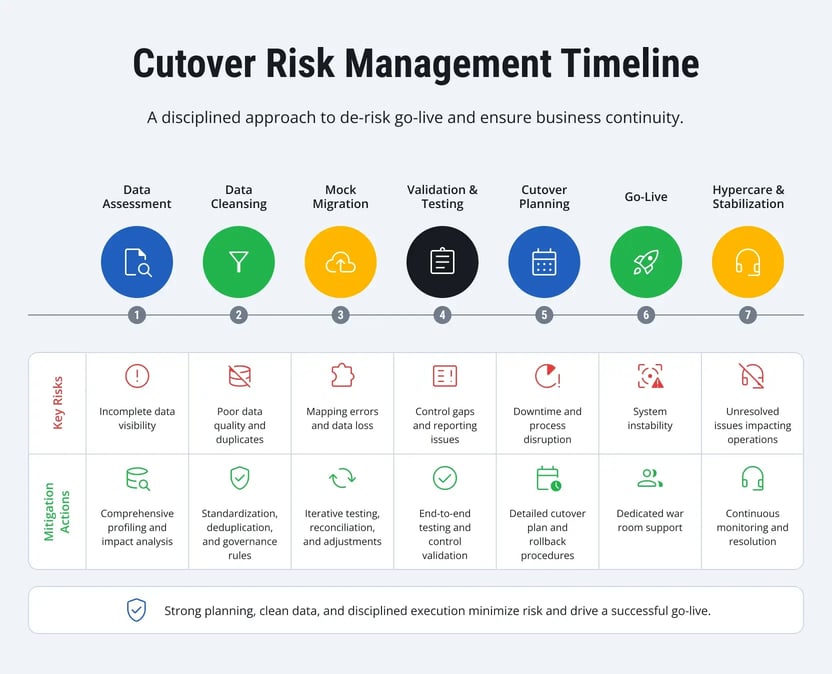
The final transition must protect day-to-day operations while ensuring that the migrated data and new finance processes are ready for use.
Rehearse the cutover
The project should conduct cutover rehearsals to verify data extraction and loading steps, execution times, dependencies, reconciliation procedures, interface activation, and responsibilities.
Each rehearsal should produce measurable results and a list of issues to resolve before production cutover. The objective is to make the final transition controlled and repeatable rather than dependent on untested assumptions.
Protect period-end activities
Go-live timing should take account of the organisation's financial calendar. Starting a new finance platform too close to a month-end, quarter-end, or year-end close can place unnecessary pressure on finance teams.
Where appropriate, parallel reporting or close comparisons can help confirm that key balances and reports agree between the old and new environments. The length and scope of parallel operation should reflect the business risk and the agreed cutover strategy.
Plan for hypercare and ongoing support
After go-live, real transaction volumes and day-to-day user activity may reveal issues that were not apparent during testing. A dedicated hypercare period gives the project team an opportunity to monitor critical processes, resolve defects, and support users before transitioning to the normal support model.
The handover should include known issues, integration monitoring, data-quality responsibilities, support procedures, and ownership of future improvements.
LeverX offers SAP managed services in the UK to support ongoing operations, application management, and system optimisation.
Decide what to do with historical data
Not all historical information needs to be loaded into the operational SAP environment. Before migration, classify records according to operational use, reporting needs, and retention requirements.
|
Data category |
Typical approach |
|
Current master data and active transactions |
Migrate and validate for operational use |
|
Historical information needed for regular reporting |
Migrate selectively or provide a suitable reporting and retrieval solution |
|
Records retained primarily for audit or legal purposes |
Use an approved archive or retention environment where appropriate |
The choice should balance accessibility, compliance, implementation effort, and long-term operating cost. Archiving is not simply a way to reduce data volume; the organisation must still be able to retrieve required records and explain historical transactions when necessary.
How LeverX Supports Workday-to-SAP S/4HANA Programmes
Workday-to-SAP S/4HANA programmes can combine financial redesign, data migration, enterprise integration, reporting changes, and organisational change. Delivering those activities as disconnected technical projects can increase the risk of inconsistent decisions and avoidable rework.
LeverX brings SAP consulting, implementation, data migration, and integration capabilities together to support organisations through the transition.
Depending on programme scope, this may include:
- Assessing the current Workday and SAP landscape and defining the target architecture.
- Designing the target SAP financial model and mapping Workday financial dimensions.
- Planning and executing the migration of master data, balances, open items, and selected historical records.
- Cleansing, transforming, validating, and reconciling financial data.
- Integrating SAP with Workday HCM and other enterprise applications where required.
- Supporting reporting, audit trail, data governance, and relevant UK compliance requirements.
- Planning cutover, hypercare, and the transition to ongoing support.
Our SAP S/4HANA Finance services, data migration services, and SAP integration services can be scoped to the organisation's existing systems, target operating model, and business objectives.
Conclusion
Moving from Workday Financial Management to SAP S/4HANA is an architectural and business decision as much as a data migration project.
For UK organisations, the main challenge is to design the target financial model, preserve required reporting and control capabilities, and decide how finance should connect with the wider enterprise. This may involve redesigning Workday financial dimensions, integrating SAP with Workday HCM, or consolidating finance and operational processes on a common SAP foundation.
There is no universal migration strategy. The right approach depends on the current landscape, the target operating model, the amount of data that must be retained, and the degree of business-process change required.
A disciplined programme should establish the target structure before mapping data, validate financial outcomes through repeatable migration cycles, address UK reporting and VAT requirements, and plan historical access and support beyond go-live.
Done well, the transition can provide a more consistent financial data model, clearer reporting, stronger integration with operational processes, and a foundation that can evolve with the organisation's needs.
Frequently Asked Questions
Can Workday Financial Management be migrated directly to SAP S/4HANA?
Not as a standard system conversion. Workday and SAP S/4HANA use different data models and application architectures. The project typically involves implementing the target SAP environment, mapping and transforming the required financial data, and validating the resulting processes and reports.
Should a Workday-to-SAP S/4HANA project use Greenfield or Brownfield?
A new implementation is commonly the central approach when Workday Financial Management is the source finance platform. Brownfield system conversion is designed primarily for eligible existing SAP ERP systems, not direct conversion from Workday. Selective data transition may be relevant when the programme also consolidates or transforms existing SAP landscapes.
What happens to Workday Worktags during migration?
Worktags are assessed according to their business meaning and use. They may inform the design of SAP Cost Centres, Profit Centres, Internal Orders, General Ledger classifications, or other appropriate structures. Mapping is not necessarily one-to-one and should be validated against reporting and process requirements.
Can a company keep Workday HCM after moving finance to SAP?
Yes. A hybrid landscape can retain Workday HCM while SAP S/4HANA supports finance. The organisation must define which system owns each data element and establish controlled integration for the employee, organisational, payroll, or cost-allocation information needed by relevant processes.
How should UK VAT and reporting requirements be handled?
Include the relevant accounting framework, VAT processes, Making Tax Digital requirements where applicable, record-keeping, and audit evidence in the target design. Validate the configured system and integration processes against the organisation's actual obligations rather than assuming that migration alone ensures compliance.
What is the biggest risk in Workday-to-SAP financial data migration?
One of the principal risks is mapping source financial dimensions into the target SAP model without fully understanding their business meaning. Poorly defined mappings can affect reporting hierarchies, allocations, reconciliation, and downstream processes. Early finance involvement, data cleansing, clear ownership, and repeated validation reduce this risk.
Disclaimer: This article is for general informational purposes only and does not constitute legal, tax, accounting, regulatory, or professional advice. SAP capabilities and supported migration scenarios depend on the product, release, deployment model, and configuration. UK reporting, tax, record-retention, and compliance requirements should be assessed against the organisation's circumstances and validated with qualified advisers.