A practical guide to preparing SAP systems for upcoming UK e-invoicing requirements, covering compliance, Peppol, SAP DRC, and implementation.
The UK's planned move to mandatory structured e-invoicing from April 2029 will change more than the way businesses send and receive invoices. For SAP customers, it can affect the entire invoice lifecycle - from billing and Accounts Receivable to Accounts Payable, tax, master data, integrations, exception handling, and financial controls.
Whether you're running SAP ECC or SAP S/4HANA, the starting point is understanding how invoicing works across your current SAP landscape - which systems create and receive invoices, where tax and master data come from, how documents move between SAP and external platforms, and which steps still require manual intervention. The right preparation approach will depend on your SAP environment, existing integrations, and broader ERP roadmap.
Under the government's current plans, mandatory e-invoicing for relevant B2B and B2G VAT transactions is expected to begin in April 2029. HMRC and the Department for Business and Trade are continuing to develop the detailed framework, with further guidance, technical specifications, and legislation expected before implementation. The HMRC Transformation Roadmap provides the current policy direction.
At the same time, the UK government has identified Peppol as the core interoperability network for the future framework. This gives SAP customers an important architectural direction, even though some implementation details are still being developed. The UK Government Tax Update provides further context.
For businesses, this creates a practical question: what should be done now, while the final rules are still taking shape? The answer does not start with configuring a future invoice format. It starts with understanding how invoices move through the organisation today.
Many enterprises operate a mixture of PDF invoices, EDI, portals, email, OCR, AP automation, tax solutions, and third-party platforms. An invoice may pass through several systems before it reaches an accounting document in SAP. Some steps may be automated, while others still depend on people checking data, correcting errors, or resolving exceptions.
E-invoicing brings an opportunity - and a requirement - to make that process more structured.
The future flow is not simply about sending a different type of document. It is about moving invoice data through a connected business process:
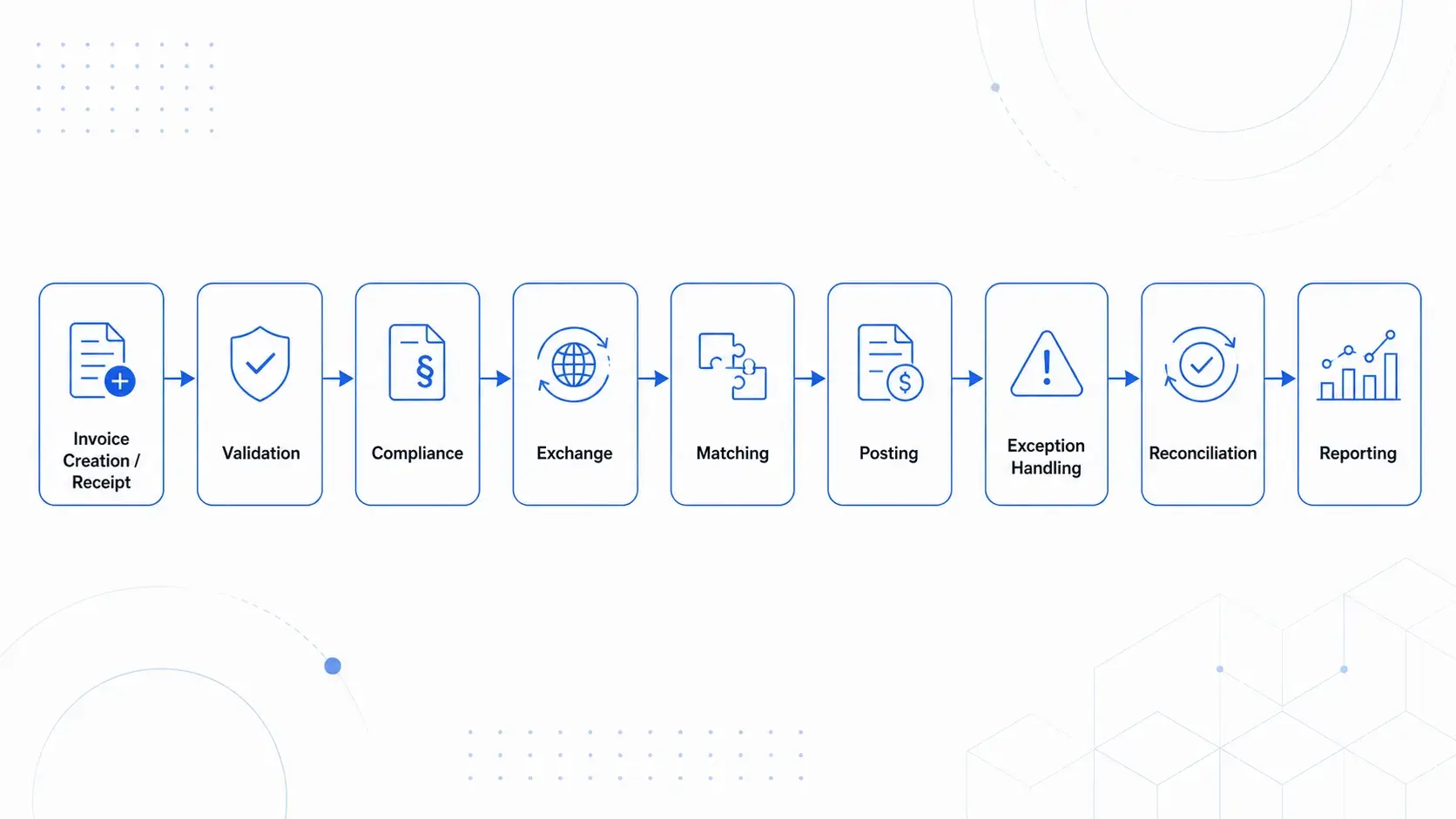
Invoice Creation / Receipt → Validation → Compliance → Exchange → Matching → Posting → Exception Handling → Reconciliation → Reporting
That’s what this guide covers: how to prepare SAP ECC and S/4HANA for UK e-invoicing, where SAP DRC and BTP fit into the architecture, and what businesses should address before 2029.
Executive Summary and Strategic Takeaways
- The timeline: VAT e-invoicing for B2B and B2G transactions becomes mandatory from April 2029. The detailed technical requirements are still being worked out. HMRC Transformation Roadmap
- Peppol is the direction of travel: The government has confirmed Peppol as the core network for the new regime. UK Government Tax Update
- A PDF isn't an e-invoice: Emailing a PDF doesn't provide the same machine-readable, system-to-system exchange as a structured e-invoice.
- Your SAP architecture matters: Review how billing, AP/AR, tax, master data, compliance, and integrations work together across your current landscape.
- SAP DRC can support the document layer: SAP Document and Reporting Compliance supports electronic document processing and Peppol Exchange, depending on your SAP product and setup.
- Master data gets more important, not less: Once processing is automated, inaccurate VAT numbers or Business Partner records can create more downstream exceptions.
- You need a plan for exceptions: Rejected invoices, missing data, failed integrations, and invoices that cannot post automatically all need defined processes and ownership.
- You don't need to wait until 2029: Data cleansing, architecture assessment, process redesign, partner onboarding, and testing can start now, even before every technical detail is finalised.
What Is E-Invoicing and Why Does It Matter for UK Enterprises?
E-invoicing is the automated exchange of structured invoice data between a seller's and buyer's business systems.
This is different from sending a PDF invoice by email. A PDF may be digital, but the invoice information is not necessarily available to the receiving ERP as structured data - depending on the process, businesses may need OCR, manual entry, or additional document-processing tools before the information can be used. Structured e-invoicing changes this model by allowing invoice information to be exchanged in a machine-readable format and processed through defined financial and compliance workflows.
For SAP users, the difference is important because electronic invoice data can be connected to Business Partner records, purchase orders, goods receipts, tax information, financial postings, approval workflows, and payment processes.
The result can be a more automated process:
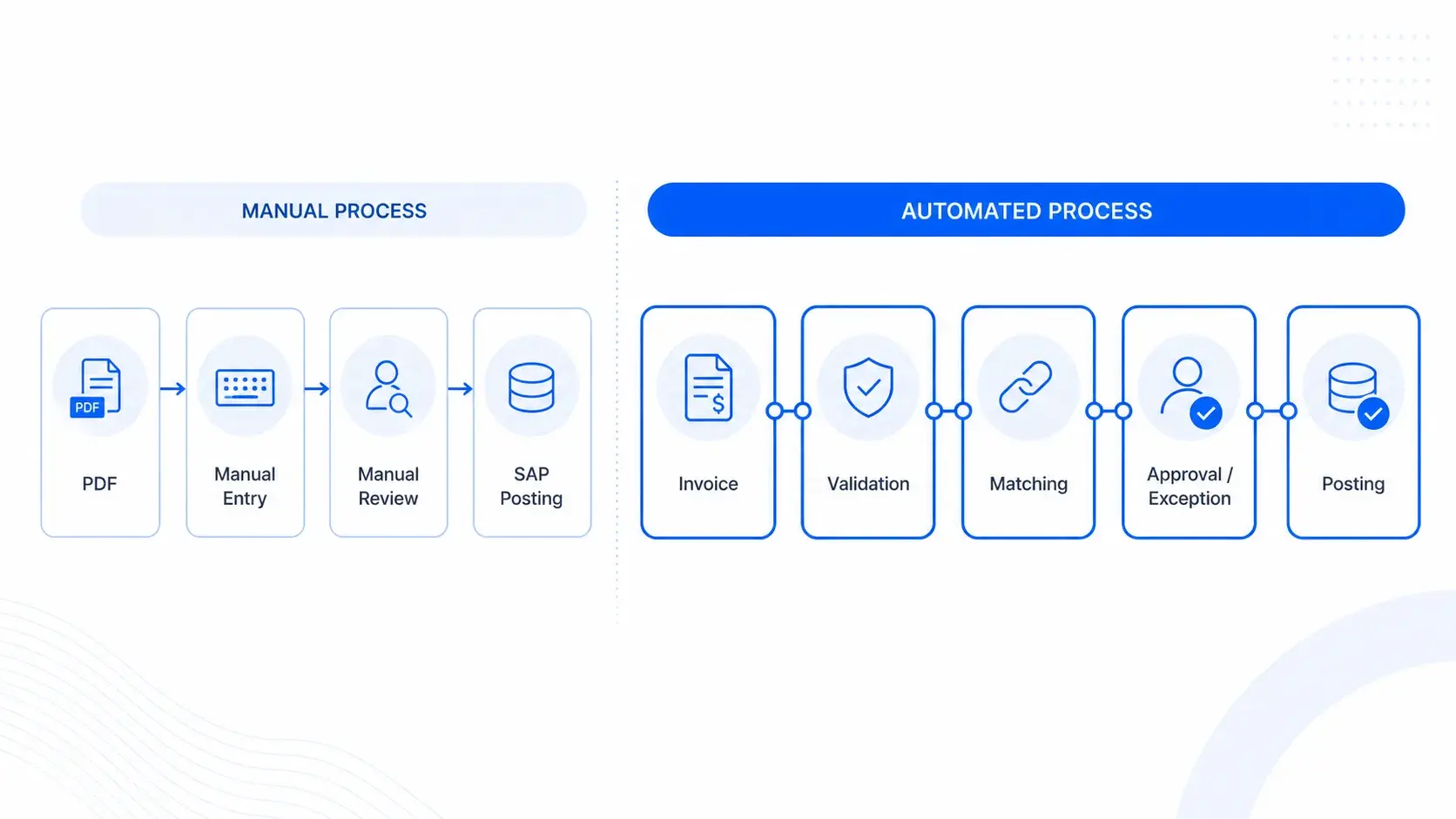
Invoice → Validation → Matching → Approval / Exception → Posting
rather than:
PDF → Manual Entry → Manual Review → SAP Posting
Architectural Evolution: PDF Invoices vs. Compliant E-Invoicing
The difference between traditional digital invoicing and structured e-invoicing becomes clearer when viewed as an architectural change across the finance technology stack.
|
Architectural Layer |
Traditional Digital Invoices (Non-Compliant) |
Structured E-Invoicing (Compliant Target State) |
|
Document Data Format |
Unstructured PDF, TIFF image, or email body text. |
Structured, machine-readable XML / UBL data stream. |
|
Data Ingestion Engine |
Manual keying or fallible Optical Character Recognition (OCR). |
Direct, automated system-to-system digital exchange. |
|
Pre-Posting Validation |
Post-processing manual checks; errors detected late. |
Automated pre-posting validation against SAP master records. |
|
Ledger Posting Mechanism |
Manual data entry into SAP by AP specialists. |
Automatic posting into Universal Journal (ACDOCA). |
|
Audit Trail Traceability |
Disconnected PDF attachments in email archives. |
Integrated digital audit trail connected to the relevant SAP transaction and financial records. |
The transition from PDF-based invoicing to structured e-invoicing represents more than a change in document format - it changes how financial processes operate. By moving invoice data directly between connected systems, organisations can reduce manual processing, improve accuracy, and create a more controlled accounts payable environment.
For SAP users, this evolution is particularly important because structured invoice data can be integrated directly into ERP workflows, enabling automated validation, matching, and posting activities.
The Death of "Digital PDFs"
The limitation of PDF-based invoicing is not the document itself, but the fact that invoice information remains locked inside an unstructured format. To process these invoices, organisations typically rely on OCR technologies or manual review to extract supplier details, tax values, invoice amounts, and line-item information.
Structured e-invoicing removes this additional processing layer by allowing invoice data to flow directly between connected business systems. Information such as supplier identification, tax details, payment terms, invoice values, and line-item data can be automatically captured, validated, matched against Purchase Orders (POs) and Goods Receipts (GRs), and processed according to predefined business rules.
For enterprises running SAP S/4HANA, e-invoicing provides the foundation for a more automated Accounts Payable process with improved efficiency, stronger compliance, and greater visibility across the procure-to-pay lifecycle.
However, adoption is not driven only by operational efficiency. UK organisations are also moving towards structured e-invoicing due to changing regulatory expectations, increasing digital tax requirements, and the need to align with international standards.
The UK E-Invoicing Regulatory Landscape: 2026–2029
The UK framework is being developed in stages, so businesses should distinguish between confirmed policy direction and technical requirements that are still being finalised.
The HMRC Transformation Roadmap confirms that VAT e-invoicing for B2B and B2G transactions will become mandatory from April 2029. HMRC also states that full guidance, standards, technical specifications, and legislation are expected by the end of 2027–2028, while the government continues co-creation with businesses and industry.
For organisations, this means the preparation task in 2026 is not to lock down every future technical detail. It is to create an SAP landscape that can adapt when the final requirements are published.
Regulatory Milestones and Compliance Timeline
|
Regulatory phase |
Current position |
What businesses should consider |
|
Existing B2G requirements |
Structured e-invoicing is already used in parts of UK public-sector procurement |
Review applicable public-sector requirements and existing Peppol connectivity |
|
2026 policy development |
HMRC and DBT continue industry consultation and implementation planning |
Assess SAP landscape, invoice channels, master data, and integration dependencies |
|
2026–2027 roadmap and standards |
Further implementation details are being developed |
Track published technical, policy, and legislative updates |
|
2027–2028 preparation |
Further technical guidance and implementation work are expected |
Design, build, supplier onboarding, integration testing, and process preparation |
|
April 2029 |
Mandatory e-invoicing for VAT invoices is planned |
Operate the compliant target-state process |
This approach gives organisations a valuable preparation window.
They can address the parts of the transformation that are already knowable - data, architecture, integrations, process ownership, and testing - while keeping the implementation flexible enough to accommodate the final UK specifications.
Peppol and the UK Four-Corner Model
The UK government has announced Peppol as the core interoperability network for the future e-invoicing framework. Peppol enables businesses to exchange structured electronic documents through certified Access Points.
For SAP users, the basic model can be represented as:
Supplier ERP → Supplier Access Point → Peppol Network → Buyer Access Point → Buyer ERP
In this model, the ERP creates or receives the business document, while the Access Points provide the connectivity needed to exchange structured invoices through the Peppol network.
For SAP customers, SAP Document and Reporting Compliance can support Peppol Exchange scenarios for sending and receiving electronic invoices, depending on the SAP product, edition, and configuration. In the cloud edition, SAP DRC can also act as the Peppol Access Point, providing the connection between the SAP system and the Peppol network.
A possible SAP architecture therefore looks like:
.webp?width=1672&height=941&name=Blue%20SAP%20Network%20Architecture%20Diagram%20(1).webp)
SAP S/4HANA / ECC → SAP DRC → Peppol Network → Customer / Supplier Access Point → Finance System
The exact design will depend on the organisation's SAP landscape, DRC edition, existing integrations, and whether an external Access Point or additional integration services are required.
The key implementation question is therefore not simply:
“Can SAP generate an XML invoice?”
It is:
“How will invoice data move from SAP billing or procurement processes through validation, integration, and the Peppol network into the customer’s or supplier’s finance process?”
This makes ERP readiness, master data quality, DRC configuration, Peppol connectivity, integration monitoring, and exception handling important parts of UK e-invoicing preparation.
How SAP Supports UK E-Invoicing
SAP can provide the ERP, compliance, integration, and data foundation needed to prepare for structured e-invoicing. The objective is not to replace the existing finance landscape, but to connect invoice creation and receipt with validation, electronic exchange, financial posting, and monitoring.
A typical architecture can connect:
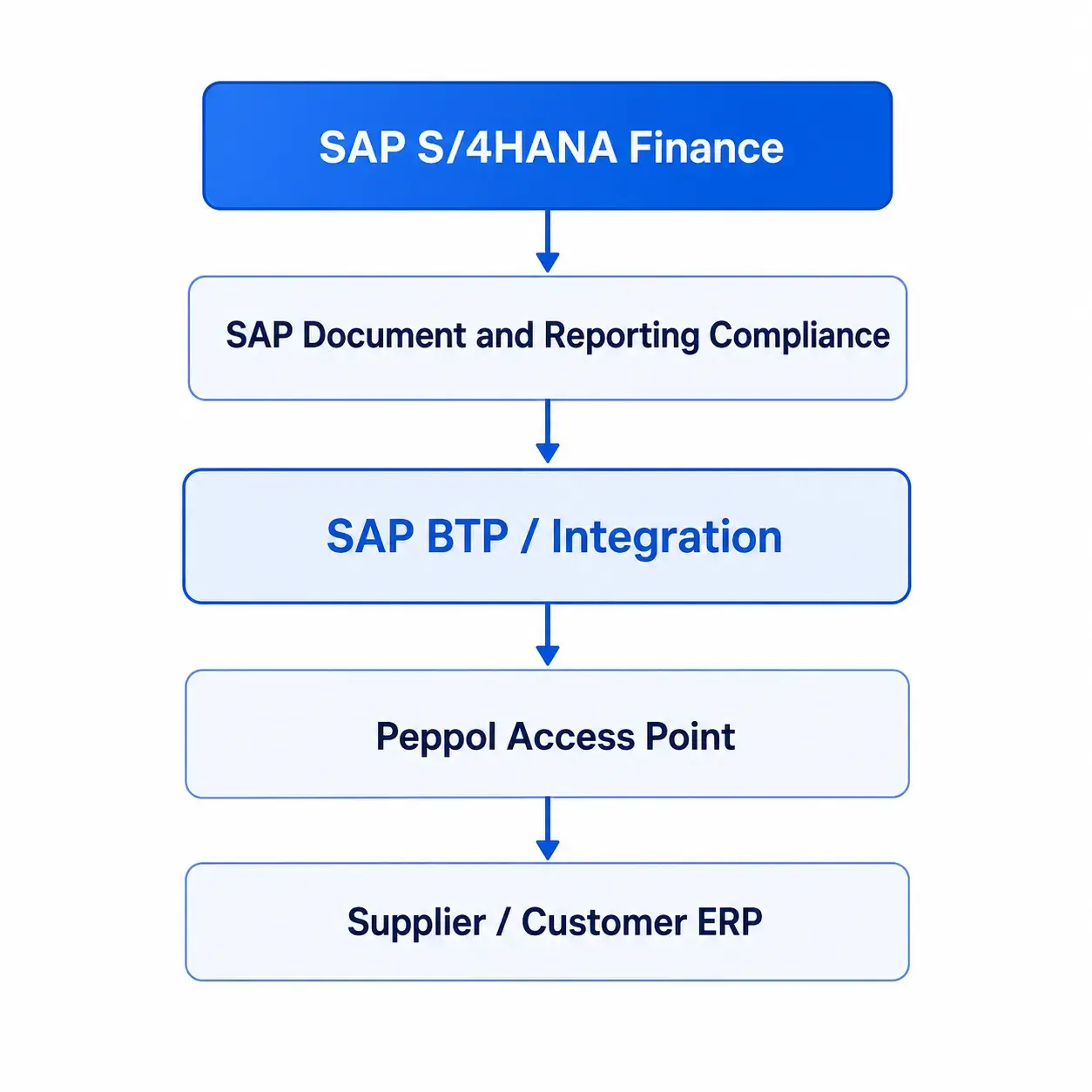
SAP S/4HANA Finance → SAP Document and Reporting Compliance → SAP BTP / Integration → Peppol Access Point → Supplier / Customer ERP
In this model, S/4HANA remains the financial system of record, while SAP Document and Reporting Compliance supports electronic-document and compliance processes. SAP BTP and integration services can connect SAP with external systems, trading partners, and network services where required.
The exact setup depends on the organisation's SAP landscape, DRC edition, existing integrations, and Peppol connectivity model. In some scenarios, DRC can also provide the connection to the Peppol network without requiring a separate integration layer.
For organisations already running SAP, this approach allows e-invoicing capabilities to be built around the existing digital core rather than introducing a separate finance platform.
SAP Document and Reporting Compliance
SAP Document and Reporting Compliance supports electronic documents and statutory reporting processes for supported countries and scenarios.
For e-invoicing, relevant capabilities can include:
- electronic document generation;
- inbound and outbound invoice processing;
- document validation;
- electronic exchange;
- monitoring of document status;
- integration with SAP financial processes.
SAP documentation describes Peppol Exchange scenarios for electronic invoicing, including the exchange of structured invoices through the Peppol network.
For a UK implementation, the exact capabilities and deployment approach depend on the SAP edition, release, country localisation, DRC setup, and selected connectivity model. Organisations should therefore assess their current SAP landscape before defining the target configuration.
SAP S/4HANA Finance Integration
SAP S/4HANA Finance provides the financial execution layer for invoice-related transactions.
A structured invoice can be connected to:
- supplier or customer master data;
- purchase orders;
- goods receipts;
- tax information;
- financial postings;
- payment processes.
The target process can therefore move towards:
Invoice → Validation → Matching → Approval / Exception → Posting → Payment / Collection
This reduces the need to re-enter invoice information manually and creates a closer connection between the electronic document and the underlying financial transaction.
For inbound invoices, the quality of the result still depends heavily on Business Partner data, purchasing information, tax attributes, and matching rules. E-invoicing therefore should not be treated as an isolated compliance project; it is also a data-quality and finance-process initiative.
SAP Business Technology Platform
SAP BTP can provide the extension and integration layer around the SAP core.
Potential roles include:
- external network connectivity;
- API orchestration;
- custom validations;
- workflow automation;
- supplier or customer onboarding;
- specialised applications;
- monitoring.
Where additional functionality is required, BTP can help maintain a Clean Core approach by keeping differentiated integration and extension logic outside the S/4HANA core.
The target architecture can therefore be understood as:
SAP S/4HANA → DRC → Integration / BTP → Peppol → Trading Partner
with finance, master data, compliance, and monitoring remaining connected throughout the process.
This architecture also provides flexibility as the UK e-invoicing framework develops. Organisations can prepare the underlying SAP processes and integration layer now while retaining the ability to adapt message formats, validation rules, and network configuration as further UK technical requirements are published.
Preparing SAP for UK E-Invoicing: What Should Businesses Do Now?
The April 2029 deadline gives organisations time to prepare, but enterprise SAP changes rarely happen overnight. Finance processes, integrations, master data, trading partners, and compliance controls may all need to be changed and tested together.
The best approach is to use this preparation window to understand how invoices actually move through the organisation today, identify where the biggest gaps are, and gradually build the target architecture. There is no need to wait for every technical detail of the future UK regime to be finalised - many of the foundations (clean master data, clear process ownership, reliable integrations, exception management, and a well-defined SAP architecture) can be addressed now.
A practical preparation programme can start with the following steps.
1. Assess the current invoice landscape
Start by documenting inbound invoice channels, outbound billing processes, PDF and EDI usage, AP automation, AR processes, tax integrations, customer and supplier connections, invoice archiving, approval workflows, and manual intervention and exception handling.
The objective is to understand how an invoice actually travels through the organisation, not simply which SAP transaction creates it. For example, an inbound invoice may currently follow:
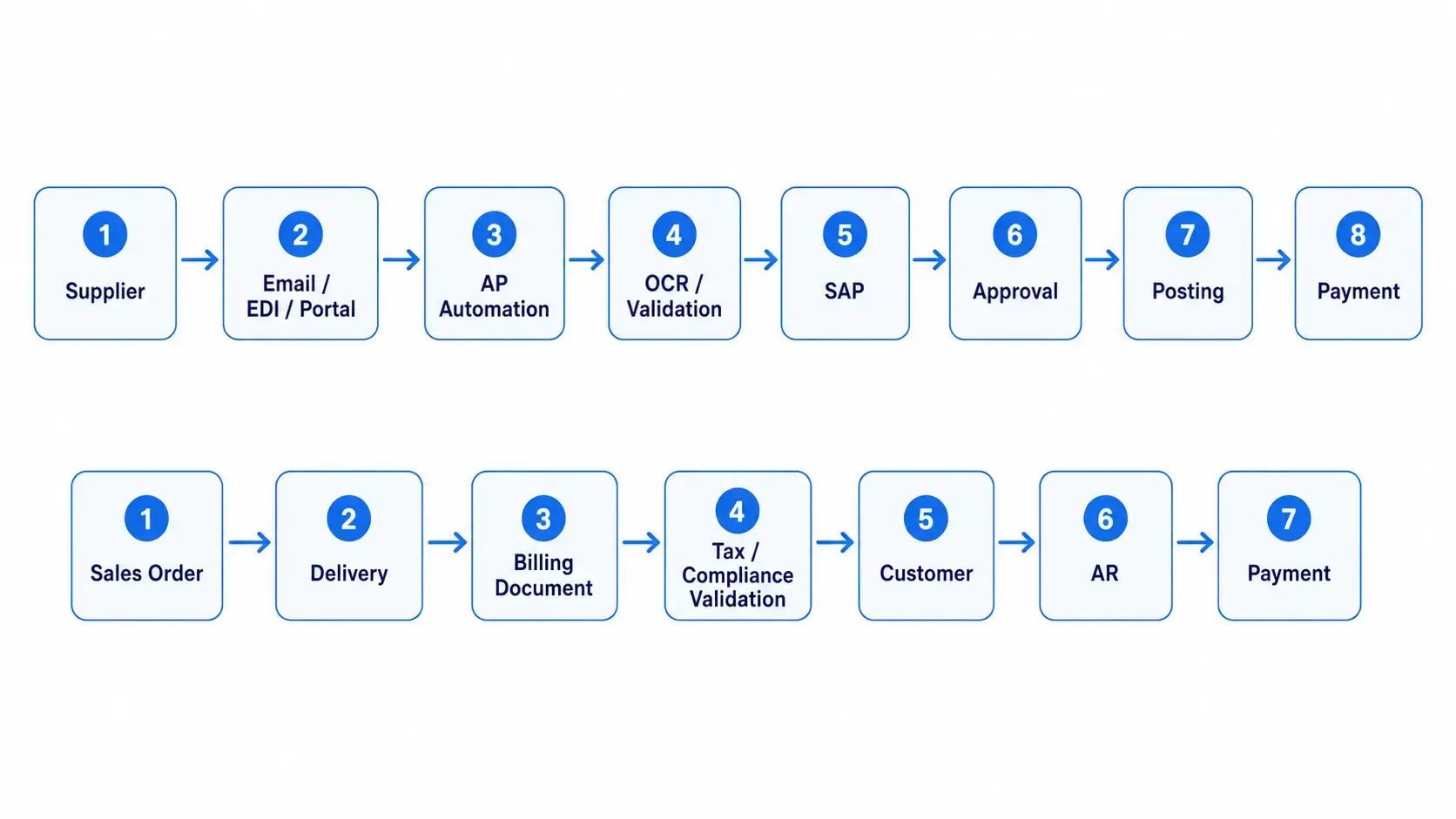
Supplier → Email / EDI / Portal → AP Automation → OCR / Validation → SAP → Approval → Posting → Payment
while the outbound process may look like:
Sales Order → Delivery → Billing Document → Tax / Compliance Validation → Customer → AR → Payment
In practice, both flows can involve several applications, interfaces, manual controls, approval queues, and reconciliation steps. This current-state assessment should identify where invoice data is created, transformed, validated, enriched, stored, transmitted, and manually corrected, and should highlight the points where errors most often occur.
For example, if supplier VAT information is manually corrected before posting, that is not simply an AP issue - it may indicate a master-data or integration problem that will become more important once structured invoices are validated automatically.
2. Review master data
Structured e-invoicing makes data quality much more important because information that may previously have been corrected manually during invoice processing can become part of automated validation.
Review the quality and consistency of Business Partners, VAT numbers, legal names and addresses, customer and supplier identifiers, payment information, tax attributes, company codes, legal entities, bank details, and payment terms.
Key questions include: Is the supplier's legal name consistent across systems? Is the correct VAT registration number maintained? Are customer and supplier identifiers mapped correctly? Are tax codes and rates configured consistently? Are payment terms maintained correctly? Are bank details complete and controlled? Can SAP clearly distinguish the relevant legal entity, invoicing party, and tax registration? Are the same business partners represented differently across SAP and external systems?
This is also an opportunity to identify duplicate or obsolete records before they become a problem in automated invoice processing. A useful principle is:
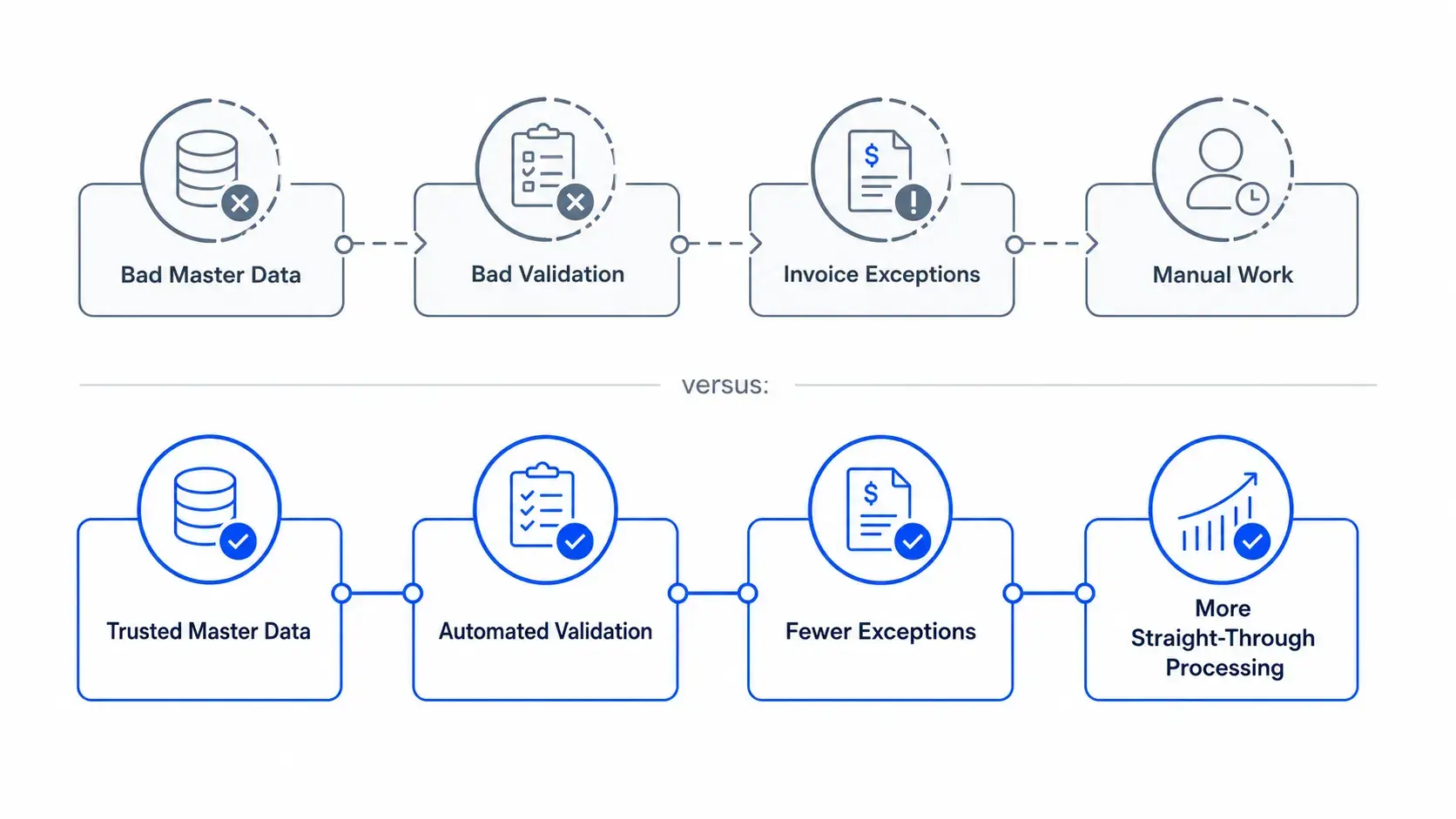
Bad Master Data → Bad Validation → Invoice Exceptions → Manual Work
versus:
Trusted Master Data → Automated Validation → Fewer Exceptions → More Straight-Through Processing
3. Assess SAP DRC and integration requirements
Next, determine whether the existing SAP landscape can support the required electronic-document processes and where additional capabilities may be needed. The assessment should consider:
SAP Release → DRC Capability → Localisation → Invoice Scenario → Integration → Access Point → Peppol Connectivity
For organisations using SAP Document and Reporting Compliance (DRC), the assessment should cover the relevant DRC functionality, deployment model, supported scenarios, and integration architecture. SAP BTP and Integration Suite may also have a role where organisations need to connect SAP with external applications, trading partners, workflow services, or network providers.
For ECC customers, this assessment is particularly important. Available capabilities, technical options, integrations, and migration paths can differ from those available in S/4HANA environments.
The key question is therefore not simply:
“Do we have SAP DRC?”
It is:
“Can our current SAP landscape reliably create, receive, validate, exchange, monitor, and archive the invoice information required by the future process?”
That broader question helps avoid treating e-invoicing as a standalone technical add-on.
4.Define the target process
Once the current state is understood, define the future process:
Invoice Creation / Receipt → Validation → Compliance → Matching → Approval → Posting → Reporting
Then determine which activities should be:
Automated → Exception-Based → Manual
The objective is not to eliminate every human interaction.
Instead, finance teams should spend their time on genuine exceptions and business decisions, rather than repeatedly entering or checking information that is already available electronically.
For example, a standard PO-based invoice could potentially move through:
Invoice → Automated Validation → PO / GR Match → Posting → Payment
while an exception such as a price discrepancy could be routed to:
Invoice → Validation → Price Exception → Buyer Review → Approval / Rejection
The future-state design should therefore define more than the happy path. It should specify what happens when an invoice is rejected, who owns the exception, how missing information is corrected, how failed documents are resubmitted, how duplicate invoices are identified, how integration failures are detected, how finance users monitor invoice status, and how the organisation reconciles electronic documents with SAP accounting postings. This is where e-invoicing can become an opportunity to redesign AP and AR processes rather than simply digitise existing ones.
5. Establish clear ownership and governance
E-invoicing sits across several business functions. Finance may own the invoice process, but the underlying information can belong to:
Finance + Tax + Procurement + Sales + IT + Master Data + External Trading Partners
Clear ownership should therefore be established for:
- customer and supplier master data;
- tax data;
- invoice validation rules;
- electronic-document configuration;
- Peppol connectivity;
- integration monitoring;
- exception management;
- invoice archiving;
- regulatory updates;
- trading-partner onboarding.
For example, someone should be explicitly responsible for answering:
What happens when an otherwise valid invoice cannot be transmitted through the network?
Likewise:
Who updates the process when UK e-invoicing requirements change?
Without clear ownership, these issues can fall between finance, tax, procurement, and IT teams. This is why e-invoicing should be treated as an enterprise process and governance programme, not only as an SAP configuration project.
6. Segment and prioritise trading partners
A large enterprise may have thousands of suppliers and customers, all with different levels of digital maturity. Classify trading partners by invoice volume, existing digital capability, Peppol readiness, EDI capability, API capability, integration method, business criticality, and geographic footprint.
A practical segmentation could be:
Peppol-ready → EDI-capable → API-capable → Portal / Service-provider dependent → Manual / Exception
High-volume and strategically important suppliers and customers should normally be prioritised first.
For example, onboarding a supplier sending 100,000 invoices per year can deliver a very different operational benefit from onboarding a supplier that sends ten invoices.
Partner readiness should therefore be treated as a programme in its own right, covering:
Partner Identification → Technical Assessment → Onboarding → Testing → Certification / Validation → Go-Live → Monitoring
Smaller suppliers should not simply be ignored because they lack technical capabilities. The target architecture should define an appropriate fallback or service-provider route while maintaining compliance and process control.
7. Test before the mandate
Testing should begin well before the regulatory deadline. Use pilot partners and representative invoice scenarios to validate standard invoices, credit notes, non-PO invoices, foreign-currency invoices, partial deliveries, tax exceptions, price discrepancies, duplicate invoices, rejected documents, invalid master data, failed integrations, and missing acknowledgements.
Most importantly, test the full transaction chain, not just the XML message. For outbound invoices, this may look like:
Invoice Generation → DRC → Access Point → Peppol → Customer → Response → SAP Status → Accounting
For inbound invoices:
Supplier → Peppol → Access Point → DRC / Integration → SAP → Validation → PO / GR Matching → Approval → Posting
The testing scope should include both technical and operational scenarios. For example: What happens if the invoice is technically valid but the supplier VAT number does not match SAP master data? What happens if the invoice reaches the Access Point but SAP does not receive the acknowledgement? What happens if the invoice is accepted electronically but fails the company's internal PO or Goods Receipt matching rules?
These scenarios are important because a compliant e-invoice is not necessarily a processable invoice — the document still needs to pass the organisation's own financial, procurement, tax, and accounting controls. Testing should therefore cover:
Network → Integration → SAP → Validation → Business Rules → Workflow → Accounting → Audit Trail
The aim is to arrive at 2029 with a tested operating model, prepared trading partners, clean data, clear ownership, and a resilient SAP architecture — rather than starting technical implementation when the mandate takes effect.
A Practical Preparation Sequence
For many SAP customers, the preparation can be approached as a staged programme:
- Discover — map the current invoice landscape, systems, integrations, volumes, and manual processes.
- Clean — improve Business Partner, tax, legal-entity, and invoice-related master data.
- Design — define the target e-invoicing process, SAP architecture, DRC role, integration model, and Peppol connectivity.
- Pilot — select representative suppliers and customers and test real invoice scenarios.
- Scale — onboard trading partners, expand invoice coverage, automate exceptions, and strengthen monitoring.
- Operate — monitor compliance, integration performance, data quality, exceptions, and regulatory changes.
The result should not simply be an SAP system that can send or receive an electronic invoice. The goal is a finance environment where structured invoice data can move reliably from business transaction to accounting record, with compliance, validation, exception handling, and auditability built into the process. That is the real preparation for UK e-invoicing.
What Changes Inside Accounts Payable?
The move to structured e-invoicing can fundamentally change the role of Accounts Payable.
In a traditional environment, AP may spend significant time on:
- opening emails;
- downloading PDFs;
- reading invoice information;
- correcting OCR results;
- entering invoice data;
- checking VAT information;
- matching invoices;
- chasing approvals;
- resolving duplicate invoices.
In a structured environment, the process can increasingly become:
Receive → Validate → Match → Route Exception → Approve → Post
The AP team's role shifts from data entry and document handling towards exception management and financial control.
For example:
PO = £50,000
Goods Receipt = £50,000
Invoice = £50,000
A rules-based process can potentially identify the transaction as a clean match and move it through the appropriate workflow.
By contrast:
PO = £50,000
Goods Receipt = £45,000
Invoice = £50,000
can be routed to an exception workflow rather than requiring the AP team to discover the discrepancy manually.
This is where structured e-invoicing becomes an operational transformation rather than simply a compliance project.
What Changes Inside Accounts Receivable?
The impact is not limited to inbound invoices.
For Accounts Receivable, structured e-invoicing can change the outbound billing process:
Sales Order → Delivery → Billing → Validation → E-Invoice → Customer ERP → Payment
Instead of:
Sales Order → Delivery → Billing → PDF → Email → Customer Manual Processing
This can improve visibility into:
- invoice delivery;
- acceptance or rejection;
- customer disputes;
- payment status;
- failed transmissions;
- invoice corrections.
The AR organisation can therefore gain better visibility into where an invoice sits between billing and payment.
This is particularly important for large organisations with high invoice volumes, multiple legal entities, and customers using different procurement and finance platforms.
Data and Master Data Readiness
E-invoicing can expose weaknesses that already exist in the SAP master-data landscape.
A business may discover that:
- the VAT number is missing;
- the legal entity name differs between systems;
- customer identifiers are inconsistent;
- supplier addresses are incomplete;
- tax codes are incorrectly mapped;
- invoice units or currencies are inconsistent;
- payment terms are not maintained consistently.
These issues may have been manageable when humans reviewed PDF documents.
They become more significant when automated validation rules are applied.
For this reason, master-data remediation should begin before the technical e-invoicing implementation.
A practical data workstream should include:
Discover → Profile → Cleanse → Harmonise → Govern → Monitor
The objective is not a one-time data-cleaning exercise. It is to establish governance that keeps invoice-relevant master data accurate after go-live.
Integration Architecture: SAP, Peppol and External Systems
E-invoicing rarely exists as a single SAP transaction.
A large enterprise may have:
- SAP ECC;
- SAP S/4HANA;
- SAP DRC;
- SAP BTP;
- SAP Integration Suite;
- EDI platforms;
- tax engines;
- procurement platforms;
- customer portals;
- supplier networks;
- external Access Points;
- third-party AP automation solutions.
The architecture therefore needs clear ownership.
A practical model can be:
SAP S/4HANA / ECC → Compliance & Document Layer → SAP DRC → Integration / Extension Layer → SAP BTP / Integration Suite → Peppol Access Point → Customer / Supplier Access Point → Customer / Supplier ERP
This does not mean every organisation must deploy every component.
The architecture should instead be designed around the existing SAP landscape and the capabilities already provided by the chosen service providers.
The key is to avoid creating a parallel invoice-processing architecture that duplicates SAP financial logic.
Exception Management Is a Core Capability
A common mistake is to focus on the successful invoice path and underestimate exceptions.
In production, the business will encounter:
- invalid VAT numbers;
- missing mandatory fields;
- incorrect tax codes;
- duplicate invoices;
- PO mismatches;
- quantity differences;
- price differences;
- rejected e-invoices;
- unavailable trading partners;
- network failures;
- incorrect customer identifiers;
- credit-note discrepancies.
A mature architecture therefore needs:
Detection → Classification → Routing → Resolution → Reprocessing → Audit
For example:
Peppol Message Rejected → Technical Error Identified → Responsible Team Assigned → Correction → Document Resubmitted → Status Updated in SAP
The exception process should be measurable and auditable.
Relevant KPIs can include:
- rejection rate;
- average resolution time;
- percentage of invoices processed without manual intervention;
- integration failure rate;
- duplicate rate;
- percentage of invoices requiring manual correction.
Security, Controls and Auditability
Structured e-invoicing also changes the control environment.
Organisations should consider:
- who can create or change invoices;
- how invoice data is validated;
- how documents are transmitted;
- how status changes are recorded;
- how corrections are handled;
- how rejected invoices are retained;
- how access to invoice information is controlled.
The target state should provide a clear relationship between:
Business Transaction → Invoice → Electronic Document → Transmission Status → Accounting Document
For SAP environments, this can provide finance and audit teams with a stronger end-to-end trail than disconnected email attachments and manually archived PDFs.
The architecture should also define appropriate retention, access, and security controls in line with the organisation's legal and financial-record requirements.
SAP Clean Core and UK E-Invoicing
UK e-invoicing preparation should be part of the broader SAP Clean Core strategy.
A common risk is to add country-specific custom code, validation rules, or integrations directly into the ERP core to meet evolving regulatory requirements. This can make future SAP upgrades and regulatory changes more complex.
A more sustainable architecture separates the stable SAP financial core from compliance and external connectivity:
SAP S/4HANA / ECC → SAP DRC → SAP BTP / Integration Suite → Peppol Access Point
SAP remains focused on core financial transactions, while compliance processing, integration, and external connectivity can evolve around it.
This is particularly important while UK e-invoicing requirements are still being finalised. Instead of hard-coding assumptions about future specifications into SAP, organisations can keep the architecture flexible and update:
- invoice formats;
- validation rules;
- partner mappings;
- integrations;
- Peppol connectivity;
without unnecessary changes to the ERP core.
The goal is simple:
Keep the SAP Core Stable → Keep Compliance Flexible → Make Regulatory Change Easier to Manage
SAP ECC vs. SAP S/4HANA: What Should UK Businesses Consider?
The UK e-invoicing mandate does not require organisations to migrate from SAP ECC to SAP S/4HANA.
However, preparing for structured e-invoicing can expose limitations in an older ERP and integration architecture. This makes the 2029 deadline a useful opportunity to review the broader SAP roadmap.
SAP ECC
ECC customers should assess:
- current release;
- existing electronic-document capabilities;
- custom invoice processes;
- integration architecture;
- tax and compliance solutions;
- third-party platforms;
- long-term ERP roadmap.
Where ECC remains strategically viable, organisations can build an e-invoicing architecture around the existing environment.
Where an S/4HANA migration is already planned, e-invoicing should be incorporated into the transformation roadmap rather than implemented as a disconnected interim solution.
SAP S/4HANA
S/4HANA customers can evaluate:
- available DRC functionality;
- finance integration;
- Business Partner master data;
- billing architecture;
- BTP integration;
- Peppol connectivity;
- Clean Core principles.
The important question is not:
“Which SAP product should we buy?”
It is:
“What is the most sustainable architecture for our finance, compliance, integration, and regulatory requirements?”
The answer may be different for an organisation staying on ECC, one preparing for S/4HANA migration, and one already operating S/4HANA.
Business Benefits of Preparing SAP for UK E-Invoicing
The benefits of structured e-invoicing extend beyond regulatory compliance.
Lower Manual Processing
Structured invoice data can reduce manual keying and document handling.
Faster Validation
Automated validation can identify missing or inconsistent information earlier in the process.
Better AP and AR Visibility
Finance teams can monitor invoice status, exceptions, and processing more systematically.
Improved Data Quality
Structured exchanges create stronger incentives to maintain accurate customer, supplier, tax, and product data.
Stronger Auditability
Digital invoice records and associated transaction data can provide a more traceable financial process.
Scalable Finance Operations
A standardised electronic-invoicing architecture can support additional suppliers, customers, legal entities, and future regulatory requirements without adding equivalent manual effort.
Better Working Capital Management
Faster and more predictable invoice processing can also support better visibility into liabilities, payment timing, receivables, and cash-flow planning.
More Effective Finance Operations
By automating routine processing, finance teams can spend more time on exceptions, supplier disputes, customer issues, controls, and financial analysis.
UK E-Invoicing Readiness: A Practical SAP Checklist
Before starting implementation, organisations should be able to answer:
Regulatory
- Which transactions will fall within the future UK mandate?
- Which current B2G requirements already apply?
- Which regulatory details are confirmed and which remain under development?
- How will the organisation monitor future HMRC and government updates?
SAP
- Are we running SAP ECC or S/4HANA?
- Which DRC capabilities are available in our release?
- What integrations already exist?
- Are any critical invoice processes heavily customised?
- Which systems currently generate and receive invoices?
Data
- Are Business Partners complete and accurate?
- Are VAT and tax attributes maintained consistently?
- Which supplier and customer records require cleansing?
- Are legal-entity and invoicing-party relationships correctly maintained?
Integration
- Which Access Point will be used?
- Which suppliers and customers require direct integration?
- Where will APIs, EDI, or BTP be used?
- How will technical and business acknowledgements be handled?
Operations
- How will invoice exceptions be handled?
- Who owns rejected documents?
- What SLAs apply to invoice processing?
- How will finance teams monitor failures?
- How will suppliers and customers be onboarded?
Testing
- Which invoice scenarios need end-to-end validation?
- How will the business reconcile SAP postings?
- How will supplier onboarding be tested?
- Has cutover been rehearsed?
- What happens when an invoice is rejected or a network connection fails?
A Practical SAP Roadmap to 2029
Rather than treating 2029 as a single implementation deadline, organisations can use the preparation window to progress through several stages.
Phase 1 — Discover
Current-State Assessment
Map:
Processes + SAP Systems + Invoice Channels + Data + Integrations + Partners
Identify manual activities, legacy interfaces, custom code, and compliance dependencies.
Phase 2 — Prepare
Data + Architecture + Governance
Clean master data, define ownership, assess DRC capabilities, select integration patterns, and establish the target architecture.
Phase 3 — Build
Configuration + Integration + Partner Onboarding
Configure the required SAP capabilities, establish connectivity, develop required extensions, and begin onboarding priority suppliers and customers.
Phase 4 — Test
End-to-End Business Validation
Test invoice creation, receipt, validation, matching, posting, rejection, correction, credit notes, tax scenarios, and network failures.
Phase 5 — Deploy
Controlled Rollout
Start with selected entities, invoice flows, or trading partners before expanding across the organisation.
Phase 6 — Operate and Optimise
Monitoring + Exceptions + Continuous Improvement
Measure automation rates, rejection rates, processing times, integration failures, and partner adoption.
This approach allows organisations to build readiness progressively rather than treating the April 2029 deadline as a single technical cutover.
Prepare Your SAP Landscape for UK E-Invoicing with LeverX
Executing a successful SAP e-invoicing transformation requires more than enabling electronic document exchange. Organisations need to connect finance processes, master data, SAP architecture, integrations, supplier and customer onboarding, and regulatory requirements.
As an SAP Gold Partner, LeverX supports UK and multinational enterprises with SAP consulting, finance transformation, SAP DRC, SAP S/4HANA, SAP BTP, integration, and ongoing SAP application management.
We can help organisations assess their current invoice landscape, define the target e-invoicing architecture, prepare SAP master data and integrations, and build a roadmap towards the future UK requirements.

Frequently Asked Questions
Is e-invoicing mandatory in the UK?
E-invoicing is currently mandatory for suppliers transacting with the National Health Service (NHS) via the Peppol network. For all other B2B and B2G VAT-registered transactions, the UK government confirmed that mandatory structured e-invoicing will come into force on April 1, 2029.
Does a PDF invoice count as an electronic invoice under UK regulations?
No. Unstructured PDFs, email attachments, and scanned documents do not qualify as e-invoices under upcoming legal mandates because they require manual intervention or OCR processing to extract data. A compliant e-invoice is a structured, machine-readable data file (such as XML or UBL) exchanged directly between software platforms.
What is SAP Document and Reporting Compliance (DRC)?
SAP Document and Reporting Compliance (DRC) is SAP's integrated compliance software. It allows enterprises to generate, validate, transmit, receive, and monitor electronic documents (e-invoices) and submit statutory real-time tax reports directly from SAP S/4HANA or SAP ECC.
What is the Peppol network in the context of UK e-invoicing?
Peppol (Pan-European Public Procurement On-Line) is an international standardized network framework allowing businesses to exchange electronic documents securely with any trading partner connected to the network. The UK government confirmed Peppol as its core interoperability network for structured e-invoicing.
How does SAP S/4HANA support three-way invoice matching for e-invoices?
When a structured e-invoice enters SAP S/4HANA via SAP DRC, the system automatically matches the line-item quantities, prices, and tax details against the corresponding Purchase Order (PO) and Goods Receipt (GR). If values fall within defined tolerance limits, the invoice clears and posts automatically without human intervention.
Can legacy SAP ECC handle UK e-invoicing mandates?
Yes, but it requires additional configuration, specialized add-ons, or integration middleware. While SAP DRC is available for SAP ECC, migrating to SAP S/4HANA provides native Universal Journal integration, embedded AI document processing, and superior performance for high-volume electronic document exchange.
Conclusion
The UK's move towards mandatory structured e-invoicing should be treated as a finance and enterprise-architecture transformation, not simply as a new invoice format.
For SAP customers, the change reaches across:
Billing + Accounts Receivable + Accounts Payable + Tax + Master Data + Integration + Compliance + Audit
The fundamental architectural shift is from:
PDF → Human Review → Data Entry → SAP
towards:
Structured Data → Automated Validation → Business Rules → SAP Financial Process
Peppol provides an important direction for interoperability, while SAP Document and Reporting Compliance, SAP S/4HANA, and SAP BTP can form important components of the future SAP architecture, depending on the organisation's landscape and requirements.
The April 2029 mandate may appear several years away, but enterprise e-invoicing programmes involve more than configuring a document format. They require master-data remediation, SAP assessment, integration design, trading-partner onboarding, workflow redesign, testing, exception management, and operational change.
The strongest preparation strategy is therefore:
Assess the Current Landscape → Clean the Data → Define the Architecture → Prepare SAP → Connect Peppol → Onboard Partners → Test End-to-End → Deploy → Optimise
Organisations that use the preparation window effectively can reach 2029 with more than regulatory readiness. They can create a more automated, controlled, and scalable finance operating model.
For SAP customers, the ultimate objective is not simply to send and receive compliant electronic invoices.
It is to create a connected financial process in which:
Business Transaction → Invoice → Compliance → Integration → Accounting → Payment → Audit
remain digitally connected from end to end.
Disclaimer: UK e-invoicing requirements, implementation dates, technical specifications, standards, and reporting obligations may evolve as the government develops the 2029 regime. This article reflects information available at the time of publication and is intended for general guidance only. Organisations should verify current requirements with HMRC, GOV.UK, and their professional advisers before making regulatory, tax, or SAP implementation decisions.